Will the sustained negative premium of GBTC bring down the "DCG Empire"?
Original Title: "How the GBTC premium trade ruined Barry Silbert, his DCG empire and took crypto lending platforms with them"
Original Source: James Van Straten, cryptoslat
Translated by: Moni, Odaily
At the beginning of the 2023 New Year, Cameron Winklevoss, co-founder of the cryptocurrency exchange Gemini, sent an open letter on behalf of its platform users to Barry Silbert, founder of the Digital Currency Group (DCG), demanding the repayment of over 900 million US dollars by January 8th. The letter was strongly worded and revealed that DCG owes Genesis approximately 1.68 billion US dollars. The escalating crisis at DCG has attracted high attention from the cryptocurrency community.
DCG Introduction
Barry Silbert founded DCG in 2015 and subsequently created the "DCG Empire" by investing in hundreds of projects and companies.
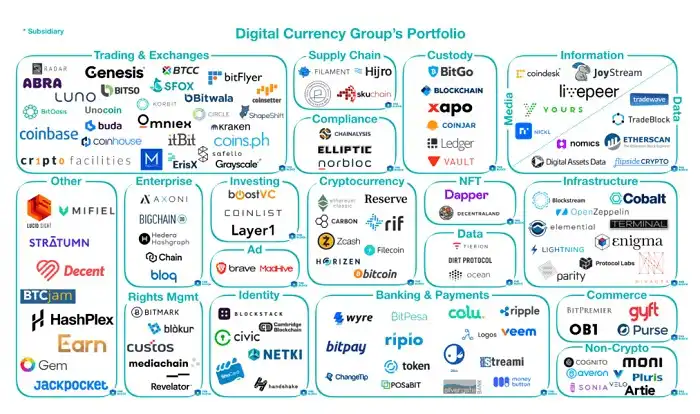
DCG Investment Landscape
The most important company in the DCG investment portfolio is Grayscale Investments, which is the largest Bitcoin holder in the world after Satoshi Nakamoto. GBTC currently holds approximately 633,000 Bitcoins, slightly higher than 3% of the circulating supply of Bitcoin. At the time of writing, the net asset value (NAV) of the trust fund is approximately $10.5 billion.
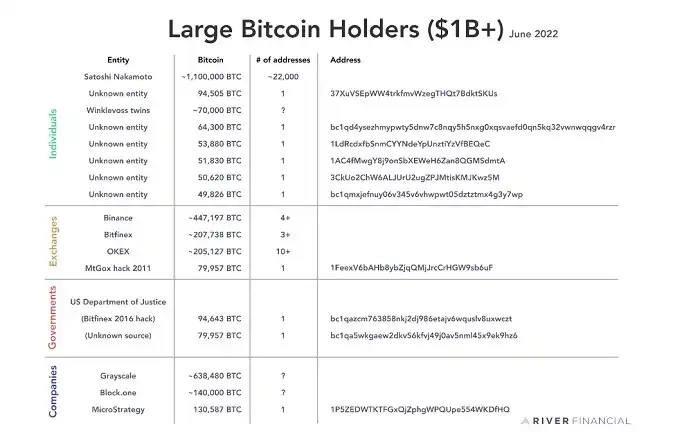
Grayscale claims that its Bitcoin is held in custody by Coinbase Custody. As a publicly listed company in the United States with high credibility and audit requirements, it is likely that Grayscale's BTC is stored in accordance with standard compliance practices.
DCG makes money in what way?
DCG charges a 2% management fee on the underlying Bitcoin held in the GBTC Bitcoin Trust Fund. According to documents submitted by DCG to the US Securities and Exchange Commission in Q3 2022, the company can generate approximately $230 million in revenue and $68 million in profit from this fee annually. This revenue accounts for a significant portion of DCG's total annual revenue of approximately $800 million, which was confirmed by Barry Silbert in a shareholder letter on November 22nd.
For a considerable period of time, GBTC has been the only way for American investors to access Bitcoin through IRA or 401k accounts. This is also one of the reasons why the trust has maintained a premium trading rate in recent years (the premium rate has even reached 40% at one point).
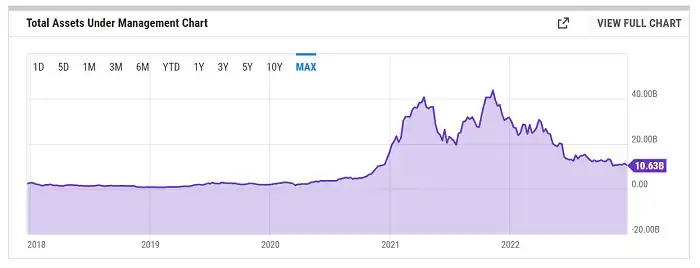
Although GBTC is considered a security, it does not carry the self-custody risk associated with holding Bitcoin keys. With the growing market demand, the assets under its management have continued to rise, reaching over $40 billion during the bull market in 2021.
GBTC premium and discount issues
When the stocks of the grayscale Bitcoin trust fund are traded at a premium to the underlying Bitcoin price, GBTC trades at a premium. Conversely, if the trading price of GBTC stocks is lower than the net asset value, it is considered a discount (negative premium) trade.
On February 24, 2021, the net asset value (NAV) of GBTC changed from premium to discount. Unfortunately, it has not returned to the premium level since then, and the discount has continued to deepen.
The reason for this situation is largely due to the launch of Bitcoin futures ETF, which has intensified market competition. Valkyrie Bitcoin Strategy Futures ETF (BTF) launched during the bull market in November 2021 and Purpose Bitcoin Exchange Traded Fund held in Canada are the two main competitors of Grayscale Bitcoin Trust Fund. These Bitcoin funds often offer lower management fees than Grayscale, causing customers to switch to Bitcoin Exchange Traded Funds, and the market demand for GBTC has also declined.
The current discount rate of GBTC is in the 48% range, and the previous decline once dropped to as low as 50%, setting the largest discount rate on record. Previously, holding GBTC had another problem: GBTC stocks would be locked for 6 months, resulting in extremely poor liquidity. This means that when the discount rate rises, investors cannot redeem their GBTC stocks. In addition, GBTC stockholders do not actually own Bitcoin because GBTC is essentially a paper derivative of Bitcoin.
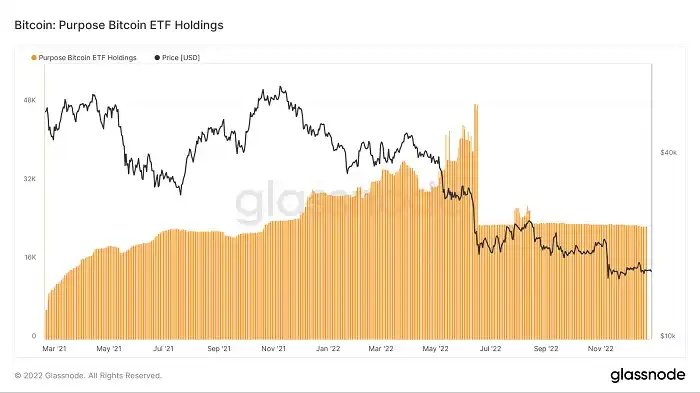
From March 2021 to June 2022, Digital Currency Group began repurchasing nearly $800 million worth of GBTC shares at a price below net asset value, in an attempt to defend the GBTC price. As a result, the company currently owns approximately 10% of the trust's outstanding shares. While the GBTC buyback has indeed alleviated some of the selling pressure from institutions, it has been discovered that the fund's net asset value is artificially inflated.
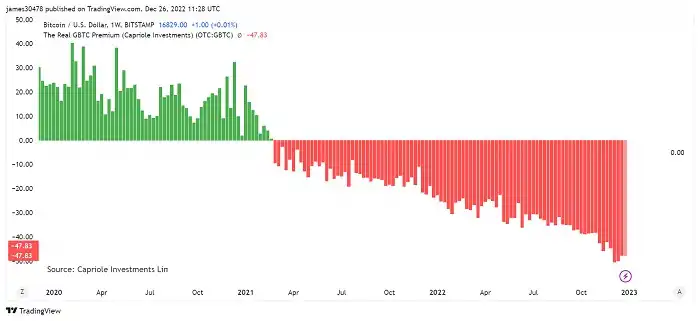
Some may ask, is this different from FTX issuing FTT tokens and attempting to use leverage to protect the tokens? In fact, FTT and GBTC respectively account for a large portion of FTX and DCG's balance sheets. Grayscale provides other similar trusts as alternatives to cryptocurrency assets, such as the Grayscale Ethereum Trust (ETHE), which is currently trading at a huge discount. On January 3rd, the net asset value discount rate of the Grayscale Ethereum Trust Fund hit a record low of 60%.
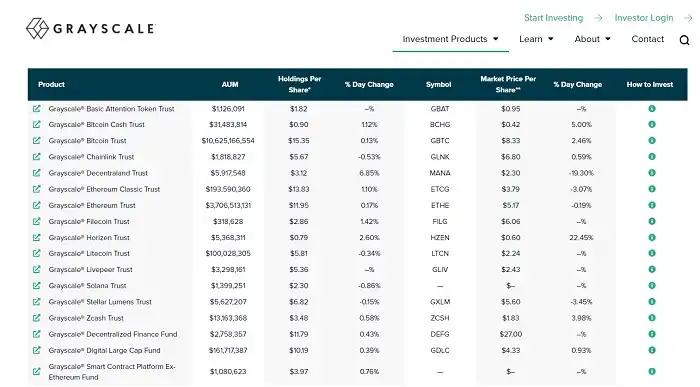
Genesis and lending platforms create ripple effects
What's even more frightening is that several failed cryptocurrency companies, including 3AC and BlockFi, have significant exposure to GBTC stock.
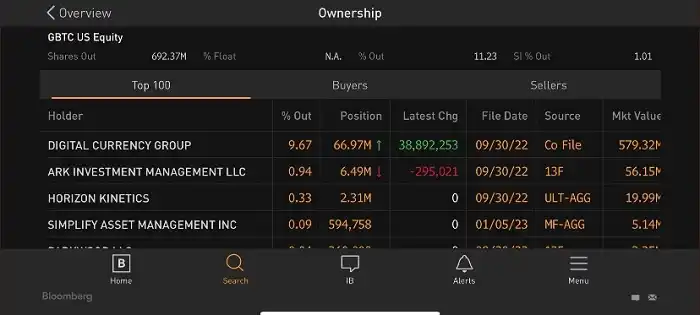
During 2021, Three Arrows Capital held a large amount of GBTC shares, nearly 40 million shares, worth approximately $1.3 billion. In addition, "Wood Sister" Cathie Wood's Ark Invest now holds about 1% of the supply, equivalent to 6.5 million shares, and is also the largest shareholder outside of DCG (as shown in the figure below).
Due to the previous 40% premium increase of GBTC, companies such as Three Arrows Capital and BlockFi have started using leverage for market speculation. BlockFi has begun offering high-yield cryptocurrency lending products to its customers. The ban on sales by Grayscale every six months has allowed these companies to continue to profit, and Genesis is happy to continue providing loans to companies such as Three Arrows Capital.
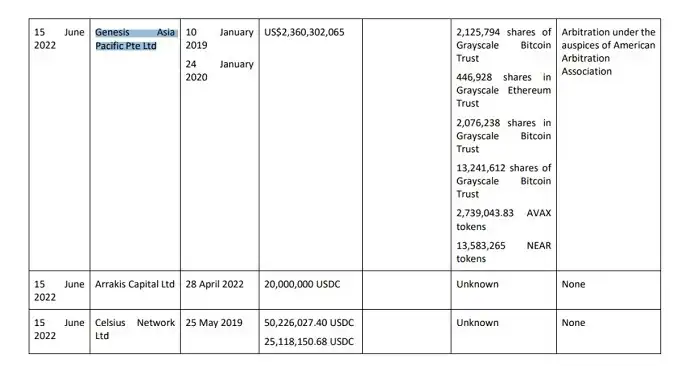
Sanjian Capital has obtained a loan of 2.36 billion US dollars from Genesis, a management company under DCG. This loan accounts for nearly 50% of the total loans of Genesis and is composed of some illiquid cryptocurrencies as well as "paper derivatives" of Bitcoin and Ethereum.
According to the data, Genesis provided a loan to Three Arrows Capital, which received support from Grayscale Bitcoin Trust for about 17 million shares over the years. Grayscale is a subsidiary of DCG and owns 446,000 shares of Grayscale Ethereum Trust, 2 million AVAX, and 13 million NEAR.
ETF cannot save DCG
Recently, Barry Silbert and DCG have been requesting the U.S. Securities and Exchange Commission to convert GBTC into an exchange-traded fund (ETF) because ETFs can directly track underlying products without premium or discount. At the same time, if GBTC can be converted into an ETF, they can redeem assets and greatly reduce management fees. Moreover, after GBTC is converted into a spot ETF, any investor who buys at a discount will profit because it will be traded based on the net asset value.
ETFs based on Bitcoin spot have been approved in Europe, Canada, and Africa. However, despite the approval of exchange-traded funds based on Bitcoin futures, ETFs are safer, more transparent, and have no premium or discount, and lower fees than closed-end funds. For investor protection reasons, the US Securities and Exchange Commission still refuses to approve the listing of ETFs based on Bitcoin spot. As of now, the regulatory agency has rejected applications from institutions such as Grayscale, NYDIG, and Wisdom Tree.
Grayscale is currently suing the US Securities and Exchange Commission, and the deadline for the related lawsuit is February 3, 2022, after which a decision will be made.
In short, due to the significant discount faced by GBTC and increasing competition from other ETFs, DCG is facing difficulties.
美 SEC 未能有效帮助投资者
US SEC fails to effectively assist investors
We have seen that GBTC has lost its premium advantage, and the cryptocurrency ecosystem has exploded after the collapse of cryptocurrency lending platforms. These funds and lenders have had to further expand their risk curves to profit.
If the US Securities and Exchange Commission approves GBTC's spot ETF application, a series of market risks can be prevented, leverage may also be eliminated, GBTC's premium will no longer exist, the scale of these companies will not expand, and crises will not erupt.
In order to get approval for a bitcoin-based ETF, Grayscale has been doing everything possible, but the US Securities and Exchange Commission has rejected Grayscale's application on the grounds that spot bitcoin is easily manipulated by the market. The problem is that the CME bitcoin futures ETF, which does not track the underlying spot price, is also susceptible to manipulation and fraud, but has received regulatory approval.
As mentioned above, there are multiple Bitcoin spot ETFs in Europe and Africa that allow global investments, which undoubtedly leads to capital flowing out of the United States and into other jurisdictions.
2023, where is the future of the encryption industry?
If DCG enters bankruptcy proceedings, the company may be forced to liquidate its assets and see significant sales in GBTC and ETHE, which could bring considerable selling pressure to spot Bitcoin and Ethereum.
However, according to Ryan Selkis, CEO of blockchain research firm Messari, the controlling shareholders of Grayscale Bitcoin Trust, Genesis Global and Digital Currency Group, cannot simply "sell off" their holdings to raise more funds. This is because under the 1933 US Securities Act Rule 144A, issuers of over-the-counter trades or entities must give advance notice of proposed sales, and the sales limit for issued stocks or weekly trading volume can only account for 1% of the total stock volume.
On December 28, 2022, investment advisor Valkyrie proposed to become the sponsor and manager of a new GBTC fund, while also launching a fund to purchase discounted GBTC.
On January 2, 2023, Cameron Winklevoss published an open letter to DCG CEO Barry Silbert, questioning Barry's delay tactics as Genesis owes Gemini Earn users $900 million. In addition, Cameron Winklevoss also accused Barry Silbert of using asset net trading strategies to benefit himself personally. However, the letter did not reveal whether DCG and Barry Silbert have responded; one possibility is that DCG has filed for bankruptcy. As rumors continue to spread, DCG/Genesis is under active investigation by the US Securities and Exchange Commission. Sources confirm that multiple whistleblowers have come forward.
Barry Silbert promised to provide a solution on January 8th, but that time has passed.
The current situation of DCG is:
Genesis is currently considering bankruptcy; DCG has closed its wealth management subsidiary; DCG has a debt of $2.025 billion; Genesis can access their $1.675 billion loan; Genesis owes Gemini $900 million...
What can we learn from all of this?
Bitcoin is a type of digital asset with no counterparty risk. If it is self-managed correctly and compliantly, there will be no leverage or return. However, investors have a personal responsibility to manage their finances.
But the number one problem for humans is often greed, as history has shown us, greed often leads to fraud, manipulation, and centralization. By holding your own Bitcoin, you hold Bitcoin itself, not a promissory note or paper derivative.
As we have seen in 2022, the pursuit of high returns and the use of Bitcoin to chase returns has led to a frightening counterparty risk in the cryptocurrency industry. The industry should learn from this and due diligence is always crucial.
Finally, everyone in the encryption ecosystem must remember one sentence: "Not your keys, not your coins".
Original article link
Welcome to join the official BlockBeats community:
Telegram Subscription Group: https://t.me/theblockbeats
Telegram Discussion Group: https://t.me/BlockBeats_App
Official Twitter Account: https://twitter.com/BlockBeatsAsia