Arthur Hayes: The world is splitting into the West and Eurasia

Original article by Arthur Hayes
原文 编译:GaryMa 吴说区块链
Note: SBF responded to the article by saying: "I obviously strongly disagree with many of the specific FTX-related expressions here, but I largely agree with your higher-level point. This is a variation of something I've heard time and time again. I think you might be a little surprised by my point of view".
It is clear that the world is splitting into two camps: the West and Eurasia. The West is the United States, Western Europe and their Allies. Eurasia is a mixture of China and Russia, with China as the main partner and Russia as the junior partner. The war in Ukraine is a physical manifestation of this rivalry, as it has quickly become a proxy war between the West and Eurasia. The semiconductor chip/trade war between the US and China is another example of the non-lethal/economic side of this war.
Between the West and Eurasia, there are non-aligned countries that have something both sides need. These countries have young productive workers who can produce things at affordable wages. These countries have key resources such as hydrocarbons, cobalt, lithium, nickel and copper. These materials will power the next stage of human economic and technological progress. These countries can choose who they trade with. This choice is based on emotions (i.e. how they feel they are treated in the bilateral trade relationship) and actual economic terms of trade. Economic terms of trade include both the amount paid and the currency received (e.g., US dollar, RMB, gold, etc.).
In this article I will explore how the world's view of the West may be beginning to shift after another case of Western financial exceptionalism: SBF/FTX, aided and unwittingly abetted by Western financial and media institutions, robbed the rest of the world (ROW). I say ROW because most of the affected individuals and entities are neither American nor Western European. It is the east and south of the globe that are most hurt by this fraud. I think the reason these countries are letting the fox in the henhouse again is due to misplaced trust caused by centuries of social conditions, which historically resulted in little "white" boys like SBF getting an automatic seat at the proverbial table without any problem.
This matters because if we are to navigate financial markets over the next few decades, we have to analyse whether the West, which consumes things, or the non-West, which produces things, will win in terms of returns to investors. I, and many others, believe that the long-term trend of the West feasting as much as it likes at the expense of the West's unfair trade will slowly reverse. The growing confidence of the rest of the world to challenge the west is driven by a historical sense of unfair treatment, both perceived and actual. I believe the FTX incident is a perfect example of how the rest of the world is not happy with this kind of behavior, and it may push them further to come out against the West. This means that when producers choose to adjust the terms of trade to their advantage, investors who allocate capital to various instruments and enterprises will receive above-average returns.
西方和欧亚的博弈
Eurasia is home to 70 percent of the world's population and, until recently, was the locomotive of human civilization.

Until recently, India and China accounted for 50 to 60 percent of world GDP. It was not until the 16th century that Western Europeans (and later Americans) began to displace their mainly Asian rivals and create respectable empires such as the British and American Empires.
These "whites" are few in number, but they make up for it with strong political organization and technological progress. The reasons for the West's victory over the East are complex and hotly debated by historians over the centuries, and everyone has a theory. But regardless of your specific views on how the West has used its advantages to rise from its perennial underdog position, there is no disputing that the West has been inadequate in terms of the number of its human subjects (that is, its users) and the natural resources it has brought to the world. (Eurasia contains most of the world's human and key natural resources and, most importantly, its hydrocarbons).
To overcome the lack of indigenous labor and resources, the West resorted to slavery and colonial conquest of the rest of the colored world.
Thousands of troops, sailing far from their homes, were able to conquer hundreds of millions of people. At first, overwhelming technological forces were at work. But as information about basic science and technology spreads along with education, it becomes harder to subdue locals with sheer force. Realizing that their iron-fisted rule was slipping, Western countries adapted, synthesizing a social hierarchy that represented local elites of color by buying their loyalty.
Make sure your people work hard for wages far below what they would receive as citizens of the Empire. Protect the property rights of your group and foreign industrialists who own all farmland, factories and natural resources. Exporting all essential minerals and food cheaply to the West and importing more expensive manufactured goods in return. If your country finds itself in a current account deficit because of the inverted terms of trade (for example, you import more than you export), then you can borrow from Western banks using the empire's reserve currency. When you fail to pay your foreign debt and the inevitable financial crisis occurs, you dare not default. Instead, sell more of the country's productive resources to foreigners to "pay off" the loans.
Now you can bask in the adoration and glory of the West, be an enlightened rich gentleman, and hang out in the rich cultural hot spots of the empire, showing off the wealth you've acquired from the people of your country.
When some of you get a little education and protest this lopsided economic deal, put all kinds of labels on them. Neither you nor the workers toiling under your high boots have a say in the construction of the above order nor benefit from the "liberal" democratic Western society. You just happen to have the "right" last name, or belong to the "right" religious sect, and therefore you inherit your unearned power.
The formula has worked so well that it has enriched Western countries to such a large extent that elites have forgotten that the universe is constantly changing. Because of their arrogance and/or incompetence after the second world war, Western political elites made two huge mistakes that, in this armchair historian's view, gave Eurasia the breathing space it needed to regroup and regain its strength over the past 80 years.
They put their differences aside and focused on defeating imperial Japan. After the war, they started fighting each other again.
The chart below shows how China has succeeded in displacing the United States as the world's largest trading partner in record time.
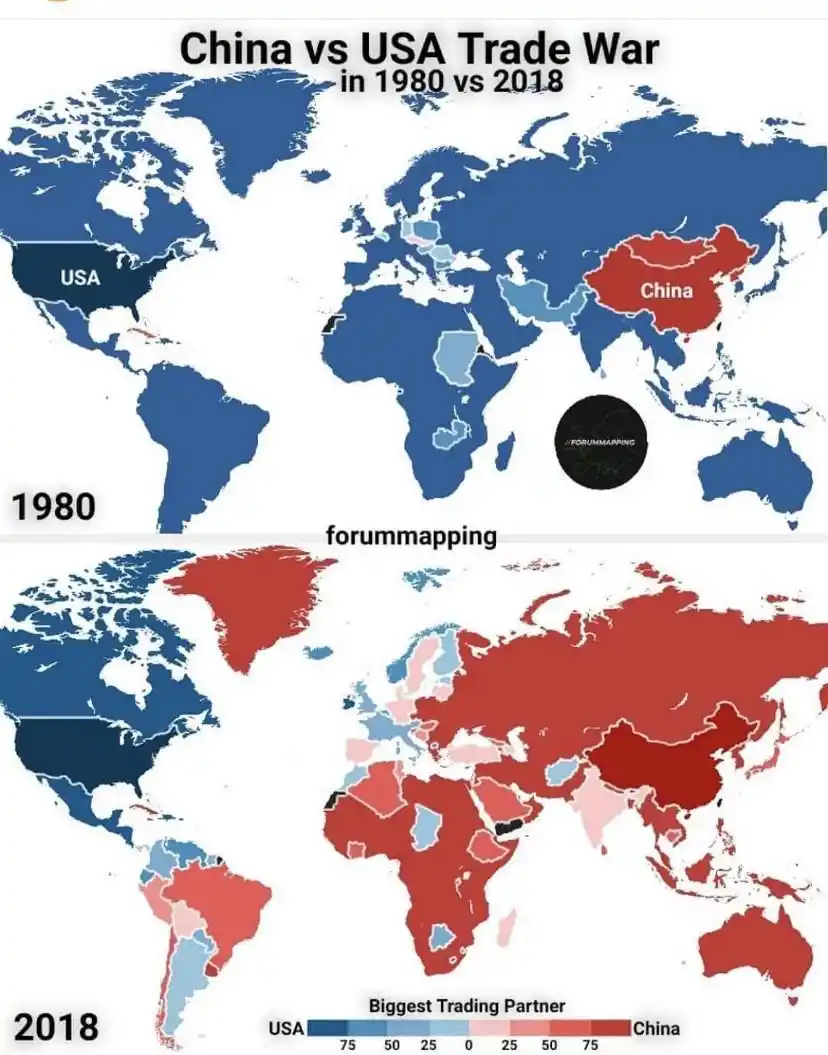
The second big mistake was Russia's failure to integrate with the West after the collapse of the Soviet Union in the early 1990s. Whether it is arrogance or another bout of isolationism on behalf of America's elite politicians, a major opportunity has once again been squandered. Instead, the west allowed a bunch of Russian opportunists to take control of productive state assets at knockdown prices and confiscate all the wealth to Knightsbridge.
Then he came along, dedicated to righting what he saw as historical wrongs and reconstructing the mighty Mother Russia of yesteryear. That's one point of view - I'm sure many readers thought he was just a bloodthirsty egomaniac. But it doesn't matter what you think of him. From his point of view, he cares about Russia's progress. Now that he has drawn Russia into its latest proxy war with the West in Ukraine, the only direction Russia can turn is to the southeast. The West seized Russian sovereign wealth in Western financial institutions and refused to do any business with Russia.
Russia is now a staunch economic ally of China as a result of Western alienation that began in the 1990s. In light of the recent sabotage of the Nord Stream pipeline, Russia will make every effort to build pipeline infrastructure to connect Russian energy with China's manufacturing base. Eurasia will now have the cheapest energy in the world, powering the world's biggest manufacturers. Germany and Japan should tremble for their space boots.
Agent of the Empire
The world monetary system is extremely important when it comes to resource sharing. Money simply converts the earth's potential energy into a form that can be traded. Each form of money represents an energy claim. If you control the monetary system, you control energy. If you control the energy, you control the progress of human civilization.
The western financial system underpins the world's reserve currency, the dollar. Much of the world's energy and commodity trade is denominated in dollars. That means the West can print energy at will. Clearly, if they abuse this privilege, a new monetary and financial system will emerge to challenge the corrupt old system. Bitcoin and cryptocurrencies are a natural reaction to the profligacy of the dollar-based Western financial system.
The TradFi system is based on trust. You trust some centralized Western financial institution to process transactions, fulfill contracts, and generally keep the system running. In return, we the people allow them to make money out of it. Bankers get rich without doing actual tangible work. I'm not denigrating my former career as a financier, but that's the hard truth - we don't make money.
Human political organizations, also known as governments, are complex adaptive systems that have evolved over time. The playbook for how the West projects and maintains its financial power around the world was written by a bunch of old guys at a conference a few centuries ago. It just naturally evolved over time into a system that made sense from a self-preservation point of view.
So by the same token, if you were a sophisticated political organism facing the threat of a reactionary technological currency called bitcoin (the most hardcore and purest form of energy money ever created), wouldn't you want one of your own at the forefront of adopting bitcoin to bring it into your sphere of influence?
Now, I want to take a quick step back and clarify that I do not support some conspiracy theories that suggest Illuminati is using SBF as a factory to come to power in an attempt to control the crypto capital market. What I'm saying is that the TradFi system will unconsciously try to cater to individuals and companies that it believes will continue to support the supremacy of a legal-dominated financial order.
SBF made it abundantly clear that running a centralized crypto business was the best way to make the most money in the shortest amount of time so he could give it all away for the betterment of humanity. The organisation to which SBF has entrusted the spoils of its commercial success is effective altruism (EA). I have friends who work there or have worked there, and they're all good people. But I find it hard to believe that, as someone with funds to distribute to charitable causes, I should hand over all the agency to a group of highly educated people from elite Western universities. They don't represent the interests of humanity -- no organization does. But their arrogance that they alone can foresee the means necessary to protect and save humanity is disgusting.
In SBF's own words:
If you really want to maximize your impact, at what point does your marginal return start to decline? Well, when it comes to doing good, there's no such thing as more good is more good. It's not that you've done something good, so it doesn't matter if it's good... That means you should be very positive about what you're doing and really try to hit home runs, not just make some impact, because the benefits are absolutely huge.
To take a flippant example, take the idea put forward by effective altruism about how we should change our diet to minimise the amount of animal protein we eat in order to reduce our carbon footprint. Who are they to determine the best diet for every person on the planet? If you want bugs, go ahead and eat them. Everyone should be able to experience that sublime pleasure if they so choose, and who am I to tell them otherwise? If you think that only you (or the organization you belong to) know what is best for society and should have the sole right to direct the poor unwashed masses to correct behavior,
When certain TradFi folks heard through the grapevine that SBF had no real interest in the crypto spirit and only wanted to support effective altruism, an organization that firmly perpetuates the status quo of humanity's current power pyramid, they knew that SBF was their partner. It also helped that he was a young white boy educated at MIT. He checked all the standard Western financial institutions. If SBF is supposed to lead the development of a new technology-driven monetary and financial system, then it fits the popular narrative that he should be a young white male who went to the "right" Western STEM key university. Had he been some outdated former managing director of Goldman Sachs, many people around the world would have rolled their eyes at any suggestion of this man extending the dominance of western financial capitalism.
Every tentacle of the TradFi system in the West supports SBF's global expansion. It is in their interest to do so. It is not in SBF's interest to ask too many questions about exactly how it runs its business. It is desirable to retain plausible deniability. So the lackeys of the system did not thoroughly vet the SBF, to their detriment. It is not in the interests of the western financial system to support what we now know to be one of the biggest financial smash-and-grab frauds in human history.
Civilians used to trusting agents on TradFi systems are having a "fuck up" moment. The TradFi system concocted a series of stereotypes to trick their brains into thinking SBF and FTX were believable. As the gatekeepers of the TradFi system in the West, it is the job of the establishment to properly vet those they tout as card-carrying members of the guild. These people have been told from an early age to embrace change and new technology. They put their trust and money into FTX, a supposed pillar of the Western financial system, to build a new one, and poof, this little boy took their money so he could cover the losses of a hedge fund run by his girlfriend, who admitted she wasn't good at math. So, the natural reaction has been a universal: "What the hell?!"
Now we the people will watch the public trial of SBF in federal court in New York, the seat of the West. Whatever the outcome, the trial will not affect the recovery of lost FTX client funds. Ignore these minutiae and focus on how to adjust your portfolio for the future. The future belongs to Eurasia and the past to Western particularism. Let's take a look at my theory, what this means, and what happens next.
Change of trading partner
The very fact that any sovereign country uses the dollar to price its exports and buy your imports means that they have the Western financial system inherent within their borders. It is understandable that many countries are willing to do this - when the world uses a currency in global trade, there are benefits in terms of cost and speed of exchange of goods. Yet trust in that financial infrastructure tends to weaken when the system that underpins the global reserve currency throws crooks at industry leaders and says "trust them, it doesn't matter".
Today, Eurasia (led by China) has an alternative financial system that they want to offer the world's non-aligned countries. Since the non-aligned trading partners of the victimized countries of the global South can turn to another system in place, this episode has the potential to have a considerable impact on how and with whom those countries trade. Non-aligned countries are not in the Western orbit, nor are they in the Eurasian orbit. These countries will trade with both sides, depending on which side offers the better deal. Of critical importance are India, Indonesia and the Democratic Republic of the Congo. These countries matter because they have a large and growing pool of young productive workers and/or the key natural resources needed for a future "green" economy. India is the world's largest country with a growing, young and educated population. Indonesia is the world's fourth most populous country and has a growing, young and educated population. Indonesia also has large amounts of key resources such as bauxite. The Democratic Republic of Congo is the world's largest producer of cobalt, a key mineral needed for a variety of advanced technologies. The list goes on and on.
Former US President Donald Trump may label these and other non-aligned countries as "shithole countries", but rest assured - these shitholes contain the seeds of technological progress, not human excrement. Now, these non-aligned countries can choose the currency in which their labor and goods are used, and who gets what. There is a global shortage of young productive workers and natural resources at reasonable prices. (As an aside: That's why inflation is here to stay, no matter what central bankers want to be true.)
The question is, will these non-aligned countries hurt their own economic interests by exporting raw materials and importing expensive manufactured goods, as their predecessors did? Or will they try to raise their game by asking their trading partners to invest in them, thereby allowing them to produce intermediate goods and manufactured goods at home and export those manufactured goods to world markets at higher prices? My prediction is the latter - that from 2023 Indonesia will ban exports of many key resources and require companies to invest in facilities to export mid-level, high-value versions of these resources. I expect other countries to adopt similar policies.
Will these countries, whose biggest trading rival is China, continue to price their trade in dollars? Will these countries continue to give preferential status to Western financial institutions? When the agencies and the people who run them screw them up time and time again, as has just happened with SBF and FTX? (To that end, New York Magazine published a very sad and poignant account of how ordinary Nigerians trusted the SBF's scam with their meager savings.)
The western financial system offers the same thing in the same way, but China has a different message. China does not offer a "are you with us or against us" foreign policy. Instead, the Chinese want to participate in what they see as a fair exchange of capital and resources, free of political issues. Whether you believe the rhetoric or not, it stands in stark contrast to various historical examples of Western imperialists enforcing the terms of trade at gunpoint - their violent coercion in turn ensuring that certain Western currencies continue to be used to price international exports. One example is the CFA franc, which is issued and managed by France and used by many West African countries.
In the near future, we will know if my theory and views are correct. Yet those who are obsessed with infallibility miss out on the financial rewards of being relatively correct. Eurasia -- as well as the global South -- is starting from a historically low base (see the first chart above, describing each region's historical share of global GDP). A drop of just a few percentage points in America's share of global GDP could mean a doubling or more of the share of certain "shithole" countries. As investors, we want to experience rapid gains from a low base rather than die by going long the S&P 500 as it has underperformed emerging markets and inflation recently.
As I mentioned earlier, the extent to which a resource-rich country decides to trade more with the West or China is a combination of positive or negative emotions and who is willing to pay the appropriate price. In today's climate, as non-aligned countries gain greater access to trade opportunities, this emotional piece is more important than ever. If a country that has historically felt that they got a raw deal in the colonial and neocolonialist structure of the Western world economy, and is supported by Western media and financial institutions has just stolen your people's money under the guise of some novel technological stuff, you might be provoked enough to dabble in a yuan-based financial system, This financial system actually has commodities (Russia), gold (Russia and China have the world's largest gold reserves), manufactured goods (China), and no colonial history.
This is not to say that the dollar will die in the next 12 months. But at the margin, the relative importance of this Eurasian upstart, powered by a rock-solid alliance between China and Russia, could easily score economic points. As investors, we are always happy to press the "easy" button.
The future
Let's take a quick look at some charts that show the global South has a chance of winning from its current low base.
Ratio of SPY US (S&P 500ETF) /EEM US (MSCI Emerging Markets)
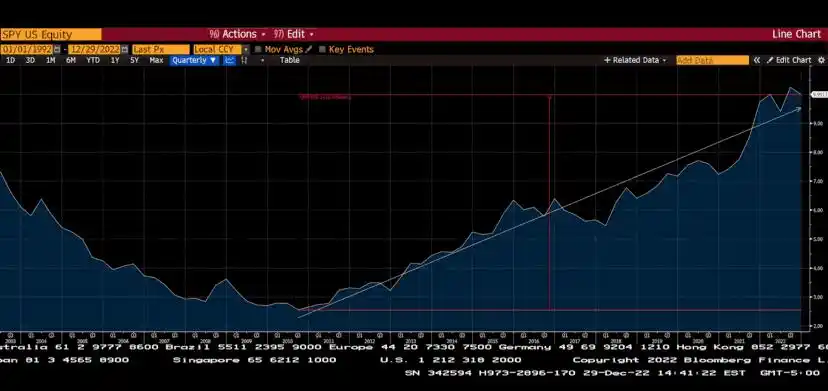
The chart above shows the ratio of SPY/EEM ETFs. As you can see, U.S. stocks have outperformed emerging markets by nearly 300 percent over the past decade. The past decade was the peak of financialisation, money-printing and the trough of inflation in developed markets. This combination will not be repeated for decades.
The ratio of the S&P 500 index to the Bloomberg Commodity index
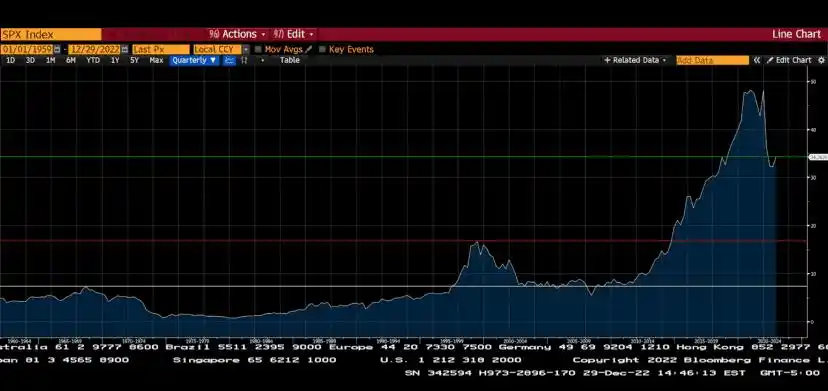
The chart above clearly shows how the west has beaten commodities over the past decade by the largest margin in the history of the Bloomberg commodity index. A return to long-term trend lines means that the financialised west will underperform significantly compared with the eastern and southern parts of the world with young workers and investments in key natural resources.
From a broad index perspective, I don't want to have anything to do with the S&P 500 and probably the Nasdaq 100. Sure, individual stocks may do well, but as an index representing the best companies the West has to offer, I think they will badly underperform commodities and emerging markets going forward. This is especially true because of the resistance of many of the West's formerly staunch Allies (see Saudi Arabia's recent refusal to do so at the behest of US President Joe Biden). Something similar will happen with other demands to provide the Western economic giant with cheap, critical inputs. There will always be a sufficient and high enough price for a particular commodity, but in its current form of over-indebtedness, the West cannot afford to pay too much to fuel an economy of its current size.
Investing in commodities isn't as simple as picking an ETF from a stockbroker and hitting the buy button. You have to understand contango and backwardation, you have to understand where a company is upstream or downstream on the journey from production to sale of a particular commodity. In short, passively saying "I want to invest in commodities" is not enough. Real jobs are needed. So I expect that in the coming months, the market will be looking for an easier way to express and trade this view, and in my case, I'll be looking for a theory of how a rise in the commodity's Zhu-per cycle is tied to a rise or fall in the value of bitcoin and other cryptocurrencies.
This will be the subject of many articles this year. My immediate goal is to better understand the theoretical interaction of several potential outcomes before I offer my own guesses. In my efforts to achieve this goal, I have several questions:
What if inflation is sticky in the West because the global East and South refuse to sell their crown jewels for pennies on the dollar and demand their fair share of the economy?
If inflation persists, will Western central banks continue to raise interest rates to cool their economies and suppress demand? Or, do central banks print money to maintain economic growth and full employment, rather than raise interest rates to lower inflation?
Are Western politicians simply handing out coupons to the poor and middle class so that Western voters do not feel the real impact of wage and commodity inflation, leading to massive government borrowing to finance this move?
If Western politicians follow this path, will central banks print the difference to keep government bond yields low, or will they stand pat and let interest rates rise alongside ballooning government deficits?
All of these subproblems lead to two of the most important questions:
Are nominal interest rates high and falling, or low and rising?
Is Bitcoin's performance linear in terms of nominal interest rates, or is Bitcoin's relationship to nominal interest rates non-linear and quirky? (That is, bitcoin may fall when short-term U.S. Treasury rates rise from 0% to 5%, but rise if short-term rates rise from 5% to 10%).
At the moment, it is impossible to know the answers to these questions - but we can conduct thought experiments to understand what would happen under these circumstances and how politicians, central bankers and capital allocators might respond. With these thought experiments, we can construct a portfolio of government bonds, bitcoin/cryptocurrencies, and commodities that hopefully will grow in all scenarios, a task I've set myself in 2023.
Original link
Welcome to join the official BlockBeats community:
Telegram Subscription Group: https://t.me/theblockbeats
Telegram Discussion Group: https://t.me/BlockBeats_App
Official Twitter Account: https://twitter.com/BlockBeatsAsia

 Related Articles