Miss Doge, Shib, tread Bonk? Maybe you need to relearn the Meme economy
Missing Doge and Shib, skipping Bonk? Maybe You need to re-understand the Meme Economy
Kyle Chayka is a staff writer at The New Yorker.
Perry Wang, WhoKnows DAO
WhoKnows?
The Meme economy is also the history of personal experience in 21st century capitalism: identifying the right scarce digital meme at the right time.
Note, the headline is for flow only and is not any investment advice. The original article was published in 2021 Year 1 Month.
I wrote this long post at full throttle because it's been boiling over in my head for the past week, with all sorts of ridiculous ideas popping up. If you want to share your thoughts on GameStop, Reddit, Robinhood For a coherent explanation of the stock manipulation series, read this piece by Taylor Lorenz in the New York Times. In the meantime, I'll take a slightly different approach to the subject: anecdotal, abstract, investing with a grudge against the 21st century economy we've had the misfortune to experience.
# Meme economy
During my freshman year of high school, I was addicted to Ragnarok Online, an online role-playing game (MMORPGs, as nerds call them). Like all games of this kind, it has multiple characters to choose from, along with millions of other players: knights, wizards, thieves, archers, priests. There are also businessmen.
Each MMORPG is also a digital marketplace for trading various goods: players earn in-game currency and spend it on in-game purchases, mainly things like weapons, potions, or special armor. You fight monsters, drop loot, and then sell it to an in-game automated (NPC) store for currency, which you can use to buy new equipment. It never ends.
That's pretty much how the whole game works: slow growth of digital currency and more and more expensive things.
But the merchant's role in the game is not just to fight monsters, but to arbitrage when trading items. If you're a merchant, you can sell loot to NPC stores at a higher price, buy items at a cheaper price, and, crucially, open a store and sell them directly to players through a bubble dialog that pops up over your avatar for whatever price you choose.
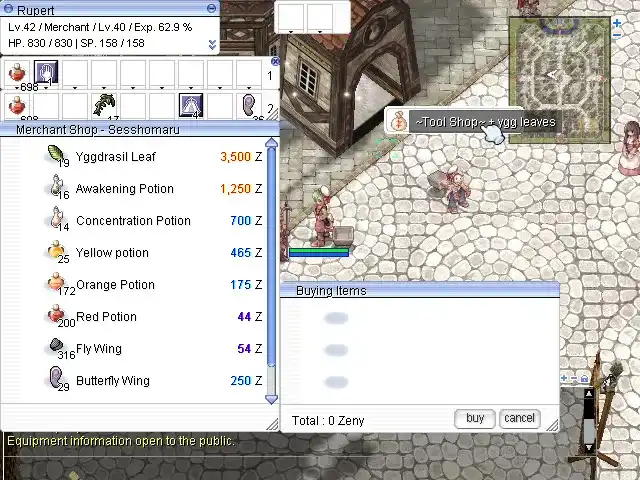
Let's say you're in a town in the game, and you can buy a dagger from the game store for 20% off the regular price. The money-making strategy is to set up your own shop outside the real shop, sell daggers for less than the normal price, say, 5% off, and then pocket the difference. Of course, it takes volume to make money: you have to sell dozens of daggers at a time to make a lot of money, so enough money is needed to stock the store to make a small profit, which you can then reinvest in more items.
That's what I did! To me, this is more fun than killing giant monsters or anything else in the game. Often, you'll see groups of merchants in front of the store, who may offer different items or undercut each other until one player gets up and leaves -- then the remaining merchants can raise their prices and increase their profit margins again.
This cycle was supposed to be my first lesson in the kind of post-industrial capitalism that I would have to live with for the rest of my life: not only do we compete on supply and demand, but even in a virtual economy where objects are entirely artificial, just pixels and calculated drop rates that can be adjusted at the company's will. The economy is arbitrary, with any set of pixels superior to another.
For example: there are monsters wearing Santa hats during the holidays, you kill the monsters and get Santa hats to put on your profile picture, but after the week of Christmas, they are cancelled and the object of your dreams disappears until a full year later, when you can repeat the process.
There was also a lot of cheating: I sometimes used an external robot program to manipulate my character, hanging up and upgrading while I slept. I don't really want to cheat, because we players do it for fun. In the 2000s, there was no real connection between dollars and virtual goods in games; You get a reward, and it's just an honor to have something to brag about in the game, an honor or an influence in your Ragnarok career.
Unfortunately, I didn't do a good job of feeding off this casual lesson in digital capitalism, or I might be rich right now.
I took my first economics class in college, calculating supply curves, tariffs, balances of imports and exports, currency exchange rates. This seemed important to my major in international relations at that time. When I graduated, I tried to find a job that would pay me an annual salary, understanding that this is how one makes a living, receiving a pay check every two weeks from an entity called a company. Of course, in the real world, just after the financial crisis of 2010, I was offered an internship and a modest stipend, and then I was paid informally. I've been working for myself for ten years now. There's no such thing as a paycheck.
Now I realize that "Ragnarok" has taught me everything I know about money and profit in our time, a lesson that is more important than almost anything else in my life. The lesson is that Santa's hat is everything, that digital scarcity is often more important than material scarcity, and that your hand on capital is almost always better than hard work: to be a businessman, not a worker.

My experience as an adult working in the economy has been a series of shocks, or negative epiphanies. My parents lived on engineer and teacher salaries; It's not that they don't own stocks or participate in the stock market, but I think: I didn't understand the concept of equity in capital or the means of production until -- like so many things -- I felt its full impact in my own life.
Because I wrote about art at the beginning of my career, one of the first things I probably noticed was that the skyrocketing prices of young artists' work, and that their work being shown in certain galleries, or getting proper attention, could mean that they had been known for years. A work that sold for $000, or was even given away for free, is suddenly worth 100. That's $000.
(I once interviewed for an art gallery internship and had a Rothko propped casually against the chair I was sitting in.) Another time, I visited the country house of an art agent friend who handled art for a wealthy family. They took down a small Roman statue from the wall and threw it about. The art world's close relationship with money does not mean that being in it is guaranteed to make money; In the art world, there are people who can make so much money that they can afford the useless luxuries at auction, and there are people who desperately need money to continue their artistic careers.
The next shock is the re-emergence of Silicon Valley in the 2010s as the engine of great wealth for my age (and younger). An early employee of a tech company might have been a developer with a normal social life who amassed a small stake in the company and got rich as its market value soared into the billions. Because these firms have replaced the filters in some of the massive capital flows that preceded them - Google's monopoly on advertising, for example. These tech companies go public or are bought out, and their small stakes are worth millions of dollars: employees instantly become rich, not because of their salaries or the importance of their jobs, but because they participate in the software blast furnishes that eat the world.
With the sale of Tumblr to Yahoo for $1.1 billion in 2013 (a hilarious deal), a Tumblr employee early enough, even on the editorial side, made hundreds of thousands of dollars from the company's stock. That's a small amount of money for a tech company, but I've never seen that amount of money once in my life, nor did my parents or grandparents.
# Cryptocurrencies and GameStop hit
Cryptocurrency can be called the third shock to me. Like ether. ETH And Bitcoin. BTC Such coins are an arcane equation that takes up huge server resources to maintain an unbreakable level of digital scarcity: Like the Santa hats in Ragnarok, they're actually gold and can't be canceled after the holidays, but only have 1 in them. 000. You can trade pieces of the hat.
As a journalist, I've seen this capital mutate and become worth a few dollars. Very interesting! A strange experiment with digital currencies, and then their price increases exponentially. Cryptocurrencies that sold for just a few dollars in the early 2010s are now worth tens of thousands of dollars, then hundreds of thousands. People who used to buy hallucinogens (LSD) on the dark Web became millionaires.
I think it's the same feeling people had when Gutenberg started printing the Bible in the 15th century: From nothing, what we once considered sacred seems to be produced infinitely, and the world is never the same. It breaks some unspoken rules of the social framework.
I won't regret not buying BTC or other cryptocurrencies sooner because I couldn't understand what the money meant to me. There are no major problems in my life and no shortage of major opportunities that money can solve. I can't afford to buy my own real estate in a major US city, but by the standards of our time, my life is perfectly fine. However, as these magic numbers pour into certain accounts, I know people who have become secret stewards of mysterious venture funds that, if they choose not to work, will never have to work another day for the rest of their lives. I think that's the real change money can make for me: a sense of security about the future, which currently sees more threats than opportunities. If you buy BTC, you will be able to pay for your water rights in 2050, or get your COVID-19 vaccine without waiting in line.
The same thing happened again last week: A handful of stock traders on Reddit, carefully researched and acting on bets made by at least a few major hedge funds, propelled the stock of GameStop, the outdated video game retailer that flourished in the early 2000s at the same time as Ragnarok, Its shares soared to 10 times their previous price a few weeks ago. Twenty times. Hedge funds shorting the stock had to buy it as it rose. This is the age of the young rising up against the corporate overlords, but there are still a few little ones who have prospered.
If I knew these clues one way or another, would I invest $10,000 long GameStop stock? Can I clear out at the right time? 200, A profit of $000 is more than four years' income.
Here's where money still hits me hard: It's very little, and it's a lot. Co-founder of Airbnb Brian Chesky's net worth soared into the billions when his company went public for an initial public offering. Just as Jeff Bezos, the founder of Amazon, has profited hugely from the paralysis of civilisation caused by quarantines. These people may never run out of money -- you could call it a country of extraordinary wealth, like the pharaohs, and they can't slow the growth of their wealth even if they spend a lot of money on things like space travel. Wages, a family's health insurance policy, or the accruals for a cup of coffee matter little in the face of so much inequality.
I don't mean to denigrate anyone's work; I know it takes as much skill and awareness as luck to spot the right opportunity, seize it and become a survivor until it can finally be cashed in. You also have to pay taxes, unless you also come up with a tax avoidance route, of which there are many in the US. It's not that I think what I've been doing for the past decade is worthless, sitting in front of a laptop, noticing certain things and writing about them, collecting data points about one's worldview and trying to share them with other people - that kind of work necessarily requires a certain amount of narcissism. I could have become a private equity banker or moved to San Francisco and played the startup lottery. I could have invested on my hunch rather than publishing them for public consumption.
But I describe these phenomena now only to frame my thoughts around them, to show how far the world and normal life have moved away from the small-scale expectations I grew up with, from the vague promises society made about meritocracy, the value of the pursuit of happiness, the value of hard work, and so on. As we are forced to live like medieval peasants under a psychotic king, I try to digest these lessons from capital so that I can better judge future trends. For what purpose, I'm not sure - knowing when it might make my head big so I can avoid it? Or are you trying to seize your chance? Sometimes I think I have no other choice. The dilemma is that if you own a tiny amount of Amazon and Palantir, you can make a small profit while being exploited by the giants, or you're just being screwed.
When we look at what is happening in the digital capitalist economy, the idea that wealth somehow means a measure of success; The recipients of wealth are wholly deserving; Or that the pain of so many people working in marginal jobs without adequate support is inevitable; How long can this illusion last? I grew up thinking that labor was worth it, that it had stable value. That may be so, but the truth is that the unlabour value of capital is much higher, the latter being like a tide, while the former is little more than a splash on the beach. Yet I also believe that meaning means less, if it has any value at all.
# Roulette of Fortune
The French economist Thomas Piketty published a book in 2014 called "Capital in the 21st Century" that summed up our problem with one theory: G. Return on capital (a company's profits or dividends; Rent on real estate, etc.; Interest) has been greater than the rate of economic growth, the overall output of society, or labor compensation. It's easy to explain: a GameStop retail clerk who bought $GME stock with his or her paycheck a month ago will make many times more money from the stock than he or she makes in a month, even though they're the reason the company exists.
It's a lucky roulette, of course, and you'll need a lot of upfront money to buy enough shares to profit from a stock rally. But it is pure and simple. G: The basic value of the labor that runs the stores, or even the physical infrastructure that runs the stores, is a drop in the bucket when it comes to random trends in stocks. The trend itself is artificial. The reason GameStop's stock is going up is not because people think GameStop is going to be worth more because it's doing a lot better; The stock surge was essentially a participatory joke, and when the inevitable selloff followed, GameStop's stock price was knocked back to its 2020 price. The joke's inventor got rich from the farce, and the subsequent followers lost all their money.
It's a Meme economy, ultimately settled by real dollars, not just vague social media influencers.
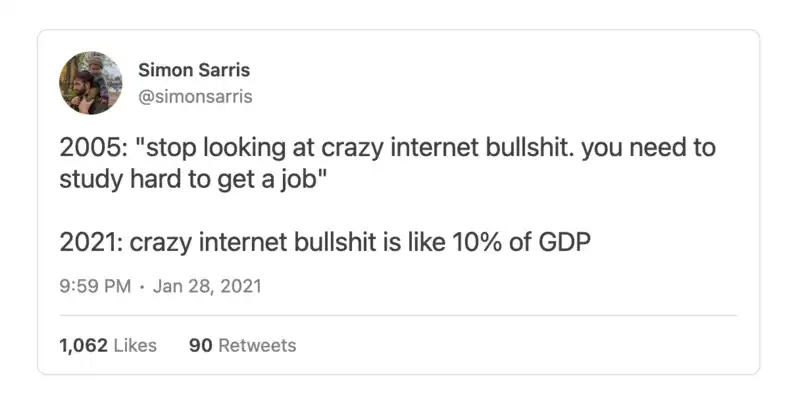
GameStop clearly demonstrates the Ragnarok Santa hat theory of digital capitalism. The money doesn't come from a paycheck on the job or even slow index fund returns. It comes from recognizing the right scarce digital meme at the right time and knowing when to catch the Santa hat before it disappears. Guessing the right meme's payback multiple is no less rewarding than the best venture capital investment or being an early Apple employee. You need money to play the game, but the amount required is much lower than becoming an accredited investor in the United States, which requires an annual income of more than $200,000 or a net worth of $1 million. Beyond that, all the meme economy requires is time, snooping, and the cultivation of accurate judgment through the extraordinary amount of time spent online -- Internet addiction was an embarrassment when I was a kid, and probably still is a mental dysfunction.
To me, bitcoin, GameStop, or Facebook Work, like every Santa hat I collected suddenly sold 100. The high price of $000. It's like you got rich overnight just because you know which episode of the Great British Bakeoff is really the best. Forgive me, but what is this? (It already is in the art world, but you have to know the right people in the real world and pass the right tests to get into the money-making game.)
The earning power of capital far exceeds that of labor, and the skyrocketing returns of capital in the Internet age, its replication rate constantly and crazily hitting new peaks, have more to do with entertainment, memes and followers than with income, productivity or utility.
If my high school teachers had known this reality, they would have sent me home to play video games in the basement. I used to think that stability was formed by career advancement, the slow yield of work, the respect of peers, and establishing authority in a field, even if not through paid full-time employment. However, my concept of professional advancement has been superseded by a series of increasingly mysterious gambles in our lives and digital platforms. Any successful bet is likely to pay off more than years of work.
We want to hire the right start-up, buy the right cryptocurrency, be an early adopter of a new platform and become our own meme before the audience comes in. This is how the meme economy works: you spread, you get attention, you get sponsorship, you sell members, you get a book.
Being satisfied with your work sometimes seems like giving in to the invisibility that capital wants (because it is more efficient to go unnoticed), like forgetting that there is a game behind the scenes. Or believe it all has a more solid foundation or logic than the appearance and disappearance of pixels in the shape of Santa's hat. And that Christmas hat is being fought over by millions of players in the virtual world.
Often an article ends with some suggestion of a solution, or a vision of a problem or the future of an industry, in order to leave the reader with some hope and a clear narrative of an otherwise indescribable world.
But this article is not a traditional publication. I think we are in a chaotic world, and we are still trying to summarize the rules of this accelerating age. In 2014, the US government told us that companies are people too. In order to survive or benefit from the evolving structure of digital capitalism, people must do the opposite and become companies, markets, platforms or memes. Because only these things can flourish.
Original link
Welcome to join the official BlockBeats community:
Telegram Subscription Group: https://t.me/theblockbeats
Telegram Discussion Group: https://t.me/BlockBeats_App
Official Twitter Account: https://twitter.com/BlockBeatsAsia

 Related Articles