Here are seven Bitcoin related themes for 2023

Original title: Seven Topics Related to Bitcoin in 2023
Stephan Livera (Bitcoin magazine)
The DeFi way
This is an op-ed by Stephan Livera, host of the "Stephan Livera Podcast" and managing director of Swan Bitcoin International.
With the 2022 chapter closed, it's time to turn our eyes to what's in store for 2023. Here are some of the themes I think will be relevant to Bitcoin in 2023.
overregulation
The Financial Action Task Force travel rules are forcing exchange platforms and bitcoin service providers to record and share more information about their customers' transactions. We're seeing politicians like Elizabeth Warren speaking out against bitcoin, even if her proposed digital Assets anti-money laundering bill has no real chance of passing, but it does fotell the bitcoin battles to come.
But on the other hand, we should also remember that the government was also initially opposed to Voice over Internet Protocol (VoIP) technology (e.g. Skype, etc.) and now they are also using VoIP. This is similar to bitcoin, where some countries have adopted bitcoin as legal tender, held reserves, provided bitcoin services to their citizens, and encouraged bitcoin investors and entrepreneurs.
CBDCS and the War on Cash
In the war on cash gains, many countries have taken large denominations out of circulation or banned physical cash transactions above a threshold. There is a lot of talk about experimenting with central bank digital currencies (CBDCS), but my guess is that most countries will not have the technology and overall economic capacity to build fully functional CBDCS by 2023.
2023 will be all about experimentation and talk, preparing for the rollout of future CBDCS. In countries with high welfare, the government can especially force people to adopt CBDCS, which you can read as "If you want your welfare check, you'll use it as a CBDC."
Once upon a time, CBDCS might have been dismissed as a "conspiracy theory", but now they have clearly become a threat to financial freedom and privacy. Sadly, most people won't see the threat until it's too late and CBDCS are in front of them -- and the pain of CBDCS will push more people to use Bitcoin and the Lightning network.
The Maxis is having a Renaissance
Bitcoin maximalist is enjoying a Renaissance as casual "crypto" fans are harvested for Celsius, BlockFi, FTX, Voyager, vault, and more. So, in a way, it's very cyclical, with the 2014-2015 bear market cycle following the collapse of Mt. Gox, and in the 2018-2019 bear market cycle we saw the collapse of QuadrigaCX. So, we just went through another round that people had to learn the hard way.
By 2023, we will see a stronger culture of self-care, because the pain of 2022 is so recent. This is not to rule out future cycles and waves of new adoption, because new people come in with less caution. Sooner or later, yields and shitcoin scams will return in another form, but it will belong to a new wave of people succumbing to them.
We are seeing more content and webinars related to self-hosting. Offering simple automatic withdrawal or 100% unmanaged will be an important feature of the Bitcoin entry in 2023.
Miniscript wallet and features
According to Pieter Wuille's website:
"Miniscript is a language for writing Bitcoin scripts (subsets) in a structured manner, supporting analysis, composition, universal signatures, and more."
For those unfamiliar with it, Miniscript is an easier way to express the different scripts or conditions of consumption of bitcoin. This can be built in different wallets for easier compatibility across hardware and software.
The first thing you might think is, "Why should I care?" You were right to ask that question in the first place. But over time, this will enable more complex self-custody, enterprise and even succession planning scenarios. Want to have a 3/3 multisignature wallet setting that is downgraded to 2/3 Multisignature wallet setting after 90 days? Or are there different "exit" conditions in the business context? Miniscript makes these things easier and allows people to use their existing software or hardware for this purpose. To be clear, some of this is already possible with bitcoin scripting, but Miniscript makes it technically more feasible, or practically easier to implement.
These solutions take time to build, but the functionality looks promising. This may be of particular interest to enterprises and enterprise customers, as it can make their self-hosting practices more practical for employees and key holders.
Currently, there's Liana (developed by the same team behind Revault) and Ledger working on this, the latter having announced Miniscript support in its hardware, while Spectre DIY has enabled support in 2021! Rob Hamilton also talked about the application of Miniscript in the field of insurance. I expect Miniscript to gain even more support in 2023.
This could help push the use of bitcoin in the direction of self-custody and away from the "old model" of financial services, where you had to trust governments, banks and statutory financial institutions more to keep their word or reduce your wealth.
Lightning network priority
It is time to introduce a lightning network-first model for both types of bitcoin transactions (low value and face to face). We see the mempoolfullRBF debate broke out in the end of 2022, but for most of us, the real answer is, as far as possible first network promotion and use of lightning.
As a brief anecdote, I remember talking to Giacomo Zucco, who explained his experience using Bitcoin to pay at a supermarket in El Salvador. Unfortunately, Chivo terminals at the time adopted Bitcoin on-chain payments by default, and when he paid on the chain, the person behind him in line had to wait for confirmation, which was very embarrassing. By contrast, the Lightning Web-First experience looks more like this:
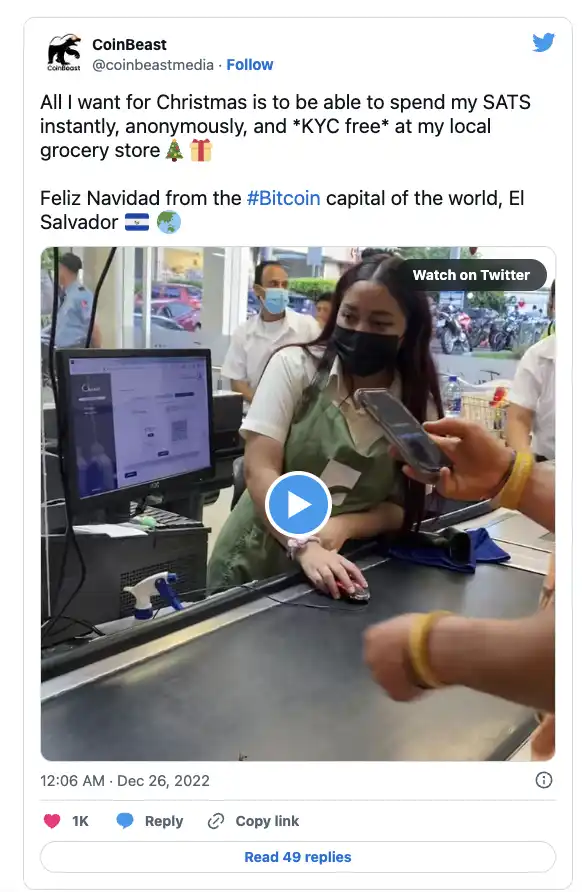
We should show people the best of Bitcoin, and for face-to-face, low-value commerce, we should choose Lightning network first. I believe we will start to see more Bitcoin enthusiasts and local communities pushing and encouraging this in 2023.
The expansion of the Bitcoin community and activities
We will see more events and smaller meetings in countries around the world. Contrary to some who argue that there are too many bitcoin meetings, the question is more of an assumption that you have to attend them all!
Instead, attend events and meetings that align with your interests and/or geographic location. Having more meetings is a good thing, as long as they are done in a low-cost, efficient way. Bitcoin bush bash, for example, is a model we might see around the world - free to attend, held in halls or other free/cheap locations, no recording, smaller parties in cost-effective locations.
By lowering expectations for things that usually cost more money (e.g., fancy, specialized operations, live streaming, lots of international speakers), bitcoin enthusiasts can expand their local scene and gatherings. This is not to disparage larger bitcoin events and conferences, as they also play a key role - but I see a "middle ground" that can be occupied by low-cost, local events.
Overall mood
In the absence of a crystal ball for 2023, I think bitcoin fiat prices will mostly remain in a sideways trend. Forget what fanatics are Posting and talking about, they are usually in pursuit of engagement or too caught up in their own echo chambers. It takes time for the cycle to bottom out.
But let's look on the bright side, this is a great time to stock up on bitcoins and build things. Remember, in previous cycles, it wasn't so clear that "Bitcoin is coming back," and now the world is slowly waking up to the fact that Bitcoin is here to stay.
Original link
Welcome to join the official BlockBeats community:
Telegram Subscription Group: https://t.me/theblockbeats
Telegram Discussion Group: https://t.me/BlockBeats_App
Official Twitter Account: https://twitter.com/BlockBeatsAsia