Review the bear market Grant ecosystem and components
原文标题:《 DAOrayaki |回顾熊市下资助(Grant)的生态系统及组件 》
原文来源:DAOrayaki
In a bull market, we have Yield Farming; In a bear market, we had Grant Farming.
Why are grants important?
Grants and grant programs have always had a place in the crypto world, or Web3. These grant programs initially focused on base-layer network infrastructure, software development, and developer tools.
Today, there are many fields involved. Including content creation, planning and community building. Over the past year, these grants have increased across the wider ecosystem and have been greatly welcomed. Therefore, in this article, we will take an in-depth look at the Grant ecosystem and its future trajectory.
What is Grant?
A Grant is "a sum of money given by a government or other organization for a specific purpose." That may sound like free money to many, but the key word in that definition is "for a specific purpose." Rather than the government doling out most of the money for Web3, this role is being assumed by a more interesting new organizational model.
Why do different types of organizations fund builders and projects?
To better understand this, let's first understand two concepts:
Fat Protocol Thesis Grants Flywheel Grants Flywheel Fat Protocol Thesis Grants Flywheel
1. Fat Protocol theory (Fat Protocol Thesis)
Joel Monegro's Fat Protocols paper is a seminal article in the Encryption Knowledge directory [1]. The article points out that unlike the walled garden of Web2, in the walled garden of Web2, most of the value growth occurs at the application layer (e.g., Google, Facebook, Amazon) rather than the protocol layer (e.g., HTTPS, SMTP). Value accumulation in Web3 will occur at the protocol layer, not the application layer.
This is mainly due to two important factors:
Complete data transparency
A Token exists to access a protocol that can add value
The moat of the Web2 project is the data and technical IP it has. In Web3, when both data and code are available to the public, the only moats come from network effects and the cost of switching to another product.
Network effects directly affect the number of valuable products built on protocols. These beneficial products must also have a strong community with strong network effects to reduce switching costs for users.
How can agreements incentivize worthwhile projects to build on them, now that everyone understands the practical applications on which they need to be built? How to create a value flywheel for incentive programs?
2.Grant value flywheels
Organizations that pay grants have a basic belief that the grantee will build something that will add value to it. The Grant Flywheel is best explained by Joel John in the infographic of his work "Grants & Web3" (another must-read in the Encryption Knowledge catalog).
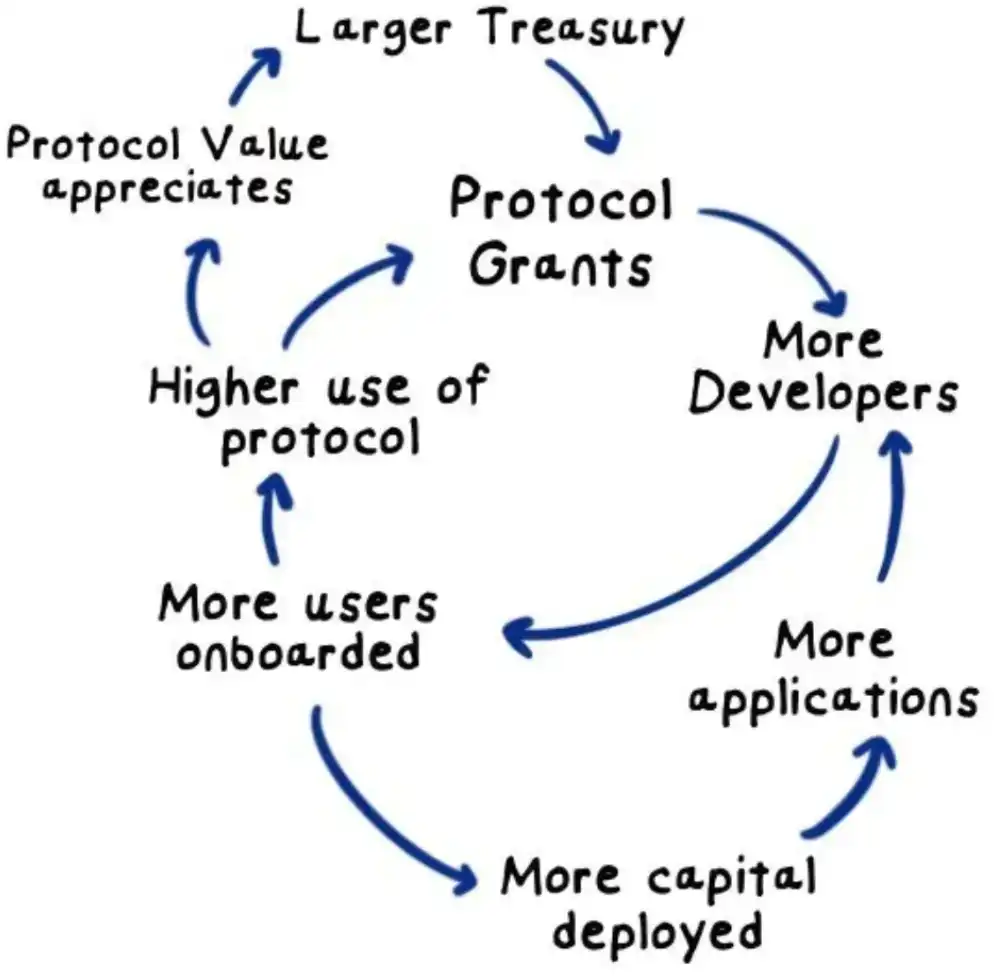
Sources: Joel John, Grants & Web3
While the figure above is self-explanatory, it is clear that the primary goal of the Grant program is to maximize the number of individuals and teams that create value in the broader ecosystem and leverage that value to attract more users. Moreover, the Treasury, which supports these programs, has a very limited role in how the money is spent. As a result, Grant organizations must bet wisely on operating costs and Grant allocations, especially in the depths of bear markets.
Web3 中授权的另一个有趣方面是,这些程序管理各自协议 Token 的一部分 Treasury。这意味着 Grant 计划的任务是花钱来增加剩余 Token 的价值;这在 web2 中从未见过。想象一下如果苹果公司用 Apple Stocks 来激励早期的应用程序开发者。在这种心智模型中,如果 Apple 因应用程序而增值,那么开发人员也有无限的上行空间。
Grant component/composition
To understand how the Grant program works, we need to understand the different components:
Organizational structure
capital
participant
Workflow and tools
1. Organizational structure:
Sov has recently written an article on "Organizational Patterns" [2], describing the different types of organizations that are common in Web3, especially for funding projects. These organizations are:
foundation
Ecosystem DAO
Protocol DAO
At a high level, you see a spectrum where at one end are more centralized entities (foundations) that sometimes serve as stepping stones to traditional venture capital money through ecosystem funds or venture capital networks. These organizations often have strict regulatory requirements, such as KYC/KYB, as well as oversight due to legal restrictions where they are headquartered and various other factors.
In the middle of this range is the ecosystem DAO. These organizations are created to help strengthen support for a particular community or purpose. These organizations can be composed of foundations or Protocol DAOs and exist in many ways to help the parent organization be closer in interacting with the community and the wider ecosystem. For example, Aave Grants DAO administers and distributes grants. At the same time, others see Grant as a primary feature, but also support other aspects of the community, such as the Polygon DAO.
At the other end of the spectrum, the protocol DAO. These organizations embrace the core ethos of decentralization and make every effort to promote community participation and governance. Often, you will see that these organizations have outstanding participants who are actively involved in the governance function. These stakeholders strive to steer the conversation and community sentiment toward goals they believe will best help manage the sustainability and development of the underlying organization.
Highlight case: MakerDAO and Compound.
2. Capital
The funds of organizations are managed in many different ways, with varying levels of transparency in their flows and processes depending on the type of organization.
At one end of the spectrum, there are more decentralized organizations, such as protocol DAOs and some ecosystem DAOs. Most of them are on the chain. Others take this commitment to transparency one step further by developing their websites, which provide a dashbox-like view of how money is spent (such as Polkadot's Dotreasury or NounsDAO's governance).
Funding for these more decentralised organisations is allocated through open governance processes managed in forums such as Discourse or Commonwealth or by dedicated teams that oversee the appropriations process and are responsible for budgets and so on. Typically, the entity is responsible for managing funds and resources for these goals, according to an agreement or ecosystem.
Other organizations at the more centralized end of the spectrum are often more opaque in their processes. For example, they may spread their money across many chain wallets or traditional bank accounts. Funds are sometimes allocated and managed by the grant team, but you will usually see business development or foundation leaders playing an important role in oversight.
Step 3: Participants
Participants include both internal organizations and external organizations involved throughout the funding lifecycle.
Internal participants include all individuals and teams that work directly for the organization in some capacity. These roles can be full time, part time, contract, or appointed by the community (this usually happens in protocol DAOs). Depending on the size and popularity of the organization, they may have dedicated Grant teams that typically serve as Grant analysts, managers, and committees with specific areas of focus. Other responsibilities at times include business development, developer relations, leadership, and protocol development. These teams may play a supporting role or, if the organization does not have a dedicated Grant management team, be directly responsible for managing the Grant lifecycle.
These internal participants work throughout the grant lifecycle, including facilitating review of the application, engaging with the applicant, keeping up to date with documentation, approving the application, and ensuring follow-up or follow-up after the application is accepted, such as funding disbursements, progress tracking, and ongoing support for the project and its stated goals.
External participants include those who apply for funds (applicants), those who receive funds (donees), and active community members (usually within a protocol DAO structure that participates in some form of governance).
Applicants and donees are generally divided into several categories:
developer
Marketing personnel
researcher
curator
Most projects today are looking for qualified developers to build infrastructure, tools, and interesting applications on top of their networks. Recently Alchemy published a report detailing Web3 development [3] that provided some interesting insight into the current state of development of the wider ecosystem, and it is clear that even though we are currently in the depths of a bear market in terms of price behaviour, the number of developers is expanding at an incredible rate. One thing to consider is that while this report shows a growth trajectory for Web3 development, it does not show the scarcity of capable developers that many different ecosystems and their programs are facing.
In addition to developers being the primary focus of many of these projects, we are starting to see an openness to other skill sets, including content creation such as marketing (blogs, newsletters and social media) and research that helps build more awareness, delving into complex topics that require further scrutiny or explanation, and even branching out into new areas, Examples include Decentralized Science (DeSci), which recently appeared on Polygon DAO or Ethereum Foundation. In addition to these types of content creation, we also see opportunities for curators to use tools such as Notion or Obsidian specifically to gather and organize information for wider use and dissemination.
One of the more significant challenges facing many projects in the field today is finding qualified applicants who can fulfill the commitment to build worthwhile projects that help develop ecosystems. We joked about the "grant farming" phenomenon earlier in this article, but its impact can be seen in programs that only receive an extremely small double-digit percentage (usually 10-15%) of applications to them. Low approval rates can be attributed to a variety of reasons, including a lack of vision on the part of applicants, doubts about their ability to execute, or applicants who do not fit within the program's focus areas for developing their ecosystem.
4. Tools and workflow
Tools and workflows refer to the processes and supporting infrastructure that these organizations use to develop and manage their funded projects. While traditional nonprofits (which many people think of when they hear the word "grants") typically have a more mature process for seeking and receiving grants, as well as a vast network of products and services, the Web3 space is just beginning to develop mature tools and workflows to address this emerging need.
In Web3, the range of tools and workflows teams use today includes the traditional Web2-based tools such as Google Sheets, Notion, Salesforce, and a growing number of other Web3 native tools such as Questbook, Is being developed specifically to meet the needs of these new types of organizations supported by cryptocurrencies. Tool types can be influenced by a number of factors, including the type of organization and its approach to building and managing its programs, the focus of the program, the capabilities of the team, the complexity of the process, and the specificity of the requirements.
Many projects have a simple process for applying for grants, especially for smaller grants (usually under $30,000). Typically, these steps will involve submitting the proposal details in a form either on Github or directly in the community governance forum. For a broader proposal, the process may involve more detailed explanation, including explaining the project plan for submitting milestones.
Upon receipt of the application, a review of the applicant will commence. Depending on the type of organization, the review process may involve internal team members. They are usually members of foundations or ecosystem DAOs. A good example of such a structure is the Aave Grants DAO and its funding Committee. Aave Grants DAO has a number of part-time members involved in the review process who are well known and respected community stakeholders.
In the case of the protocol DAO, the review process typically involves community discussion through a governance forum, where community members provide their thoughts and opinions on the proposal, and vote on the proposal using mechanisms such as snapshots. The goal is to ensure that there are processes in place to ensure that the review process is fair and transparent, and that the people involved in the decisions are qualified to make them. The challenge with this model is that it can be cumbersome and does not lend itself to more proposals seeking smaller funding.
Following the review and approval of the Grant, monitoring and evaluation of project progress will commence. Funders can monitor grants involving multiple milestones to ensure progress is being made and provide feedback or resources when needed. For more direct grants that involve some specific task or goal, the grant-giver has the option of paying out at completion or half at the start of the work and the rest when the task is completed.
Many grants focus on influence. The challenge is that different projects consider different areas of impact, and the tools they use, including custom tools, are often not built to capture a variety of factors. As a result, many organizations are trying to learn more about "influence" after the fact. Hopefully, new tools can be built to help organizations evaluate projects, developers, and organizational impact and usage patterns and gain actionable insights.
Original link
Welcome to join the official BlockBeats community:
Telegram Subscription Group: https://t.me/theblockbeats
Telegram Discussion Group: https://t.me/BlockBeats_App
Official Twitter Account: https://twitter.com/BlockBeatsAsia

 Related Articles