How to identify bad crypto assets and assess project risks?
Original author: Michael Nadeau
Original source: The DeFi Report
Original translation: DeFi Road
Previously, we analyzed the market updates driven by data (compiled in the DeFi Way). Our conclusion is that we believe cryptocurrencies will continue to be adopted in the cycle. The market has not fallen into a long-term decline, nor has it lost interest in public blockchains. SBF has not destroyed the cryptocurrency market, and Bitcoin, Ethereum, and the entire ecosystem are still running well. At the same time, the situation will certainly change, but the data shows that the current valuation of this cycle has bottomed out.
Therefore, it is time to do some serious work to identify potentially severely underestimated but still persistent cryptographic assets. Currently, we are in the first cryptographic bear market, where there are real use cases, projects with real daily active users, cash flow, and product/market fit.
On the other hand, it is a fact that the valuations of many projects are still severely overestimated. However, with the help of emerging data providers such as Token Terminal, we can distinguish between "wheat" and "chaff". When liquidity returns to these markets, some projects may increase by several orders of magnitude. People's lives will change, as Warren Buffett often says, "I like to buy high-quality assets at a discounted price and hold them for the long term."
This report is a guide to the identification, screening, and evaluation of illicit cryptocurrency assets that we are currently researching. The topics covered include:
Currently, the market situation.Identifying Non-Performing Assets.Assuming that the input is in Chinese, the translation of "
评估风险" to English is "
Evaluate Risks".
Let's get started.
Current Market Situation
Trading volume has significantly decreased - BTC decreased by about 33% YoY, and ETH decreased by 52% YoY, depending on the daily situation. This may lead to some future fluctuations. The significant surge in trading volume we see in the following chart is related to the FTX crisis.
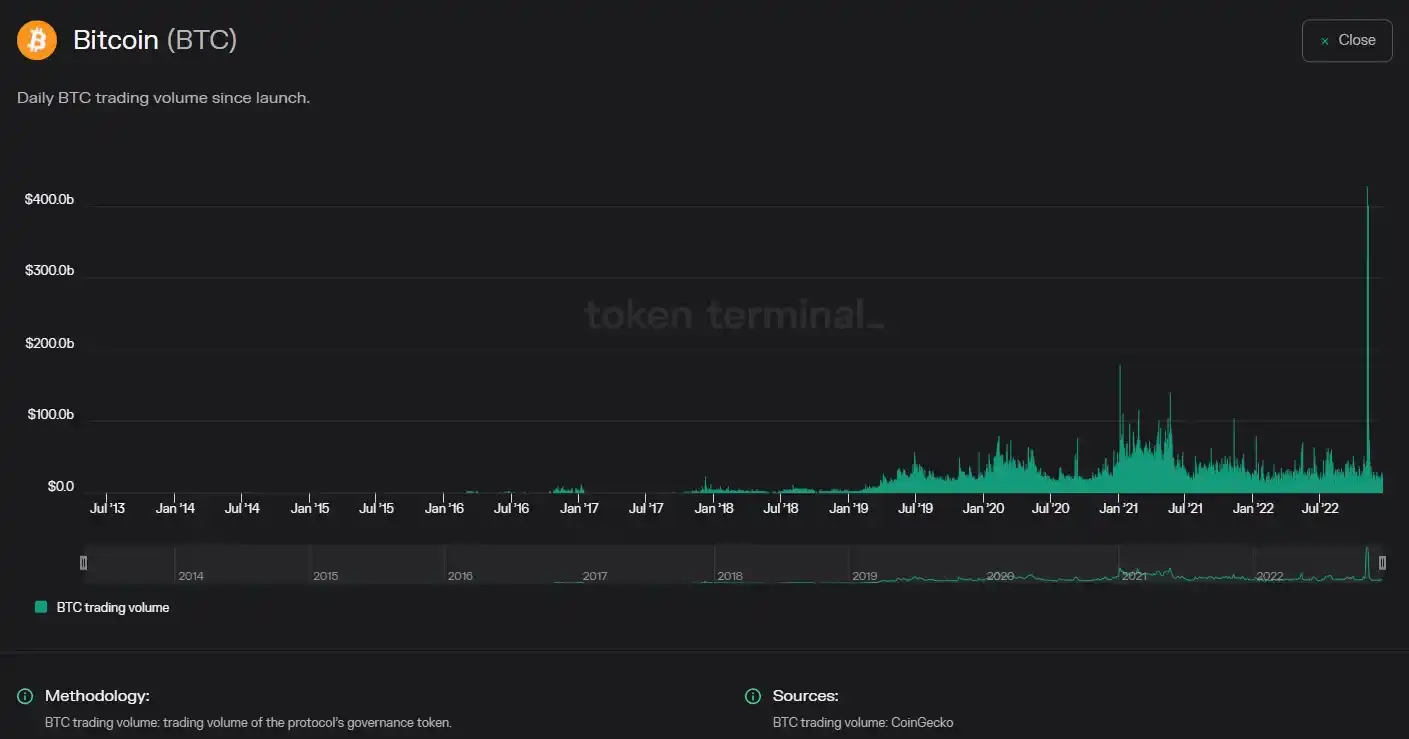
Source: Token Terminal
This year, the average daily trading volume of BTC is 31 billion US dollars, which is lower than last year's 46 billion US dollars/day, but still several orders of magnitude higher than the last bear market in 2018 (10 times). If you are curious, the compound annual growth rate of daily trading volume since 2013 is 99.8%. Despite the volatility, the compound annual growth rate (CAGR) of Bitcoin price during the same period is 65%.
We want to know who is currently selling cryptocurrency? Anyone who wanted to sell in the past few months may have already sold. If you hold cryptocurrency but haven't sold, what is the reason for selling now? As a result, prices may rise - contrary to most people's expectations. Many people are calling for BTC to fall to $14,000 or $10,000. But what are the triggering factors that cause more selling? It's not visible now.
Of course, this could change overnight, but it may require another black swan event, such as Binance or Tether collapsing. Meanwhile, the bankruptcy proceedings of fallen giants are unlikely to result in any forced selling in the short term - as evidenced by Mt. Gox in 2014. Therefore, we believe that the only sellers in the current market are miners (who must sell to pay for operating costs) and investors who want to reduce their holdings to obtain tax benefits.
Who is buying? Given that we are starting to exhaust the number of sellers in the market, we may be approaching a point where there are more buyers than sellers in the market. Who are these people? Smart investors looking for opportunities in times of crisis. Considering the volatility of the past 12 months, BTC at $17,000 and ETH at $1,200 may be seen as signs of growth and opportunities to enter the market.
The buyers may be macro hedge funds, family offices/other high net worth individuals, and convicted long-term retail investors. Due to professional risks, larger institutional asset management companies are unlikely to be buyers. Therefore, they are more likely to stand by and wait until the market starts to move - as game theory and professional risks shift to the other side, they will FOMO in with their peers.
Identifying Non-Performing Assets
It's time to roll up your sleeves and search for signals in the noisy ocean.
Step 1: Cash Flow
Our focus is on projects with cash flow. We don't care about cool ideas or new projects that tweak existing ideas with new features. We only want to see users and cash flow, especially in a bear market. That's the signal. New features and unrealistic ideas are mostly noise in this field.
Step 2: Market Value
Next, we need to take a look at the current market value. First, we can identify projects with cash flows exceeding their current market value within one year. Then we use these projects as the initial screening process. Here are some simple examples of projects that can be screened in the first stage:
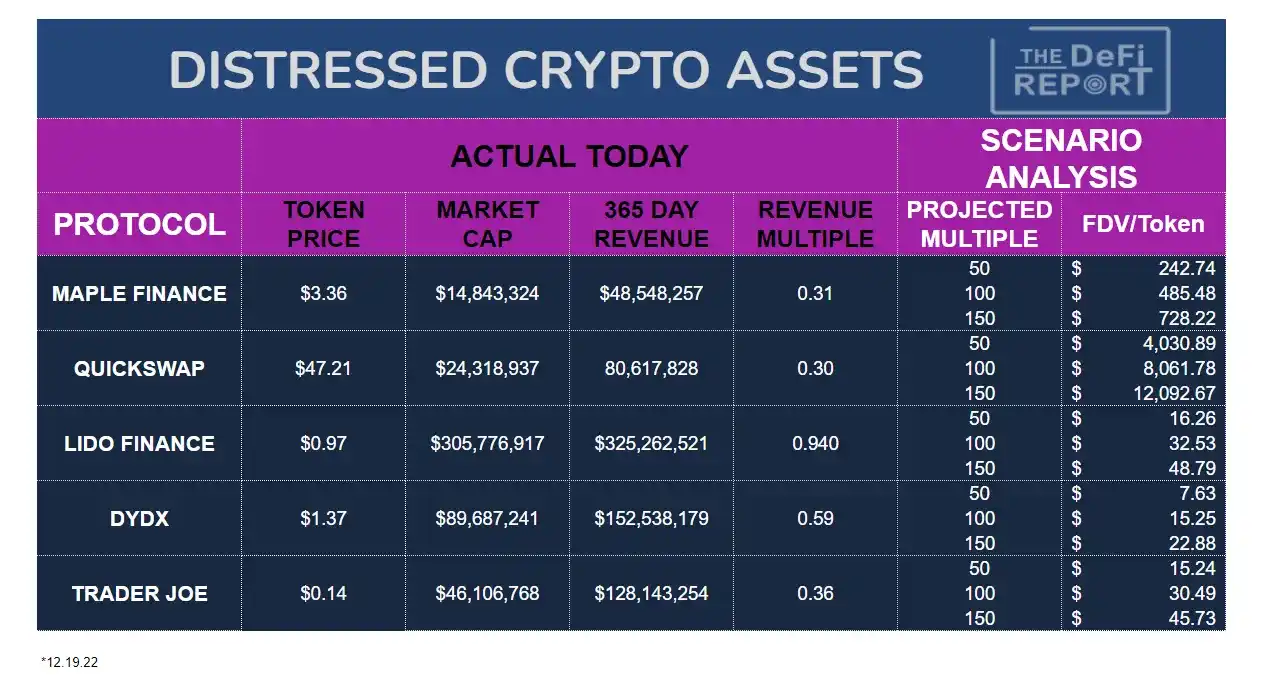
Data: Token Terminal
Translation:
数据:Token Terminal
(Note: No translation needed as the content is already in English and contains HTML tags that should not be translated.)
*Please do not take the above data as investment advice.* This is just the first step of analysis - the multiples are only to understand the direction of development. That being said, there are many cryptocurrencies in the public market that have users and cash flow, and their trading valuations are lower than those of projects that raised funds through private placements before launching their products. We believe this may be a rare opportunity.
上述数据和 DeFi 商业模式的快速分解
The rapid breakdown of the above data and DeFi business model
Pay attention to the *total* revenue of these projects (not just protocol revenue). Each project has a different business model, but we need to set a level here where the functionality of the crypto network and protocol is fundamentally different from that of traditional companies. For example, these projects do not have ongoing "revenue costs". There are basically no operating costs directly related to the network or protocol, or variable costs per unit of revenue. Why? Because only open-source computer code generates revenue. Once smart contracts are coded, audited, and deployed, they run automatically 24/7. This will attract market participants to use these smart contracts when providing and consuming services. The supply-side personnel bear incremental "operating or variable costs".
Meanwhile, the revenue of DeFi projects is usually distributed between the protocol (managed by DAO) and the distributed service providers. We focus on the *total* revenue because we want to evaluate the overall value creation of the project at this stage. A project (through DAO voting) can always vote to return a certain percentage of the revenue to the protocol treasury or Token holders as future dividend payments - at the appropriate time.
Future Dilution
When we predict the income multiple of a Token in the future, we use fully diluted Token supply. Many projects are in the early stages and less than 50% of the Tokens have been issued to the market. Therefore, in order to compare projects on a relative basis, we need to look at the fully diluted Token value in the predicted income multiple.
Evaluating Risks
Once a project is identified where the cash flow exceeds its market value, we can move on to the second phase of analysis. This is where we roll up our sleeves and get our hands dirty. We have identified some data points, which are typically more qualitative in nature. Each data point can be evaluated on a scale of 1 (high risk) to 5 (low risk). The ranking of data points is not in any particular order.
1. Core Team: The first rule is that the core team cannot be anonymous. We want to see people who have jobs and are responsible for them, and we want to see some kind of performance record - whether it's in Web2 or Web3. If the founder is young, we would like to see them in interviews, read their work, and understand their papers. Basically, we are looking for excellent talents who will participate in the game for the long term.
2. Supporter: Who provided seed funding for this project? What is their reputation? Have they been involved in the industry for a long time? What is the percentage of tokens they received? How long is their lock-up period? Do they have other investments in this field? Are they working with the core team, providing resources and assistance as needed? Similarly, we are looking for outstanding talents who have been involved in the industry for a long time. Messari is a good source of VC support for web3 projects. Click here to view the project's governance document.
3. Product/market fit and business model: What is the business model and why is it better? What is the product? On which blockchains is it deployed? Who is using it and why? Are there other integrated services to complement the project? Is the economic incentive of the market supply side sound?
For example, in the long run, it is necessary to incentivize Bitcoin miners to protect the network, and to incentivize liquidity providers on Uniswap or any DEX to use the protocol and continue to provide services. For instance, loan underwriters on Maple Finance need to be compensated and incentivized to continue underwriting loans, which means there needs to be a demand for loans.
4. Competition: Has the project been forked/copied? This is usually a positive signal of value, but the original project needs to be able to maintain network effects. For example, Uniswap has been forked multiple times, but it still maintains a 70% market share in decentralized exchange trading volume.
5. Addressable market: Is the addressable market large enough to support higher valuations? Who are the users and how is user growth? Comparing it to traditional financial peers as a starting point can be helpful.
6. Token Economics: How many Tokens are there on the market? What is the total supply? What are the internal and public segmentation of Tokens ? What is the lock-up period for internal personnel? Does the Token have practicality beyond governance voting? How is the value of Token accumulated - for example, is the network repurchasing or destroying Tokens based on usage? Can users mortgage assets to provide services and earn profits? Can users vote to redirect some protocol revenue back to the treasury or Token holders at the appropriate time?
7. Security Audit: Has the smart contract been audited? By whom? What type of audit was conducted? Are there any unresolved issues? Do they have a white hat bounty program to incentivize external individuals to conduct real-world testing on the code?
8.Crypto Presence: Does the project have a strong community? Are people talking about it on Twitter? Do the founders have a large number of Twitter followers? Are there active Discord servers? What are the community members discussing? These things are important.
9. Governance/Community: How strong is the community? This may sound silly, but if there is a religious-like fervor, it could be a good sign. Are there many people spreading and defending the network? We should also ask whether the decisions made by the DAO are good or bad. For example, if the community demands dividends to be paid to Token holders a few years after project implementation, this would be a very bad sign and a sign of an immature community. A community that delays dividends and instead pays 100% of revenue to their service providers or returns a small portion to the protocol for reinvestment in growth is a good sign. Because we want to see the community playing the long game.
10. Fund Management: How many tracks do they have? Can they survive a bear market? We hope to see some diversification - this is tricky because the community does not want to see the native Token being sold to another Token, such as USDC. However, diversifying funds from 100% native Tokens can reduce risk and extend the project's lifespan.
11. Narrative: Narrative is crucial. Most conversations happen on Twitter, Discord servers, YouTube, Newsletters, etc. Reflexivity is a powerful force in the crypto industry. We should ask ourselves if the project aligns with emerging narratives in the market.
For example, DeFi projects now have strong narratives because many "blue chip stocks" have been repeatedly tested in actual combat over the past year. At the same time, CeFi has basically collapsed. So where will crypto-native market makers, traders, and borrowers go to obtain liquidity in the next cycle? This may create significant demand for platforms such as Aave, Compound, Maker, and Maple.
At the same time, the valuation of DeFi has been suppressed in the past year, but many of them have product/market fit and cash flow. Note this description. Gaming is another issue to pay attention to. Once price behavior conflicts with the narrative, it becomes a self-reinforcing feedback loop.
12. Trading Volume/Liquidity: How much trading volume does the project receive daily? On which trading platforms is it listed? We typically exclude any project that is not listed on major websites such as Coinbase, Gemini, Kraken, or Binance. Please note that many low market cap tokens have low trading volume. If you were a buyer during the bear market depths and a seller during the bull market, that's okay. However, if you are trying to obtain liquidity during a market sell-off, you may find yourself holding an illiquid token. Your trading volume threshold should be consistent with the amount of tokens you hold and your risk tolerance.
You may be wondering how to access all of this data, and the challenge is right here. Obtaining the data is not easy. You must do some tedious work. Warren Buffett was famous for manually searching and combing through mountains of data when he started his business. At that time, there was no internet, no Yahoo Finance, and no EDGAR database. This created information asymmetry, which in turn created opportunities.
The only way to make these markets more efficient is to have better data, professional analysis, and new valuation frameworks and standards that are suitable for new business models. During this period, arbitrage is simply doing its job - waiting for the market to develop.
Original article link
Welcome to join the official BlockBeats community:
Telegram Subscription Group: https://t.me/theblockbeats
Telegram Discussion Group: https://t.me/BlockBeats_App
Official Twitter Account: https://twitter.com/BlockBeatsAsia
 Related Articles