Is DeFi really the future? A critical study of DeFi
原文标题:《 The Problems with DeFi & Crypto 》
Written by Lyn Alden, founder of Investment Strategy
GaryMa, Wu says blockchain
In the wake of the Luna, Celsius, Voyager, 3AC, and FTX/Alameda debacle, many crypto industry analysts have suggested DeFi as the potential solution.
This article takes this view as a guide to the analysis, acknowledging that there are certain opportunities for DeFi, but also making a rather critical assessment of the current state of the industry as a whole.
In addition, this article covers other concepts in the cryptocurrency industry, including Web3, NFT, tokenized securities, and the broader problem of creating cryptocurrencies that serve no purpose other than making founders rich.
CeFi: Opaque leverage problem
The supposed benefit of DeFi is that the technology can be decentralised and add transparency to a variety of trading and leverage services.
Therefore, before discussing DeFi, it is necessary to analyze CeFi.
In the crypto industry, the two main types of centralized companies are trading platforms and deposit/lending institutions. The term "CeFi" refers primarily to the latter, but more broadly can include both, especially since the two business models can be intertwined.
Trading platforms allow traders to exchange various crypto assets and often provide leverage for traders.
Deposit/lending institutions (aka "liquidity providers") allow people to deposit crypto assets and earn income, allow people to deposit crypto assets as collateral to borrow stablecoins or fiat currencies, and allow some institutions to borrow unsecured.
There are other companies, such as pure hosting, technology development, etc., but these two types of companies are relatively related to DeFi.
Much of the legacy financial system is opaque. It is difficult to determine how much debt any given entity has unless it is publicly traded. Even so, it is still possible to commit fraud or use certain accounting techniques to muddle the details to some extent.
This trend continues in the CeFi cryptocurrency industry, but it is strong. Various trading firms and funds often use leverage to speculate on crypto assets, especially altcoins. Since few of these companies are publicly traded, almost all of them are fairly opaque, even with billions of dollars at stake.
Throughout 2021 and 2022, the industry began to run into cycle problems. The early problems started when the premium over nav of the Grayscale Bitcoin Trust (GBTC) shifted to discount-below nav. In other words, there was a time when the market price of the fund was $1.40 for every dollar of bitcoin in the fund, and now the market price of every dollar of bitcoin in the fund is less than 60 cents.
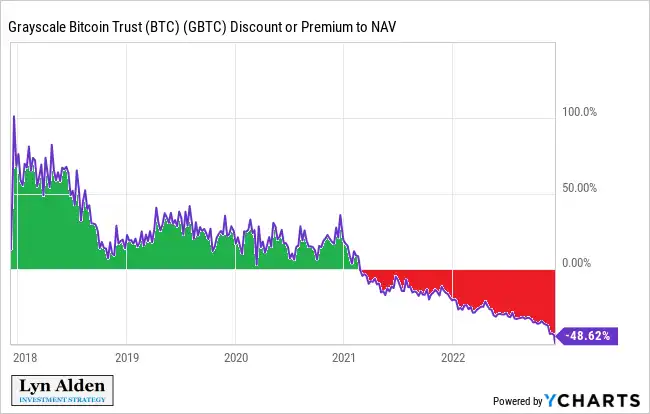
Many trading firms have leverage exposure to this instrument, so this is a bigger problem for them than people might realise.
For years, GBTC was one of the few ways to gain exposure to bitcoin in the form of securities, something many regulated entities wanted. As a result, it trades at a premium to the net asset value "NAV" because it offers something that is hard to come by in this type of securitized portfolio, including in a brokerage account.
As more funds and securities entered the market to provide these regulated entities with exposure to Bitcoin prices, GBTC became less unique and its premium disappeared. Most closed-end funds trade at a slight discount to net asset value, and GBTC is no exception.
The vast majority of my bitcoin exposure is directly invested in bitcoin itself (which I buy through Swan bitcoin). However, for lack of better alternatives in my brokerage portfolio, I used a small GBTC position to replicate bitcoin price exposure. I rebalance its exposure from time to time, especially when its premium gets too high, as with my No Limits portfolio:
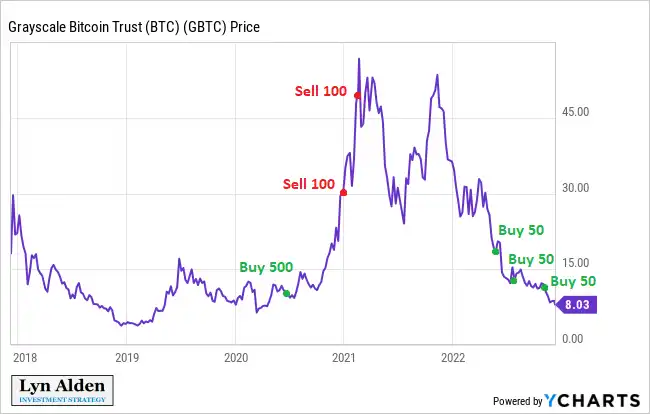
GBTC is not only a way for portfolios to gain exposure to the price of bitcoin, it has also provided a carry trade for qualified investors over the years. They can 1) short bitcoin and 2) send funds to GBTC to create new units of GBTC with NAV. They must hold this position for a six-month lock-up period and can then sell their GBTC shares at a premium to their net worth and close out their short bitcoin position, thus taking the premium above their net worth as profit without exposing themselves to fluctuations in bitcoin itself and GBTC's price. They can then repeat the trade again and again.
This went on for a long time, until it became easier to gain exposure to bitcoin in a variety of other regulated vehicles. At that point, the trust could no longer justify holding a premium over NAV.
This has caught many trading firms off guard, as they are stuck with large short bitcoin positions and large long GBTC positions, and instead of trading at a premium, as they used to, they are now trading at a discount. In other words, they experienced significant losses from what they considered to be low-risk trades, so their size and leverage increased.
That was the first blow.
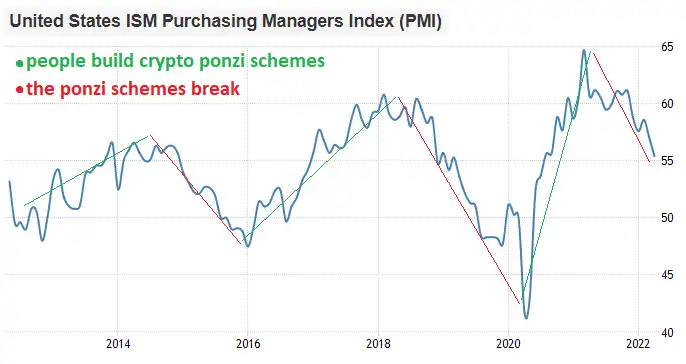
The second strike is Terra/Luna's thunder. It was a Ponzi scheme from day one. Retail investors were artificially lured with an unsustainable 20 per cent yield. I warned Terra/Luna near the April and May 2022 highs, and then wrote a post-mortem in May 2022 called "Digital Alchemy."
One of the themes of the post-mortem is that crypto Ponzi schemes tend to be set up when liquidity and general business conditions improve, while crypto Ponzi schemes tend to be exposed and broken when liquidity and general business conditions deteriorate:
Many leveraged trading firms were exposed to Luna, making the crypto industry's subsequent explosion even more serious than I thought at the time. For many, the biggest surprise was the fall of 3AC, which was hurt by the GBTC discount and then hit by the collapse of Luna, whom the 3AC team had been particularly bullish on.
Three Arrow Capital is a big cryptocurrency trading firm that's been around for a decade and they use a lot more leverage than most people realize because it's opaque and they quietly borrow from a lot of different sources that don't necessarily talk to each other. A number of lenders, including Voyager and Genesis, provided large unsecured loans to 3AC.
BlockFi also has a large loan to 3AC, but it is secured, which reduces the total impact on them. Celsius and dozens of other companies have also loaned 3AC money.
As a result, the collapse of 3AC led to the collapse of a large number of crypto lending industries, after which only a few are still standing. Overall risk management in the sector is poor, although some conditions are better than others. Many lenders offer loans only to a small number of large borrowers like 3AC.
I explored the CeFi platform in early 2021 to understand the ecosystem. Back in February 2021, I endorsed BlockFi in a post as a small part of the configuration for novel things like stablecoin yields, gold Token yields, etc. I emphasized its risks and the fact that deposits are not insured by the FDIC, and suggested that at most, one should put only a small portion of one's assets in it and keep most of them in one's hands. However, a year later in February 2022, when BlockFi and the industry were still functioning normally, I withdrew my endorsement as I no longer felt the risk/reward was worth it.
Unlike many lenders, BlockFi successfully weathered the subsequent May/June 2022 cryptocurrency lender debacle, while other CeFi deposits/lenders such as Celsius and Voyager failed. BlockFi avoids centralising the issuance of unsecured loans, which at least minimises the impact on its solvency and provides a way for it to continue processing withdrawals and operate with investor support.
However, BlockFi then sealed their fate by partnering with FTX/Alameda in June 2022 to provide liquidity and a takeover offer. Following the collapse of FTX/Alameda in November 2022, BlockFi had to stop processing withdrawals, joining most other deposit/lending institutions.
Overall, the largest losses in the CeFi industry come from 1) making unsecured loans to leveraged entities with opaque balance sheets, or 2) holding assets in custody for leveraged entities with opaque balance sheets. The problem with opaque balance sheets, of course, is that it is hard to know exactly how leveraged they are, especially as some cases involve blatant fraud.
What is the DeFi's goal?
The risk of DeFi vulnerabilities is everywhere
DeFi offers some transparency benefits, but it also provides a huge attack surface for hackers.
These are often referred to as "DeFi hackers", in which someone has figured out how to steal money from smart contracts. Indeed, they are best seen as exploitation or arbitrage opportunities rather than hacks.
"Code is law" was a common motto in the early days of DeFi. If there is a loophole in a smart contract, then someone can exploit it and potentially give themselves an advantage, even including access to assets in ways not intended by the contract. Similar to a poorly written reality contract, clever lawyers can find loopholes and help clients abuse the contract in a way that is unintentional on paper. After all, what's the point of a smart contract if code isn't the final arbiter?
The Bitcoin network, the most streamlined blockchain, has been in operation for nearly 14 years. It is intentionally simple, intentionally slow to change, and intentionally resistant to change except in cases of overwhelming consensus. Still, the Bitcoin network has encountered some serious vulnerabilities over the past few years.
So what hope is there for ever-changing and highly complex smart contracts? Anyone holding money in DeFi or other smart contracts should assume that there is always a risk that the code will be exploited and the money lost. You get 3%, right? That's great. Weigh this against the probability of a 100% loss occurring at any time during the year, and repeat the process year after year. The risks are amplified when smart contracts from different blockchains or layers interact with each other.
Over the past two and a half years, more than $2.5 billion in crypto assets have been stolen from smart contracts:

Secured vs. unsecured: This is key
Many DeFi supporters point out that most CeFi lenders went bankrupt in 2022 and DeFi contracts continue to operate.
While there is a grain of truth in this, we should examine the root cause: mortgages. CeFi lenders, which offer full mortgages, have also generally performed well. If they have to liquidate a customer, it's the customer who goes bankrupt, not the lender. The problem occurs when CeFi lenders make under-secured or unsecured loans to entities they consider trustworthy (those entities then gamble on the DeFi, such as LUNA, and are unable to repay the loans).
Because of the automated nature of DeFi, it is difficult to accomplish it in a meaningful way without over-mortgaging. Thus, by its very nature, DEFIs consist mainly of over-mortgaged leverage. The lesson here is not that DeFi is better than CeFi; It is that over-secured loans are safer than under-secured or unsecured ones when it comes to volatile assets.
In a DeFi environment, depositors are mainly exposed to the risk of mortgages (which is a good thing in terms of loans), but also to the constant risk of smart contract theft (which is a bad thing). In a CeFi environment, depositors may have some mix of mortgage and non-mortgage risk (which is a bad thing) but greater protection against loopholes (which is a good thing).
My takeaway from the crypto industry events of 2022 is not that DeFi is better than CeFi.
Instead, my argument is that the hunt for yield in these highly volatile assets is inherently unwise. In terms of prudent lending, excess mortgages should be chosen.
Bitcoin provides users with the ability to self-hold a limited liquid asset and use that asset to send or receive unlicensed payments without relying on a centralized third party. In my opinion, this is the signal in the noise, and it is more powerful than many people realize.
Medium-term use of Stablecoin for savings and payments is another good utility use case in developing countries where access to dollars is difficult. They should be aware of counterparty risk, and in general, I'd like to see more and more transparency around stablecoin collateral.
Almost everything else involves speculation, or picking up coins (gains) in front of a steamroller (opaque counterparty risk and/or code holes). The fact that it took me a year, even with very little capital, to stop investing before the crash even happened is what I think was a mistake in navigating this industry.
DeFi's centralization disadvantage
In addition to the circular, speculative and sometimes outright fraudulent nature of the crypto industry, including the DeFi sub-industry, there is the problem of centralisation at the heart of the technology, despite being marketed as decentralised.
Centralization of smart contract platforms
In contrast to the decentralized Bitcoin network, the foundation of DeFi's technology stack, the underlying smart contract blockchain, has started with some centralized aspects.
For example, the Ethereum network had difficulty bombs in the code for more than seven years between its founding in 2015 and PoS conversion in 2022. This reduces the power of miners and individual node operators and enhances the power of head developers, a form of centralization. It allows them to push ahead with the roadmap and change the agreement according to their vision, which basically makes it an investment contract. Even after the 2022 PoS conversion, network users will still have to wait for developers to implement PoS withdrawals.
Meanwhile, Binance can all but call for the BNB Chain to be suspended if something goes wrong, as it did between October 6 and 7 this year. In theory, BNB Chain is a decentralized system independent of the centralized company Binance, but in practice:

Similarly, when Solana unexpectedly went offline five times in 2022, the validator operator had to meet through Discord to manually restart the chain.
Many PoS chains work this way. The technical or capital requirements to become a verifier are quite high, which ultimately results in the system operating quite oligopoly.
Unlike proof-of-work protocols, proof-of-equity protocols do not have an unfalsifiable ledger history, so if the system goes down intentionally or unintentionally, determining where the appropriate checkpoints are and where to restart the network from is a fairly manual process. Since it is cost-free to create an almost infinite number of alternative histories, and each history appears to be valid, there is no unfalsifiable, self-verifiable way to determine the "true" history of the books in the proof-of-equity system (which is exactly what proof-of-work does), so with proof-of-equity checkpoints, some authority or set of authorities needs to be trusted.
That's why there are projects like Babylon Chain that allow PoS chains to insert uncounterfeitable time stamps into the bitcoin blockchain. It attempts to alleviate some of the circular problems inherent in the proof-of-equity system by using the dominant proof-of-work system. They use the Bitcoin network as a checkpoint authority.
In addition to the centralised difficulty bomb, centralised developer decisions, centralised validation and/or centralised checkpoint authority issues, there is a simple problem, in most cases smart contract blockchain nodes are too big.
The best blockchain privacy and decentralization happens when users run their own nodes, or at least have the actual choice, if they need it. This allows them to validate all aspects of the network themselves and allows them to initiate transactions themselves, rather than requiring third parties to initiate transactions for them.
However, it increases the processing, storage, and bandwidth requirements of the running node by adding higher throughput or higher code representation at the base layer of the protocol. For example, in order to run Solana or BSC nodes, you very much need enterprise-class equipment or use a cloud provider.
Ethereum nodes are lighter than Solana or BSC nodes, but are still too large to run on Tor. There are only about 6,700 Ethereum nodes in existence, according to ethernodes.org. Of these, more than 4,400 are hosted by providers (usually cloud services), and 2,700 of those are hosted through Amazon. There are only about 2,300 unmanaged nodes.
Most users and applications rely on third-party node operators such as Infura and Alchemy (which themselves are heavy users of cloud providers). When the U.S. Treasury sanctioned Tornado Cash, a privacy-focused smart contract, in August 2022, Infura and Alchemy complied and stopped processing transactions related to Tornado Cash. This means that many foreigners, including those not even under U.S. sanctions, cannot use Tornado Cash unless they are willing to run their own Ethereum node, which is not easy to do and cannot be run through Tor.

By contrast, when Satoshi Nakamoto invented Bitcoin, he deliberately sacrificed in terms of bandwidth and complexity to make it as small, simple and decentralized as possible.
This allows individual users to easily run Bitcoin nodes from a laptop with a normal Internet connection. The demand to run a node has been much slower than technological improvements in processing, storage, and Internet bandwidth, so it has become easier rather than harder to run a Bitcoin node over time. The goal of the Bitcoin network from the start was to get rid of all the unnecessary fat and make it as lightweight as possible.
Centralization of custodial assets
In addition to some aspects of centralization on the underlying smart contract blockchain that the DeFi industry relies on, actual DeFi use cases tend to rely more heavily on centralized entities.
The vast majority of DeFi's total lock-in value relies on centrally managed stablecoins and other centrally managed assets. In pseudo-decentralized deposit and loan agreements, stablecoins account for a large portion of lending and borrowing, and stablecoins are common trading pairs in pseudo-decentralized trading platforms.
A fiat backed stablecoin, such as USDT or USDC, is a central issuer that holds assets in the form of bank deposits, Treasury bills, repurchase agreements, commercial paper, or similar types of assets, and issues redeemable Token liabilities that can be traded on the blockchain. In other words, there is a centralized issuer to manage the collateral and process redemptions, but the liabilities are the holders' digital headless assets and can therefore be traded between people effectively and automatically without the need for further action by the centralized issuer. However, centralized publishers can still choose to actively freeze specific addresses at the request of law enforcement or due to various code exploits.
In addition to relying heavily on centrally hosted stablecoins, DeFi on Ethereum also makes heavy use of encapsulated bitcoin "WBTC." This is a managed product where bitcoin is held in custody and its Token liabilities can be leveraged or traded on the Ethereum blockchain. Ethereum's number of managed Bitcoins rivals the number of managed Bitcoins held by the largest crypto exchanges. Much like Stablecoins, this is a centralized product whose liabilities are bearer assets.
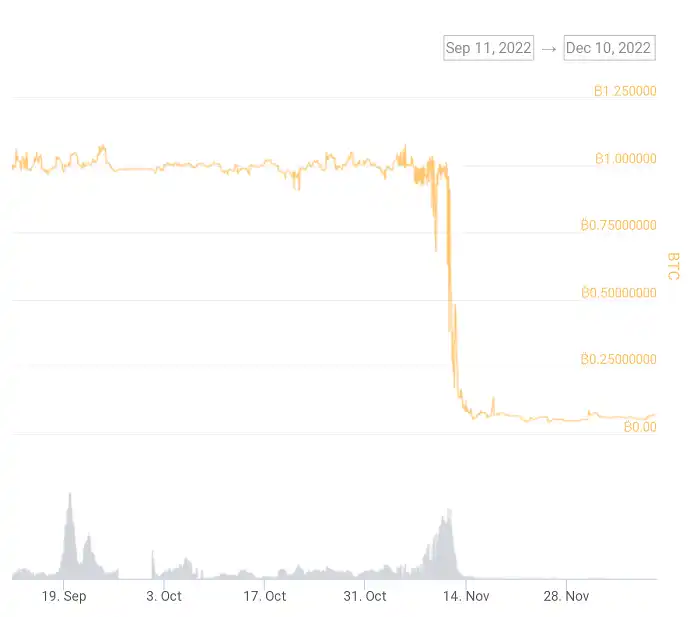
The worst that could happen on Ethereum has already happened to Solana. There are encapsulated Bitcoin and Ethereum on Solana, allowing these assets to be leveraged or traded within the Solana ecosystem. But the problem is that FTX was the issuer of these assets, and FTX is now bankrupt. As a result, these custodial assets became decoupled from the dollar and lost almost all their value:
An attempt to synthesize stablecoins
Some stablecoin developers are trying to wean themselves off centralized issuers and custodians. After all, if most of the asset values traded on "decentralized finance" agreements are themselves fully centralized, is the term appropriate?
MakerDAO, for example, launched DAI a few years ago, which was originally an Ethereum-guaranteed synthetic stablecoin. This means that DAI are not convertible into actual dollars like USDT or USDC, but are backed by over-pledged Ethereum and balanced using stable algorithms to represent a dollar collectively.
Fiat money is a centrally managed ledger. Trying to link a pseudo-decentralized ledger (such as the cryptographically collateralized stablecoin protocol) to an actively managed and centralized ledger (such as the Federal Reserve system) always introduces limitations and risks. In this case, the use of volatile assets as collateral means the likelihood of a sudden liquidation is quite high. Sudden clearing is likely to occur during periods of volatile markets, which lead to chain clogging and extremely high transaction fees, as too many people compete for exit at the same time, triggering too many clearations at the same time for the network to handle properly.
In March 2020, during the pandemic that caused global markets to collapse and economies to go into lockdown, the price of Ethereum plummeted, and in an emergency, MakerDAO ironically voted to increase the centralized USDC fiat currency collateral Stabecoin as a form of DAI collateral. That's because crypto-collateralized stablecoins (basically an attempt to back a low-volatility asset with a high-volatility asset) are inherently either fragile or capital-inefficient. Since then, USDC has been a large percentage of DAI's collateral. The USDC can freeze DAI's collateral and end the project essentially at any time, if requested by the government.
In order to have a low enough clearing probability, crypto-collateralized stablecoins need a high enough overcollateralized ratio. Simply put, if you want Stablecoin to avoid liquidation with a 75% reduction in collateral, then you need 4:1 excess collateral. If you want Stablecoin to avoid liquidation if the collateral is reduced by 90%, you need 10:1 excess collateral.
This would be extremely inefficient capital if handled in this way, so most agreements will try to work around these, relying on incentives to bring in more collateral from the community when needed, rather than keeping it there all the time.
For example, newer crypto mortgage stablecoins, such as Liquity and Zero, aim to achieve 100% crypto mortgage through incentives. Liquidity "LUSD" is pledged by Ethereum, and Zero "ZUSD" is a branch of it on the Bitcoin network RSK side chain, pledged by RBTC, a federally encapsulated version of Bitcoin that RSK merges and mines.
A centralized prophecy machine
Linking digital assets to real-world information involves a centralized prophetic machine, or a quorum of several centralized prophetic machines, to try to decentralize prophetic machine readings. The oracle is the source of information that the smart contract needs to perform its functions.
For example, tying a crypto asset to the US dollar means the smart contract needs to know the price of that crypto asset in US dollars, which means it needs information from the trading platform.
Similarly, a sports betting smart contract requires an external source of truth, gleaned from real-world sports games, so that the smart contract can reward the proceeds to the winning speculator.
This reliance on one or more prognosticators represents another point of centralization. Who controls the seer? How easy is it to manipulate a given seer or group of seers and hack into a contract?
Centralized governance operations
Many deposit/loan agreements and transaction agreements have a centralized Web-based user interface and a centralized company that supports them. The underlying technologies may be open source and accessible without them (requiring the user to run a node, or technically hands-on), but for most users, a Web-based user interface is how they access the service.
These centralized firms and interfaces already have precedents for removing certain tokens from their trading or leverage environments, either at government request or in a pre-emptive move to avoid violating securities laws.
And many of these systems have far more centralized control than they let on. For example, as Jameson Lopp pointed out earlier this month, the DeFi protocol on the Solana blockchain called Serum markets itself as completely decentralized on its Twitter profile and elsewhere, However, below its introduction there is a top tweet about how it failed due to centralized control.
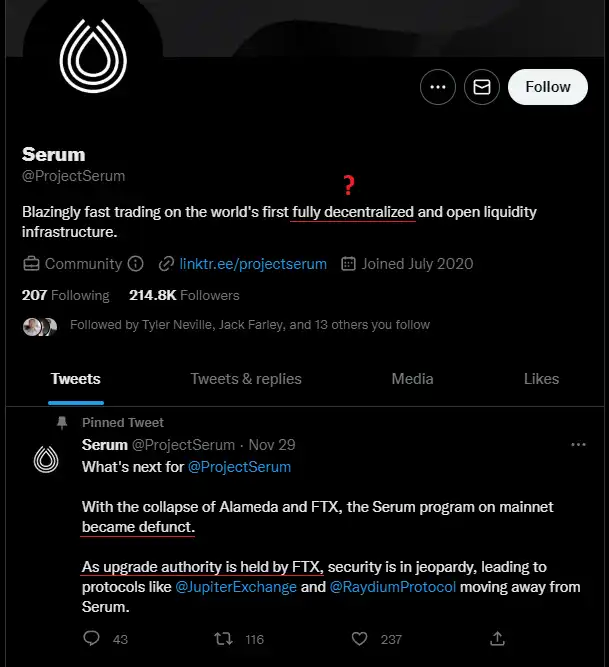
If a centralized entity has upgrade rights, how can it be considered "fully decentralized"?
Many protocols attempt to answer this question by using governance tokens to break control of services. Whether it is an initial Token offering or an airdrop to users, these tokens can be distributed and allow voting on various governance actions related to the operation of the service. These same tokens can also receive a share of the profits generated by the agreement.
While this is interesting in theory, it starts with a few questions.
First, as with most things in the crypto space, the vast majority of governance tokens are held by whale companies, meaning a handful of wealthy entities retain controlling stakes in voting rights.
Second, voter turnout tends to be low, giving highly active and motivated parties greater control over the governance of the agreement in practice.
Third, because it is anonymous, these models of governance are often easier to play with than real-world democracy. Paying for votes, entities secretly controlling a larger share of governance than the market realises, and other issues make it difficult to operate in a truly decentralised way.
Vitalik Buterin, co-founder of Ethereum, recently raised economic issues related to governing Tokens, and I agree with him:
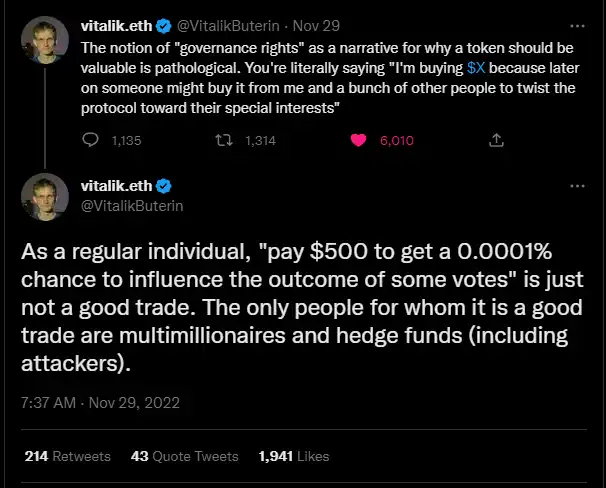
As a result, recurring profits may be able to support Token value, but governance alone is not enough to sustain Token value. Whether they are profitable or not, they are likely to be centrally controlled in practice.
In short, the DeFi agreement is likely to face greater scrutiny and regulation over time. Because they have so many centralized attack surfaces, it wouldn't be hard for regulators to clamp them down, make them less available, and make them more traceable.
In terms of the DeFi ecosystem, its blockchain nodes mainly run on the centralized cloud provider, and most of its locked value relies heavily on the centralized custodian. Users interact with the ecosystem mainly through the centralized web interface maintained by the centralized company.
DeFi does not solve the bottleneck of fiat money into gold
One of the criticisms DeFi industry insiders tend to make of Bitcoin is its heavy reliance on centralised trading platforms and brokers. The vast majority of bitcoin buying and selling takes place on centralized trading platforms or through centralized brokers.
"That's why we need DeFi," many of them said.
However, we need to conceptually distinguish between 1) post-entry speculation/trading and 2) actual entry and utility.
If you want to trade DeFi, how do you get started? Are you magically channeling your money into the DeFi ecosystem? No. First, you transfer money from your bank to a fiat currency entry trading platform, such as Coinbase or Kraken. Or you can go through another centralized payment provider. You can then purchase various crypto assets and move these crypto assets into the DeFi environment. From there, you can trade and leverage these crypto assets in a variety of smart contracts.
Therefore, DeFi does not eliminate the bottleneck of relying on centralized trading platform or centralized bank connection to achieve fiat currency entry. DeFi is simply a competitor that provides a post-gold smart contract environment to trade or leverage crypto assets as an alternative to staying on these trading platforms to trade and leverage crypto assets.
But really, how many people should be trading or leveraging crypto assets? These are not "banking" services; These services cater mainly to speculators.
On the other hand, the Bitcoin network has a similar entry bottleneck. You send money to a trading platform or broker, buy bitcoins, and from there you can withdraw bitcoins from the trading platform or broker. From then on, you are financially "self-sovereign," meaning you can self-keep your own Bitcoins and use a decentralized network to send or receive unlicensed Bitcoin payments around the globe. Also, if for some reason you want to get a loan (fiat or stablecoin) while using bitcoin as collateral, you can use some multi-signature escrow services.
If centralised trading platforms are cut out of the banking system altogether, then the only way around the entry bottleneck is peer-to-peer buying. In addition to mining, this is also how people got their hands on Bitcoin, before trading platforms existed.
There are now methods like Bisq, RoboSats, Hodl Hodl, Paxful or Azteco for people who don't want to buy bitcoins through centralized exchanges, sometimes anonymously. The downside is limited liquidity; These types of services are only good for buying and selling small amounts of bitcoins. However, the number and scale of such services could increase significantly if centralised trading platforms are excluded from the banking system.
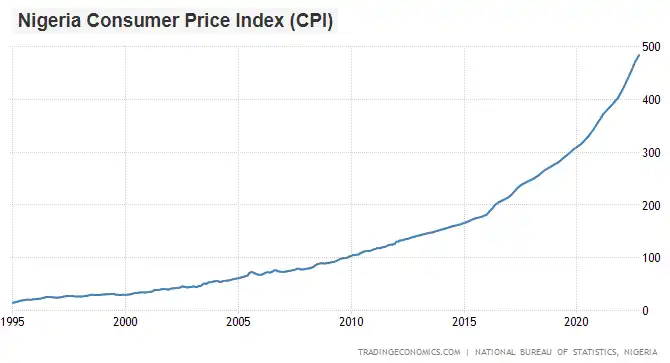
As a tangible example, Nigeria excluded crypto assets from its banking system nearly two years ago. Banks in Nigeria are banned from letting customers send money to cryptocurrency exchanges. However, Nigeria has one of the highest per capita bitcoin/cryptocurrency adoption rates in the world, with the country's bitcoin/cryptocurrency adoption rate far higher than eNaira, the country's central bank digital currency. How is that possible? Because they use a variety of peer-to-peer methods to get Bitcoins. They can even do remote jobs like programming or graphic design, and pay foreign customers' Bitcoins directly to their own custodian, which they can then use to make global payments.
Where there is a will, there is a way. Official consumer prices have risen about fivefold overall since 2010, thanks to an expanding money supply, and there is surely a will to do so when the authorities have arbitrary powers to freeze protesters' bank accounts.
Bitcoin's "killer app" is simply using it for what it was originally designed for: to self-host and send/receive unlicensed payments in the most decentralized, secure, and tamper-proof crypto asset to date.
Trading/leveraging is something a subset of Bitcoin holders may choose to do, but that's not to say the world is crying out for more ways to speculate on 10,000 crypto assets, especially when DeFi is only related to post-gold, not to the gold process in the existing legal banking system.
Section summary
In summary, DeFi environments try to solve the real trading/leverage problem, but usually consist of multi-tiered partial centralization, such as centralization of smart contract platforms, centralization of assets, centralization of governance, etc.
The problem of arbitrary seigniorage
When founders and early venture capitalists form a tech startup, they often tie their fortunes to the success or failure of the idea. They invest in fairly illiquid stocks, and the main way to unlock those stocks and have a successful exit from liquidity is either to go public or to be acquired.
In order to go public, they must undergo an expensive disclosure process in which they must open their books, disclose primary ownership and discuss risks in detail. The average startup takes more than eight years to go public.
To be acquired, they need to build something attractive enough for other businesses to want to buy them. In other words, professionals with Mbas or other business experience/education review their business and decide to buy.
As a result, the fortunes of founders and early investors in startups are often largely tied to the underlying fundamentals of the businesses they are building and funding. Companies need some revenue, some use cases, and a certain amount of due diligence. They have to spend years building a company that will either be bought by another company or become big enough and exist long enough to go public and make all the necessary disclosures.
In the crypto world, things are different. Founders and early investors can create a project, sell the Token publicly (usually to qualified investors or overseas investors to avoid now open securities laws as initial Token public offerings get hit), work on it for a year, two or three years, market it heavily and get it listed on crypto trading platforms, The hyped tokens, which may be unregistered securities, are then dumped on public retail speculators, making exaggerated or outright false claims about the decentralisation and utility level of the project.
In other words, founders and early investors can separate their profits from the actual success of the project's rationale. They don't have to spend 10 years building a business that's good enough for another business to want to buy, and they don't have to go through the SEC process to get to the public markets. In order to exit liquidity quickly, they can hype it up and sell their currency to retail investors.
"Seigniorage" is the profit a government makes by issuing its own currency, particularly in relation to the difference between the cost of production (which is close to zero) and market value. Blockchain technology allows private entities to benefit from seigniorage as well. They can create a crypto semi-liquid/homogeneous asset at very low cost, hype it up, and try to profit from it. Because very little value is created in the process, it is essentially a zero-sum game, with Token creators and promoters making money and retail speculators losing money.
Bitcoin doesn't fit the definition of a security because it has never raised money. Instead, open source software was created and just sat there. Based on on-chain analysis, it's clear that Satoshi Nakamoto didn't sell his bitcoins either; Back in 2010, he left the Bitcoin network without any apparent financial gain, and the network has continued to operate without him in a fairly decentralized fashion.
However, the technology that Satoshi created to enable peer-to-peer payments and savings has also been repurpurated by others for peer-to-peer scams, fraud, and widespread pull and dump in the cryptocurrency industry.
As this continues to happen, I think two things will happen.
First, regulators in more countries are likely to crack down harder on the practice. The US has already restricted the ability to sell unregistered initial Token offerings to the onshore public, and they may further restrict the ability of onshore trading platforms to sell tokens to the public after an offering.
Second, whether regulatory risks materialize or not, people will get burned by the cryptocurrency industry over and over again until they start associating cryptocurrencies with scams.
Is a Token required?
The problems in the crypto industry have nothing to do with cryptography. No one can blame any developer for working on interesting technologies and building interesting projects.
It is only when they try to make millions of dollars from this work before it is a fundamental success that ethical questions arise.
When evaluating any cryptocurrency or adjacent project, if it has its own Token, always ask, "Does it really need a Token?" Usually the answer is no. It has a Token so that the creator/founder can benefit in terms of quick exit liquidity, regardless of whether the underlying project provides any real value in the long run.
As an example, let's say someone invates a ride-sharing app called Rebu, except the app is labeled as a "decentralized" "Web3" project. The founding team and early investors created their own Rebu tokens, gave most of them to themselves, and sold some to raise money. It took them two years to build the app and hype it up, and to get Rebu listed on some crypto trading platforms, where many retail speculators bought the coins (which, though now sold to the public, may have been unregistered securities), and the developers and early investors of Rebu took the opportunity to exit their Rebu positions, Millions of dollars in profits. Then people realized, "Wait, wouldn't it be easier to buy the use interest in Rebu with dollars than to convert dollars into Rebu tokens first, and wouldn't that add unnecessary friction?" Of course, the project went nowhere and eventually collapsed, with the value of the Rebu Token collapsing, but the developers and early investors have exited and become rich.
Web3 is an industry marketing term for a subset of cryptocurrencies that attempts to provide a more decentralized Internet experience than the Web2 we've become accustomed to. While the goal is admirable, the problem is, of course, that most of these projects want to issue their own tokens, most of which are not really decentralized, and most of which will fail (although many of the creators will get rich anyway due to rapid exit liquidity).
There are developments that offer an alternative.
Block, Inc. (SQ), for example, has a business unit called TBD that has been working on what they call "Web5," a technology that allows decentralized interaction without the need for new tokens. Block CEO Jack Dorsey has been very critical of the questionable financial incentives associated with Web3 and its related tokens, while acknowledging that the goal of creating a more decentralized Internet is an important one.
As another example, many developers have been building technology stacks using the Hypercore protocol. Examples of this include Slashtags and Holepunch. As these technologies mature, they have the potential to enable decentralized identities and decentralized applications, which covers most of the goals of Web3 technology. These Slashtags and Holepunch protocols do not have tokens because they are not required.
I've been testing and using Holepunch's first app, Keet, a peer-to-peer encrypted video, file sharing and chat app. It also has Lightning Pay built in. It's currently in alpha development, but it's working very well so far. If a video call involves only a few people, it has higher resolution, lower latency and is more private than server-based products such as Zoom.
Another technology that these organizations are using the Hypercore protocol for is called Pear Credit, a peer-to-peer accounting system that, if successful, will allow stablecoin transfers and other centralized bearer asset transfers in a very efficient manner without attaching separate tokens.
It's still a very dynamic area and we'll see what happens over the next 3-5 years. But it's important to remember that the vast majority of cryptocurrencies that have been created don't consistently accumulate long-term value. Many of these are "push the waves" schemes, often simply allowing the creator to reap financial benefits from the project, regardless of whether the underlying principles of the project ultimately succeed.
Of the more than 20,000 tokens in the industry's history, only three have reached a higher price in the second crypto bull cycle, which is denominated in Bitcoin.
If you look around and don't know where exit liquidity is, then you are exit liquidity.
Update technology stack
I have been interested in Bitcoin and Stablecoins for years and will continue to be so.
With Bitcoin, a fairly decentralized system allows users around the world to make permission-free payments and self-keep limited anonymous assets. It comes with volatility and risk, but it is a real innovation that, in my view, will continue to offer great promise in the long run. Looking around the world, it is hard to underestimate how many people have savings or payment problems, either because of persistent inflation and monetary dysfunction in developing countries, or because of authoritarianism and financial censorship.
With Stablecoins, a centralized issuer creates dollar liabilities in the form of bearer assets, backed by collateral, thus allowing people access to dollars in jurisdictions around the world that would otherwise be difficult to obtain. Stablecoins carry counterparty risk, which can be mitigated to some extent by making collateral more transparent. I'm not so interested in Stablecoins that rich people in developing markets leverage/trade, but I'm very interested in stablecoins that people in developing countries use for micropayments and savings. This can also be done, and has been done, with other monetary assets such as gold.
Are there other use cases for blockchain technology or similar types of distributed ledgers? In theory, of course.
What the two types below have in common is that, like stablecoins, they have a centralized issuer, but liabilities can be traded as bearer assets in an automatic manner. This can provide tremendous utility. In other words, they represent the potential for an upgraded tech/distribution rails architecture for centralised trading, settlement and custody of securities.
Tokenize money and securities
The regular trading window for U.S. stocks is from 9:30 a.m. to 4 p.m., five days a week, totaling 32.5 hours. Since there are 168 hours in a week, that means U.S. stocks are traded only 19.3 percent of the time. On that basis, subtracting certain holidays, it could fall to about 19 percent.
Is it reasonable to expect them to trade the other 81 percent of the time? Like bitcoin and other crypto assets? I think so.
In addition, trades in stocks and other securities can take days to fully settle. The time has shrunk over the years, but it still runs on a legacy technology architecture. What if every trade could be cleared in a matter of minutes?
Finally, for most people in developing countries (at least outside the upper classes), investing in stocks in general is quite difficult. This applies to both their domestic and US stocks.
What if traditional securities such as stocks and bonds from around the world, as well as all commodities and currencies, could be tokenized, accessed by anyone in the world via a smartphone, traded 24/7, and fully settled in minutes? Like Stablecoins, they would still be issued centrally, but the liabilities would be digital registered assets, and quite effectively digital registered assets.
Tokenization of traditional assets seems a reasonable expectation, and it simply represents an upgrade of the technical architecture under which existing securities operate.
Digital collection
NFT, or digital collectibles, or as I prefer to call them, "first edition receipts," continue to interest some.
These can be in the form of digital art that can be copied in other ways, but there is basically a "first edition receipt" associated with it. Alternatively, they can be in the form of video game projects that can be transferred to other games or traded on the open market outside of the game. They can also be things like concert tickets, which can be transferred as digital bearer assets.
Some people might use them to directly support their favorite musician or artist.
I'm not a big fan of art or consumerism, so these trends aren't for me, but I don't dismiss them as potential markets that might emerge on a larger scale. I really don't know.
But in practice, whether it's digital art, digital gaming projects, matching of physical and digital projects, or otherwise, the current NFTs iterations have been highly speculative and rife with purposeful price manipulation (which is easier to do for non-homogeneous assets than highly liquid and homogeneous assets). Developers often make games that aren't fun and then shove tokens or NFT in instead of making an inherently fun game and seeing if, to any tiny extent, some transferable value can somehow enhance the enjoyment of the game.
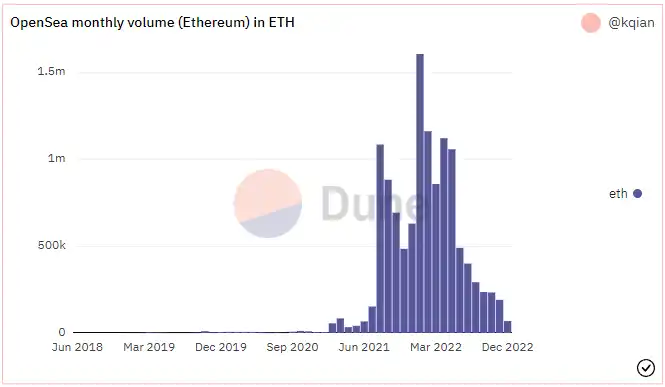
In reporting on premiums over the past year and a half, I have so far been less than enthusiastic about the sector as a whole, and in fact both the number and price of NFT have plummeted over the past year.
Conclusion: Pandora's box has been opened
Satoshi Nakamoto's 2008 invention, which itself fused decades of cryptography and computer science work, opened a Pandora's box.
Holding and transferring currency or currency-like assets internationally, without going through the existing banking system, suddenly became possible. This technology cannot be undone. The ability to do so is open source, widely distributed, and now known.
A Canadian can pay a Nigerian to do some graphic design work, and in this way the banking systems of both countries move. Mr. Putin's political opponents can raise donations even if his government shuts them out of Russia's banking system. Venezuelans can keep their own bitcoins or dollar stablecoins in case of hyperinflation, or take them with them if they leave.
There are 180 types of legal tender in circulation in nearly 200 countries. Most of these countries are extremely fragile and prone to repeated sharp devaluations. Each has a local monopoly, but the vast majority are useless and difficult to sell outside their home jurisdiction. It would be difficult for people in many developing countries to preserve the value of liquidity over many years and decades, not to mention that the dollar has lost more than 98 percent of its value since moving away from the original anchoring gold regime.
Last month, I posed a question on Twitter as the start of a thought experiment and discussion:
Imagine that you live in a developing country that is facing a serious devaluation of its currency.
You want to sell your existing home, keep it at a steady liquid value, and then maybe buy a different home within two years.
What assets/currencies would you convert?
The range of answers is surprisingly wide. Many people in the developed world don't understand the question, say they will only hold dollars, and don't seem to understand why the question is being asked.
The problem, of course, is that many people outside the upper classes in developing countries have trouble opening foreign bank accounts. Many of them do not even have domestic bank accounts. For example, in Egypt, a country of 100 million people, 74 percent do not have bank accounts. In Nigeria it is 55 per cent, Indonesia 50 per cent and India 23 per cent. Those with bank accounts often do not have easy access to foreign currency at a fair rate. Those lucky enough to have a foreign bank account often pay considerable fees for it; Foreign banks are neither fast nor efficient.
In countries with serious currency devaluation problems, dollars are usually either 1) hard to come by, 2) only available at fake exchange rates, or 3) keeping dollars in domestic banks is risky because they can be confiscated and forced back into the local currency.
Some said they would hold cash dollars or gold. Imagine you're in an apartment in a developing country with houses worth dollars or gold hidden somewhere. Every time you leave the house for work or shopping, there's a part of you that realizes you could lose your life savings due to a burglary, fire or similar problem.
I also received a lot of responses from people in developing countries who are more aware of the challenges of this issue because many of them deal with these issues regularly. Many of them say they simply hold large amounts of physical dollars, even though doing so is risky. Other banks say they will hold cars or other physical assets, which is inefficient. Others say: "I just can't do it; I can't sell the house and hold it in a liquid form for a meaningful period of time."
As a result, a large percentage of the global population is still challenging the basic concept of "saving" in 2022.
Selling something of great value and holding it in liquid and safe form for a few years until that value is redeployed should be trivial.
The fact that this is not trivial shows how deeply troubled the global financial system is, especially for people in developing countries. Fiat currencies are centrally managed flexible ledgers, with local monopolies in specific jurisdictions, most of which are very badly managed.
There is also the question of financial scrutiny. Freedom House, a non-profit organization, classifies countries as "free," "partly free" or "not free." Only 20 per cent meet their definition of "free", compared with 46 per cent in 2005. In many countries, bank accounts are arbitrarily frozen, and as mentioned above, for the working class in developing countries, even a bank account is in many cases a challenge, as banks are not worth bothering with such a small balance. For the millions of people who become refugees at some point in their lives, it is often difficult to carry most or all of their wealth with them.
So there's a lot of work to be done to strengthen the world's relationship with money. In 2022, storing and transferring value should not be rocket science. The share of the world's population with a smartphone has surpassed the share with a bank account, and is growing at a faster rate. There's no reason why everyone with a smartphone shouldn't have access to basic financial services, including cash. Even feature phones can use some of these technologies to some extent.
Trading and leverage are not basic financial services; They are mainly secondary services for people who already have a lot of capital. The first and bigger opportunity is to improve payments and savings for many people around the globe, both in developing and developed countries. That's what Bitcoin and Stablecoins offer, with various trade-offs over different time frames.
"Access to better transactions" is a legitimate goal to strive for, but it is not as big a problem to solve as "access to better payment and savings forms of money."
The industry's technology has evolved over time and will continue to do so. This will have a different impact on various industries, and it's hard to say how much at this point.
Everyone makes mistakes in exploring this new complex territory, but the way forward is to keep them small, emphasize practicality over speculation, and focus on identifying the biggest problems that need to be solved.
Original link
Welcome to join the official BlockBeats community:
Telegram Subscription Group: https://t.me/theblockbeats
Telegram Discussion Group: https://t.me/BlockBeats_App
Official Twitter Account: https://twitter.com/BlockBeatsAsia
 Related Articles