



SPOT, a new stable for AMPL's ambitions
Source: Ji Ji Grocery Store
TL; DR
1.Spot is a bond stabilized with AMPL as the underlying mortgage asset. Its biggest function is to reduce the volatility brought by AMPL rebase and loosely anchor AMPL. Improved composability of AMPL;
2.Spot represents a unilateral claim on collateral (AMPL bonds), so there is no liquidation, so in principle no predictor is required;
3. The mechanism makes use of zero-coupon bonds, so if you put aside the lock-in issue of the zero-coupon bond itself, it is 100% guaranteed at book value. In this mechanism, the requirements for governance are very low, basically can be counted as a fully automatic operation of the stable system;
4. At the same time, Spot's mechanism ensures that its value will not return to zero if users drop to zero, that the system can be restarted at any time, and more importantly, Spot will only exceed the collateral value, but never fall short of the collateral. It's a little bit like OHM but it's not exactly the same.
A stable dilemma
Before we get into SPOT, let's take a look at the age-old question of what makes a good (ideal) stability, and what does it take? If we follow the previous stability articles I have written, a good stability should have the following characteristics:
The value is stable. The concept of stablecoins is similar to the concept of money in the real world (fiat money is a little different, but for the time being it can be considered the same), so for the vast majority of stablecoins, value stability is almost synonymous with price stability. But because of factors like inflation, value and price are not the same. Value stability is more important for stablecoin's "store of value" function. However, for simplicity of illustration, we will use purchasing power stability to express value stability.
Good composability. The other two important functions of currency are as a "medium of exchange" and a "means of payment", which is reflected in the blockchain, is that the composability should be good enough. For the vast majority of stable, because it itself belongs to the category of common tokens (e.g. ERC-20), so there is no problem of composability on the basis of stable value. However, for today's protagonist AMPL, because of its rebase mechanism, its composability has always been criticized. Of course, "good composability" is not only a requirement of technical composability, but also a requirement of good liquidity.
Credible and neutral. In fact, apart from the decentralization in blockchain, this is also related to the third important function of currency, the value scale. Only when stablecoin is credible and neutral, and the overall mechanism can still run stably, can its function of "value scale" be meaningful. Otherwise, adjust the interest rate today, adjust the mortgage rate tomorrow, the day after tomorrow because of governance attacks to lose the user's collateral, such a stable, still not what we want stability.
Freedom of casting/redemption/redemption. The last feature is free convertibility, free casting and free payment. This is fine for many tokens, but for stablecoins, it's not so easy. Although we are free to exchange, mint, and use stablecoins, don't forget that these contracts can still blacklist you. In fact, I don't want to discuss this point. After all, we all came into the industry because of BTC. I don't want to say much about what BTC stands for.
Let's see what happens if we apply the above characteristics to the existing mainstream.
USDT/USDC:
First of all, although these two brothers have USD in them, we still need to understand thatUSDT/USDC is not USD, but stable by casting USD as offline mortgage.This is involved in the line of stability, or direct use of dollar collateral, is bound to existThe problem of centralization. Although after a series of operations, they would regularly disclose their asset reserves and declare themselves to be at least 100% fully collated, this kind of "stable" completely controlled by a centralized institution, no matter how reliable the disclosure data is, it is not as reliable as the assets that can be fully tracked down the chain. Not to mention the frequent occurrence of blacklist events, so that people's suspicion of them is deepening.
However, we have to admit that the two brothers do well in terms of liquidity, composability, value stability (mainly price stability), and certainly the first mover advantage.
DAI
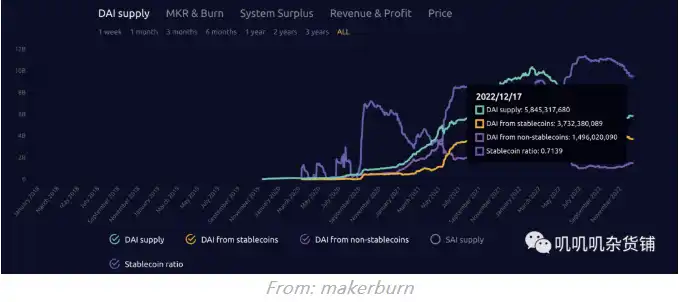
DAI is arguably the most well known and consistent with the vast majority of people. I don't think we need to say much about the mechanism. The original DAI was indeed a product of idealism, but as the scale expanded, various on-chain and off-chain environments affected,Today's DAI is already a product of USDC with more than 70% of the collateral.There are many factors leading to this result, but in the final analysis, it is because of the imprisonment of "governance" too much. Because of governance, we gave up the original negative interest rate and changed to emphasize the strategy of anchoring 1 knife. Because of governance, USDC accounts for an increasing proportion, because of governance ………… I personally do not like to see too much governance added to a project that has a "scale" function in itself. In short, although it has good liquidity and composition, its original intention has changed, and I now basically view DAI as a warpped USDC. Some special additions to the Maker mechanism are included in my previous article"Research | view to look at is of stability in the story"Said a lot of interested friends can have a look.
FRAX
The main mechanics of FRAX, dynamic mortgage rate, and AMO have been written about and I won't go into them here. If we divide the collateral into stablecoin collateral represented by USDC and other stablecoin collateral, FRAX is similar to DAI in this respect. But the core difference between the two is the difference in operational thinking. DAI's approach is basically in accordance with the central bank ideas to engage in, so it involves a lot of governance will directly affect the mint mechanism, andFRAX took more of a commercial banking approach and expanded its reach with AMO at its core. Of course,It also has to do with the way FRAX uses USDC as collateral in the first placeSo it has little effect on the collateral itself.
Its characteristics and the above are not bad, but relative to the above big brother, in addition to the liquidity is poor, other aspects have done well.
AMPL
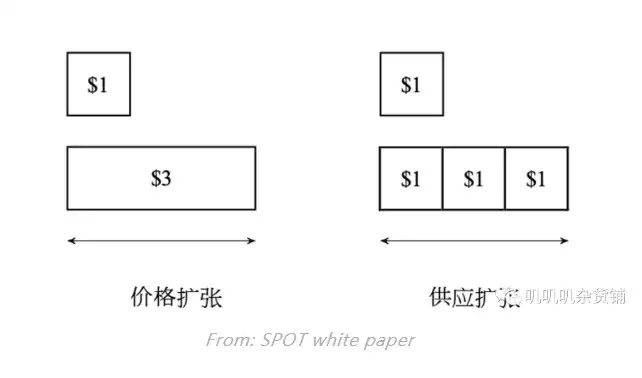
As a leader in the trend of stability, the emergence of AMPL is a thorough social experiment. Without collateral,It's not anchoring the dollar but anchoring the CPI-adjusted dollar(which basically represents the purchasing power of dollars),To ensure the stability of its own price, adjust the total liquidity of AMPL by adjusting the quantity of AMPL in user's wallet according to market demand through rebase mechanism to maintain purchasing power", too bold, too edgy. This core rebase mechanism is theoretically free of governance and relies on pure mathematics to achieve credible neutrality. However, rebase is also the reason why it's so uncomposible: Not many people want to hold "stablecoin" assets like AMPL, which have 1,000 today, 900 tomorrow, and 1,200 the next day, for the long term. This has led to a lack of liquidity and a lack of applications, the most famous of which is AAVE. If the text is very abstract, take a look at the comparison below to see the difference between AMPL and other tokens: For other tokens, the price of the token increases as demand expands, while for AMPL, the quantity increases as demand expands, and vice versa.
Through the above well-known computations, we find that there is a certain dilemma in the current computations:Both USDT/USDC, which directly uses legal currency as collateral, and DAI/FRAX, which uses the secondary packaging of USDC, are essentially pursuing strong anchoring of the dollar price, which is bound to be affected by dollar inflation/deflation. Therefore, in order to maintain stable value stability, You need to introduce a lot of artificial governance to coordinate the operation of the whole mechanism, which is not really credible neutrality.
However, the anchoring of AMPL is the purchasing power of the dollar, rather than the anchoring price. Theoretically, it can completely get rid of artificial governance and let market supply and demand maintain the operation of the whole mechanism. Originally as the most appropriate ideal stable existence is very good things, composability and difficult to say, just this step, there is no good way to solve it? In previous articles, I have mentioned that this might require packaging AMPL as NFT and achieving composability through oracle coordination.But the AMPL team recently came up with a more plausible way to package AMPL into zero-coupon bonds that could be used as collateral to create new ones: SPOT.
SPOT -- A new generation of defi composability
SPOT is essentially aAMPL zero coupon bonds are stable as collateralIt makes use of two main protocols,AMPL and ButtonWood. AMPL, needless to say, is mainly used as underlying collateral in SPOT, but due to the nature of AMPL rebase,Taking AMPL as collateral directly makes the value of the collateral more volatile, so here AMPL uses the ButtonWood protocol to hedge the rebase.
ButtonWood
We can look at the ButtonWood protocol a little bit. To be precise, ButtonWood is a defi tool,Its core function is to allow developers to quickly build structured products,For example, assets of different risk levels are packaged into one product in different proportions to improve capital utilization and reduce overall risk. This is similar to the fact that the ownership of a traditional enterprise can be divided into creditor's rights and equity rights. When equity claims are made, creditors have the priority to claim, and the enterprise will pay the equity holders after paying the creditors. In other words, the rights of creditors can be guaranteed to the maximum, which is a kind of safe asset, while the equity holders bear most of the risks of the enterprise, and at the same time exchange for the excess returns obtained after the listing or sale of the enterprise.
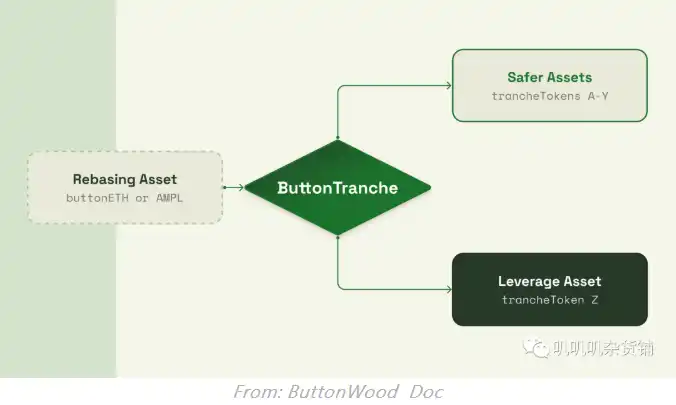
ButtonWood's core concept is called TrancheIt supports other protocols that pledge assets into ButtonWood, creating tranche assets of different risk levels. Each tranche asset has a different risk level. Safer tranche assets act as basic collateral. A riskier asset can be considered a leveraged position on the underlying asset, but no matter which tranche it is, it is an erc-20 token, so there is no problem with technical composability. The schematic diagram of the general principle is as follows:
We can use AMPL as collateral to cast Tranche assets as an example to see the process of casting Tranche and redeeming assets.
Casting Tranche
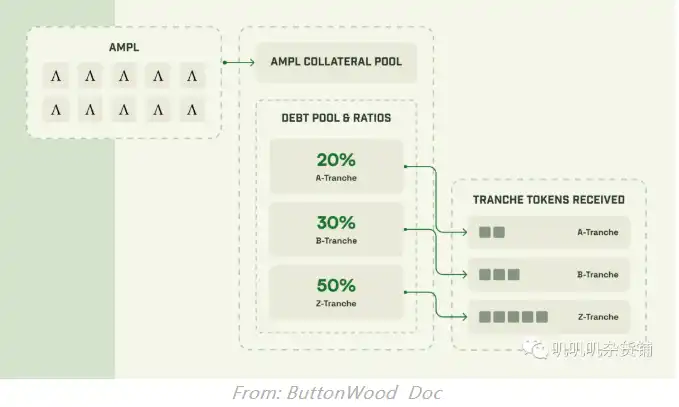
As shown in the diagram, AMPL can be pledged as collateral to the TrancheBond agreement, which then mints tranche assets in proportion to a set risk class ratio.
Suppose that in AMPL's TrancheBond protocol:
The risk grade ratio is Tranche-A 20/ Tranche-B 30/ Tranche-C 50
User mortgage 1000AMPL, will get corresponding:
· 200 (1000*0.2) AMPL-A
· 300 的 AMPL-B
· 500 的 AMPL-Z
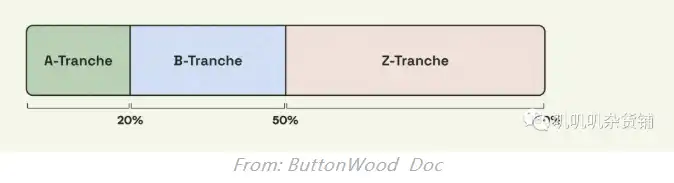
If we define AMPL-A as a safe asset that is similar to a corporate bond, then after this interaction, the user gets the 200 safe assets with the highest guarantee rate, and these assets will remain the priority to be paid in the subsequent redemption. AMPL-B, on the other hand, is a riskier asset. TrancheBond will pay off AMPL-B after it has paid off AMPL-A first. The last AMPL-C is the asset that is repaid last and bears the most risk. It is also the asset with excess earning rights (the future rise or fall in the value of the company), similar to the equity in the company.
With this interaction, the user's position value is still equivalent to holding their original AMPL. However, they now own AMPL assets that represent different levels of risk.
Redemption of collateral
Knowing how to mint, you need to know how to redeemed. Since tranche's idea is similar to corporate ownership, there is also a need to pay off at different levels of risk with different priorities.
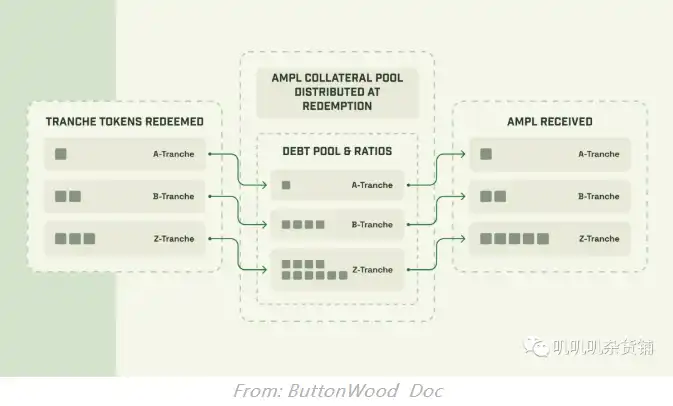
As shown in the figure, when the corresponding tranche asset matures, A-trache with the lowest risk level will be paid first, trying to ensure that the payment of this part can reach 1:1. Then class B assets are paid, and finally class Z assets are paid. Assets with higher risk levels are paid in lower order, so they are more likely to bear losses or gain excess profits.
We still use the above tranches cast by AMPL as examples to look at the redemption process under different market conditions.
Assuming that the market demand for AMPL decreases, according to the rebase mechanism, the circulating amount of AMPL on the market should be reduced, and then the payment limit corresponding to tranche is allocated as follows:
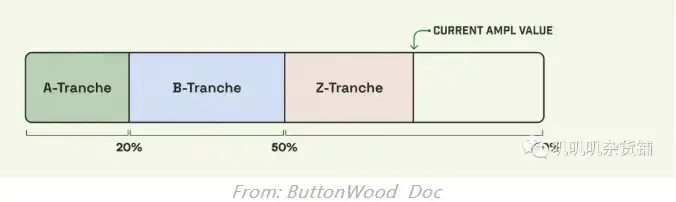
· Full reimbursement of 1 AMPL for each A-tranche;
· 每个 B-tranche 获得 1AMPL 的全额偿付;
· Z-tranche 获得剩余的 AMPL,算下来每个 Z-tranche 大概可以获得 0.5 个 AMPL;
Assuming that the market demand for AMPL increases, according to the rebase mechanism, the quantity of AMPL circulating on the market needs to increase. At this time, the payment limit corresponding to tranches is allocated as follows:

· Full reimbursement of 1 AMPL for each A-tranche;
· Full reimbursement of 1AMPL for each B-tranche;
·Z-tranche gets the remaining AMPL. Each Z-tranche can get about 1.2 AMPL;
We can see that in this example, Z-tranche bears the risk of AMPL's change in value, but gets all the benefits of AMPL's appreciation. Of course, ButtonWood has a lot of other features, but they're not really relevant to SPOT today, so if you're interested, check out their official documentation in the appendix below. For Tranche, the principle is summed up in one sentence:
It is to use the principle of bonds to wrap the volatility of assets and release the volatility to Tranche assets of the corresponding risk level when it needs to be redeemed.
Start to assemble
Let's look in A little more detail at the characteristics of the AMPL tranche asset above. Let's call this asset NewAMPL for the time being (referring to the overall asset created by A-tranche+B-tranche as collateral called NewAMPL).
You can see that NewAMPL has several distinct features:
If we take AMPL purchasing power as the measure of NewAMPL's value, then the asset is at least 100% mortgaged at any time, but if we take individual AMPL holdings or the total market value of AMPL as the standard, because rebase will affect z-tranche, Then it may become an undercollateralized asset.
A-tranches generated by different collateral are not interchangeable because each A-tranche corresponds to A different maturity time, experiences different market conditions, and stores A different degree of value for the original collateral
Such assets represent only a one-way claim on the collateral, and their value changes as the collateral changes. So there's no need to anchor anything, there's no need to liquidate. So you could theoretically leave out the prophecy machine, the most problematic thing in the Defi world.
So, for such a NewAMPL, in addition to the third feature, in additionTwo features will always exist the possibility of insufficient collateral rate: Either AMPL itself rebase mechanism, or because A-tranch is not interchangeable will cause the user to redeem the collateral liquidity. So we need to adjust the combination to make it more reliable.
The specific design of Spot
The first change is that AMPL is mortgaging on SPOT,Currently there are only two tranche types produced in a 20:80 ratio, Senior tranche (Sr-tranche), Junior tranche (Jr-tranche). Sr-tranche, which represents the least risky bond, gets priority, while Jr-tranche bears any fluctuations in the value of AMPL and also gets most of the gains from any increase in the value of AMPL. As a SPOT, only Sr-Tranche is included as collateral. In order to allow Sr-tranche to trade freely, SPOT introduced the concept of Rotators. The entire operation of SPOT can be illustrated in the following figure:
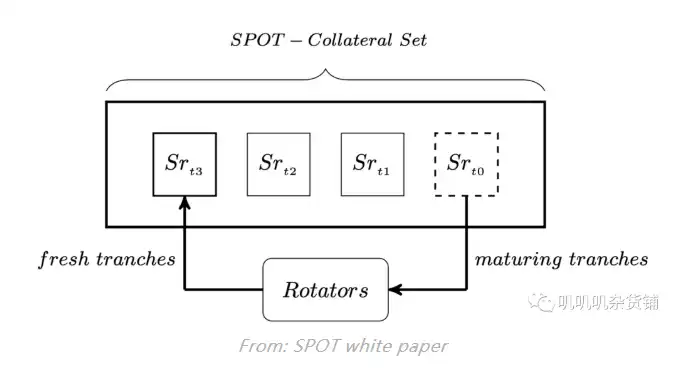
The whole process is summarized as follows:
SPOT uses Sr-tranche and AMPL, which are automatically redeemed at maturity, as collateral. An incentive is introduced to introduce rotators to replace expired SR-tranches with an equal or excess of newly generated SR-tranches, thus ostensibly achieving a circular system in which SR-tranches can be redeemed at will.
There are a few details that need extra attention in this process.
Casting and redemption are fees, fees will be given to the cost buffer. whileThe Sr-tranche represents a call on a future AMPL, so it is essentially a zero-coupon bond(A brief explanation of zero-coupon bonds. The bonds pay no interest and are sold at a discount to face value and redeemed at face value when they mature.)
In addition to the outstanding Sr-tranche, the SPOT collateralSr-tranche that has expired is automatically redeemed into AMPLBut this part of the AMPL is stored in a special data structure called the hoding pen, which also contains information such as which Sr-tranche was redeemed into the AMPL. So the collateral is a package of assets made up of Sr-tranche and AMPL. It should be noted that AMPL in holding pen will also participate in rebase.
So when the user redeems the asset, yesRedeemed pro rata across the whole package. For example, if you own 1% of Spot, when you redeem assets, you redeem 1% of each Sr-tranche + 1% of the AMPL in the holding pen
Sr-tranche doesMinimum lock-up periodEven if you replace Sr-tranche with a cast Spot immediately, you will have to wait a while to replace Sr-tranche with AMPL. Only Sr-tranche after the minimum lock-up period will participate in this cycle. What does this mean? We know that Sr-tranche and its collateral should be strictly 1:1 in theory, but because of the existence of minimum lock-in period, Sr-tranche and its corresponding AMPL are more than 1:1 in the whole SPOT. For example, if the minimum lock-up Sr-tranche is now 100, and the SPOT collateral is also 100, then for the SR-tranche portion of the collateral, if a problem occurs in the current time, Sr-tranche alone has a collateral rate of approximately 200% for SPOT Cycle SR-tranche to pay off.
The idea of Rotator is to try to get in the systemThe unredeemed Sr-tranche remains at an equilibrium levelTo maintain liquidity. So as many Sr-tranches are redeemed, in theory, as many new Sr-Tranches should be minted and added to the system. At this point, its incentive idea is relatively simple, that is, you help me do liquidity, I will give you SPOT reward, such as:
If a user redeemes N Sr-tranche at the same time as injecting N new Sr-tranche, that user receives a SPOT reward of N* reward multiplier. This reward is currently prioritized from a fee buffer, and if the buffer runs out of money, new Spots are minted for the user. Of course, this is subject to the corresponding inflation formula
Basically, that's how Spot works. Yes, the principle is really simple. Let's consider what happens when a Spot designed this way encounters price fluctuations.
SPOT status
If we understand the SPOT mechanism described above, we can see that SPOT collateral can only be in three states:
Tranche Status (Fresh) : All Spots are generated entirely by unexpired Sr-Tranche. Holding a SPOT generated in this state is equivalent to holding an AMPL that is not affected by rebase.
Mixed: The collateral is composed of AMPL+ Tranche in holding pen. In theory, this state is only a transitional state between Fresh and Mature. This state may be the state with the largest percentage of SPOT, and the SPOT mortgage rate under this state is lower than the existing ratio of Sr-tranche and Jr-Tranche (20: 80), basically no less than 100%.
Mature: The collateral is fully AMPL. This is the most dangerous state we can think of. So the collateral becomes AMPL, which means that SPOT is exactly the same as AMPL, subject to rebase.
Knowing the type of state behind Spots, we can analyze whether Spots are at risk for a death spiral.
The SPOT price is greater than the collateral
In theory, the value of SPOT itself should be the corresponding percentage of the total collateral set. As the value of the collateral goes up, the total value of the collateral that can be exchanged for the same number of spots goes up, so the SPOT price goes up. However, if SPOT goes up unilaterally, then the arbitrageurs can borrow the same AMPL to create Spots and sell them to the market, marking the SPOT price to the new equilibrium price. At this time, users either use the existing AMPL to cast SPOT, or they need to buy AMPL to cast SPOT, which will double the price to balance.
Of course, since SPOT collateral is ultimately a call on future AMPL, and AMPL is anchored to CPI, this theoretically means that its value will increase year by year. For example, if CPI increases 5% per year and AMPL's current price is $1, So 100 AMPL for 100 spots is likely to become $105 next year. So the SPOT itself acts as an inflation protection, that is, if a SPOT seller thinks inflation is 3%, he may sell the SPOT for a 5% premium, and a buyer who thinks inflation is greater than 5% will accept the price.
But we don't have to worry about the price going up, we have to worry about the run on the bank and the price going down.
run
For SPOT, a run is when the entire old and new tranche cycles fail, when the Rotator modules fail and users don't want to put in a new Sr-tranche to keep the system running. The worst thing that can happen is that all the collateral becomes AMPL, so in that case you have to look at the AMPL side. This has nothing to do with SPOT itself. If AMPL falls in value, the price of SPOT itself, which represents the call, will itself fall. But in the case of AMPL itself, the collateral rate never falls below 100%.
SPOT prices are lower than collateral
This is the easiest one to think about, buy the SPOT and redeem the mortgage until the price equalizes. But it's important to note, because we're redeeming Sr-tranche. This is different from Terra, however, because what you redeem is itself an existing AMPL or Sr-tranche, so there is no effect on the supply of AMPL.
Legacy problem
After reading the above content, we will find that there are actually two questions that are not clear. SPOT collateral is only Sr-tranche (A-Tranche), so why generate Jr-tranche(Z-tranche) when pledging AMPL on the front page and show that Jr-tranche also has A minimum lock-up period? The official answer to the first half of the question is as follows:

And the second half of the problem, if you look at the contract for z-tranche, you can actually call it before it expires, but the front end doesn't give you that access. My personal guess is to lock in more AMPL, increase the price of AMPL on the market, supply more AMPL through rebase, and finally increase the total supply. This is a really clever idea for rebase tokens.
Another question is that if we cast SPOT on their official website, we will find that their Z-tranche and A-tranche are both greater than 100%. Why is that? It's really rebase at work here. In fact, it is easy to understand that the mortgage rate of A-Tranche is greater than 100%, because the ratio of A: Z is 20:80 at present, so the 20% A-tranche who do not participate in rebase should be 100% of their own +4 times the mortgage rate of their own Z-tranche. And the AMPL in Z-tranche itself needs to absorb the fluctuations of AMPL in its own collateral and the fluctuations of AMPL in A-tranche. Recently, the AMPL premium is very high, resulting in its mortgage rate always greater than 100%. In fact, the Z-tranche itself is equivalent to a 1.25x AMPL lever.
Finally, the Bond/Action in the tranche panel means nothing, but people in the community tell me that this represents the CDP of the spot when you redeem a mortgage or rotator in a similar system. Of course, the specific explanation will have to wait for the official documentation to be updated.

summarize
As we can see, SPOT is an important step in AMPL's expansion. Under the same market conditions, by temporarily reducing the amount of AMPL in circulation in the market, the price of AMPL will rise and eventually the supply of tokens will be increased. At the same time, it cleverly uses the idea of bonds to reduce the impact of rebase on the spot of AMPL, and even makes use of the CPI anchored by AMPL itself to turn rebase into an expectation of the price rise of AMPL itself, which is really great.
Finally, thank you very much to the AMPL community for your guidance.
Welcome to join the official BlockBeats community:
Telegram Subscription Group: https://t.me/theblockbeats
Telegram Discussion Group: https://t.me/BlockBeats_App
Official Twitter Account: https://twitter.com/BlockBeatsAsia
 Related Articles








