Bright Stars in the crypto Winter: The status quo, Challenges and opportunities of Web3 Wallet circuit

Bright Stars in the Crypto Winter -- Status, Challenges and Opportunities of Web3 Wallet Circuit
原文作者: Huobi Research
1. Introduction to wallet
The Crypto Wallet is often called the crypto wallet or the digital wallet. In the Web3 world, wallets are not only the traditional function of managing assets, but also a necessary tool to operate in the Web3 world. Technically, a wallet is the custodian of a private key, which can be thought of as the account password for the wallet.
1.1 Introduction to Public and Private Keys
In the concept of wallet, the most basic is the private key and public key and their mechanism. The following diagram nicely illustrates the relationship between random numbers, public and private keys, addresses, mnemonics, and the KeyStore. Briefly clarify as follows:
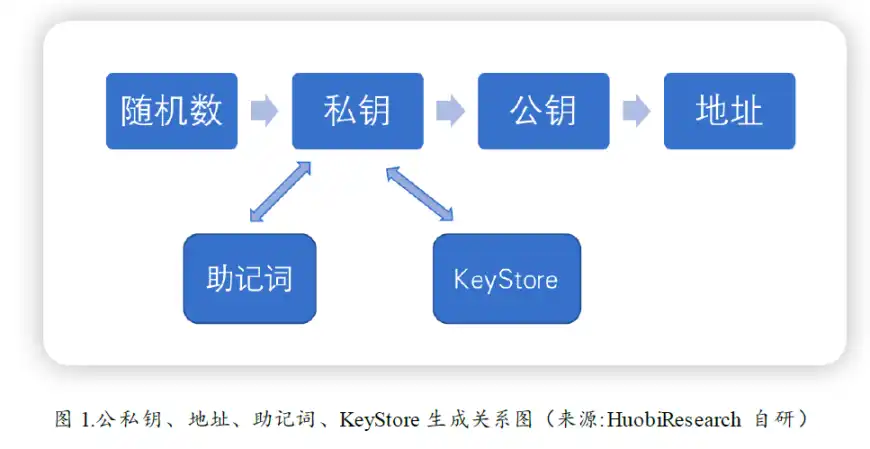
Random number: Random number is a random number in the computer, there are 16 ^ 64 possibilities, this number is about equal to the number of all the atoms in the universe;
Private key: The private key is generated by random number processing, after asymmetric encryption (ellipse algorithm) to generate a public key;
(1) Private key and mnemonic words: form mnemonic words after format conversion;
(2) Private key and KeyStore: KeyStore is a file format (JSON) that stores the private key. Users can customize the password, which is convenient for backup and import. If the peer party does not know the password, the private key cannot be imported. The KeyStore is used to store the private key for convenience and security
Public key and address: The public key is derived from the private key. After hashing operation and encoding format conversion, and take the tail, generate our common address with "0x";
Compared with traditional wallets and accounts, the public key is equivalent to the address of the wallet, which can be understood as a bank account. The private key can be understood as "bank card number + bank card password", the mnemonic is equivalent to the private key, equivalent to "bank card number + bank card password", and the relationship can be expressed as: "Keystore+ password = private key = bank card number + bank card password".
The above uses Etherum as an example to introduce public and private keys. Although the address format and standards of non-EVM-compatible public chains are different from the above, the principle and process of generating public keys from random numbers to private keys are the same.
1.2 Classification of wallets
From the above analysis, we can see that the concept of wallet is mainly based on the need to understand the public and private keys. At present, there are many ways to classify wallets. According to our generally accepted classification method, we can classify them according to the following logic:
Dimension 1: The wallet can be divided into decentralized wallet and centralized wallet based on whether the user has the private key. Decentralized wallet means that users master private keys, such as MetaMask, TokenPocket, imToken, etc. A centralized wallet is also called a custodian wallet, in which the private key is kept by a third-party central institution, such as Binance, Huobi and other trading platforms.
Dimension 2: According to whether the private key of the wallet touches the network, it can be divided into cold wallets and hot wallets. The broad concepts of cold wallet include "paper wallet" kept by mnemonic words, offline mobile phone, hardware wallet, etc. Hot wallet refers to the wallet whose private key needs to touch the network when the transaction is signed, including our common wallet APP, web plug-in wallet and so on.
2. Purse Track Market Situation
2.1 Overview of purse track market
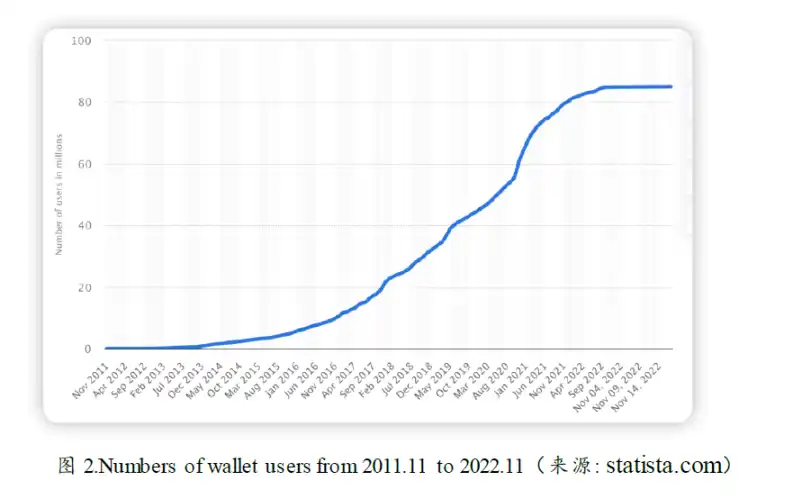
In terms of the number of users, there are more than 300 million people in the world using crypto assets. According to the data from statista.com, as of November 2022, the number of wallet users in the world is 85M, an increase of about 6.3% compared with 80M at the end of 2021 (December). That's down from 35 percent the year before, but it's on the cusp of an explosion as the bear market ends and the next cycle begins.
From the perspective of revenue scale, according to the research of future market insight, the total revenue of the global crypto wallet market in 2022 is about $1.398 billion, which is expected to break through $3.371 billion in the next ten years, with an annual compound growth rate of 9.2%, showing a rapid growth trend. Of course, head wallets will go from strength to strength, accounting for about 35% of the total market share.

From the perspective of regional distribution, North America started earlier in the global market and occupies a dominant position. Last year, it dominated the crypto wallet market with a revenue share of more than 30.0%. There are several major players in the North American market, including Coin base Global, Inc., Bit Go and Bit Pay, among others. June 2022, PayPal Holdings, Inc. The company's announcement that all eligible PayPal account holders in the United States can now send and receive cryptocurrencies using PayPal also accelerated wallet user growth in part. This is followed by the Asia-Pacific region, with mainland China and Hong Kong being the fastest growing regional markets. The Asia-Pacific region will play a crucial role in blockchain innovation. The region's large population, including a financially conscious and technologically inclined population, is driving crypto wallet innovation in the region.
2.2 Profit model of wallet
At present, the profit model of crypto wallet is also changing with the development of the industry. In the early days of most wallet (hot wallet) apps, they mainly existed as a private key storage and management tool, that is, to precipitate the user's funds. Before all kinds of chain applications come out in 2020, the main profit model is to charge transaction commission, and the wallet is relatively small based on this income.
With the development of the industry, especially with the growth of Defi and cross-chain demand, crypto wallet continues to launch various on-chain services, such as built-in cross-chain, pledge, flash exchange, etc. Some even launched financial products, mining, market information and so on. Some companies have even embedded H5 trading platforms on top of wallets, trying to open trading platform services through wallets.
At present, from the perspective of ordinary hot wallet, managed wallet and hardware wallet, we have investigated and counted most wallets on the market, and analyzed their income sources and business models as follows:

2.3 Introduction to the head wallet
According to public information, head wallets are now almost entirely occupied by large companies, either developing them directly as their products or investing in them as equity. In the following table, we classify the wallets commonly used in the market at present. One is the wallets directly developed by leading companies, such as Metamask, Coinbase Wallet, and wallets launched by Facebook; the other is the wallets invested by Binance, such as Trust Wallet and C98. Finally, there are the newer, faster-growing wallets. Its circulating market value and total market value are given in column 4 and 5. Detailed description is shown in the following table:


Overall, Meatmask, as the wallet entered by the giant, has the highest income (up to $200 million), and the second tier is the wallet owned by Binance. In particular, it is the Coin98 wallet, which focuses on aggregate trading and DEFI, with a market value of 2.1B. Among the rapidly growing wallets, imToken and TokenPocket are the most familiar, topping the list in the Chinese circle.
3. Purse Circuit current challenge
In this cycle of bull and bear (2020 till now), the development of wallet has entered the fast lane, and numerous innovations have accelerated the development of wallet, such as DeFi Summer in 2020 and public chain ecology in 2021. However, the development of wallet has been faced with various challenges, such as usability (user friendliness), Security and privacy and regulation.
3.1 Usability (User friendliness)
Compared with the centralized asset management platform, the operation and understanding of the use of wallet are more complicated. The trading platform or the centralized financial management platform only needs to provide more convenient services, and users do not need to understand the logic behind it. However, the use of wallet requires users to operate every step of interaction by themselves, which requires users to have certain basic blockchain knowledge reserve. Once there is a problem with the interaction and wallet authorization, the user has no way to go to the wallet customer service to solve the problem, which is very difficult for users who do not understand the relevant technology, which is not conducive to the entry of new Web3 users.
At present, the interaction experience between users and wallets is poor for most wallet brands, and there are many areas that can be improved and perfected, such as more user-friendly interactive anti-phishing (security) reminders in plug-in and mobile terminals, more convenient and user-friendly integration of NFT\Token tools, and more widely applicable Dapp environment adaptation (Table 4). In addition to the interactive experience, the wallet usage/login method /UI is currently different from the Web2 application usage. It is precisely because of the above ease of use of decentralized wallet, many new and old users finally choose the traditional centralized wallet. Although the centralized wallet has some artificial security risks, it is simple to operate and user-friendly. If the decentralized wallet wants to get more users, it must solve the problem of usability.

3.2 Privacy and Regulation
Privacy and regulation have always been the topic of Web3 field, which is also the problem encountered by wallet, including user data privacy, wallet business compliance, etc.
Recently, Metamask's privacy collection incident finally brought the wallet privacy issue to the forefront. First, Alchemy, the blockchain development platform, updated its privacy statement in October. It said it may automatically collect personal information such as IP addresses, user Settings, MAC addresses, Cookie identifiers, mobile carriers, browser or device information, location information, Internet service providers, and may also obtain user personal information through third-party services and organizations. ConsenSys' privacy policy update on November 23 has sparked a debate among the community and media about wallet privacy. ConsenSys (the parent company of MetaMask and Infura) has updated its privacy policy to state that when users use Infura as the default RPC in MetaMask, the corresponding IP address and ETH are collected when the user sends a transaction. Address (Figure 3).

After all, one of the biggest features of Web3 narrative is that users can control their own data, which breaks the situation of Web2 dominated by traditional technology giants to realize decentralization. MetaMask, by far the most popular wallet, goes against the grain of most Web3 users. However, the decentralization of data expected by users will inevitably lead to a lack of supervision. Once disputes occur or assets are stolen, it is difficult for any third party or law enforcement agency to intervene and investigate.
At present, wallet has been essentially the largest traffic entry of Web3 ecology, but in the current situation of wallet profit model is not clear, how to operate the wallet compliance business is not a small problem. Wallet service providers provide digital assets currency exchange, lending and other services, and the global sales and agency of hardware wallets should comply with the policies and regulations of the countries where the wallets are located.
3.3 Security
Wallets generally have a high level of security, and they do not need to trust any third party, so wallet users have complete control over their wallet assets. Compared with a centralized wallet, users do not have to worry about misappropriation of assets or abuse of asset management authority by banks or trading platforms. Wallets are less dependent on centralized institutions and less vulnerable to single points of failure and attacks. However, most wallet users are responsible for managing private keys and assets by themselves, so they are more vulnerable to social engineering attacks, virus infections and other threats (Table 5).

For users, the biggest security challenge lies in keeping private keys and preventing social engineering attacks. Lack of security knowledge and awareness, bad operating habits, will create excellent opportunities for hackers. For wallet developers, the underlying security of wallet is also full of challenges. In addition to open source wallet code, the development also needs to do a good job of code security audit for each major update, and the storage and management of wallet private key.
4. Wallet future outlook
The Dapp ecology of wallet and wallet has been greatly developed in this cycle of bull and bear (2020 till now). As the traffic entry of Web3, wallet has become a necessary tool for new users to enter the field of encryption, as well as one of the most important blockchain infrastructure. The influx of entrepreneurs on the wallet circuit is also competing in multiple directions, such as EOA wallets, smart contract wallets and MPC multi-signature wallets. In the future, wallet portals are likely to surpass all transaction platforms in importance and become Web3 traffic centers. It is expected to take the lead in the development of Web3 identity portals, payment portals, non-self-custody wallets and multi-chain wallets.
4.1 Web3 Identity Entry
Web3 is a decentralized version of the current Web2 Internet, built on blockchain and encryption technology. Web3 not only enables users to use the Internet more fairly, but also enables users to control their own data, host their own websites and applications, and freely transact using encrypted applications without the authority of a centralized company, and avoid the centralized control of Web 2.0 in general. The decentralized nature of Web3 offers many advantages and endless possibilities. According to GrandView report data, the global Web3.0 blockchain market size is expected to reach $33.53 billion by 2030, with a compound annual growth rate of 44.9% from 2022 to 2030.
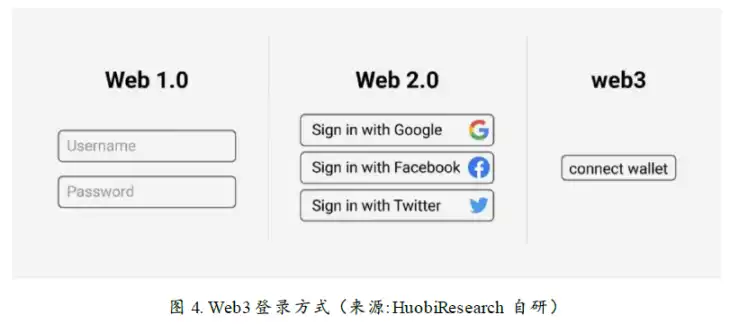
Compared with Web2, Web3 does not require a variety of different login methods, and the decentralized wallet can be linked to all Web3 application ecosystems, which makes the wallet the most important entry point for Web3 traffic at present, as reported by Metamask in its 6th anniversary review in July 2022, The total number of Metamask users has exceeded 80 million, with more than 30 million monthly active users. The number of users of other wallets that disclose data, such as Trust and Tokenpocket, has also exceeded 10 million, which is undoubtedly the most important traffic entry in the encryption field, covering almost all mainstream users in the coin circle. The wallet is expected to eventually realize functions such as off-chain identity authentication, on-chain behavior portrait, and on-chain credit score by relying on the huge user group. Achieve on-chain user supervision and project compliance.
In the future, users' encrypted wallets will act as identity portals, allowing them not only access to any digital assets and meta-universe virtual assets (land, real estate, game items, etc.) they own, but also participate in projects that match their identity on the chain.
4.2 Payment Entry
At present, the restriction of ToC's cryptocurrency payment is still at a very early stage due to various reasons, such as the unsound global regulatory act and the low cognition of merchants to cryptocurrency. However, with the gradual popularization of cryptocurrency and the implementation of regulatory act, the number of project developers and users of cryptocurrency payment increases. As a Web3 traffic entry, wallet can integrate all the items that can be used for cryptocurrency payment into wallet, forming a new generation of Web3 payment ecosystem. All relevant offline and online operations of users can be carried out through the wallet, including shopping, ordering food, taxi hailing, travel and other P2P payments.
4.3 Non-safekeeping wallet
Non-self-custody wallet refers to the custodial wallet for helplessly remembering words, which mainly includes two categories of wallets, MPC wallet and smart contract wallet. Multi-Party Computation (MPC) wallet is a wallet that realizes multi-sign verification in the chain through multi-party computation of private keys. Smart Contract Wallets are wallets based on smart contracts rather than EOAs. Compared with the traditional wallet that requires users to keep the private key (Figure 4), the non-self-keeping wallet does not involve the traditional private key generation and storage, effectively lowering the threshold for Web2 users to enter Web3.
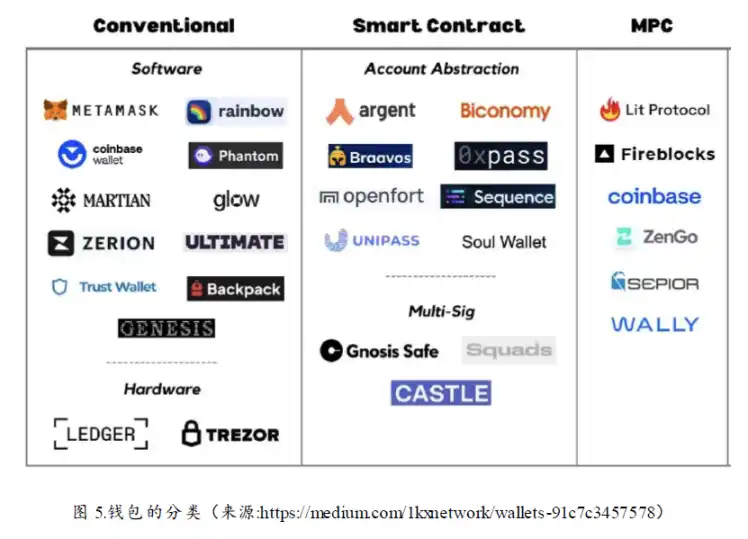
For a first time Web3 user, the login experience is very different and even difficult to get started with. Traditional EOA wallets need to go through a series of complicated processes, such as wallet generation, private key management, and mnemonic saving, before using a wallet securely. Wallets are reducing entry costs for Web2 users by simplifying the login process and complexity of use. Non-custodial wallets are likely to be the next growth point for Web2 users entering Web3 in the foreseeable future.
4.4 Multi-chain Wallet
At present, the pattern of public chain multi-chain competition has been formed, and each public chain has created its own public chain wallet for its own ecological development, but this does not meet the needs of the current multi-chain and cross-chain market, and the multi-chain private key management will also have confusion and many problems. Multi-chain wallet can create multi-chain wallet through one identity, without using other tools to manage multi-chain private key. One identity can manage different chain assets including various tokens and NFTS. At the same time, users can use the cross-chain exchange of wallet ecology to realize the conversion of assets between multiple chains.
As mentioned above, multi-chain wallets have covered most of the mobile, desktop and hardware wallets. Plug-in wallets are relatively slow at present. They mainly focus on EVM-compatible multi-chain wallets, Polkadot.js cross-chain wallets of Polkadot and Cosmos multi-chain wallets. In the future, the competition of multi-chain wallets is expected to become more intense with the increasing interoperability requirements of more and more multi-chain multi-smart contracts.
This article is from submissions and does not represent the views of BlockBeats.
Welcome to join the official BlockBeats community:
Telegram Subscription Group: https://t.me/theblockbeats
Telegram Discussion Group: https://t.me/BlockBeats_App
Official Twitter Account: https://twitter.com/BlockBeatsAsia