A&T: Investment opportunities in the extractable value of Ethereum pledge
Title: A&T View: Investment Opportunities in the Extractable Value of Ethereum Pledge
Original article by Liam, A& Analyst at T Capital
Abstract
TL; DR:
In terms of sources, ETH Staking Extractable Value can be divided into Consensus Income, Execution Income and MEV. I'm going to go up, ETH Staking Extractable Value is Staking. Eth staking extractable Value can be categorized as Validator Captured Value (Validator Staking Income) or Validator Uncaptured Value.
Validator Infra Provider, Pooled Staking Protocol, CEX, and Staker are Staking a stake in the Validator Staking Income. Searchers and Block builders can get a cut of the Uncaptured Value of the Validator.
There are noteworthy investment opportunities in the Validator Infra Provider, Stake Pool, Products based on DVT and External MEV markets.
The body of the
Ethereum under The PoS consensus mechanism has been running robustly for nearly three months since The Merge took place, and ETH 2.0 has successfully taken a critical first step.
So what opportunities does this shift in consensus present?
If you are Staking an Staking staking Staking Ecosystem, then you are advised to read Staking Rewards (A& T Capital Portfolio's detailed report "Mapping the Ethereum Staking Ecosystem"
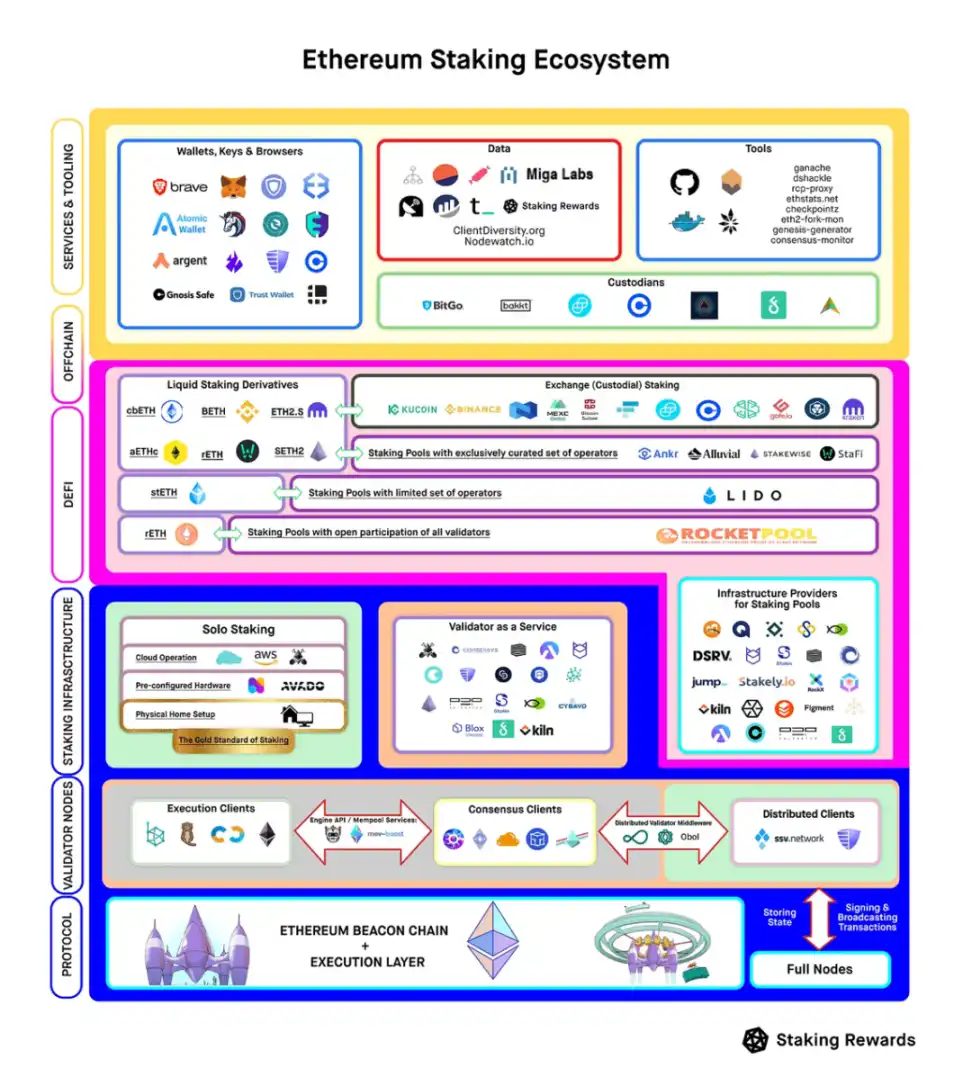
Let's focus on the direct stakeholders of ETH Staking Extractable Value, simplify the graph above, and get the ETH Staking Extractable Value Chain.
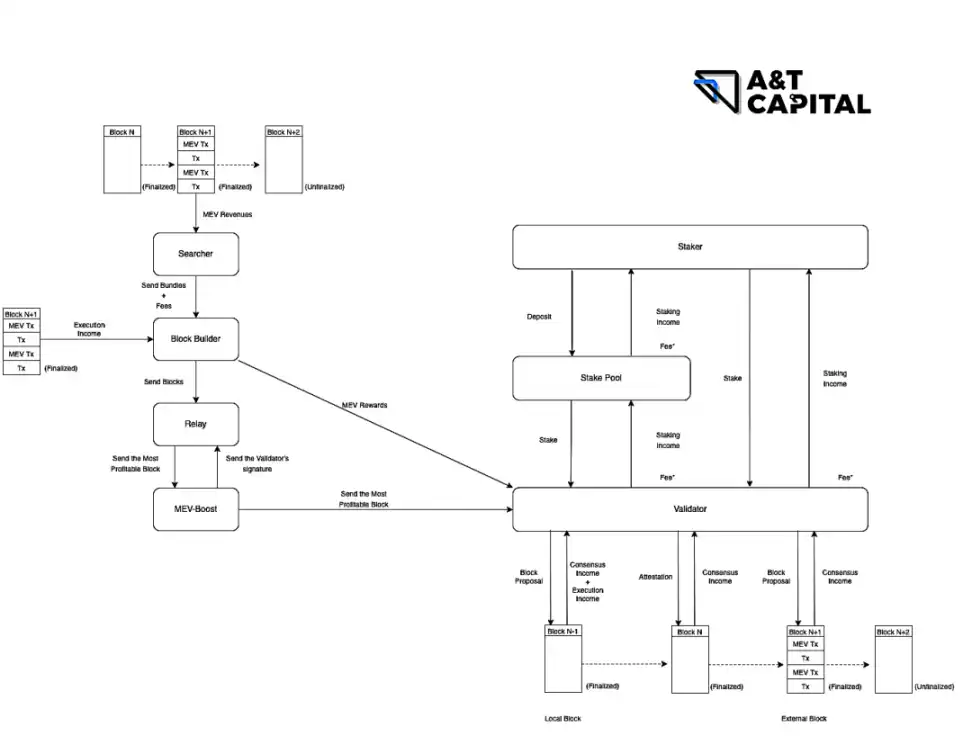
How is Staking Extractable Value constituted?
Two angles:
-Staking Extractable Value=Consensus Income + Execution Income + MEV
-Staking Extractable Value=Validator Captured Value + Validator Uncaptured Value
From the source, it is divided into three categories:
-Consensus Income: indicates the ETH Token newly issued from the network. It is a reward for the honest Validator by the consensus mechanism
-Execution Income: From the Tip portion of the Gas Fee, the tip that the user pays to a Proposer/Builder who helps package their transaction to the chain
-MEV: The economic benefits derived from executing certain trades, which take the most diverse forms and are mostly arbitrage profits
From the direction of flow, it can be divided into two categories:
-Validator Captured Value (Validator Staking Income) : Be assigned to the Validator as an economic incentive to maintain the security of the ETH network and participate in block building and consensus
-Validator Uncaptured Value: Is divided by other participants in the ExternalMEV Market as MEV plus External Block's Execution Income minus MEV allocated to the -Validator.
How is Validator Captured Value (Validator Staking Income) constituted?
Validator Staking Income=Consensus Income + Local Block's Execution Income + MEV Rewards. Validator staking income =Consensus income + Local block's Execution income + MEV Rewards
Validator Staking Income comes from three different sources: Consensus Income, Local Block's Execution Income, and MEV Rewards.
For a Validator, Consensus Income is the most basic and stable income; Local Block's Execution Income and MEV Rewards are relatively incidental and only available when the Validator is selected as the Proposer of a new block.
Exactly what revenues Proposer receives depends on different circumstances. In the case of a Local Block Building, the Proposer receives Execution Income; In the case of an External Block Building, the Block Builder receives the Execution Income and the Proposer receives the MEV Rewards paid by the Block Builder.
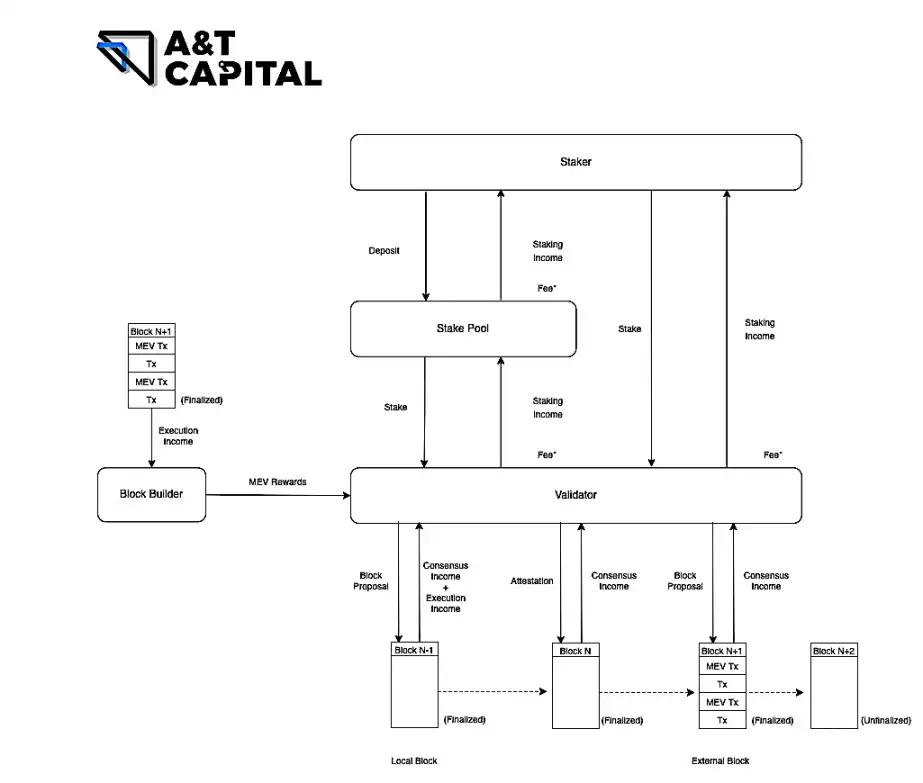
Consensus Income:Newly issued ETH tokens from the network are rewards for honest validators by the consensus mechanism, which can be subdivided into three categories:
1. Proposer rewards:When a Validator is selected to become a Proposer, it receives a Proposer rewards for the correct new block contributed by the network if its proposed new block is agreed upon by the network
2. Attestor rewards:A Validator that is not selected as a Proposer can verify that the new block proposed by the Proposer is incorrect, and the Validator that participates in the validation can earn Attestor rewards
3. Whistleblower rewards:Proposer will receive Whistleblower rewards if its proposed block includes evidence that other validators have breached consensus rules
Local Block 's Execution Income: From the Tip section of the Gas Fee, is the tip the user pays to a Proposer/Builder who helps package their transaction to the chain. In the case of a Local Block Building, a Proposer (Validator) builds the Block itself and is able to receive the entire Tip in that block, which is called the Local Block's Execution Income.
MEV Rewards:The fees paid to Proposer from Block Builder are, in essence, part of the MEV. In the case of an External Block Building, a Proposer (Validator) proposes a Block Builder to build, The fee paid by Block Builder to Proposer is known as MEV Rewards (the Execution Income from the Block that Block Builder receives). This fee may be more than the entire Tip in a Block (a Block Builder Bonus), or equal to or less than the entire Tip in a block (a Block Builder retains zero or some profit).
Note: After IP-1559, the Gas Fee of each transaction on ETH is divided into Base Fee and Tip. The Base Fee is burned and the Tip is paid to the coinbase address in the Block, which can be either a Proposer or a Block Builder.
It is worth mentioning that Consensus Income cannot be extracted at present, it is locked in the Balance of the Validator Beacon Chain; Execution Income and MEV Rewards can be withdrawn because it is transferred to a specific account.
How is the Validator Uncaptured Value constituted?
Validator Uncaptured Value=MEV + External Block's Execution Income - MEV Rewards
-MEV: The economic benefits derived from executing certain trades, which are most varied and mostly arbitrageurs
-External Block's Execution Income: From the Tip part of the Gas Fee, it is the tip paid by the user to the Builder who helps package the transaction. In the case of the ExternalBlock Building, the Builder sets the coinbaseaddress (the address used to receive the Tip) in the block it is building to the Builder's address, so the Builder gets all the tips in the block.
-MEV Rewards: The fee paid by the Block Builder to Proposer, the portion of the MEV captured by Proposer.
Who gets a cut of Staking Extractable Value?
About Validator Captured Value:
Discuss in whatever manner Staker chooses to pledge. Officially, Ethereum is divided into four categories:
1. Solo Staking: Staker-100%
Staking as a Service: Staker-90 2, staking as a service: staker-90 & NBSP; ~ 95% , Validator Infra Provider-5 ~ 10%
3. Pooled Staking: Staker-90%& staking; Pooled Staking Protocol-5% staking protocol; , Validator Infra Provider-5%
4. Centralized Exchanges: Staker-85 ~ 95% , CEX 0 & have spent ~ 10% , Validator Infra Provider-5%
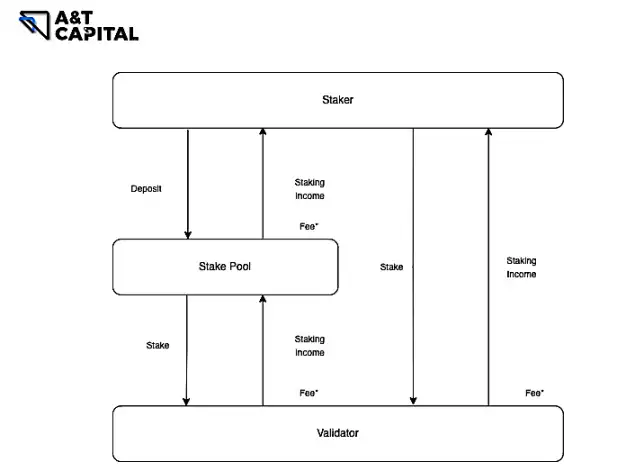
About Validator Uncaptured Value:
Currently, the Validator Uncaptured Value is split between Searcher and Block Builder, and Relay has yet to extract value from it. In theory Relay is a trusted relay structure with commercialisation possibilities as a marketplace for matching Block builders and proposers.
External MEV Market Architectures:
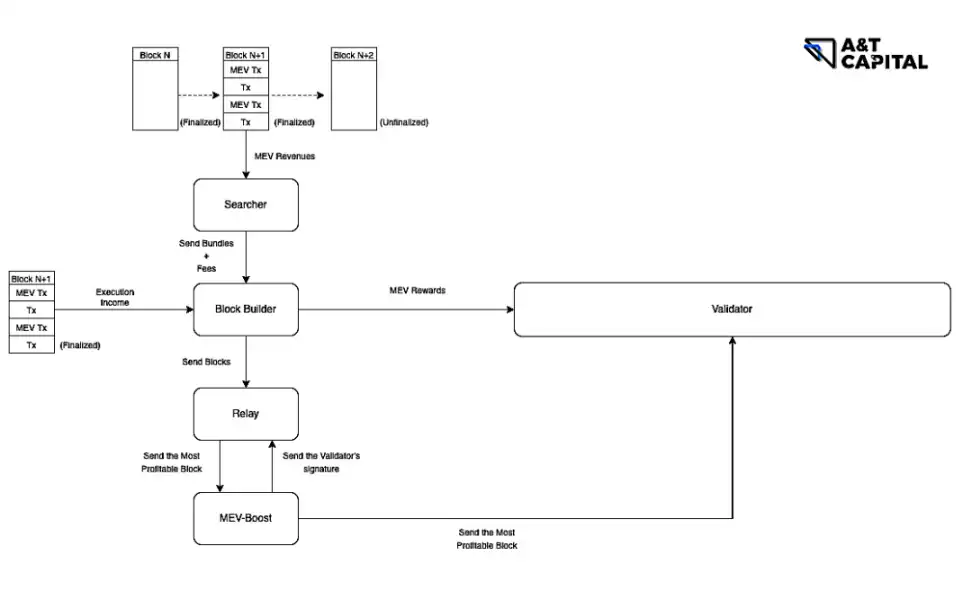
A Searcher.
Behavior: Insert your MEV TXs into a set of TXs and send Bundles to the Builder
Revenue: MEV Revenue from execution of TXs (MEV)
Cost: Gas fee (Base fee+Tip) of MEV TXs and fee paid to Builder
Block Builder:
Behavior: Form a Full Block from the resulting Bundles and TXs in the Mem Pool and send them to the Proposer. Here, the coinbase address in the Full Block (the address used to receive the tip) is set to the Builder's address, and the last TX in the Full Block is the Builder's address to the Proposer
Revenue: Fees paid by Tip and Searcher in Full Block
Cost: The fee paid to Proposer
Relay:
Behavior: Accept FullBlocks from numerous Builders and send the most favorable FullBlock to a Proposer
Revenue: No fees have been charged
Cost: Server O&M costs
Where are the investment opportunities worth watching?
Validator Infra Provider
Stake Pool
Products based on DVT
External MEV Market
"Validator Captured Value," and the market is relatively mature, with a relatively fixed proportion of captured value captured by various stakeholders.
The two most obvious places to invest are the Validator Infra Provider and the Stake Pool. A& T Capital has a layout.
The investment logic can be found in our previous article:
"A& T Family: Unicorns InfStones have raised $66 million in new funding"
"A& T Family: Liquidity pledge program Meta Pool completed seed round financing"
However, this is by no means a static market. The maturity and application of DVT (Distributed Validator Technology) will become the new catfish.
DVT uses Node operators running on different hardware to share the responsibility of a Validator, making the Validator more decentralized and avoiding single points of failure of hardware devices.
Based on DVT, different forms of products can be implemented and commercialized through different paths. SSV Network and Obol Network are just a group of good examples.
SSV Network aims to establish a public market to match Staker and Node Operator. Staker can select different Node operators and operate and maintain a Validator for them at the same time to prevent single points of failure. Node Operator also has a certain degree of redundancy, so it can respond to various emergencies more flexibly.
Obol Network is now more like a SaaS solution with both To C and To B.
The Validator Uncaptured Value is "hidden beneath the surface" and is not so transparent due to the External MEV Market (Off-chain).

MEV is more important than you think.
Mevs, which derive from the profits generated from executing particular trades, come in complex forms. In theory, the more active the on-chain transaction, the higher the MEV ceiling. Sometimes, the MEV will be higher than Consensus Income + Execution Income.
The total number of MEVs is difficult to measure (it is hard to say how much profit the execution of MEV TXs has made). But the total amount of MEV is almost certainly greater than the MEV Rewards allocated to the Validator.
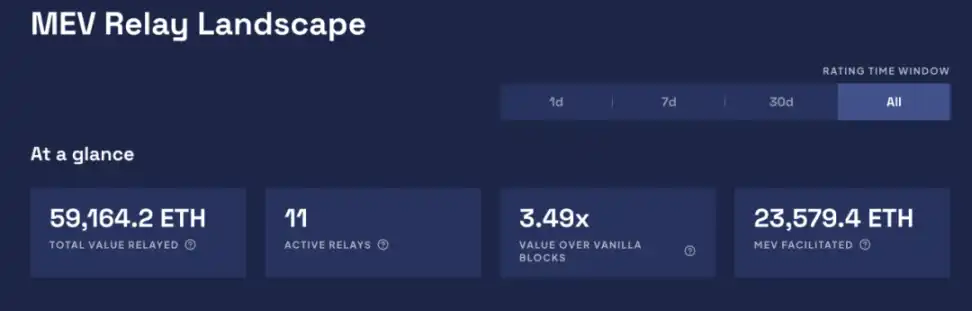
Since Merge, the External MEV Market has allocated nearly 60,000 ETH awards to the Validator, and the total MEV will only be higher than that.
It is worth affirming that the MEV-Boost system proposed by Flashbots has promoted the decentralization of Ethereum Validator. Each Validator is able to receive blocks from each Relay through the MEV-Boost client and select the best ones, without having to rely on a large pledge pool for higher revenue.
However, the current market still has a series of problems that need to be addressed:
There are many structures in the market that need to be trusted and subject to scrutiny risk
BlockBuilder and Relay have a tendency to centralize
In the External MEV Market, the Searcher needs to trust the Builder, and the Builder needs to trust the Relay. Whereas the Builder actually has the ability to review Searcher's Bundles, Relay has the ability to review Builder "s blocks.
Flashbots Relay, for example, no longer submits blocks containing Tornadao Cash deals.
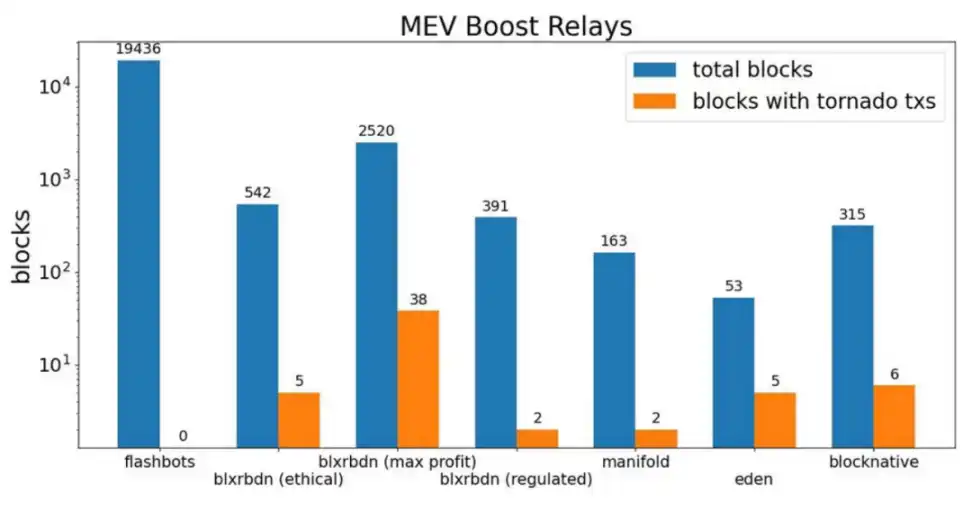
(source: https://twitter.com/nero_eth)
It's bad enough that a subject needs to be trusted, but even worse is the increasing concentration of trusted subjects.
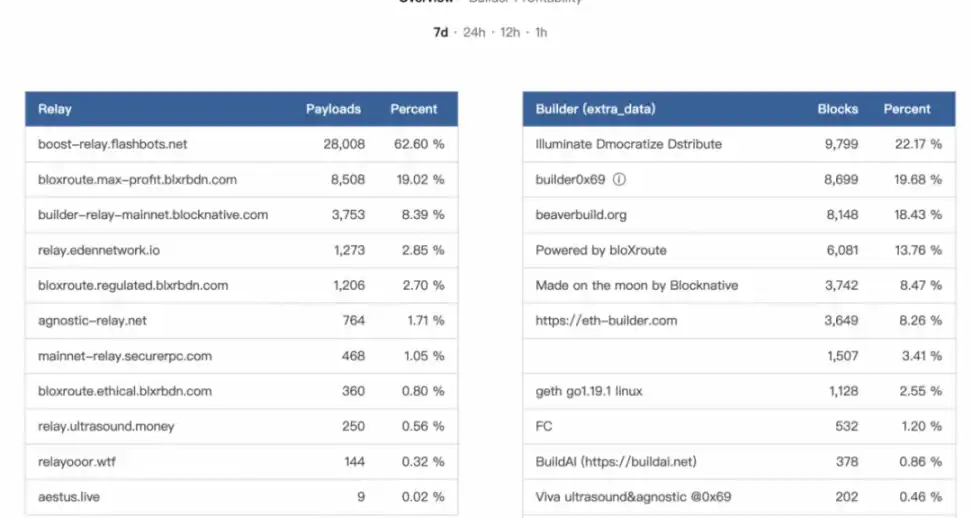
(source: https://www.relayscan.io/overview? t= 7 d)
According to RelayScanc.io, the top five Relays accounted for more than 95% of the market over the past week, while the top five Builders accounted for more than 85% of the market.
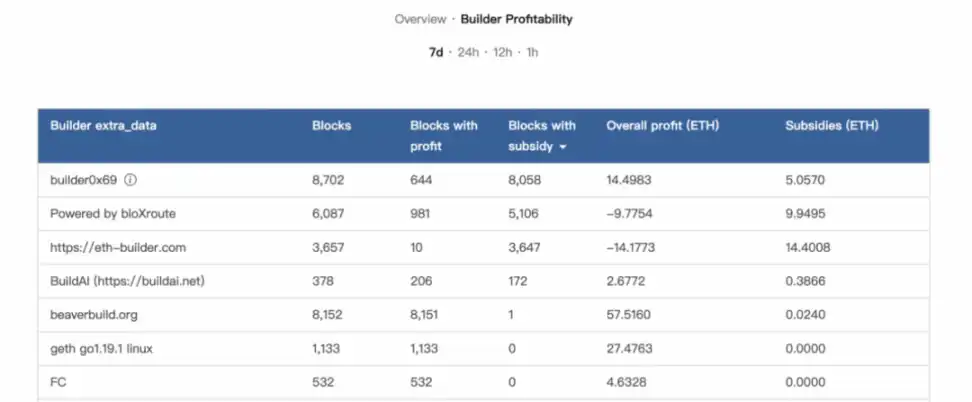
(source: https://www.relayscan.io/builder-profit? t= 7 d)
It's worth noting that some Builders have gone so far as to subsidize Proposer in order to make their blocks win (the Builder pays a Proposer more than the Tip it receives in coinbase address). The possible reason for this is that the Builder itself is a Searcher and can profit from special trade execution.
There are investment opportunities in the External MEV Market
A centralized market that needs to be trusted is not what we want. Commercial solutions that optimize the External MEV Market will be interesting investment opportunities.
Link to original article
Welcome to join the official BlockBeats community:
Telegram Subscription Group: https://t.me/theblockbeats
Telegram Discussion Group: https://t.me/BlockBeats_App
Official Twitter Account: https://twitter.com/BlockBeatsAsia