Panoptic: A new options market based on Uniswap, highly regarded by top institutions.

Original Title: Panoptic: Solving DeFi's perennial option problem
Original Author: Ling Young Loon, one of the investors of Panoptic
Translation: Leo, BlockBeats
As we all know, option trading is more complex than spot trading. Spot trading involves specific products, while option trading involves a right. Despite its advantages of high leverage and flexibility, option trading also has clear disadvantages such as high costs and poor liquidity. In traditional finance, option trading accounts for a large proportion, but in DeFi, option trading is not as well-developed and popular.
Recently, Panoptic, a DeFi protocol for options founded by Jesper Kristensen, former head of research at Advanced Blockchain AG, and Guillaume Lambert, a professor of applied physics at Cornell University, completed a $4.5 million financing round led by Gumi Crypto Capital on the Uniswap protocol. The first version of the AMM is scheduled to be launched in the first quarter of next year. One of the project's investors, Ling Young Loon, wrote an article about Panoptic, which BlockBeats has compiled and translated below:
Compared to stocks, the derivatives market is huge. In theory, the size of the high-end market usually exceeds $1 trillion, and approximately 33 billion options contracts were traded in 2021. However, the total value of locked DeFi options is only $500 million, and most cryptocurrency options trading occurs on Deribit (a cryptocurrency derivatives trading platform). An effective path to leveraged options positions has not yet been discovered.
Panoptic, created by Guillaume and Jesper, left a deep impression on me as a practitioner in the encryption industry. They believe that their model provides a powerful DeFi native solution. This article provides a comprehensive overview of the prospects of DeFi options, its core issues, and the importance of Panoptic.
Quickly Understand Options
Call options give the option holder the right to purchase an asset at a fixed price, while put options give the option holder the right to sell an asset at a fixed price. In P2P and centralized trading, options are purchased (sold) by someone, usually with the underlying asset serving as collateral. Then, someone else can buy the option and pay a premium to the option seller. DeFi's decentralized options protocol, such as Ribbon Finance, is a true automated options writer, where deposited ETH is used for call and put options.
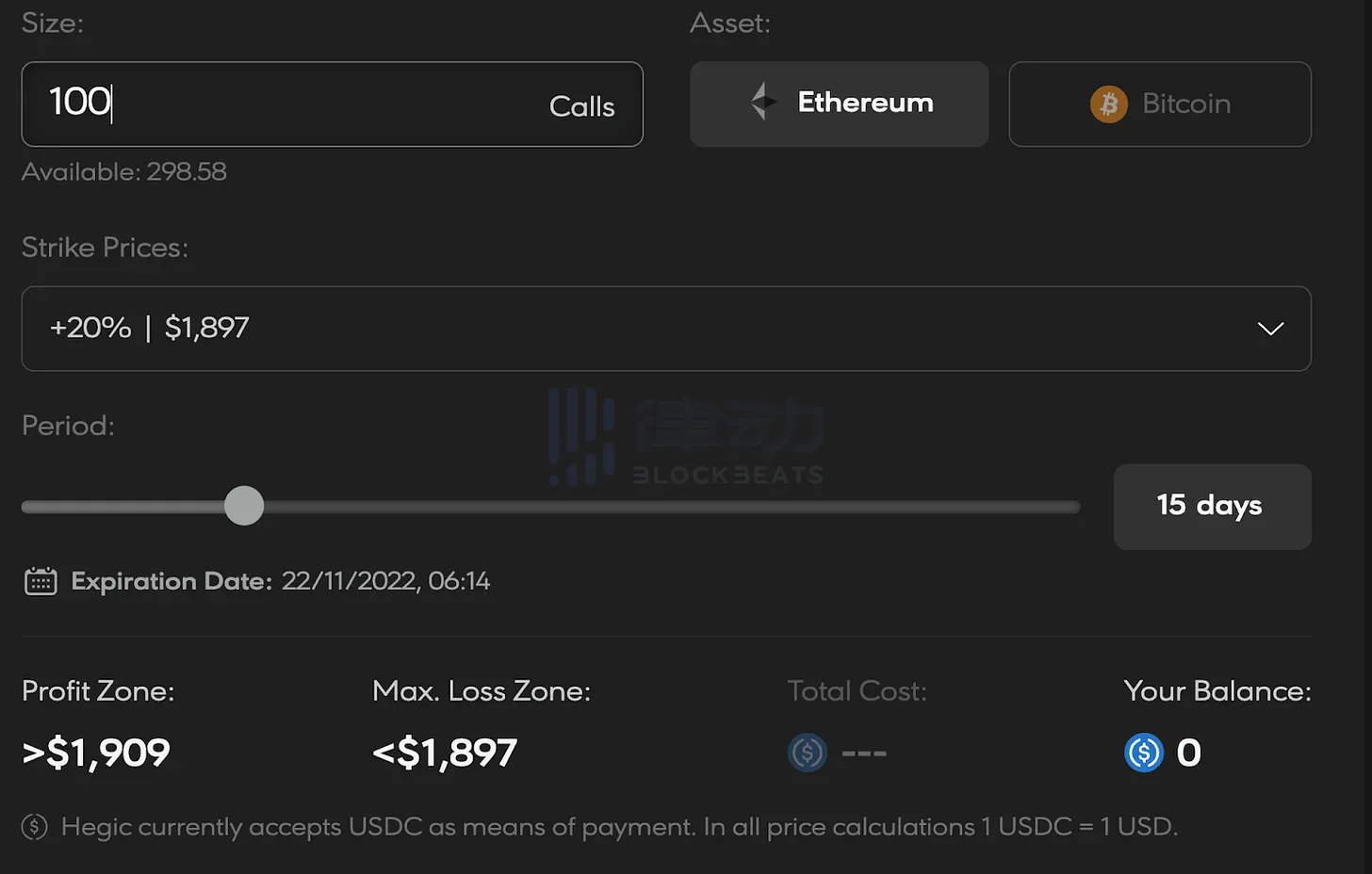
Each option has a specific exercise price, expiration date, and theoretical size. For example, users can purchase 100 ETH call options on Hegic at a price of $1,899 with a term of 15 days. During this period, if the spot price of ETH is higher than $1,899, users will be able to exercise the right to purchase 100 ETH and profit from the difference between the spot price and $1,899, minus the option premium cost.
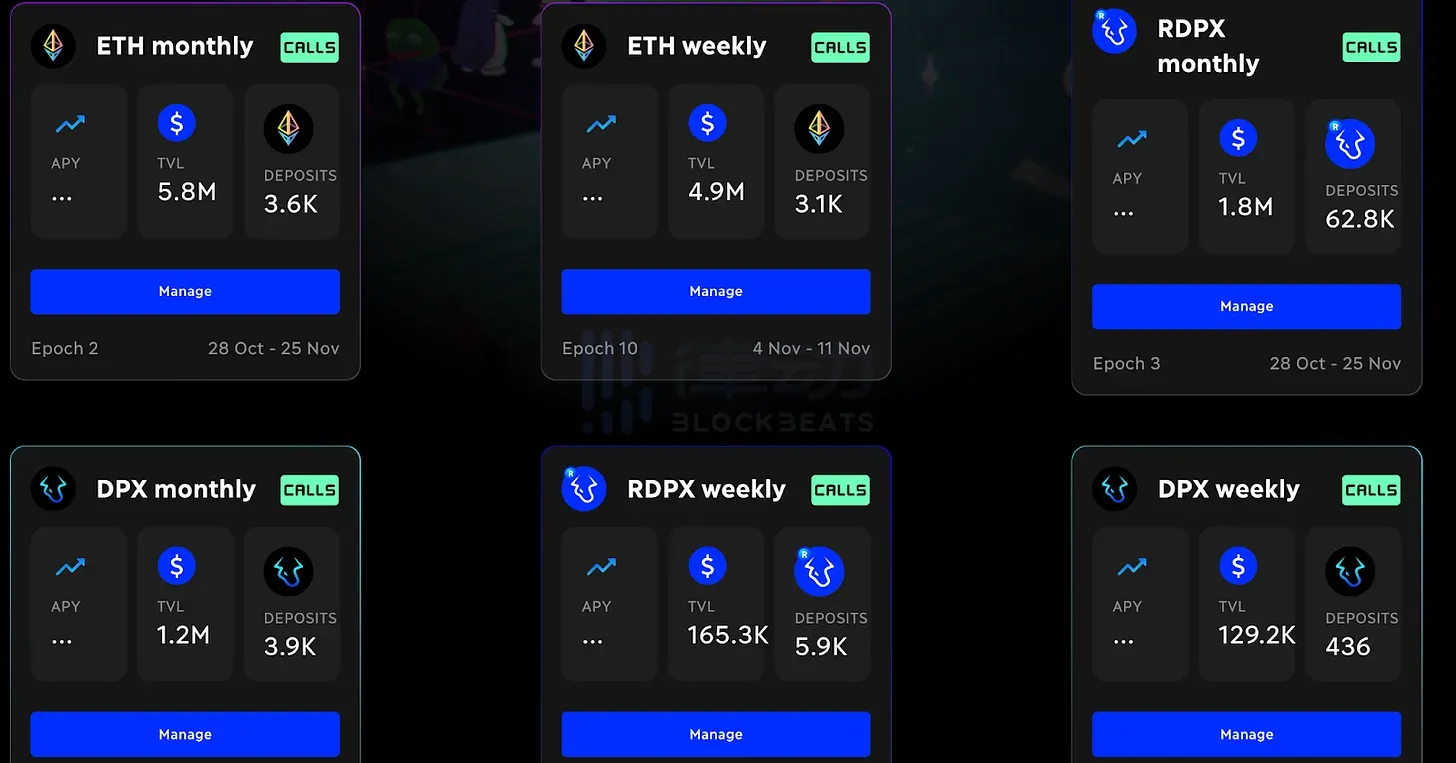
This time range and difference in execution prices greatly disperse the liquidity between single asset options, as shown on the DApp page of Dopex in the following image.
DeFi options face problems in the future
There are currently two types of option agreement models: peer-to-peer and peer-to-pool models.
Point-to-point model, such as the on-chain spot order book before AMM (Automated Market Maker), is mainly implemented on high-throughput chains or layer 2 due to the obstruction of on-chain order matching execution costs. The liquidity is always poor and it is impossible to guide the market for long-tail assets. PsyOptions is an example where people can ask off-chain market makers to provide quotes, allowing any wallet address to be the recipient, but this will lead to partial centralization.
The spot pool model involves options liquidity managed by smart contracts. Similar to spot AMM, traders buy and sell options in this options pool, while liquidity providers deposit in the pool to earn trading fees and option premiums. Dopex, Premia, Lyra Finance, and Rysk are all spot pool models.
Currently, the most important thing is how to automatically price options while preventing malicious flow. Option pricing is a complex issue because there are many variables to consider - expiration time, exercise price, volatility, and so on. It cannot be expressed by a simple formula like x*y=k. If the option pricing is incorrect, liquidity providers will suffer losses in the long run due to trading with "smart" market participants.
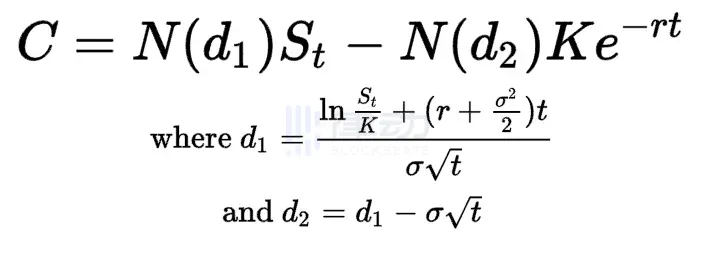
Traditional option pricing uses the Black-Scholes-Merton model. Most point-to-pool option protocols essentially address two things: pricing on-chain option premiums using the Black-Scholes-Merton model, and ensuring that prices are updated automatically and in a timely manner. The formula in the following figure can help understand the complexity of the Black-Scholes-Merton model.
Building in this direction is problematic because:
-The input of the model is difficult to determine, for example, there is currently no clear answer to what the risk-free interest rate of cryptocurrency is.
-Even if there is a correct way to input, it usually comes from the chain's link, so frequent and fast oracle updates are needed. The delay between actual price changes and oracle updates allows robots to profit from lagging option pricing. Oracle is also one of the most common attack vectors in DeFi, as seen in the "Mango Markets vulnerability incident".
-Generally speaking, blockchain is unlikely to provide the computing power required for "accurate and fully updated on-chain pricing." Traditional market makers use custom hardware (FPGA - field programmable gate array) to update 1000 option prices with every change in spot prices.
-Black-Scholes model may not be applicable to stocks, let alone crypto assets, which assumes no gas fees, spot prices follow a lognormal distribution, no dividends, no arbitrage opportunities, and so on.
Due to the difficulty of option pricing, it is extremely difficult to establish an appropriate margin system to support leveraged option positions. Hegic, Premia, Opyn v3, and Lyra all have a 100% margin requirement, which is not the most capital-efficient. We have not even obtained cross-margin (using asset X as collateral to sell asset Y options) or portfolio margin (using one option position to offset another) yet.
Leverage is the core of traditional options trading, but this function does not exist in DeFi: selling SPY put options requires a cash account of $36,000, while a "margin" account only requires $6,000. Both can bring in $600 in profits within about 40 days, but under the same risk conditions, the capital efficiency of the margin account is 6 times that of cash.
All questions point to one key issue: unless there is an efficient and secure pricing mechanism, DeFi will never be able to support the various options use cases in TradFi. Many option protocols have created obscure equations and compensation mechanisms to solve these problems. Take a look at this excerpt from the founder of Dopex on Twitterhere:
"Protocols that use fixed IV and Black-Scholes pricing often lead to pricing errors between the strike price and expiration date, especially when the underlying asset price deviates further away. Dopex uses RV (Realized Volatility), Volatility Smile replication formula, and a combination of "representatives" that reference the steepness/dampness of the curve that affects the pricing formula, where the slope is usually used to indicate the sharpness of the curve, i.e., its tilt; and damping represents the smoothness of the curve, i.e., its softness, to make Dopex options more practical and fair in pricing."
Is there any other way? According to Uniswap, there is no clear mapping of traditional financial tools to DeFi on Ethereum EVM. Prior to Uniswap and Bancor, the on-chain order book was the direction of builder iteration. In mid-2017, 0x deployed a method of on-chain order settlement transactions, which at the time, the "elegant" AMM equation must have seemed absurd.
Panoptic provides EVM-native solutions for these, which can solve options issues like Uniswap solves spot trading.
Panoptic: A New Financial Primitive
Actually, Panoptic is not an options protocol.
By adjusting the Uniswap V3 LP position, Panoptic has recreated a yield-like option using the pair pool model without relying on Black-Scholes logic.
Its core advantage lies in:
Leverage: The required collateral for selling options can be less than 100%. Panopic supports a minimum collateral ratio of 20% of the exercise value plus option funds. Similarly, option buyers only need 10% of the theoretical option quantity to open a position.
Maintain composability and permissionlessness; option positions are represented as ERC1155 tokens and can be combined with all DeFi. Since Panoptic only needs to adjust Uniswap V3 positions, theoretically, once the Uniswap V3 market exists, all users can deploy option markets in a permissionless manner.
Collaborative liquidity, not competitive liquidity; Panoptic can also be considered as a virtual liquidity manager for Uniswap V3 positions, such as Charm and Gamma, where the buyer and seller of options help to reposition liquidity at different prices during the trading process. Liquidity providers can earn more trading fees than they would with passive LP positions, and the increase in Panoptic liquidity also drives Uniswap liquidity, which may attract more liquidity than the current 250 million TVL in options protocols.
New financial features; Positions never expire, and option premiums are not paid in advance - they are only paid upon exercise. As the volatility of spot assets based on the Uniswap pool itself, rather than any oracle, increases, these premiums will increase. If you understand how Uniswap V3 liquidity positions can act as both buy limit orders and take-profit orders, you can also understand how Panoptic works.
Of course, there are many risks to be addressed; the Gas fees generated by virtual liquidity management may exceed the profitability of liquidity providers. As with all DeFi protocols, the boundary between protocol value extraction and value accumulation still exists.
DeFi is still in its early stages, with daily trading of trillions of stocks and bonds, while the DeFi market accounts for only one-tenth of its total volume. I am pleased to support Panoptic because they are pushing the possibility of exchanging risks in a world of freedom and sovereignty.
Original article link
Welcome to join the official BlockBeats community:
Telegram Subscription Group: https://t.me/theblockbeats
Telegram Discussion Group: https://t.me/BlockBeats_App
Official Twitter Account: https://twitter.com/BlockBeatsAsia

 Related Articles