Summary: Objective and intuitive DeFi primitives and technology stack.
Original Title: "Summary: Objective and Intuitive DeFi Primitives and Technology Stack"
Original Source: ChinaDefi
With the community continuing to build new primitives, assets, and tracks, promising to create greater value, the DeFi ecosystem has been full of innovation.
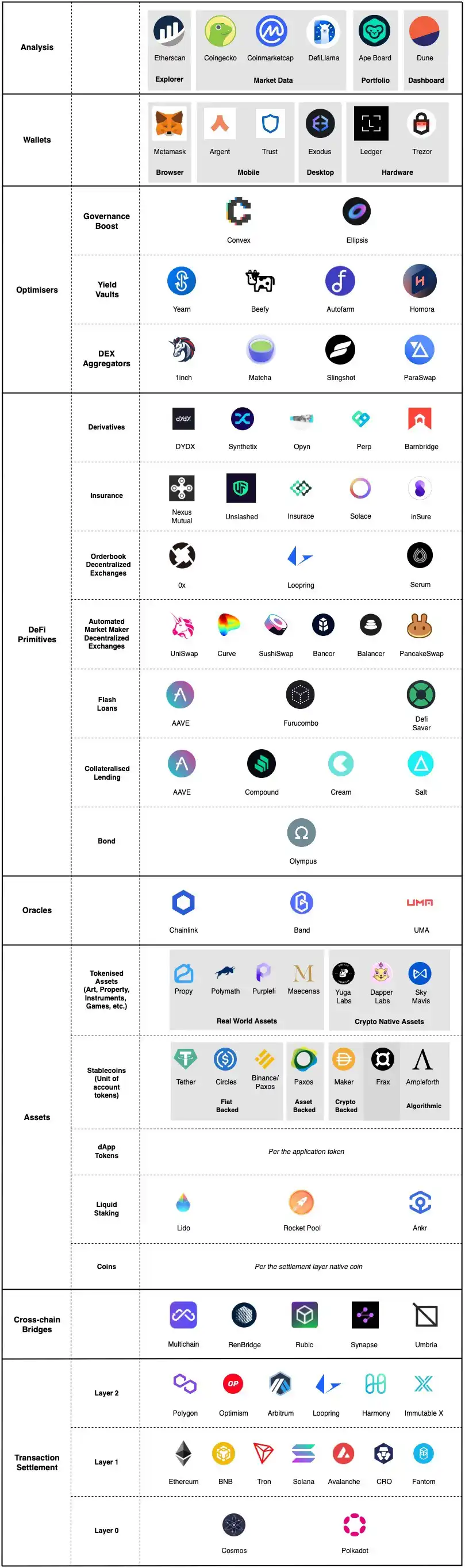
Specific to DeFi, the stack consists of 8 different layers:
Analysis: They are applications and tools that help the public understand blockchain transaction data. These are read-only applications that help enhance transparency in the field.
Wallet: The wallet owned by the user is used to store and manage the user's private key. These self-custody wallets support transaction signing and user interaction with DeFi protocols.
Optimizer: a set of applications built on DeFi primitives, aimed at maximizing profits by implementing specific strategies.
DeFi primitives: Building blocks of the DeFi ecosystem, where each protocol provides specific financial functions. These primitives can be easily combined with other primitives.
Oracle: A data provider that enables DeFi protocols to ingest external data for logical processing in smart contracts.
Asset: Projects/things traded within the DeFi ecosystem, typically represented in the form of tokens (ERC20/721).
Cross-chain bridge: a protocol that enables assets to move safely across various chains.
Transaction settlement: The foundational layer of DeFi, where all transactions are completed and protected.
The following section outlines the core functions, basic concepts, and ecosystem benefits of each layer in detail, and summarizes the components of each layer. Each section is sorted by readability. In addition, a non-conclusive protocol list is provided as a reference implementation for each section.
Assets
Stablecoin
Core Function: Token linked to value and specific value. Currently, due to the US dollar's status as the global reserve currency, most stablecoins are pegged to the US dollar. With the competition for liquidity, macroeconomics, and other factors among countries, it may create a future with multiple stablecoins.
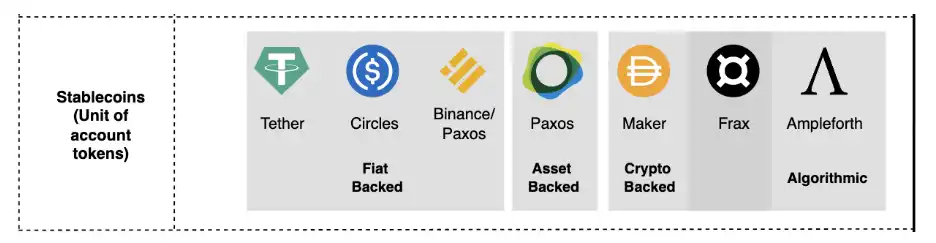
Basic concept: Stablecoins are usually minted/destroyed based on a basket of assets' collateral ratio. These assets determine the trust assumption of stablecoins, ranging from assets held in tradFi accounts (USDC, USDT, PAXG) to crypto assets/tokens (DAI, TUSD, FRAX). Stablecoin protocols can set a target collateral ratio to improve capital efficiency.
Ecosystem benefits: a stable accounting unit; trust borrowed from tradFi; target alignment is intuitive.
Protocol: Tether, Circle, Binance, Paxos, Maker, Frax, Ampleforth.
Tokenized Assets
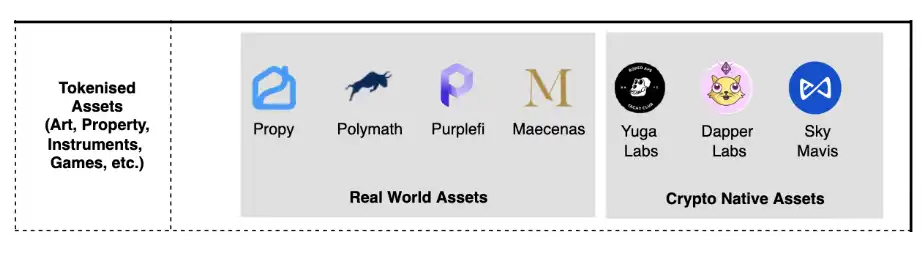
Core Function: Representing financial assets on the blockchain. This can be native assets on the blockchain (where the assets are fully described by the blockchain), or tokenized representation of assets outside the blockchain. In the latter case, an oracle or trusted party is needed to bridge the assets onto the blockchain. Tokens can represent anything, as they are simply tokenized data units.
Basic concept: Most Tokens will be defined by smart contracts, which describe Tokens as either fungible Tokens (ERC20) or non-fungible Tokens (ERC721).
Ecosystem benefits: accessibility of digital assets; optimized settlement and registration processes; transparency of transactions; new liquidity based on new Token valuation; effective real-time finality.
Protocol: Propy, Polymath, Purplefi, Maecenas, Yuga Labs, Dapper Labs, Sky Mavis.

流动性质押
translates to
Liquidity Collateralization
in English.
Core Function: By enabling users to utilize the value locked in pledged funds, it increases the flexibility of cash flow. Users can still earn returns through pledging while gaining liquidity.
Basic Concept: Proof of Stake
Token Provided to liquidity providers, who then pool funds and stake them on the protocol. Users receive a Token representing their share of the pooled funds, which they can use for other purposes.Ecosystem benefits: reduce the minimum capital cost of pledging; incentivize greater pledge amounts to improve protocol security; increase liquidity for funds that are essentially dormant; and determine the flexibility of value flow.
Protocol: Lido, Rocket Pool, Ankr.
DeFi primitives
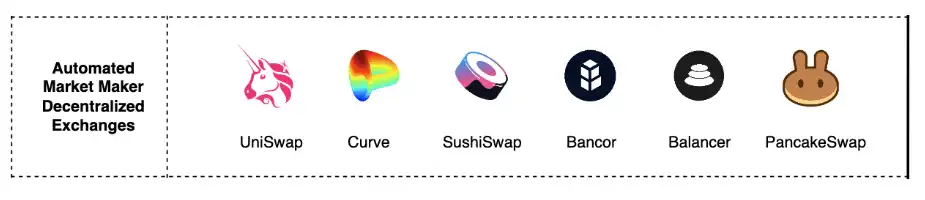
AMM DEX
Core Function: Non-custodial Token Swap. As long as the Token contract complies with the ERC20/ERC721 standard, new trading pairs can be created. DEX relies on external arbitrageurs and oracles to determine the price ratio of Tokens. Liquidity is provided by market makers who provide Tokens to smart contracts in exchange for reduced transaction fees.
Basic Concepts: Token The liquidity pool is defined by a smart contract, which manages the proportion of Tokens held by the contract. Deposits, trades, and withdrawals of Tokens are all done along the price curve, ensuring the stability of the pool. This enables market making to be automated, which has led to a mechanism known as an Automated Market Maker (AMM).
Ecosystem benefits: no restrictions on trading pairs (including stablecoins); instant liquidity along the customized price curve; automatic revenue generation for market makers; and reduced costs for stablecoin issuance.
Protocol: Uniswap, Curve, SushiSwap, Bancor, Balancer, PancakeSwap.
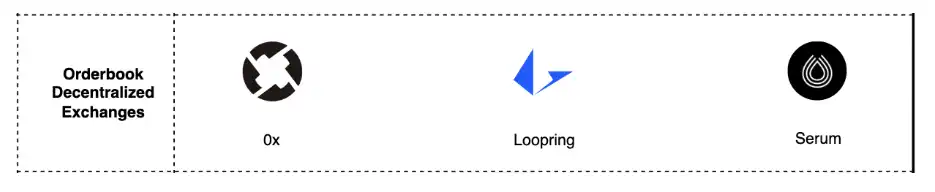
Delivery Note DEX
Core Function: Used for exchanging traditional order book trading process of Token. In addition to traditional order matching, most order DEXs also look for opportunities to settle orders on AMM DEXs.
Ecosystem benefits: intuitive exchange model based on historical precedents; ability to set target prices; reduced slippage risk.
Protocol: 0x, Loopring, Serum.
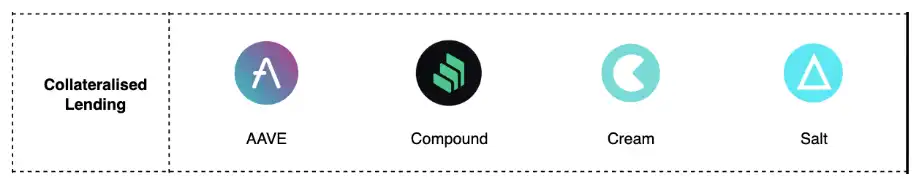
Mortgage Loan
Core function: lending of encrypted assets. Cryptocurrency providers can earn interest by depositing cryptocurrency into specific pools. Borrowers can obtain loans by collateralizing cryptocurrency. By allowing collateralization and lending between various cryptocurrencies, users can mix and match their current and borrowed assets according to their liquidity preferences.
Basic concept: The loan contract defines the reserve assets and the share of each borrower/lender. The interest paid to the lender or borrower is dynamically determined based on market mechanisms and the goals of governance agreements. Utilization rates and mortgage rates can be used to improve capital efficiency.
Ecosystem benefits: using dormant assets (i.e. leverage) to generate additional liquidity; no need to sell assets to earn profits; establishing a clearing market.
Solution: Aave, Compound, Cream, Salt.
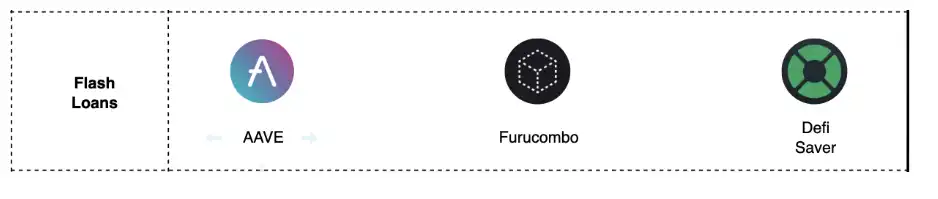
Lightning Loan
Core function: Unsecured loans for encrypted assets, which achieve profitable strategies by stacking multiple strategies into a single Ethereum transaction. This is possible because the finality of the transaction depends on the block time, which allows loans to be obtained and repaid in the same block. If the transaction proves unprofitable, it can be cancelled. In the case of profitable transactions, the protocol charges a fixed fee for flash loans.
Basic concept: The flash loan contract defines the loan terms and implementation strategies. The flash loan contract must interact with various other DeFi products to achieve profitability (loans, DEX, aggregators). All flash loan strategies are grouped into a single transaction and automatically processed by the network.
Ecosystem benefits: Instant liquidity; no need for collateral, no default risk; instant arbitrage brings higher stability.
Protocol: Aave, Defi Saver, Furucombo.
Insurance
Core Function: Asset Risk Management, purchasing insurance in the event of asset loss (such as hacker attacks, smart contract vulnerabilities, etc.). Underwriters can choose which protocols/events to underwrite in exchange for fees. Based on the insurance pool, users can insure themselves by paying insurance premiums to the pool. Payment decisions can be made through a voting process or event-driven code.
Basic concept: Smart contracts define the risks to be insured and the conditions for claims/payment. Funds, including insurance premiums, are deposited into the contract, allowing for the determination of respective pool shares.
Ecosystem benefits: Achieving more granular risk management; increasing trust due to minimized losses; creating an insurance market where insurance companies can provide funding for projects based on their relative confidence in the project.
Protocol: Nexus Mutual, Unslashed, Insurance, Solace, inSure.
Bonds
Core Function: Earn fixed income by lending assets to the protocol treasury. The borrowed assets do not have to be protocol tokens, but are determined by the treasury governance. Similarly, interest payments are not limited to protocol tokens.
Basic concept: Smart contracts are used to store Token in the treasury and implement rules based on governance voting. Token bonds are unlocked and claimed upon maturity.
Ecosystem benefits: Incentivize liquidity owned by the incentive protocol, thereby increasing trust in the protocol's token; the treasury reserve can be allocated based on DAO governance.
Protocol: Olympus.
Derivatives
Core Function: Creating markets for hedging, leverage, or downward speculation. With more advanced strategies, users can manage their risks and maximize their potential returns through derivative assets such as futures, perpetual contracts, options, and interest rate swaps.
Basic concept: The implementation of most derivatives involves creating Tokens that represent the derivatives. These assets are typically created on smart contracts that ensure the funds (i.e. collateral) are secured. The derivatives can then be traded freely while being protected from bankruptcy through clearing markets.
Ecosystem benefits: exposure to price changes of any asset (i.e. synthetic assets tracking stock prices); short selling allowed; more sophisticated risk management options.
Solution: DYDX, Synthetix, Opyn, Perp, Barnbridge.Optimizer
DEX Aggregator
Core Function: By routing trades through multiple DEXs, the DEX aggregator obtains the best combination of effective prices and lowest trading costs. The existence of DEX aggregators is due to the fact that different DEXs have different prices for the same Token at any given time.
Basic concept: DEX aggregator queries multiple DEX protocols based on the requested trading pair. By filtering and sorting potential trades, the DEX aggregator can discover the optimal trading path. This includes trading gas fees and transaction fees for each Token.
Ecosystem benefits: exchanges based on optimal rates; liquidity distributed in DEX based on actual trading value; incentives for price stability across DEX.
Protocol: 1inch, Matcha, Slingshot, Paraswap.
收益金库
translates to
Profit Treasury
.
Core Function: Automatically combine liquidity supply to maximize potential returns while minimizing the cost of interacting with DEX smart contracts. Different vault strategies will generate different expected returns based on risk tolerance. Vaults can increase returns through protocol rewards, leverage (via borrowing), and other income streams.
Basic concept: The vault contract defines the strategy to be implemented. Liquidity providers from the designated pool can delegate their liquidity shares to the vault contract. The contract manages user liquidity and automatically compounds rewards.
Ecosystem benefits: improving capital efficiency and returns; reducing risks associated with incentivizing Token; lowering transaction costs for liquidity management.
。Protocol: Yearn, Beefy, Autofarm, Homora.
治理提升
translates to
Governance Enhancement
in English.
Core Function: By controlling the fee allocation and voting of the underlying DEX protocol, the maximum profit can be achieved. This is possible because most DEX protocols allocate rewards to different liquidity pools based on Token voting.
Basic concept: Users can use Convex/Ellipsis to lock their liquidity providers' tokens at the underlying protocol. This makes them eligible to receive a share of Convex transaction fees, as well as additional rewards obtained through reallocation of governance votes.
Ecosystem benefits: Creating fee and voting markets on top of the underlying protocol, bringing new liquidity; maximizing returns through compound rewards.
Protocol: Convex, Ellipsis.
Cross-chain Bridge

Core Function: Supports asset exchange across different chains. Most bridges have additional DEX functionality, which helps exchange assets between different chains.
Basic concept: Most implementations involve cross-chain message passing protocols that support cross-chain bridging of assets. This bridging can be achieved by packaging assets, where assets on the source chain are locked by smart contracts. Alternatively, cross-chain assets can also be obtained through stable exchange pools.
Ecosystem benefits: exponential growth in trading volume based on cross-chain exchange opportunities; instant liquidity across chains; prevention of value being locked in settlement layers.
Protocol: Multichain, RenBridge, Rubic, Synapse, Umbria.
Original article link
Welcome to join the official BlockBeats community:
Telegram Subscription Group: https://t.me/theblockbeats
Telegram Discussion Group: https://t.me/BlockBeats_App
Official Twitter Account: https://twitter.com/BlockBeatsAsia
 Related Articles