Once one of the largest market makers in the Crypto field, how will Alameda affect the liquidity of the crypto market?
Original title: "Crypto Liquidity in a Post-Alameda World"
Original author: Clara Medalie, Dessislava Aubert, Riyad Carey, Kaiko
Original compilation: Qianwen, ChainCatcher
There are endless rumors about FTX. FTX, FTX US, and 134 related entities all filed for bankruptcy on Friday, a sign of how deep the trading platform and related companies have been. Just hours later, the exchange suffered a massive hack that saw more than $600 million siphoned from the wallets of FTX and FTX US, prompting rumors of an insider effort.
Perhaps most egregiously, a Reuters report claimed that the SBF had built a secret backdoor that went unnoticed by auditors. In this case, transfer funds between Alameda Research and FTX.
Today we will focus on the impact of Alameda's market making operations on cryptocurrencies and what their closure means for liquidity.
Alameda Gap
Alameda Research is one of the largest market makers in the cryptocurrency Market cap Tokens provide liquidity worth billions of dollars. It is now emerging that their entire trading operation was conducted by FTX improperly mixing client funds. Last Thursday, Alameda Research announced that they were officially closing the deal. What does this mean for liquidity across the market?
Cryptocurrency liquidity is dominated by just a handful of trading firms, including Wintermute, Amber Group, B2C2, Genesis, Cumberland and (now defunct) Alameda. With one of the largest market makers gone, we can expect a significant drop in liquidity, which we call the "Alameda Gap". Other market makers will also suffer more losses due to FTX's collapse, which will continue to widen the gap. So far, Amber Group, Wintermute, and Genesis have all announced that they have funds on FTX, which may affect their overall market making operations.
Liquidity normally drops during times of volatility as market makers draw bid/ask tasks from the order book to manage risk and Avoid bad flow. But what we have observed over the past week is that liquidity has fallen more sharply than in any previous market decline, suggesting that the “Alameda liquidity gap” is likely to persist, at least in the short term.
Since November 5th, CoinDesk announced a survey on Alameda's assets, and the BTC liquidity within 2% of the middle price has dropped from 11.8k BTC to 7k, the lowest level since early June.
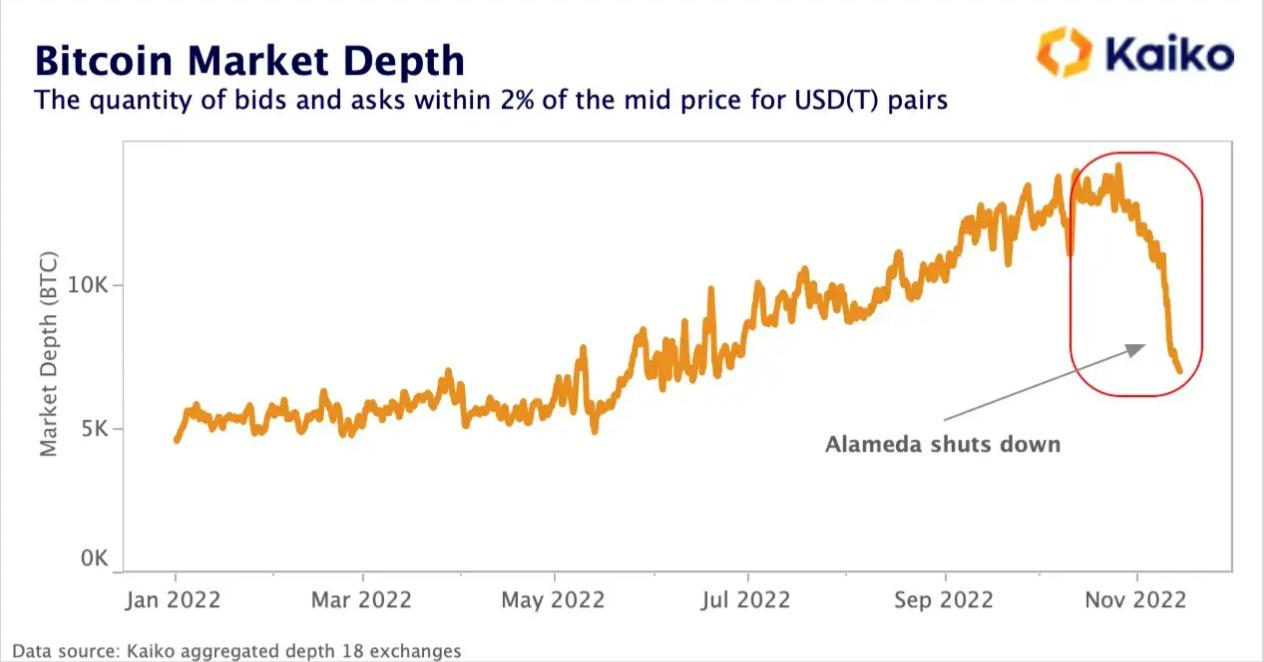
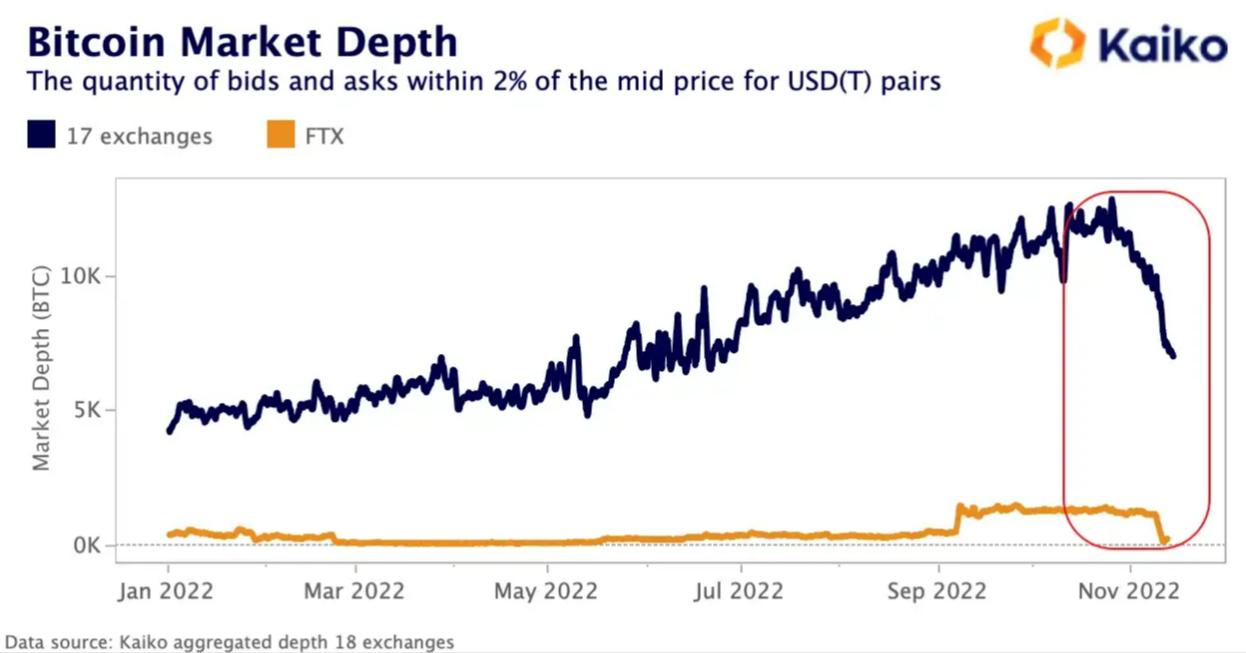
The chart above summarizes the market depth of 18 trading platforms, including FTX, which There is no longer any real market making activity. Even after excluding FTX from the chart, there is still a huge dip in depth, suggesting that liquidity across the market was heavily impacted by Alameda’s debacle and other market maker losses. Since Nov. 5, Kraken’s BTC depth is down 57%, Bitstamp’s is down 32%, Binance’s is down 25%, and Coinbase’s is down 18%.
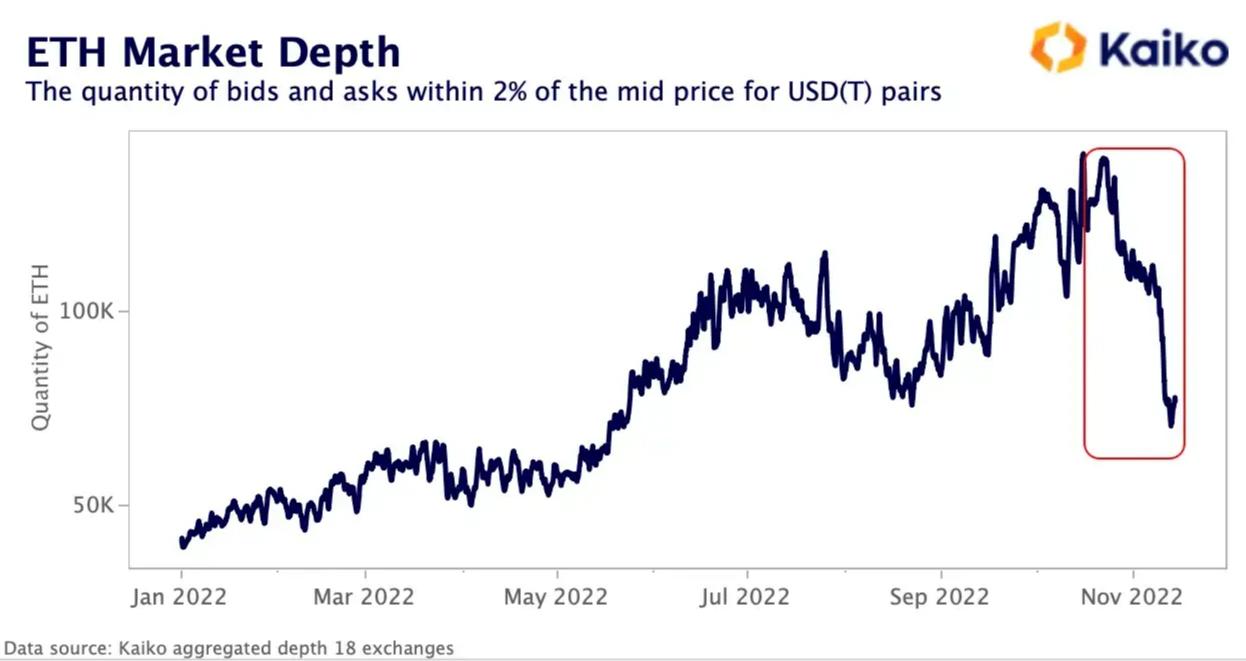
ETH market also affected by crash, 2% market depth down to May late level.
Fortunately, since the cryptocurrency credit crisis in May and June, the entire market BTC and ETH liquidity has been growing steadily, so a deep drop should not be too disruptive. Even more worrisome is the liquidity of altcoins. Alameda has invested in dozens of projects, holding millions of dollars worth of low liquidity Token . But since Alameda is also a market maker, we can assume that they are also these Token main liquidity provider.
It is unclear whether Alameda and FTX hold Token , but below is a breakdown of FTX’s balance sheet provided by the Financial Times, which ranks holdings by liquidity.
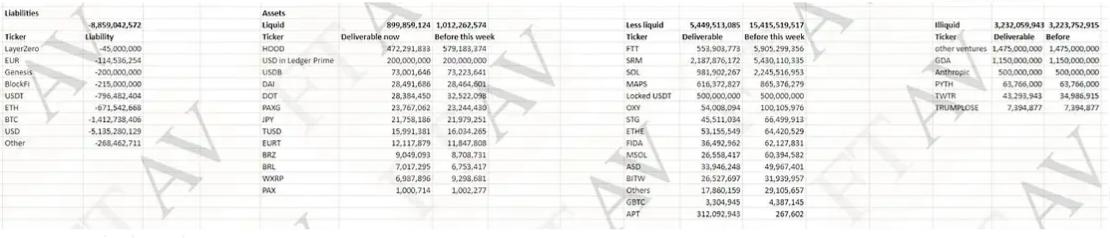
In the "less liquid" ("less liquid" in the table) category Next, the top four are FTT (where it all started today), a Solana DEX called Serum (SRM) Token , Solana's native Token SOL, and a program called MAPS Token .
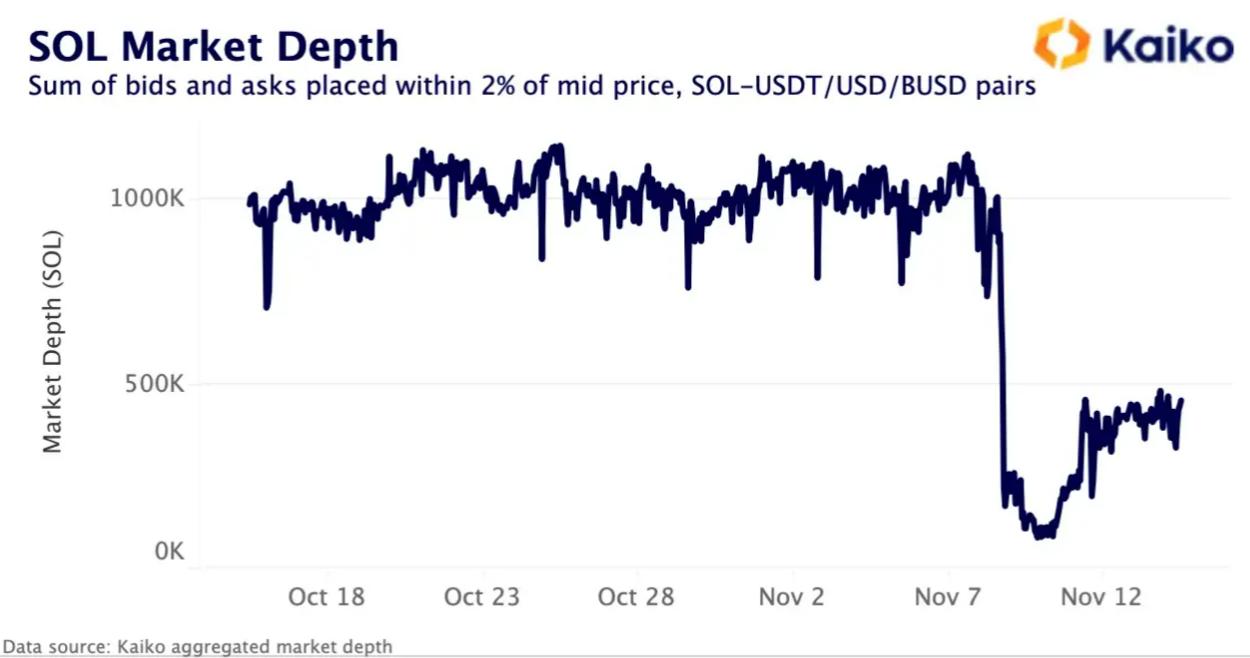
Let's look at the liquidity of SRM, SOL and MAPS before and after Alameda. The figure below is an in-depth summary of the 9 trading platforms that provide SOL trading pairs. Overall market depth dropped by 50%, from 1 million SOLs to below 500,000 across all order books, and this drop was seen across every trading platform.
SRM and MAPS also saw huge dips in depth. To avoid price effects, we use each Token Depth is represented by native units of , which suggests that market-making activity has been severely impacted by the Alameda crash.
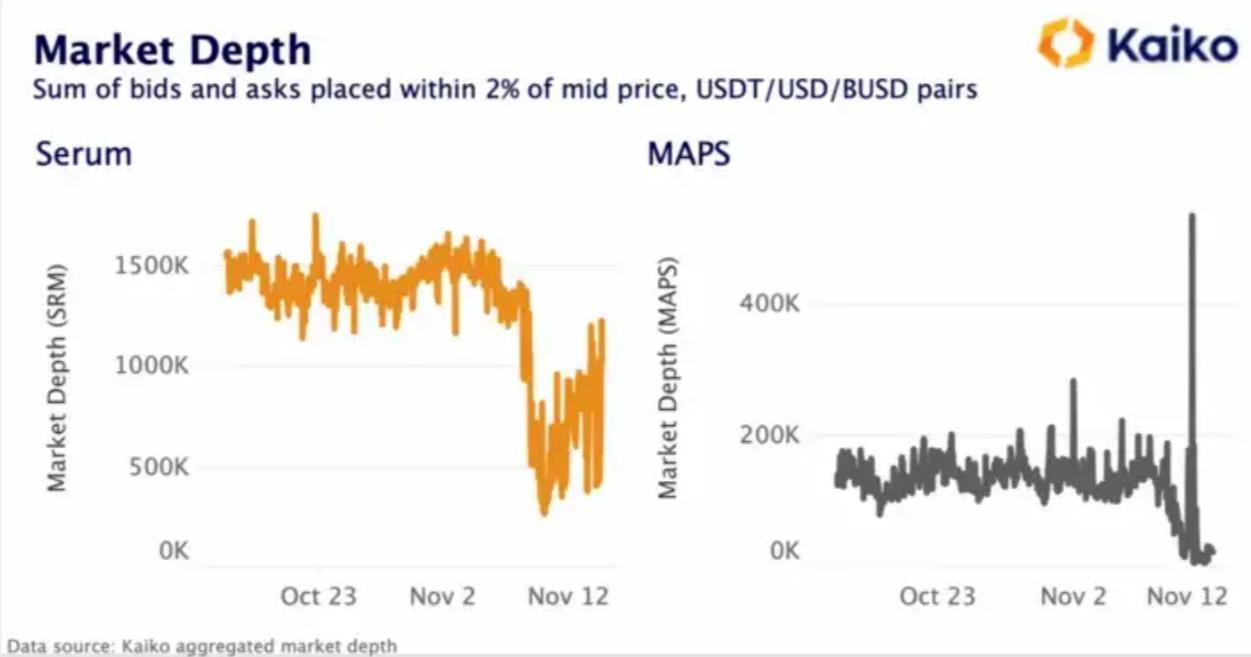
Alameda holds significant illiquidity Token , while (almost certainly) these Token market maker, making it nearly impossible for the company to survive bankruptcy. Overall, one can expect very low liquidity in altcoins in the near future, especially those heavily invested by FTX/Alameda entities.
Are there risks in stablecoins?
While illiquid altcoins make up a large portion of Alameda/FTX's balance sheet, Alameda also holds millions of stablecoins. Below is a Dune Analytics dashboard produced by 21 Shares that tracks the holdings of known Ethereum wallet addresses associated with Alameda.
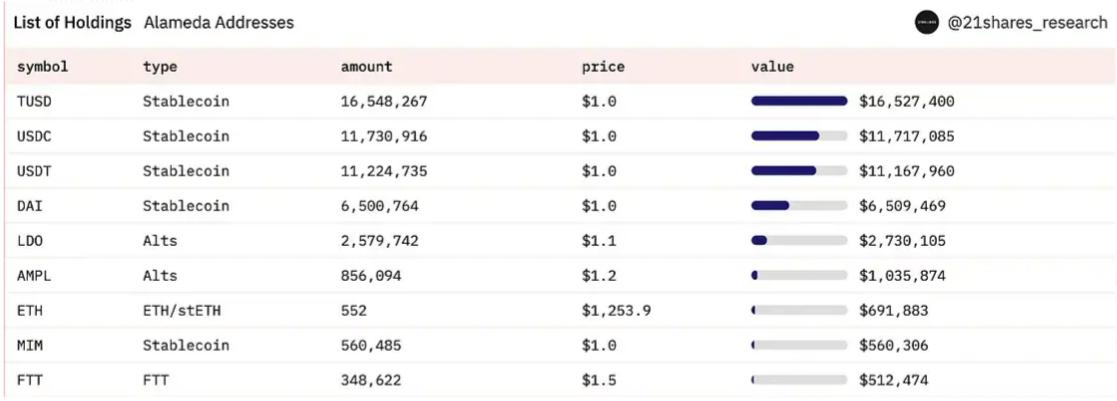
As of Monday morning, Alameda held more than $46 million worth of stablecoins, of which The largest stablecoin holding is TrueUSD (sixth largest stablecoin by market capitalization), followed by USDC at $11.7 million and USDT at $11 million. Its USDC holdings have dropped five-fold since the end of last week.
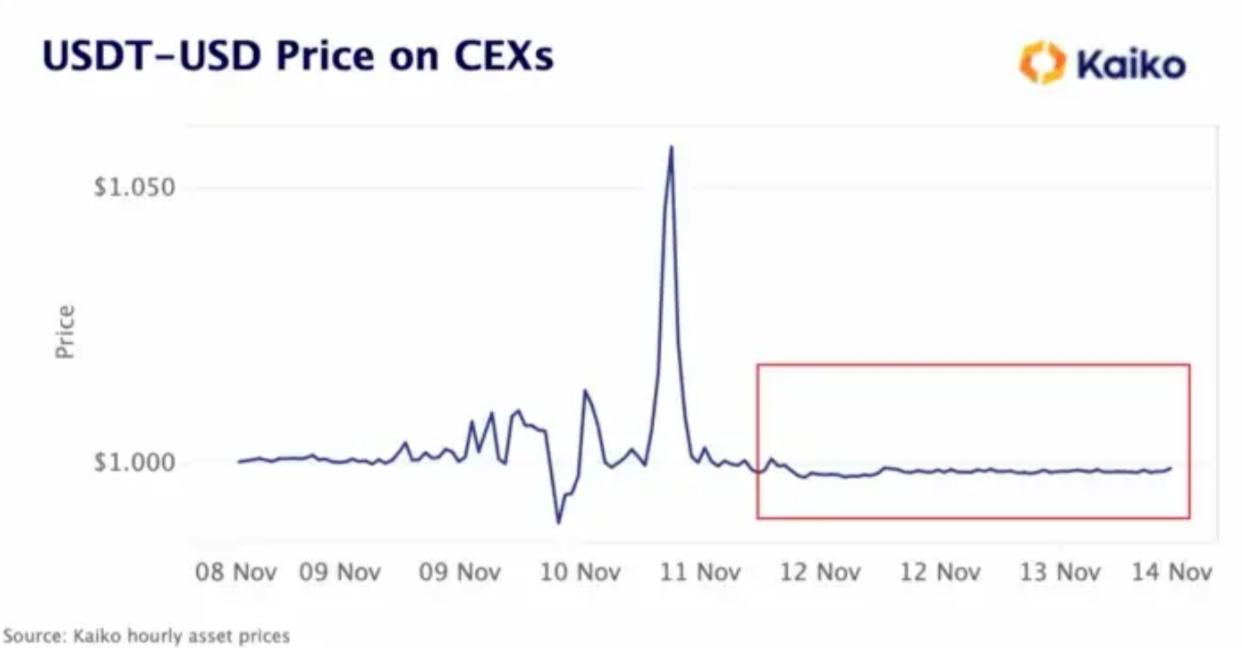
Although TUSD is one of the least liquid stablecoins, with only 10 active transactions on centralized exchanges, its price on centralized exchanges remained relatively stable over the past week.
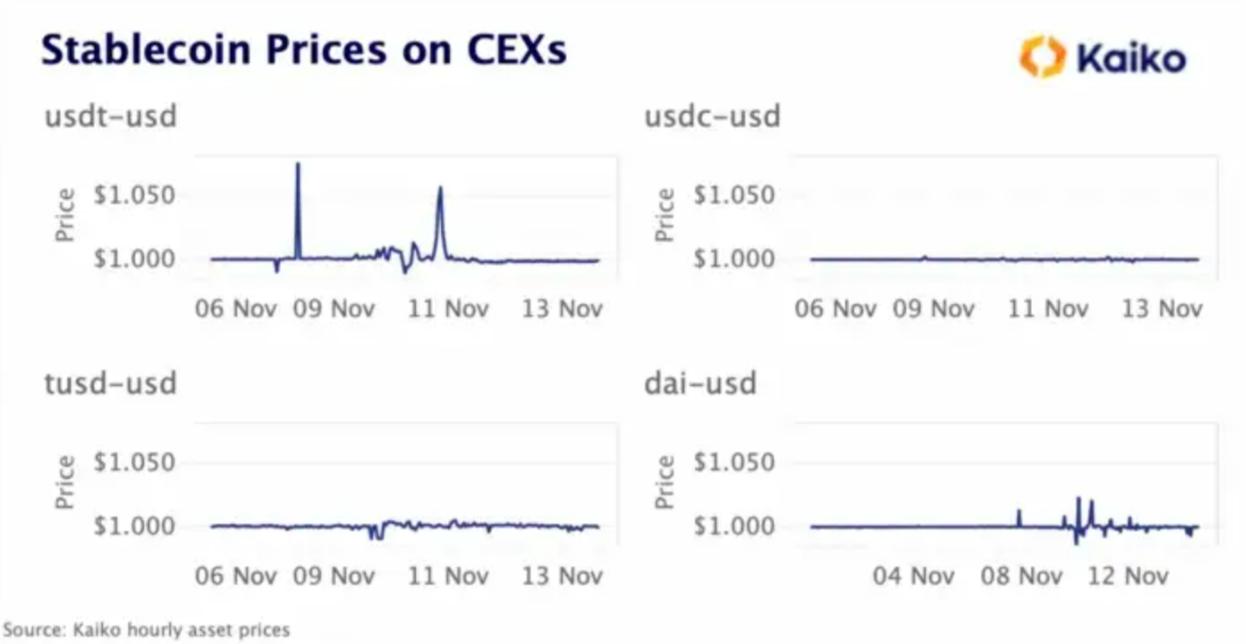
USDT exhibited the most dramatic price swings, falling to 0.989 on Nov 10 dollar before surging to $1.058 on Nov. 11. Since then, it has been trading at a small discount, suggesting continued selling pressure in the centralized spot market.
Some people even speculate that Alameda is actively shorting USDT and using USDC to borrow on Aave USDT, and then sell it on other trading platforms such as Curve. The chart below of activity on Curve 3pool shows a large amount of USDT being sold in exchange for USDC and DAI, causing USDT’s price (in blue) to drop briefly below its peg by 2 cents. The price has since recovered and is now only 10 basis points below its peg.
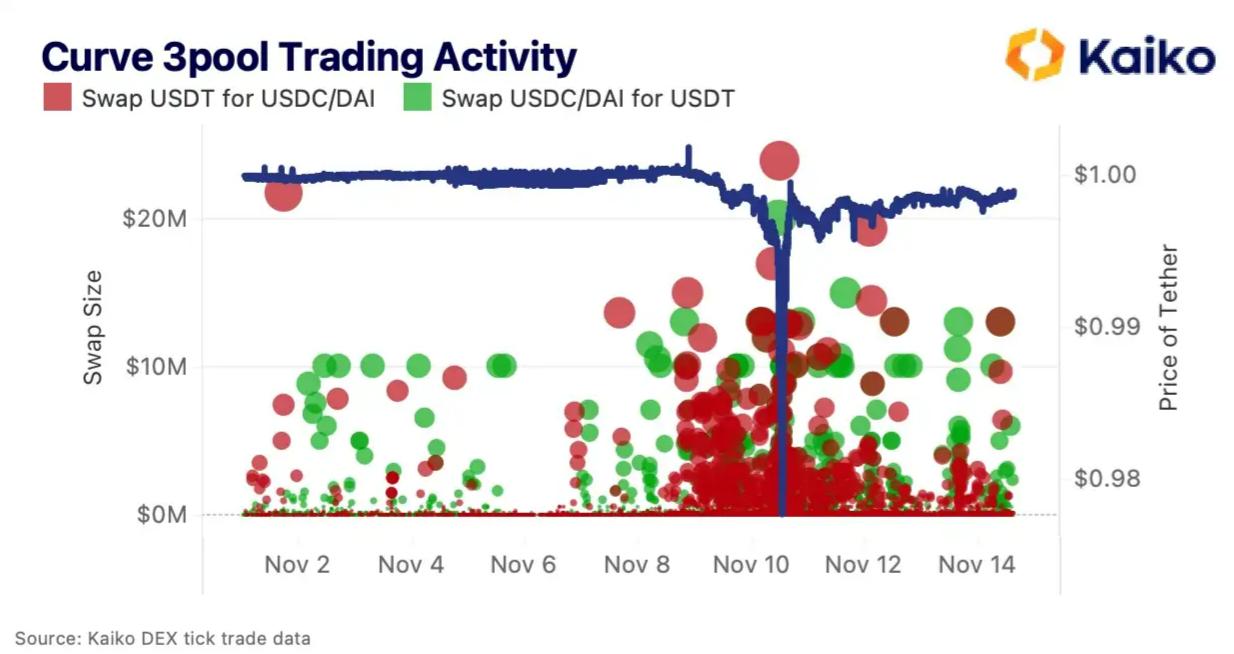
Most market activities of stablecoins still mainly take place on centralized trading platforms, so , despite slight discounts in the DeFi market, its price appears to be holding steady.
Extreme Volatility in Derivatives Market
Last week was undoubtedly the most volatile in the history of cryptocurrencies , after Binance pulled out of its acquisition of FTX on Nov. 9, both BTC and ETH saw their biggest one-day losses in more than five months. Spot prices fluctuated wildly, resulting in $875 million in cascading long liquidations in just 24 hours, and perpetual futures open interest plummeted by double digits.
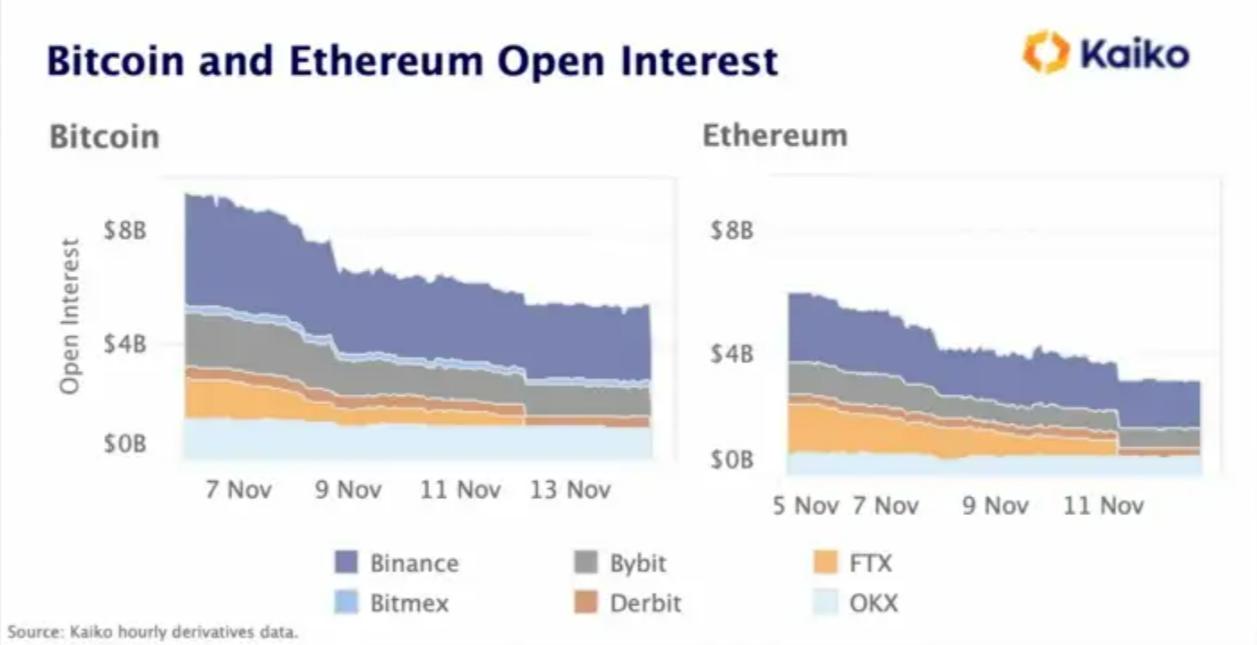
The BTC open positions of 5 trading platforms (excluding FTX) are here It dropped from around $8 billion to $5.5 billion in a week, while ETH dropped from $4 billion to $3 billion. The collapse of FTX could have a major impact on the derivatives market, which accounted for 14% of total BTC open interest and 28% of ETH’s open interest as of early November.
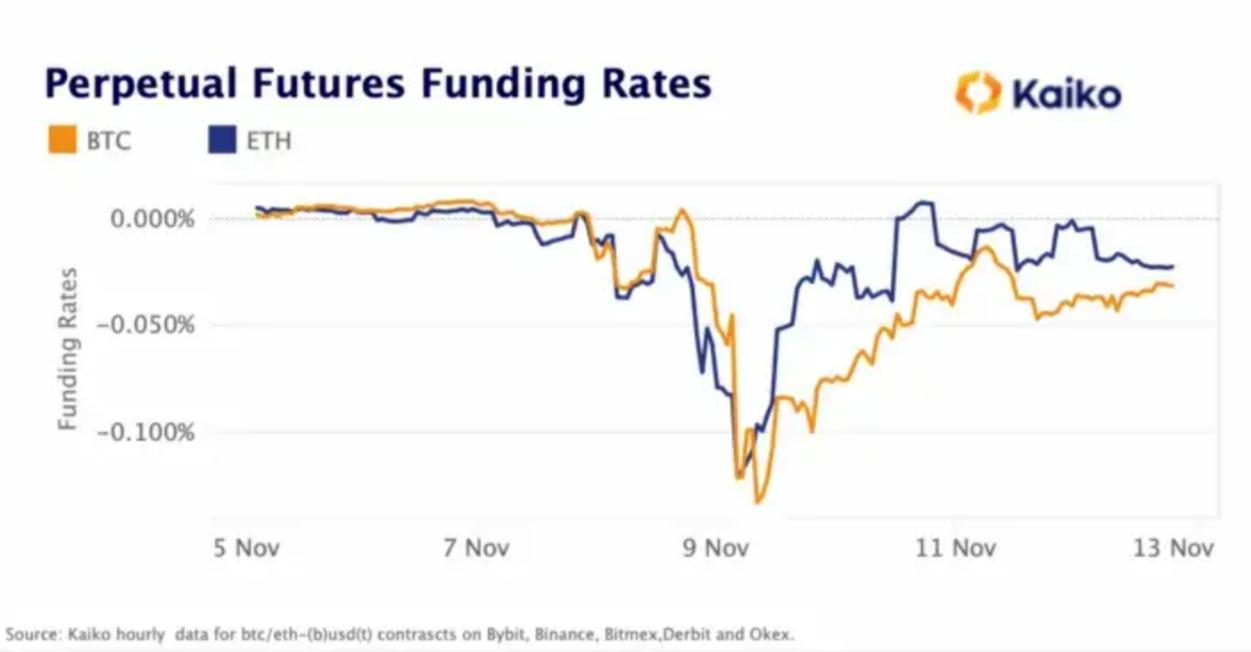
The events of last week had a major impact on market sentiment. Funding rates for both BTC and ETH have plunged into negative territory and remain in the red as of Monday morning as the market has clearly turned bearish.
There was also a sudden shift in sentiment in the options market, Nov 8-9, Implied volatility surged for BTC and ETH options. Implied volatility measures an options trader's expectations of future price movements.
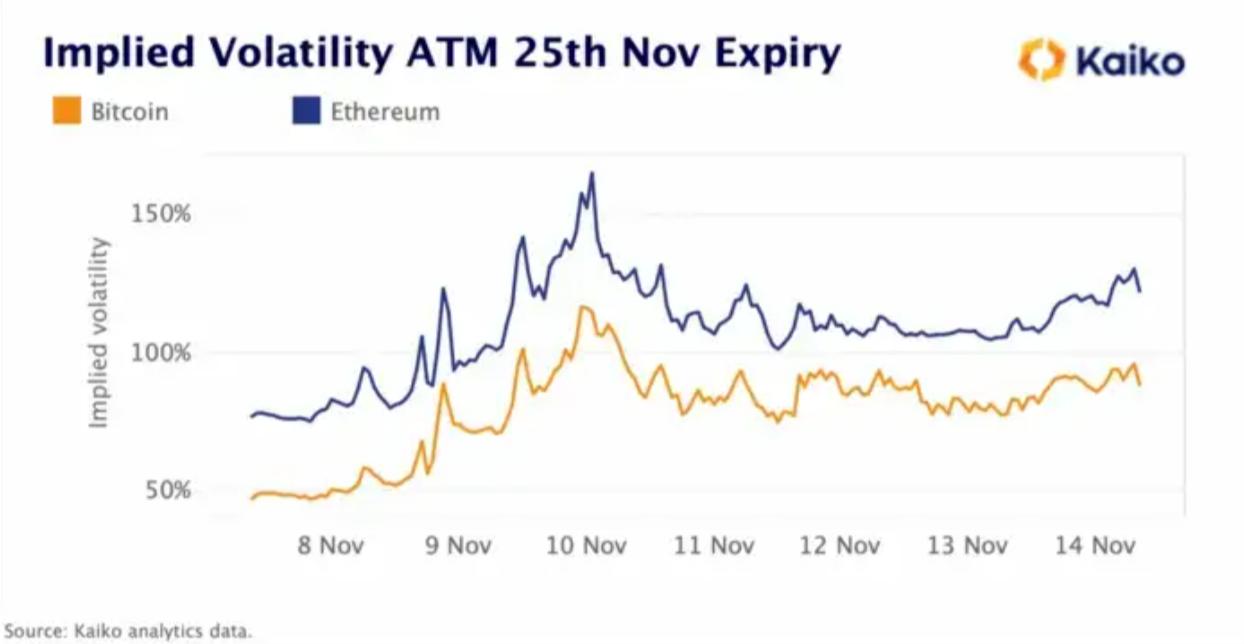
BTC ATM Implied Volatility Expiring November 25th in Just 24 It more than doubled from around 50% to over 117% within an hour. Implied volatility at ETH ATMs also spiked to 165% before easing back slightly. Implied volatility remains high, suggesting a sea change in the market's perception of risk.
The relationship between cryptocurrency and TradFi
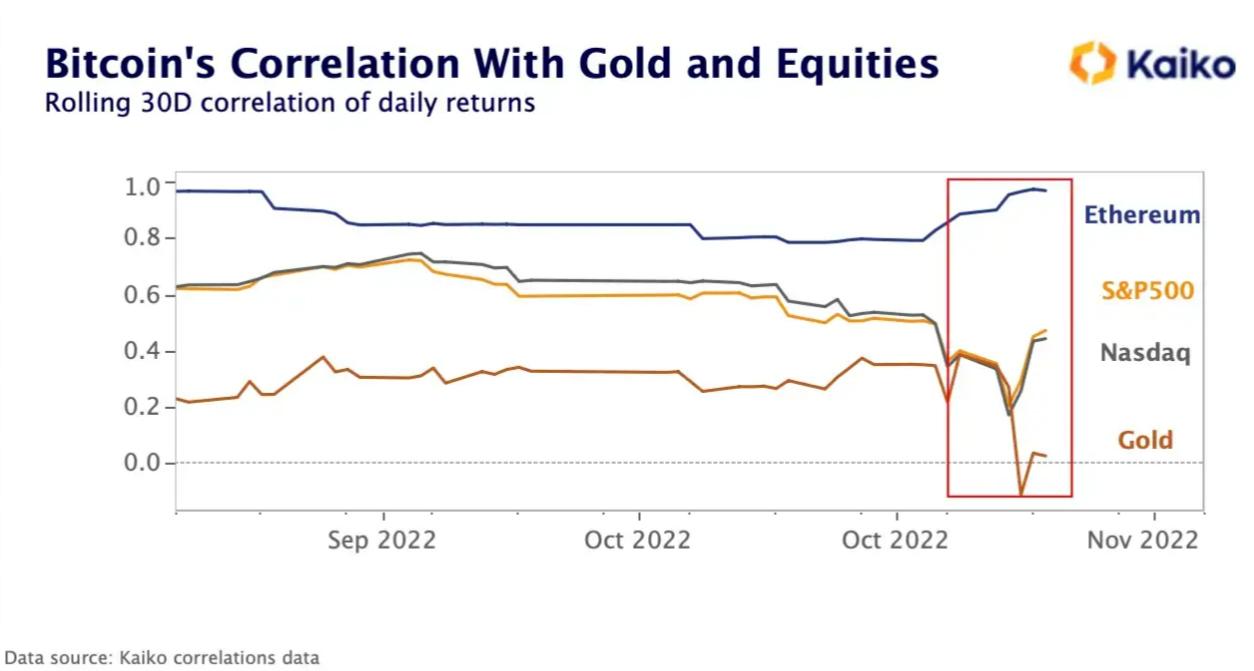
In last week's Token After the inflation print, the cryptocurrency market is sure to experience a sharp rally in the coming week, which may give people hope that inflation may peak and the Federal Reserve will slow down its monetary tightening policy. While crypto assets tumbled, the Nasdaq 100 and S&P 500 jumped 8.8% and 5.9%, respectively. As a result, BTC’s rolling 30-day correlation with U.S. stocks fell to just 0.17, the lowest level since November 2021, before recovering to 0.4.
After the gains of the past few months, BTC's correlation with gold turned negative, closing the week close to zero. In contrast, its correlation with ETH surged to its highest level in more than a year.
The turmoil in the cryptocurrency market led to sharp falls in cryptocurrency-related stocks The stocks have significantly underperformed the broader market amid falling confidence in the sector and contagion fears.
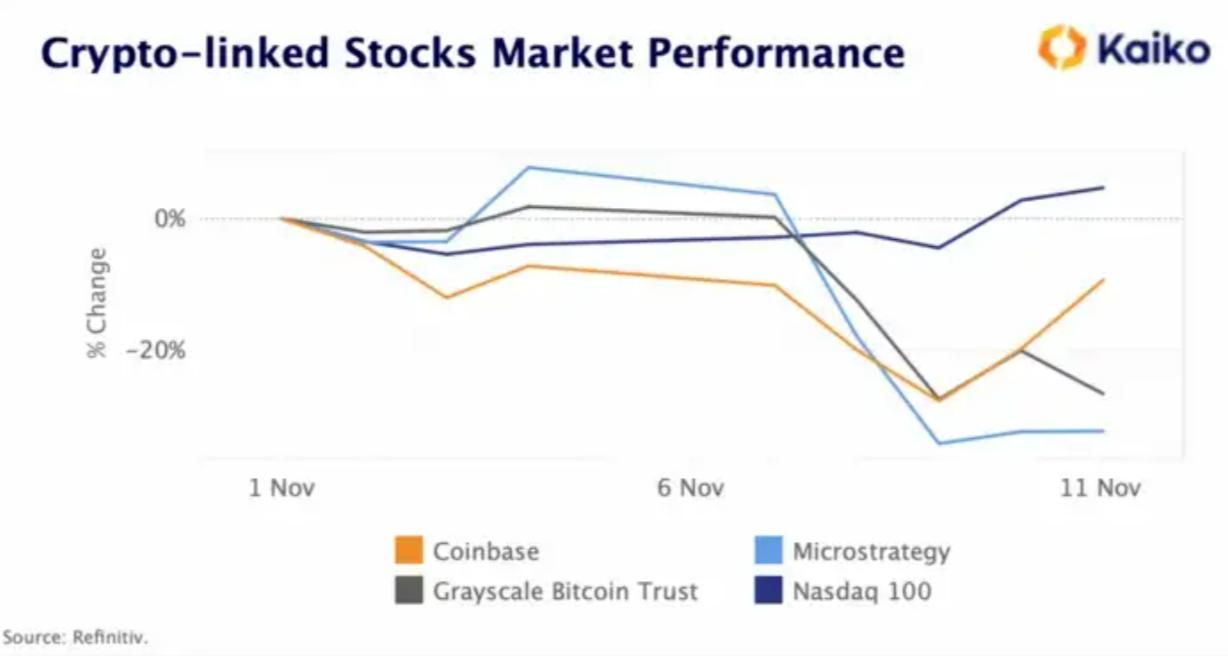
The value of the 130,000 BTC held by Microstrategy plummeted by about 5 in 5 days Its share price fell the most, ending the week down 37%. Grayscale Bitcoin Trust (GBTC), the largest BTC investment vehicle, lost 28% of its value. This movement further led to an increase in the Grayscale discount, reaching an all-time low of over 41%. The discount is the difference between the GBTC share price and the market price of the Bitcoin it holds. This figure has been expanding since February 2021 due to structural reasons and increased competition. Rumors of Alameda Research holding a large GBTC position likely added to the selling pressure.
Despite a slight loss for the week, Coinbase, the only publicly traded cryptocurrency exchange, recovered most of its losses on Friday as buying demand remained strong.
Proliferation
The impact of the FTX event has only just begun. Over the weekend, Blockfi announced that they had been bailed out by FTX during the crypto credit crisis and would be forced to halt withdrawals. Hedge fund Galois Capital admits that half of its money is in FTX. Investors in FTX, including SoftBank and Sequoia, have since written down their investments to zero. It will be several months before we fully understand the extent of the crash.
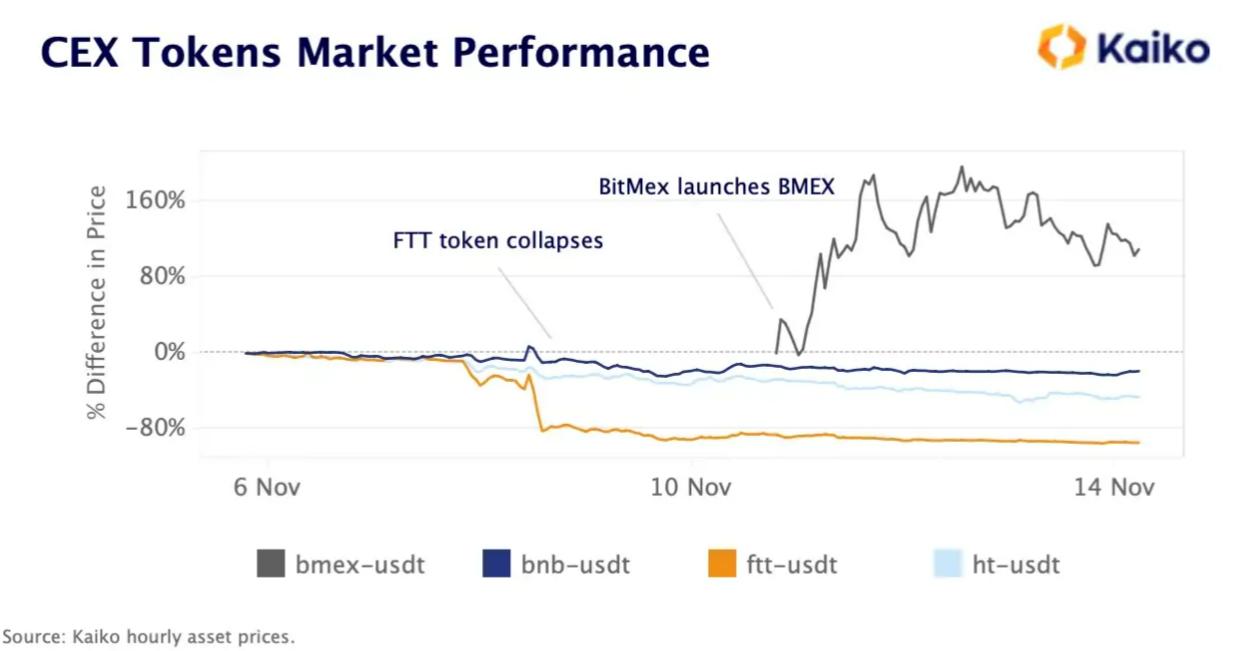
But cryptocurrencies are special, in the aftermath of the FTT debacle a whole new trading platform emerged Token . Last Friday, Bitmex launched their native BMEX Token , which they named "True Believers Token "(the token for true believers). Should Token The usage of is strikingly similar to that of FTT.
Since its launch, BMEX has soared more than 100%.
Original link
Welcome to join the official BlockBeats community:
Telegram Subscription Group: https://t.me/theblockbeats
Telegram Discussion Group: https://t.me/BlockBeats_App
Official Twitter Account: https://twitter.com/BlockBeatsAsia

 Related Articles