NFT Blur: Probably the best NFT watch platform yet
Cookie, beat BlockBeats
Some say Blur is like a "souped-up" version of sudoswap, with "efficiency" written all over its genes.
In OpenSea or other NFT trading markets, the home page recommends different new things every day, looking for the picture you like to send an Offer to the other party, and slowly waiting for the transaction, just like visiting a "big store". In Blur, the front page is only a kanban of transaction data for popular projects. There is no Offer, only a fast-paced offer, like sitting in an "exchange".
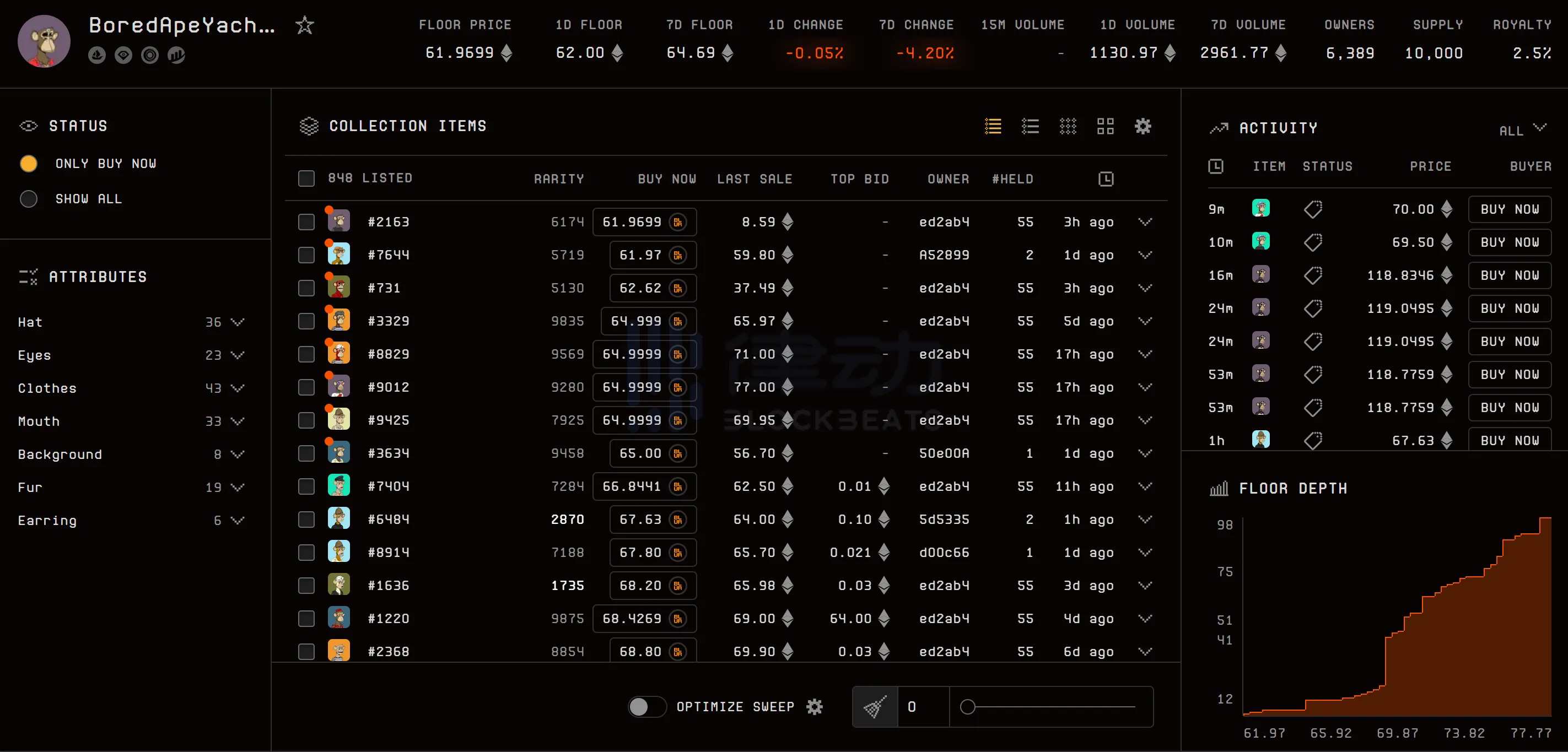
UI is also a strong "exchange" flavor
Only half a month since its official launch, this unique style of "exchange" has achieved extremely brilliant results, so brilliant that there are "OpenSea will be replaced" voice. From 31 October to 4 November, ETH volume on Blur continued to outpace OpenSea, with the highest single-day share reaching 60.3%.
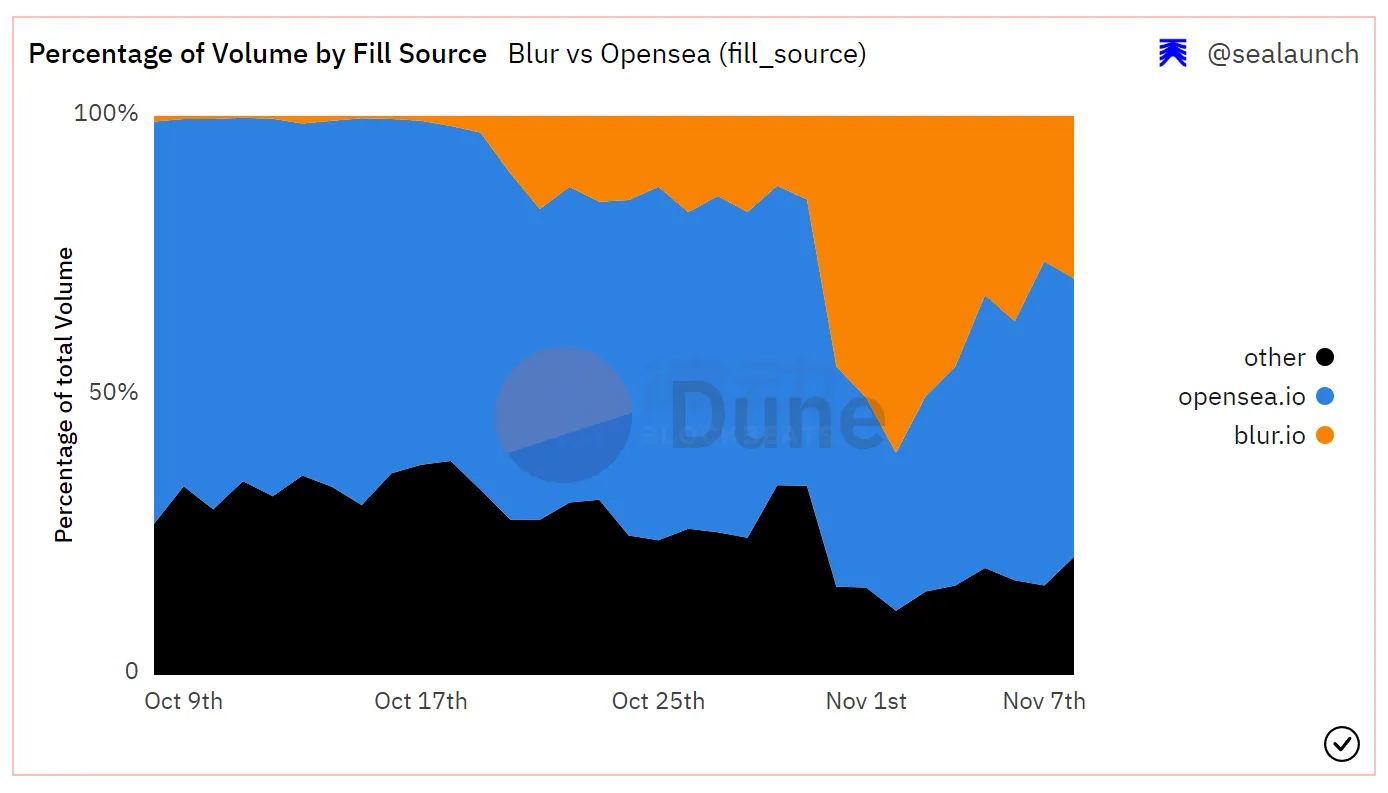
The combination of strong product quality, clever marketing and market conditions has led to a great start for Blur that is worth remembering. But as the Art Gobblers' heat fades and Blur's momentum slows, how much further can Blur go? And is Blur's success good or bad for NFT?
"Good Start"
Blur s debut is one of the coolest in the NFT market.
For the same Token of birth, Blur's new twist of "opening a blind box" has been used to great effect. Although the whale got the "box" more, but before all sentient beings equal luck, plus draw the prize "dazzle" mood everyone has, the program effect is quite good. The last time the NFT "birth Token" had such a buzz, it was probably the SOS that made the "OpenSea Everyone loved" sentiment last Christmas.
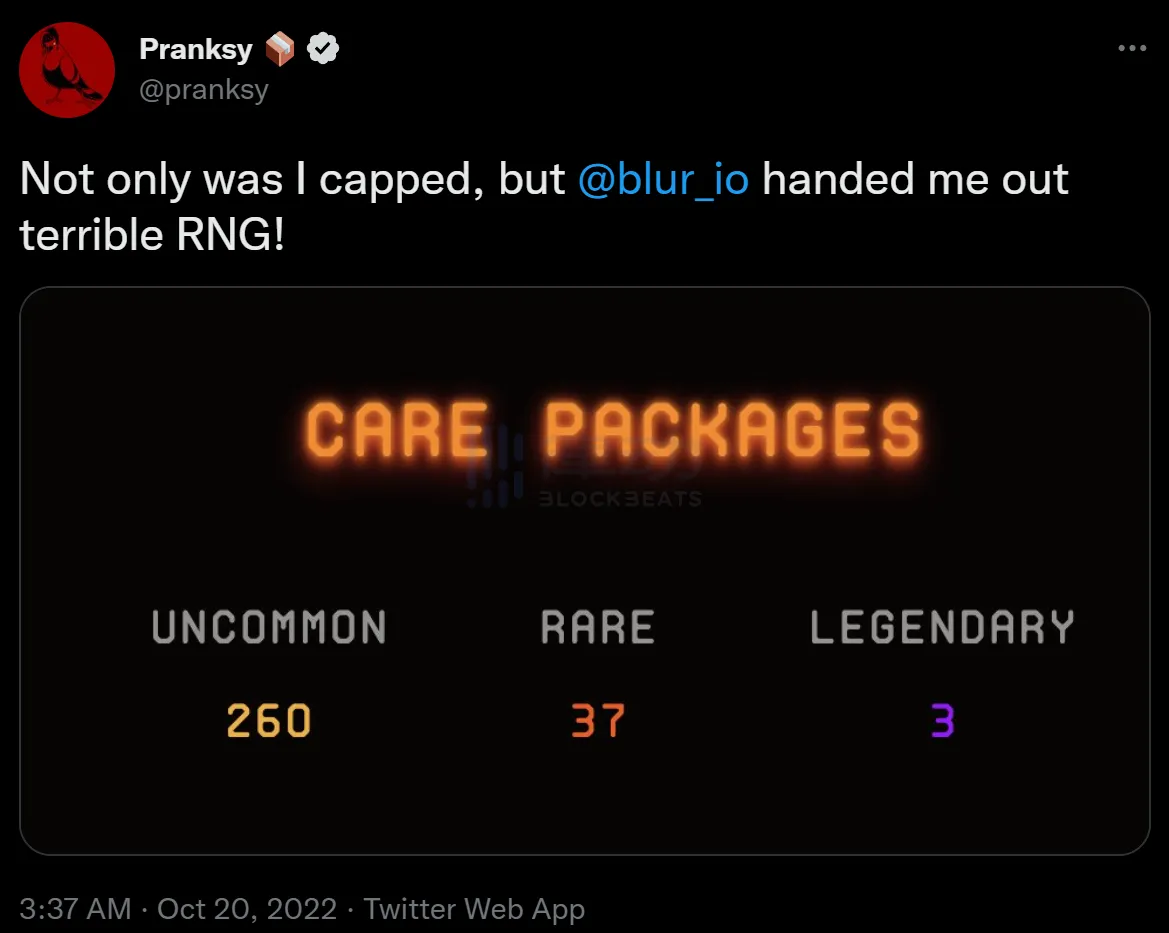
Pranksy: Blur gave me too little luck...
Of course, it's the product that really takes hold, and while Blur has been in closed beta until its launch, its reputation for being fast has spread to some extent thanks to the rapid updating of real-time streams of orders and transactions.
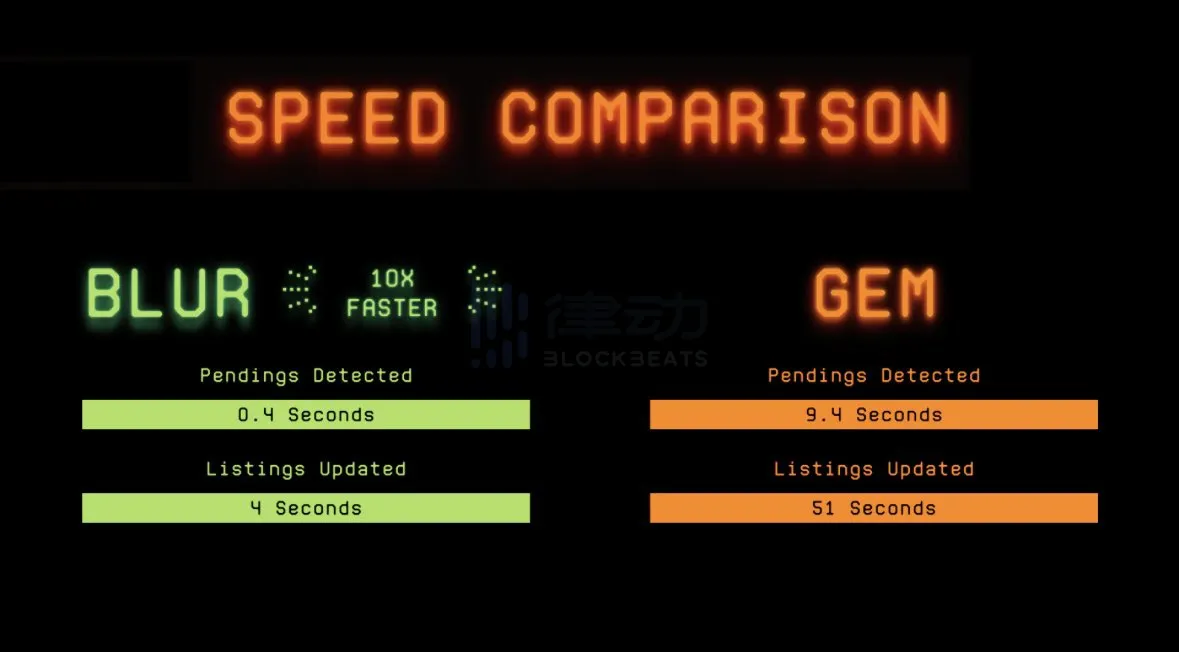
"Fast" is Blur's defining feature, and they claim to be 10 times faster than Gem
Since September, Blur has had a steady presence on the "Aggregator" circuit, outpacing Genie, x2y2 and Element overall. Officially launched on October 20, Blur's share of the Aggregator circuit has grown rapidly and is now well ahead of the previous "king" Gem.
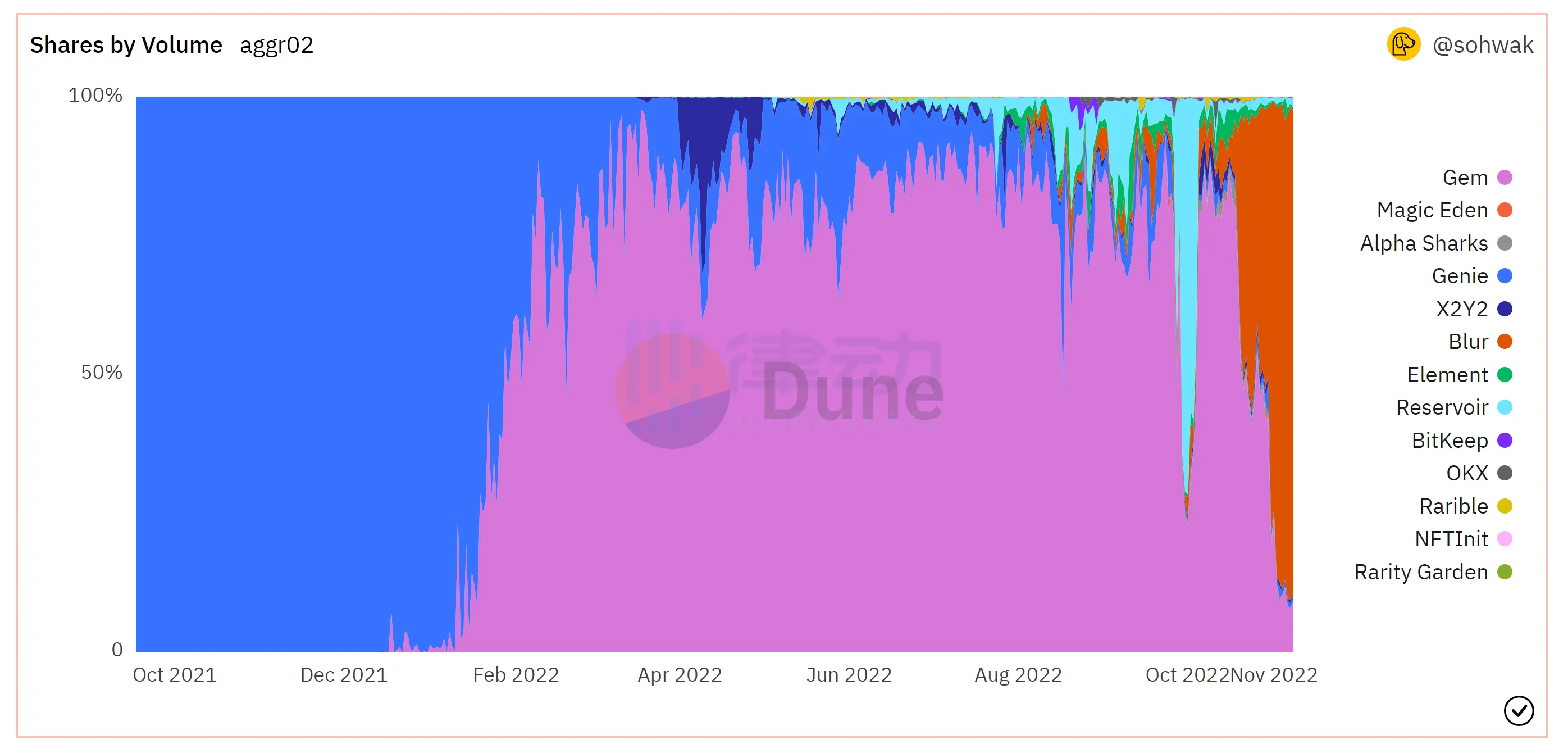
Change of turnover ratio of each NFT aggregator
The shift in the NFT market may have been an unexpected timing for Blur. At the end of March, when Blur officially announced that they had raised an $11 million seed round led by Paradigm, they talked about building the best NFT market for "Pro Traders." At that time, the price of ETH was above $3000, the floor price of BAYC was over 100 ETH, and the average amount of NFT transaction on the ETH chain was $2274. "Sweeping the floor" was the behavior of Pro Traders compared to today. As you can see clearly in the two charts below, the number of NFT aggregator transactions was significantly higher from September to November, but the volume was significantly lower compared to March to April:
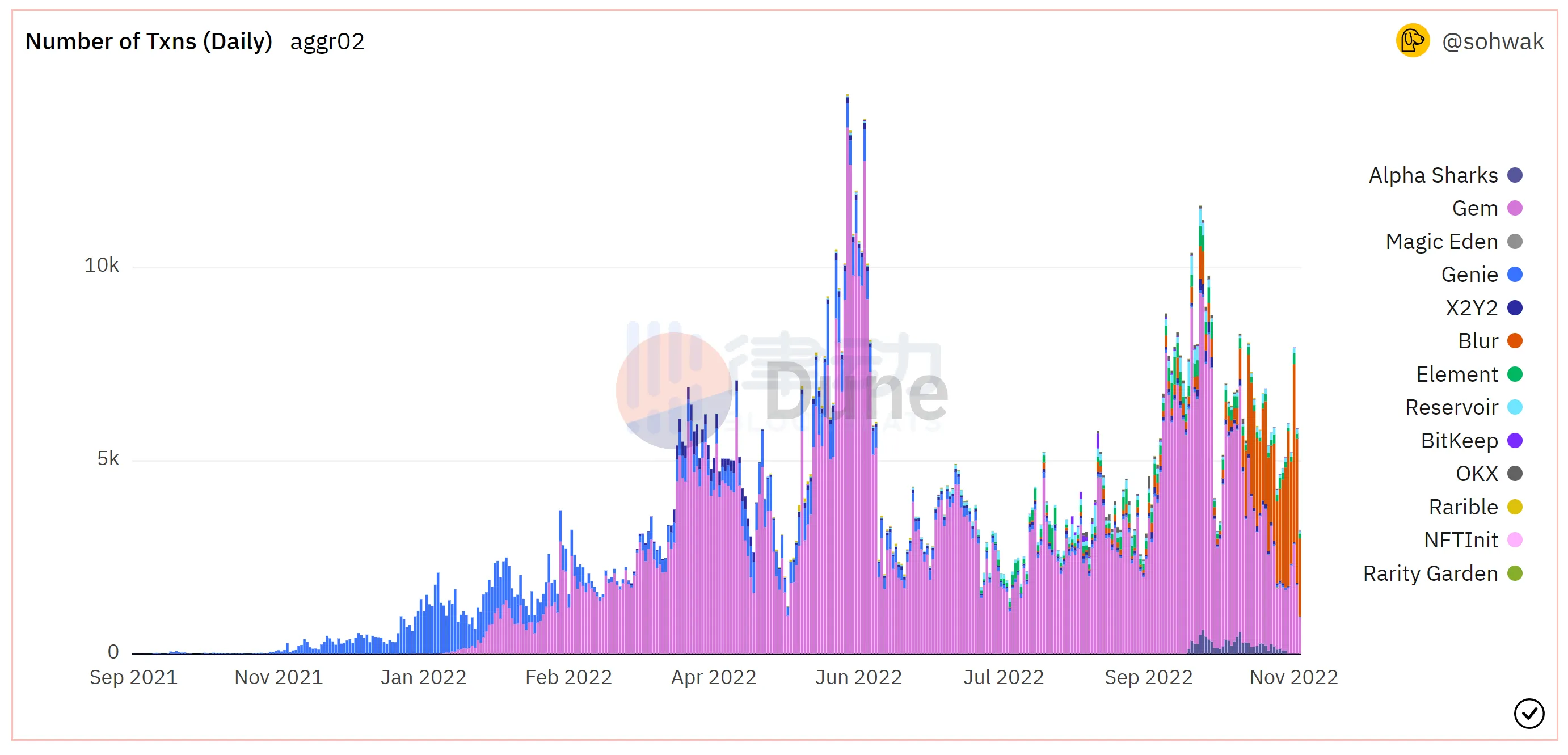
Aggregator transaction statistics
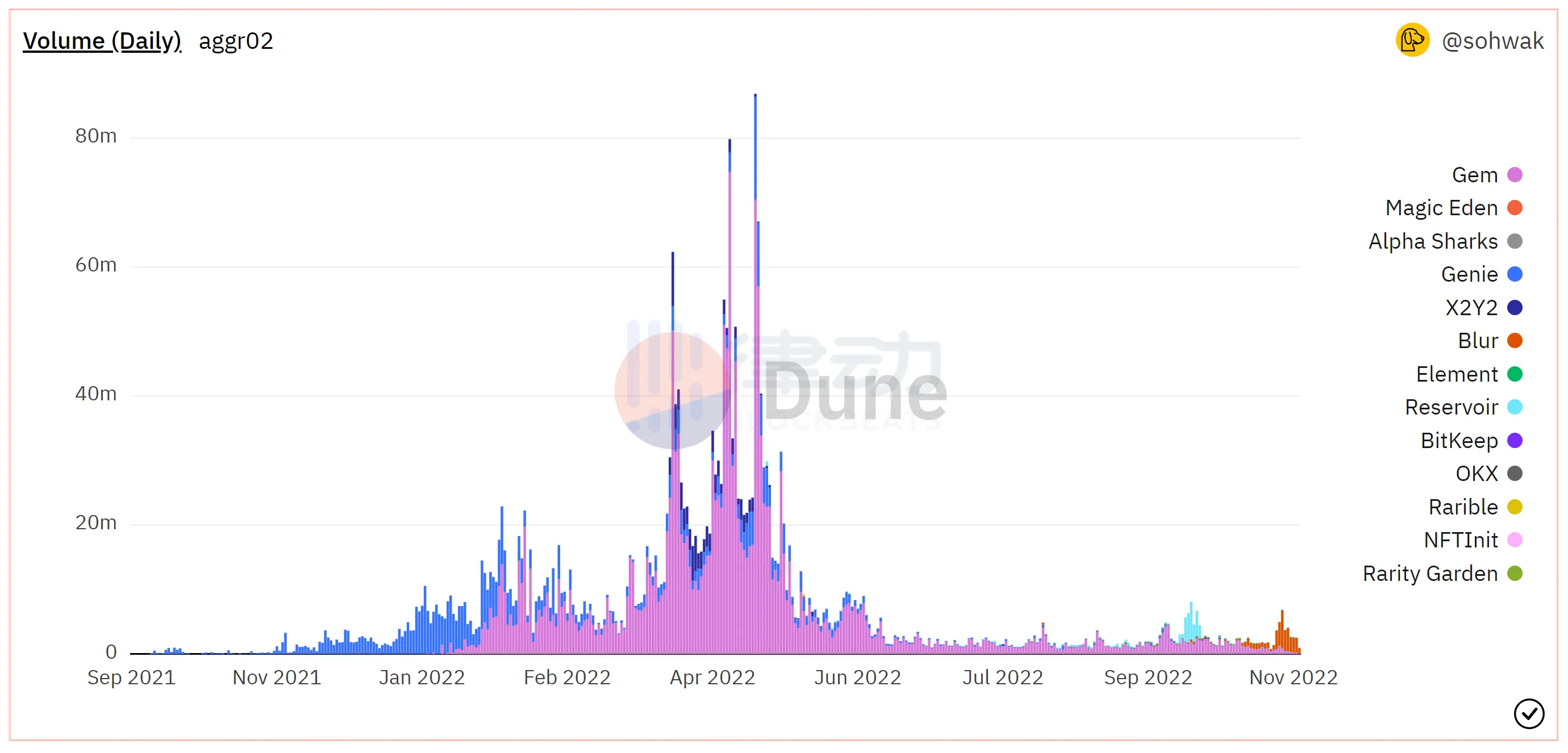
Aggregate volume statistics
But now, "sweeping the floor" has become a habit for almost all players. Since July, most new NFT launches have been launched at "Free Mint" or very low Mint prices, and the "opening price" on the secondary market is much lower than in March, making it difficult for players to get the desired revenue without buying 5 or 10 more NFT at a time.
At the same time, with the double whammy of a lack of money in the market, and "Free Mint" and "zero royalty" disrupting the sustainability of projects, players are used to "fast in and out." A good aggregator is almost a "must have" for players still active in the market -- if you buy directly in the NFT market as before, the floor price difference and slow operational response between markets will not be able to quickly acquire the right price chips, and you will either miss out or lose money.
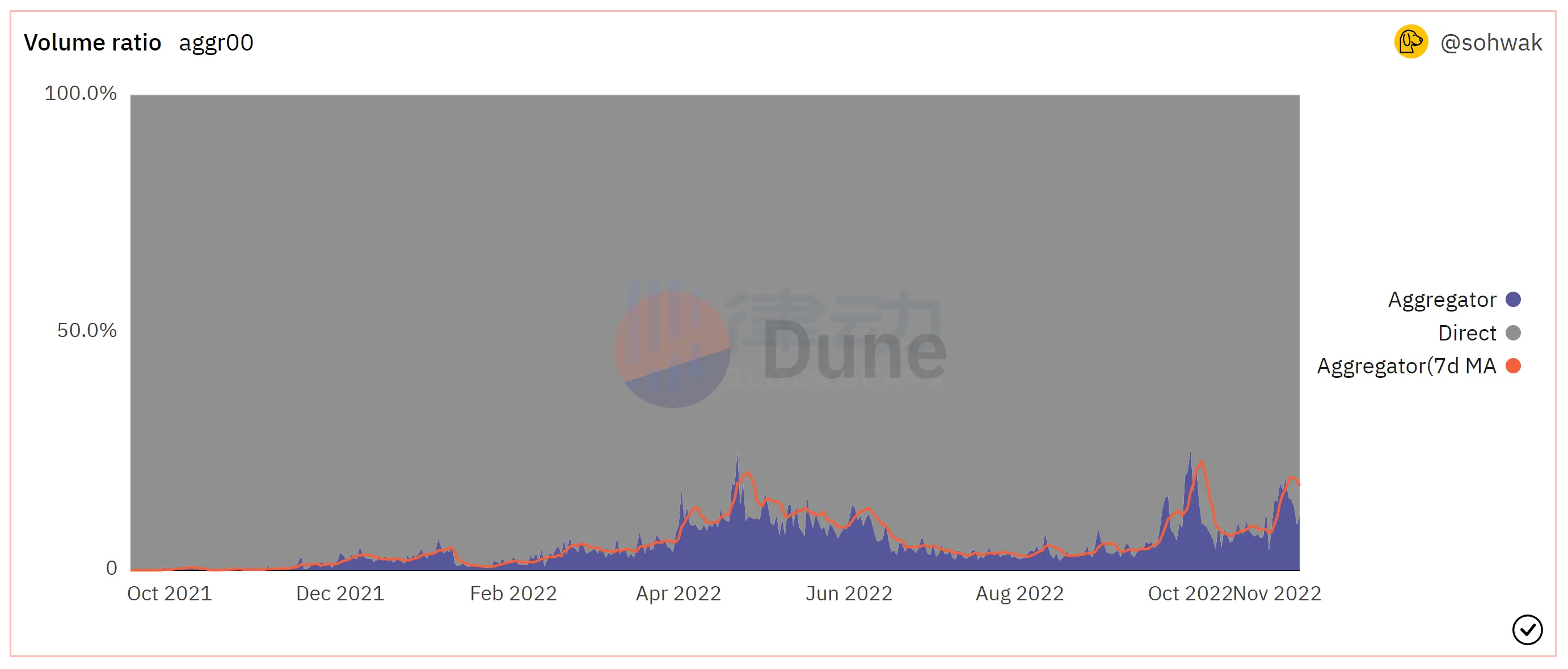
Trading volume through aggregators versus trading volume directly through the NFT trading market. As you can see, in the last two months (although the volume is only about a tenth of that of April), the share of trading done through aggregators is about the same as it was in April
As the most excellent and the most will be the whole life of that a "must-have", and step on the "day" wind. Blur got off to a bad start.
"How much further can we go?"
According to data shared by @punk9059, Blur still has 26% of the market share after stripping out contributions from Art Gobblers.
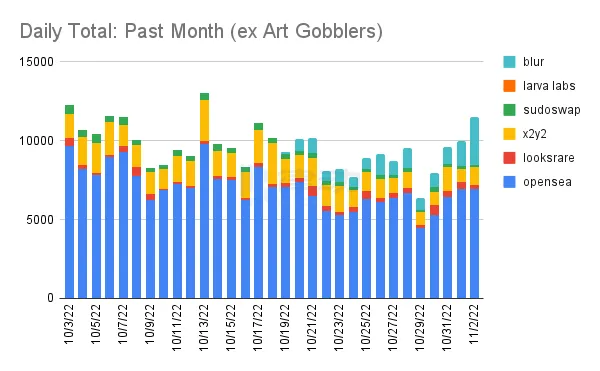
Market share after excluding the influence of Art Gobblers
With this current data, @punk9059 raises two questions:
1. Blur's second airdrop campaign is still going on. The airdrop is incentivizing users to put liquid NFT in Blur at the lowest possible price.
2. A fair number of deals have happened with Blur, probably because of "low royalties" or even "zero royalties". Although Blur's second airdrop campaign incentivise users to set royalties when they hit the NFT, the numbers don't seem to be working as well.
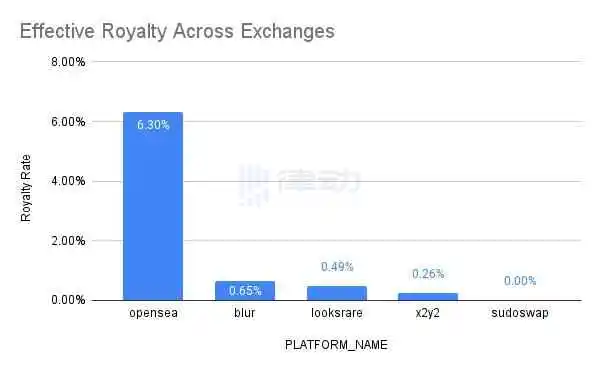
The average Blur transaction generates only 0.65 per cent in royalties
As we mentioned earlier, what happened to the NFT market may have been an unexpected "time of day" for Blur, and the "zero royalty" debate that continues to this day was a product of the "time of day" -- the NFT marketplace was trying to steal players away with "zero royalty", and players were trying to maximize Flip profits with "zero royalty". The number of people who define NFT as a work of art, apart from creators, is dwindling.
Let's take a look at this sad chain of logic. Due to the lack of market funds and confidence, it is difficult for the creators to get recognition for their painstaking work results, and it is difficult for the project parties who want to work to raise enough funds. If you look at the route map of the new project, the narrative is almost stuck at the beginning of the year. The market of "local dog" is like playing a prank. Bad money drives out good money. Players don't care what the project side wants to do, and they don't even choose a picture they like as carefully as they used to, as long as the "odds" are right, like flipping a coin to guess the size. It is common to buy a project before going to bed and return it to zero when waking up. Is it like a "local dog" of FT?
Aggregator traffic will not decrease as the casino-ized "local dog" market continues. Blur is currently interfacing with OpenSea, LooksRare, and x2y2, and this aggregator is a great way to channel aggregator traffic to the Blur market -- after all, it doesn't take much to select one more Blur market when Blur can launch at the same time. In turn, when using the aggregator to "sweep the floor", there is an endless stream of Blur monads to "sweep", a perfect inner loop.
Aggregators as traffic importers to the market are all very well, but the challenges are daunting. Gem, under OpenSea's ownership, will presumably try to close the user experience gap and reclaim the top spot on the aggregator circuit. With OpenSea's launch of the "Collection Offer" and Beta data Kanban, we can see that OpenSea is also aware of the changing needs of players in the current market environment. It is possible to integrate Gem into the market more seamlessly. Blur needs to remain at the heart of their differentiating advantage: "fast".
Blur's own revenue model as an NFT market is also unclear. For now, Blur does not charge a fee, but there is no official promise that it will be free forever. According to Blur officials, subsequent holders of $BLUR will have governance rights over Blur. If the monetization model can be determined by DAO governance, that would be really cool and could really take Blur a long way -- for example, is there a way to work together to find a new solution, "Win-win-win" for creators, players, and the market?
"For better or for worse"
Finally, back to the last question posed at the beginning of the article: Is Blur's success good or bad for NFT?
My answer is yes. Blur rode the wave of "time", but its solid product was the key to its success. The more good products there are, the more progress the NFT market will make.
You could argue that "zero royalties" makes it harder for small and medium-sized creators/project owners. Yes. After all, even the OSF lamented:
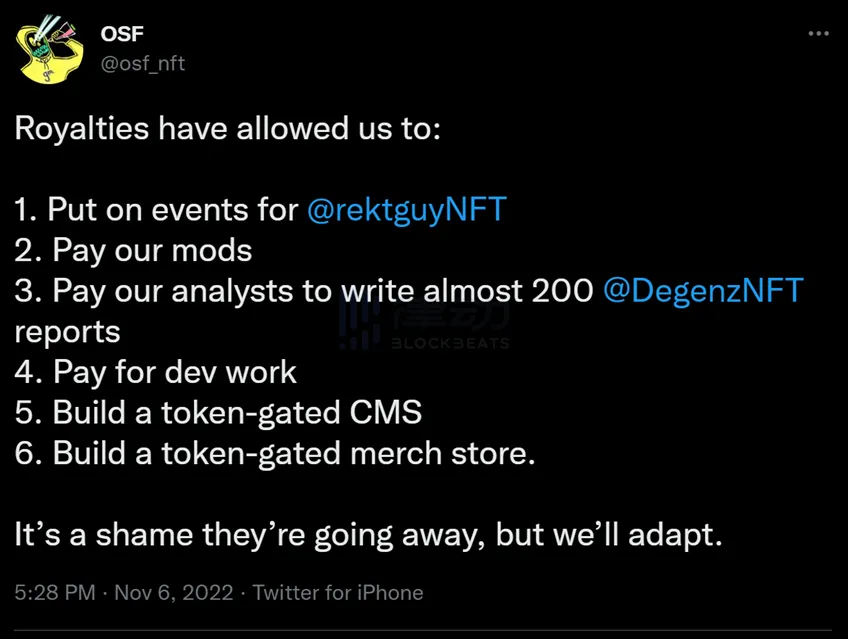
"Lost royalties, lost campaigns, lost salaries, lost apps :("
True, but that's not Blur's fault, it just went with the flow. This must have wiped out the possibilities that a lot of the project was trying to explore, but if it had made everyone more calm, maybe it was just pain -- "art" is the best "application", the fulcrum of all "application expansion" possibilities. But if it's just art, are you and I willing to pay for it? If the possibilities to pursue are impossible without royalties, should creator/project pricing and commitment be more rational and planned?
Blur didn't change the market. The market made Blur. When more ingenious new products and projects appear, more funds will join and the market will enter a benign inner roll. And what will Blur be then?
I'm looking forward to it.
Welcome to join the official BlockBeats community:
Telegram Subscription Group: https://t.me/theblockbeats
Telegram Discussion Group: https://t.me/BlockBeats_App
Official Twitter Account: https://twitter.com/BlockBeatsAsia
 Related Articles