The impact of the FTX event: the market and subsequent risk prediction

Original title: "The Impact of the FTX Event: Market and Follow-up Risk Prediction"
Original Author: Flora Li , Nolan Liu, ZengHang, Barry Jiang, Huobi Research
1. Event Review
FTX events seem to have entered a new phase by November 9th, and within the past 24 hours What happened will almost certainly be etched in the history of the cryptocurrency industry. The following is the current situation of the incident. We hope to let readers know the whole picture of the whole thing through some key figures:
< br>
1) On November 2, Coindesk broke the news that Alameda’s balance sheet has great hidden dangers. Approximately $6 billion of the total $14.6 billion in assets is FTT and SOL.
2) On November 6th, CZ tweeted that he would gradually sell the FTT held by about 23 million US dollars. FTT began to fall after the news, and the price stabilized around $22 after the Alameda CEO expressed his willingness to accept the FTT that CZ was selling at $22. But in just two days, nearly $1 billion in assets have flowed out from FTX and Alameda.
3) At 11:00 on November 8th (UTC+8), the market rumored that FTX sold 100 million bits and other Tokens it held to supplement liquidity. FTT once fell to 16 dollars due to concerns about a broken capital chain. However, on the afternoon of the 8th, several hot wallets of FTX did not transfer coins out for 2 hours, further causing panic, and FTT led the market to continue to drop.
4) At 0:09 on November 9th (UTC+8), SBF and CZ both tweeted that FTX and Binance have reached a non-binding agreement: Binance will acquire FTX Global Station to help FTX cope with Liquidity crunch. After the statement was issued, the market was boosted and rebounded sharply. FTT returned to above $20, and BTC and ETH also returned to the level of $20,000 and $1,500 respectively.
5) At 2:00 on November 9th, the US Commodity Futures Trading Commission stated that it was monitoring Binance's acquisition of FTX. And there are voices that the rapid acquisition may be due to the relatively cheap acquisition amount, which will cause losses to FTX’s previous investors and may violate the anti-monopoly laws of various countries. These voices have triggered concerns about whether the merger can be completed in the market. To make matters worse, SBF stated in an internal letter to the company on Tuesday morning that $6 billion had been withdrawn from FTX in the past three days, which made the market realize that FTX’s funding gap exceeded previous expectations.
At 8:00 on November 9th, FTX suspended all cryptocurrency withdrawals. This series of events led to a further collapse of the market. So far, the price of FTT has fallen below $5, BTC has fallen below $17,000, and ETH has fallen below $1,300. At present, the number of stablecoins in FTX's wallet has dropped by more than 80%, and it is currently less than 200 million US dollars, and there are less than 40 BTC.
2. FTX event impact scope and follow-up prediction
2.1 Impact of the FTX Event
The impact of this FTX thunderstorm event may go beyond the scope of institutions that were implicated in the previous Luna and 3AC crashes but were not bankrupt, and the impact will go deep into Every corner of the industry. Institutions that continue to participate in the lending of FTX in this round have huge potential liquidation risks. We can understand the impact of this event from three levels:
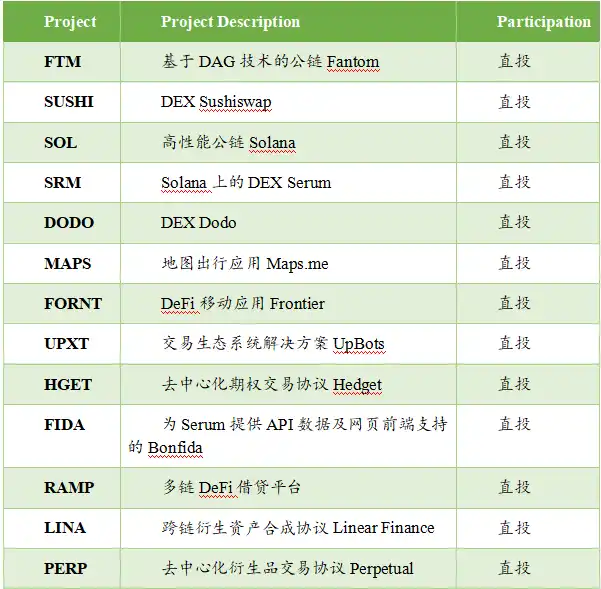
a) Direct impact layer: projects directly invested by FTX and Alameda and centralized institutions that have direct lending and cooperative relationships with FTX. The project level mainly includes important public chains and DEXs including Solana, Fantom, and Serum. As shown in the table below, these are the direct victims of the FTX thunderstorm incident.
We have analyzed the asset situation of Alameda, and currently Alameda’s monitorable wallet holds top value Token As follows: BIT, SUSHI, FTT, SRM, LDO, MATIC, RNDR, etc.

BIT: It is currently impossible to confirm whether it will be unlocked against its promise. FTX promises not to unlock, but the bit is in Alameda The value in the wallet has reached 23%, the market confidence is insufficient, and it is a high-risk currency.
SUSHI: ; Alameda has a total of 3.4 million xSUSHI, and 4.8 million SUSHI can be proposed, but the price of large-value liquidation on the SUSHI chain is very low, and it is expected to be unreachable. It is relatively safe at present. At present, it is mainly the market's fear of Alameda's huge holdings that leads to lack of confidence.
MATIC and RNDR : Strong liquidity, and not SOL assets, there is a high probability that the funds will be sold first. RNDR has lost 26% and MATIC has lost 20%. If the balance of Token Transfer to the trading platform will continue to fall.
FTT:FTX It is said that Alameda also borrowed a lot from FTX for its own platform currency and used it as collateral. However, loans and loans do not exist on the chain, and there is no way to know the specific liquidation details. Based on collateral, the FTT token price is favorable for Alameda, possibly as a last resort.
SRM: where FTX and Alameda, which are closer projects, have always had a close relationship. At present, the price of the currency has broken badly. Like other protocols on Solana, TVL has fallen by 20%-30% in 24 hours.
SOL: chain There is a large amount of asset liquidation risk. A large chain owner currently has 2,095,598 SOL (worth more than 38 million U.S. dollars) as collateral and 48,038,000 USDC in debt. If the oracle machine recovers, it will trigger liquidation and cause the price to drop sharply.
As for the organization that has a business relationship with Alameda, there is no public information to confirm it, but it must exist.
b) Indirect influence layer: Alameda as a market maker and equity replacement projects, or projects that are heavily bound with assets such as FTT, such as bitDao, MIM, etc. Although these projects do not have FTX investment, they have in-depth business relations with them and will be greatly affected under the current circumstances.
c) Radiation layer: other assets in the market, mainly affected by related assets and market panic.
In short, during the three years since the rise of FTX, as the second-ranked centralized trading platform, its tentacles have penetrated into all aspects of the industry. How many projects have caused losses, but it can be qualitatively said that compared with the luna incident, the FTX incident is regarded as the Lehman incident in the currency circle.
2.2 Follow-up market and progress forecast
a) From the market point of view, before the FTX storm, the market was already in a relatively deep bear market. With the tightening of macro monetary policy and events such as luna and Three Arrows Capital, BTC fell all the way to $18,000. However, in recent months, although the Fed’s continuous and substantial interest rate hikes have tightened the macro environment, the overall market has entered a relatively stable stage. BTC has not only held the $18,000 mark, but has also slowly rebounded to around $21,000. Seeing that the peak of interest rate hikes is about to pass, the collapse of FTX made the market turn all the way down, with BTC falling below $17,000 and ETH falling below $1,300 again. The last time I saw BTC around $17,000 was in November 2020, two years ago. Therefore, it can be said that apart from the proven $18,000 mark that has been supported for five months and can be trusted, the prices below it are currently not very credible, and the market has not reached a consensus on the next key point.
b) Developed from events From the perspective of possible path inference, first of all, Binance’s acquisition faces many difficulties: this acquisition faces the risk of review by US regulators and the legal risk of possible violation of anti-monopoly laws, which may lead to the failure of Binance’s acquisition. In addition, FTX’s financial loopholes far exceeded the market’s expectations, so that CZ also tweeted with emotion, which also scared off other possible acquirers in the market. For example, Coinbase made it clear that it would not acquire FTX. Based on the above analysis, we believe that the window for Binance to acquire FTX is getting smaller and smaller, but in order to maintain the influence of local American elites in the currency circle, there may eventually be a local American force to complete the rescue of FTX. But from the current point of view, the whole thing has not seen any dawn, and the market will still suffer from pain until there is a turnaround.
c) from the industry Impact: This incident has once again triggered distrust of centralized trading platforms in the industry. In order to strengthen industry confidence, both Binance and Huobi have stated that they will disclose auditable merkle tree reserve proofs or POFs within one month. At the same time, the voice of strengthening supervision within the industry has risen again. For example, the CEO of Coinbase stated that the FTX incident will lead to stricter supervision of the encryption industry in the United States. This event will become a landmark historical event from the perspective of industry norms.
This article is from Contributor , do not represent the views of BlockBeats
Welcome to join the official BlockBeats community:
Telegram Subscription Group: https://t.me/theblockbeats
Telegram Discussion Group: https://t.me/BlockBeats_App
Official Twitter Account: https://twitter.com/BlockBeatsAsia