Investment markets "rules of the trade to win" Martin Gel in the crypto market reuse
Original source: 0xTree
For financial market traders, the most important thing is to ensure a stable profit. An important way to ensure profitability is to improve the success rate of trading investments, and the Martingel strategy, known as "winning investing", is one of the investment techniques that investors seeking winning rates should be familiar with.
The word "Martingale" comes from a French village and was written by a number of adventurers. Legend has it that gamblers from this village spread a gambling strategy throughout Europe: after each loss, the gambler doubled his bet, so that he could recoup all his previous losses with just one win, as well as winning the same amount as his original principal.
Let's try to understand the problem in ways other than financial markets.
Let's say we have an equilibrium coin and we're playing a flip game to simulate the ups and downs of the market, where the coin has an equal probability of heads and tails. Let's say, if it's heads, then player B pays player A a dollar; If it's tails, player A pays player B one dollar. Below is the typical evolution probability path of A's principal based on the number of flips made (Figure 1).
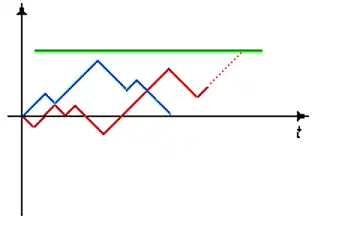
Figure 1
On average, players can't win or lose a coin toss, in the sense that one player (we don't know which) must win a dollar and the other player must lose a dollar. The mathematical expected value of their change in principal is zero. At the same time, there are many conclusions to be drawn from this. For example, the conclusion that the bet is a fair bet in the sense that it is statistically impossible to win money on such a bet is that the average of any stop-loss strategy would be zero.
No one wins or loses naturally does not meet the real demands of the market, then Martingel strategy emerged. Going back to our coin game, Player A starts the next hand as usual every time he wins, and asks to double his chip to two dollars every time he loses A dollar. If the second game is won, the chip will be reset to one yuan, otherwise it will be doubled to four yuan. So over and over again, no matter how much he lost in the last game, he averaged out one dollar per game. Mathematicians named this phenomenon "Martinger". This means that in theory you have a 100% win rate.
Risk Management under Martinger's strategy
In practice, blind faith in the Martingel strategy often slips into the "contingencies of the perfect model", leading to losses.
But back to our coin game. In A new round of coin games, this strategy can make a lot of money in the long run when Player A starts trial-and-error, especially since there is no commission on the coin toss (transaction fees are waived). However, if Player A's pool is capped (let's say $100), he will sooner or later run into a dilemma: if he does it enough times, his mathematical expectation of waiting for a win after a losing streak will continue to increase exponentially, resulting in the amount of money waiting for the next flip exceeding the pool and having to concede the loss (Figure 2).
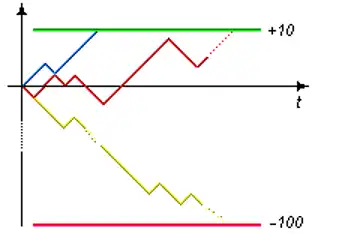
Figure 2
In practice, because no one has a capped pool of money, the only person who can really execute Martingel's strategy perfectly is the person with unlimited money, and the paradox is obvious -- the person with unlimited money doesn't need to invest and gamble to make money. But this only proves that the classic Martingel strategy is not fully applicable to this scenario of positive and negative games without a premise, and that the expectation of a high win rate of the strategy itself is still favored by professional investors.
So what successful investors do is to set up a reasonable profit and loss and position management for the Martin Gel strategy to maximize the advantages and avoid the weaknesses. The Martinger strategy is especially suitable for trend trading and volatile trading. If the trader is confident enough in the trend and the risk-reward ratio is set, the user will be able to make a steady profit during the trading cycle.
The application of Martinger strategy in crypto market
In fact, the globalization and readily tradable nature of the crypto market is very suitable for the Martingel strategy to trade.
Oyi OKX recently launched the spot Martingel strategy function, in the traditional version of the operation idea, combined with the habits and characteristics of the crypto circle users, to do a greater degree of optimization. On the basis of ensuring user experience, the strategy aims to help investors realize the maximum return.
In the following, we will restore the operating principle of Martingel strategy more intuitively by combing several essential elements of the AUYI spot version.
1. Creation mode:
Oyi version Martingel policy sets two different creation modes for users with different experience: manual creation and intelligent creation.
Manual creation, is the trader according to the personal judgment of the market, to set parameters. This applies mainly to investors with rich trading experience and strong capital strength. Ordinary users suggest using intelligent creation mode.
Intelligent creation, the user according to personal risk preference, select the system recommended parameters to set the amount of investment and the rhythm of buying. It should be mentioned that the recommended parameters of the system are calculated by means of OuYI OKX background algorithm since the historical market and asset fluctuations. They have a considerable degree of authority and can bring reliable investment reference for traders. In addition, based on the traditional securities investment, the intelligent creation mode is to control the risk as much as possible. Combined with the asset status and endurance of users, parameters of different risk levels are recommended for users according to the three levels of conservative, balanced and aggressive.

Among them, for conservative investors, the primary consideration is capital preservation, rather than returns, and the ability to resist risks is poor. Therefore, under the parameter setting of conservative strategy, the number of buying is less, the price difference between each buying operation is larger, and the trading attitude is more cautious, which can hedge the impact of extreme market conditions, and is more suitable for novice users who try the strategy for the first time.
For aggressive investors generally have a stronger risk tolerance, dare to risk assets are relatively strong. Therefore, under the parameter setting of aggressive strategy, there are more times of buying, smaller price difference between each buying operation, relatively more times of buying, and more aggressive trading attitude. It aims to continuously earn multiple rounds of profits through high-frequency trading, and the accumulation of small amounts leads to continuous profits. It is more suitable for experienced users with high trading frequency.
Balanced investors are generally neither risk-averse nor risk-seeking, and are more rational about any investment. Therefore, the risk appetite and the degree of radicalism corresponding to the balanced strategy parameters are between the two, showing relatively moderate performance.
2. Warehousing parameters:
In specific trading scenarios, each additional warehouse order is determined by the additional warehouse parameters set by the user in advance. For example, the price difference between different additional warehouse orders is determined by the "how much to buy down" (the spread) set by the user.
There are two multiples to remember. One is that the user can set the multiple of "how much down to buy", that is, after falling 2, 4, 8 points to buy in batches, which is the concept of the spread multiple. In other words, the larger the multiple of the spread, the larger the difference between the price of subsequent additional orders, and the average cost of buying is reduced, which is more suitable for conservative investors.
At the same time, the corresponding purchase amount of different warehouse receipts is not fixed, and the user can also set the corresponding multiple, which involves the concept of multiple of the amount of additional warehouse.
Add the amount multiple, refers to with the price decline, the subsequent add the order to buy the larger amount. For example, the initial order is $10,000 to buy, the next additional order is $20,000, the next additional order is $40,000, and so on, the greater the amount.
3. Trading cycle and closing target:
Literally, a trading cycle is the process from buying to selling a trade. In the Martinger strategy, the trading cycle consists of an initial order, an increase order, and a stop order.
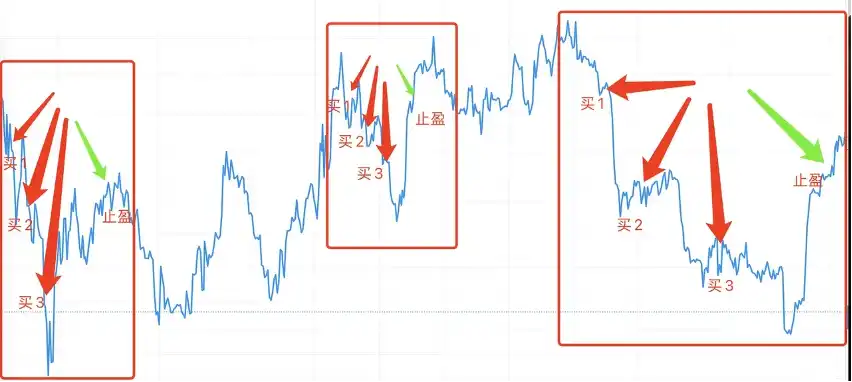
As the name implies, an initial order is the first purchase order. A warehouse order is a subsequent purchase order, which is intended to reduce the average cost of buying by buying in batches during each trading cycle, helping investors to reach their target of closing profit more quickly. From the other side, the warehouse receipt is also in the price decline of the market, an operation to protect investors.
A stop order is a sell order, which is the last order in the trading cycle. It should be noted that a trading cycle, there is at least one initial order and a stop order. The more additional orders traded, the lower the average buying cost during the trading week. The number of additional orders depends on the maximum number of additional positions set by the user.
In addition to the above concepts, there are two concepts that users actually care more about because they are directly related to the size of the revenue: the single stop target and stop price.
Simply put, a single stop target is the amount of revenue a user expects to earn in a trading cycle, expressed in 100 percent, such as 10 percent. If the user buys bitcoin at $10,000, that is, the initial order is $10,000, and the subsequent price of bitcoin rises steadily, only the initial position does not increase, then when the price of bitcoin rises by 10% to $11,000, the user will automatically sell the bitcoin at the profit stop price.
If the decline of the currency price after buying triggers the addition of positions, the average buying cost will be reduced, and the closing price will also be dynamically adjusted and reduced. The closing profit will be automatic as long as the target of 10% is reached.
The detailed calculation formula is: stop profit price = current cycle average holding cost x (1 + single stop profit target).
Therefore, Martingel strategy can help users to achieve the goal of dynamic profitability, that is, according to the user's expected goals, combined with real-time market trends, to sell as soon as possible for profit. It should be noted that when the system triggers the closing price and completes automatic selling immediately, the trading cycle of the current round will end immediately and the next round will be automatically entered directly.
4. Strategic stop loss:
In addition, as opposed to a single profit target, is a stop loss target. When the price falls to the position that triggers the stop loss target, it will automatically sell the transaction, and the strategy will stop immediately to achieve the purpose of timely stop loss. The actual stop-loss price for each cycle is determined based on the trading price of the initial order to avoid triggering the stop-loss price set at the beginning of the strategy too early in the event of severe volatility.
The detailed calculation formula is: stop loss price = current cycle initial order transaction price x (1 -- percentage of stop loss).
5. Reserve funds:
After the Martinger strategy is created, the default option regarding the use of trade funds is to reserve enough money in advance. After clicking OK, the purchase funds required for all orders during the trading cycle will be pre-occupied. Funds set aside for trading will also be transferred from the main account to a separate strategy account. At this point, this portion of the reserved funds can be regarded as locked up and cannot be used for other purposes.
For advanced users, if set the warehouse price multiples or add warehouse amount ratio is larger, and follow-up of the warehouse receipt with the price will be to trigger distance limit (i.e., the expected price declines) far away, so the probability of automatic clinch a deal to buy smaller, plus commission to buy large amount of factors, large funds are occupied by the long time the problem will be more obvious. Therefore, for the capital utilization requirement is higher, or add position multiple set quota larger investors, can choose not to lock in advance. In this case, the Martinger strategy will only occupy the funds of the initial order and the first additional warehouse order, leaving the remaining funds at the trader's disposal.
However, when there are signs of a rebound after the subsequent market decline, users who do not reserve enough funds in advance may be unable to place an order due to lack of funds, and then miss the opportunity of bottom-fishing. Therefore, for ordinary investors, it is recommended to reserve enough funds in advance, so as to give full play to the advantages of the Martingel strategy, and thus more likely to realize the maximum return.
6. Trigger conditions:
There are two kinds of trigger conditions of Martingel strategy: immediate trigger and signal trigger.
Instant trigger is a new trading cycle that begins immediately after a trader chooses to create a Martinger strategy. The initial order will then be started, and the subsequent additional warehouse orders will be completed in accordance with the parameter setting, until the final sale.
Signal trigger, after the creation of the strategy, the system according to the set technical indicators as signals, once the exact signal appears, it can automatically buy. That is, from the time the policy is created to the time the initial order occurs, the first purchase is not executed until the signal is sent. It's the difference between a signal trigger and an immediate trigger.
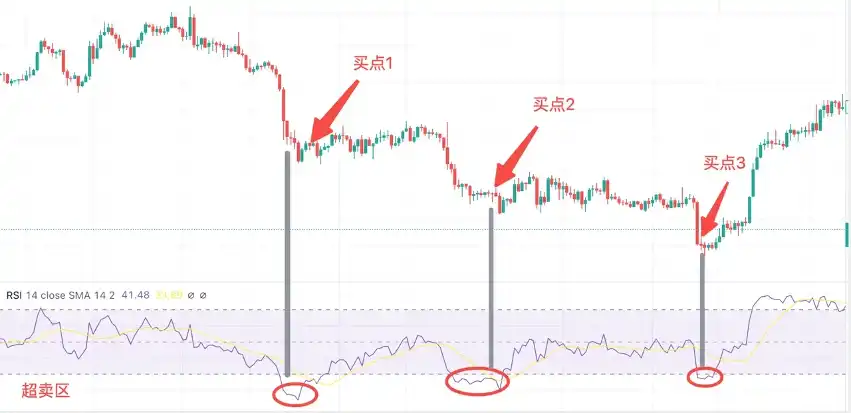
OKX, as the head exchange, is the industry leader in the development of trading algorithms and technical indicator research, so it can provide traders with more accurate buy signals. Among them, RSI index is one of the most representative buy signal reference standards. In short, the RSI index can more accurately combine the location of the superselling point with the relative price, helping traders to capture a rally and make a wider spread.
After the user selects the signal trigger mode, the system will pop up an interface with two options at the bottom: oversold line and K-line period, as well as the number of trigger times in the past period for reference.
Take the oversold line as an example. When the asset price reaches the overbought line, the oversold zone is a sign that the index price continues to fall to a certain low point and the seller's power is basically exhausted, which is usually a sign that it is suitable for investors to build positions. If the user sets the oversold line value as the signal, the strategy will be executed after the oversold line reaches a certain point.
The period of line K represents the time span of the oversold line, which is convenient for users to capture the position signal from short line, medium line, medium line and other ways.
Because this is the system according to the technical indicators and market dynamic comprehensive measurement, compared with the user's personal judgment, seize the rebound market accuracy is higher.
This article is from submission and does not represent the views of BlockBeats.
Welcome to join the official BlockBeats community:
Telegram Subscription Group: https://t.me/theblockbeats
Telegram Discussion Group: https://t.me/BlockBeats_App
Official Twitter Account: https://twitter.com/BlockBeatsAsia