Multicoin Capital: Value Flow in MEV

Original title: 《Value Flows in the MEV Ecosystem》
Original source: Multicoin Capital
Original author: Shayon Sengupta
Original translation: Kxp, BlockBeats
Before reading this article, please make sure you have a certain understanding of MEV. For an introduction to miner extractable value and the market structure between searchers and block producers, please see the article Tokenizing MEV.
Miner extractable value (MEV) is an indispensable foundation for a decentralized system without permission.
The market structure of MEV is varied and complex, but in proof-of-work networks (such as Ethereum 1.0), only miners and searchers can profit from it.
Previously, MEV has been maintaining a balance between these two players. Searchers are responsible for technically optimizing transactions and weighing the share of revenue for miners. It is important to note that both the profits paid to miners and the profits extracted by searchers belong to MEV.
However, in proof-of-stake systems, the market structure of MEV is completely different for two reasons: first, the staking pool participating in the consensus allows the profits generated by searcher activities to be redistributed to the coalition of individual stakers; second, miners are automatically split into two different roles: validators (or block proposers) and block builders.
Integrated and modular MEV infrastructure
In the Proof of Stake network, MEV has four important roles:
Staking pool - The staking pool aggregates L1 Tokens from individual stakers and delegates them to validators participating in block production (for example, Lido, Jito, Marinade, and Coinbase)
Seekers — bots or individuals that identify and explore profitable opportunities on-chain (e.g., transaction signers on the Solana and Ethereum dashboards)
Block Builders — entities that construct and arrange transactions within blocks (e.g., Jito Block Engine and Flashbots MEV-Boos)
Validators (Block Proposers) — Validators, or full nodes, vote in consensus with their stake to propose a block for validation by other nodes in the network. Services such as Staked, Figment, Chorus One, Staking Facilities, and others are running block proposers. In this ecosystem, all work needs to revolve around staking pools, because validators need collateral to produce blocks and maximize their income, and the market for collateral is quite competitive. In order to expand the size of the staking pool, the platform must provide more attractive returns to stakers. Previously, staking returns were fixed values calculated based on protocol emissions, and validators could only seek lower fees. Today, with more on-chain activity, staking pools are becoming more differentiated, including:
1. Base emissions for producing blocks
2. Fee rates
3. Share of MEV extracted
To improve the returns of staking pools, platforms must delegate to validators who build the most profitable blocks and ensure that stakers receive a share of their block revenue. If validators are inefficient at extracting MEV, or choose to keep the MEV they extract for themselves, then staking pools need to quickly reallocate their stakes elsewhere.
Searchers are constantly looking for opportunities on-chain or connecting with decentralized order flow markets such as DFlow. When a searcher finds a MEV opportunity they want to win, they use a relayer supported by a block builder to submit their carefully optimized transactions. They also give validators some tips (a portion of the expected profit) to increase their success rate. At the same time, these tips also need to be shared with the staking pools so that they can give competitive rewards to stakers.
Therefore, staking pools require validators to obtain blocks from the most efficient block builders to maximize stakers' income. Block builders are also more willing to generate more profitable blocks because they hope that more validators will use these blocks, thereby increasing their success rate and potential MEV yield.
The major staking pools in the proof-of-stake network will provide liquid staking derivatives (such as Jito's jitoSOL, Lido's stETH, and Coinbase's cbETH), which can claim the original staked assets 1:1 and accumulate all staking rewards. The purpose of setting up staking derivatives is that it can improve capital efficiency and optimize staking allocation.
Until recently, participants in these ecosystems have begun to work together as modular MEV infrastructure providers. However, as more opportunities to obtain MEV increase, we expect MEV infrastructure to be integrated, further improving value capture at every touchpoint in the value chain.
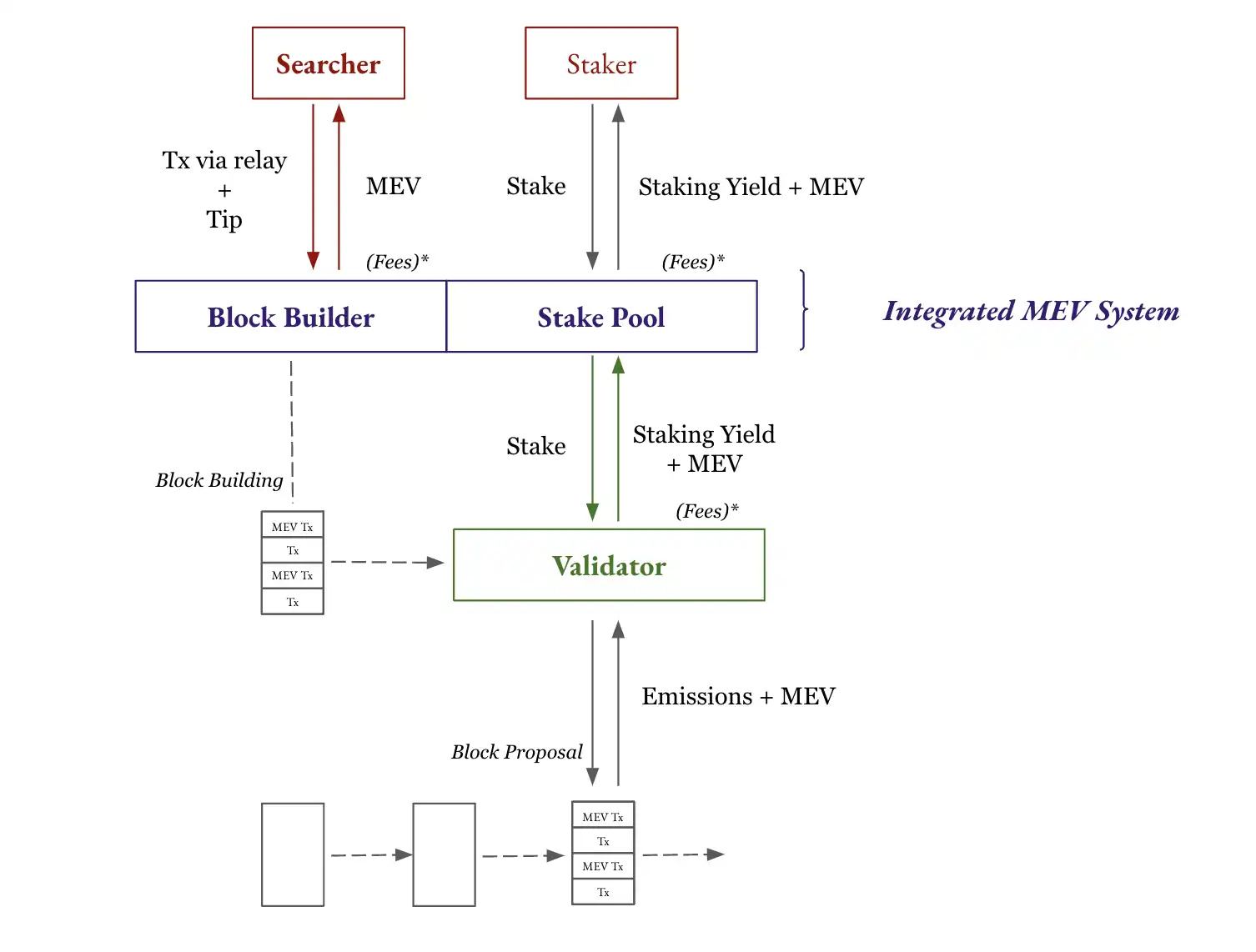
Participants with Fees will charge fees to participants on it
Jito Labs is building the first fully integrated MEV system on Solana. We invested in it in August 2021, and now the Jito Foundation has launched its own staking pool, making its MEV infrastructure the first system with both integrated block builders and staking pools.
The Jito Block Engine enables off-chain block space auctions, while the Jito Staking Pool and Liquid Staking Derivatives (JITO-SOL) create an efficient integrated system that increases stakers' returns.
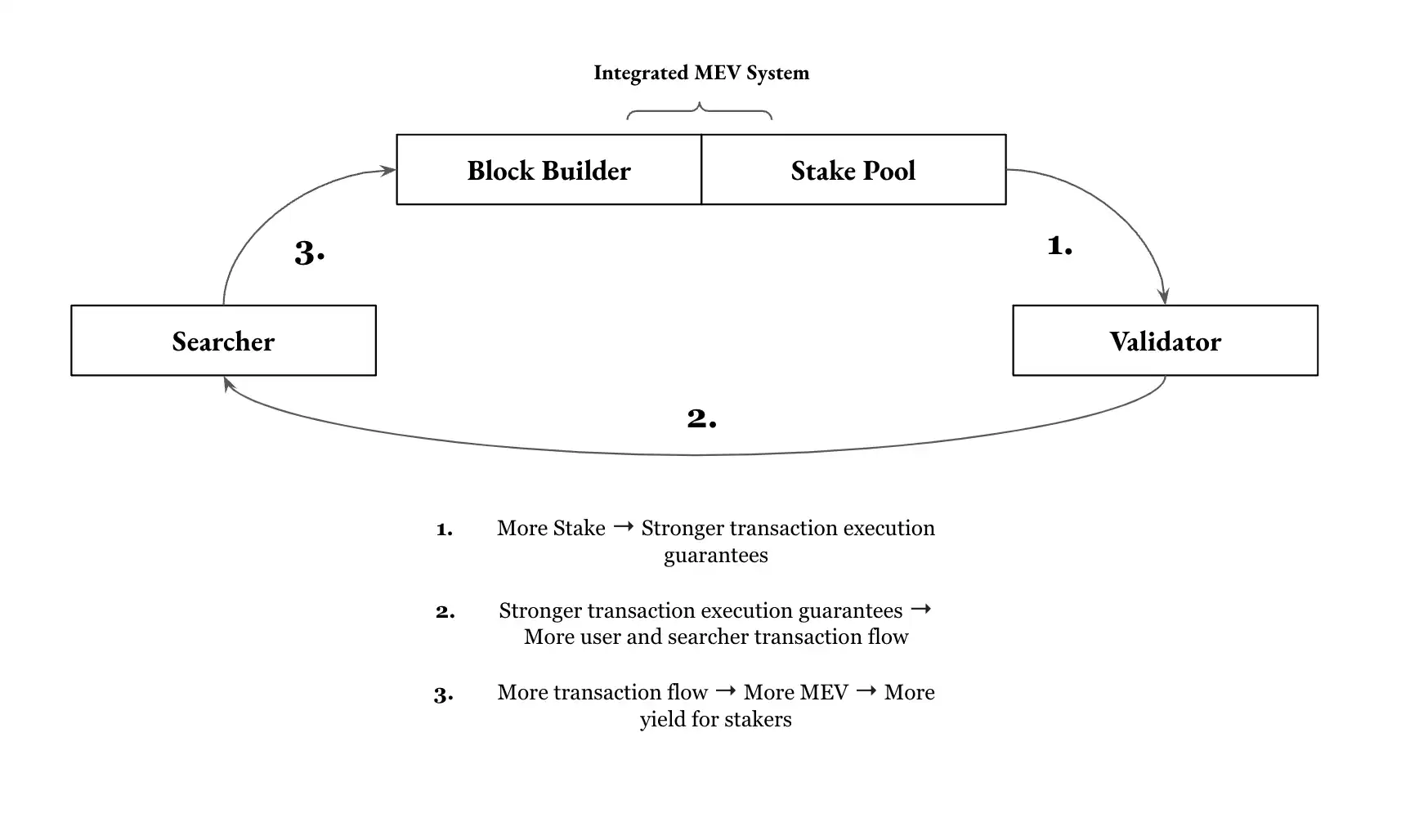
Value Accumulation of MEV
The market structure of MEV in the proof-of-stake system suggests that value will accumulate at two levels: first to stakers through the staking pool, and second to infrastructure providers that facilitate the extraction and redistribution of MEV. The more tightly integrated each component of the MEV infrastructure is, the more efficient the entire system will be in capturing value.
In 《Protocols Do Not Capture Value, DAOs Manage Risk》, we explained that statefulness and risk management are necessary conditions to drive any protocol to achieve sustainable value. The integrated MEV system can effectively manage the risks that may arise in each layer of interaction between searchers, stake pools, validators, and block builders.
In terms of risk management, each of these types of participants will take different approaches: stakers will provide higher-than-market staking returns; searchers will provide high-probability transaction confirmations; validators will provide incremental returns for block proposals through staking delegation; and block builders will provide incremental returns by increasing the probability of block adoption.
Original link
Welcome to join the official BlockBeats community:
Telegram Subscription Group: https://t.me/theblockbeats
Telegram Discussion Group: https://t.me/BlockBeats_App
Official Twitter Account: https://twitter.com/BlockBeatsAsia

 Related Articles