Vitalik Buterin: The Income-Evil Curve: A Different Way to Think About Prioritizing Public Goods Funding

Original title: "V God: Income-evil curve, different ways to think about public goods funding priorities"
Original author: Vitalik Buterin
Original translation: Old Yappie
Special thanks to Karl Floersch, Hasu and Tina Zhen for their feedback and review.
Public goods are an extremely important topic in any large-scale ecosystem, but they are also a surprisingly tricky one to define. Public goods have an economist's definition: non-excludable and non-rivalrous goods, two technical terms that together mean that they are difficult to provide through private property and market means. Public goods have a layman's definition: "anything that is beneficial to the public." There is also a definition of the public interest by a democracy enthusiast, which includes the connotation of public participation in decision-making.
But more importantly, when the abstract class of non-exclusive non-rival public goods interacts with the real world, there are all sorts of subtle edge cases that need to be treated differently in almost any concrete context. A park is a public good. But what if you added a $5 admission fee? What if you funded it by auctioning the right to set up a statue of the winner in the central plaza of the park? What if a semi-altruistic billionaire maintained the park and designed it around their personal use, but still left it open for anyone to visit?
This post will attempt to offer a different way to analyze “hybrid” goods that are somewhere between private and public: the income-wickedness curve. The question we ask is: what are the tradeoffs of different ways of monetizing, and how much benefit can be gained by removing the pressure to monetize by adding external subsidies? This is far from a universal framework: it assumes a “mixed economy” environment with a commercial market and subsidies from a central funder in a single “community.” But it can still tell us a lot about how public goods are funded in cryptocurrency communities, countries, and many other real-world contexts today.
Traditional Framework: Exclusivity and Competition
Let’s first understand how the usual economist lens views which items are private goods vs. public goods. Consider the following example:
Alice has 1000 ETH and wants to sell it on the market.
Bob runs an airline and sells tickets.
Charlie built a bridge and collected tolls to pay for it.
David produced and published a podcast.
Eve produced and published a song.
Fred invented a new and better cryptographic algorithm for making zero-knowledge proofs.
Let’s put these on a graph with two axes.
Rivalry: To what extent does one person’s enjoyment of the good reduce another person’s ability to enjoy it?
Exclusion: How difficult is it to prevent certain individuals, such as those who don’t pay for it, from enjoying the good?
Such a graph might look like this:
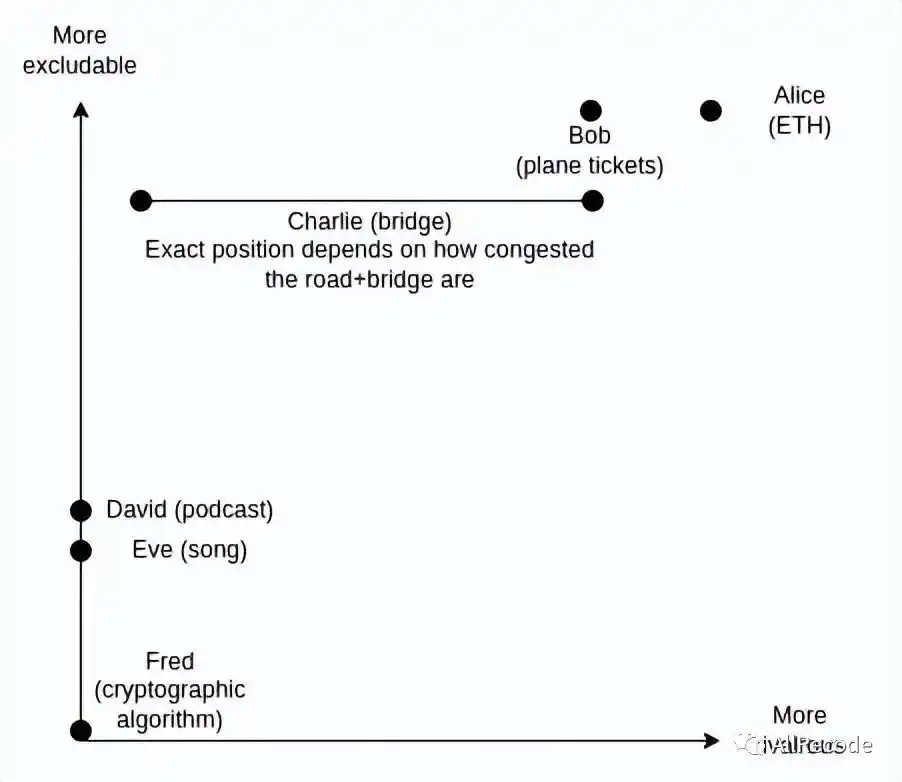
Alice's ETH is completely excludable (she has full power to choose who gets her coins), while cryptocurrencies are contestable (if one person has a particular coin, no one else can have the same coin).
Bob's plane ticket is excludable, but a little less contestable: there's a chance that the plane won't be full.
Charlie's bridge is a little less excludable than a regular ticket, because adding a gate to verify payment of the toll requires extra effort (so Charlie can excludable, but it's expensive for him and the user), and its contestability depends on whether the road is congested.
David's podcast and Eve's song are not contestable: one person listening to it doesn't prevent another person from doing the same thing. They are a little bit excludable, in that you can put up a paywall, but people can get around it.
Where Fred’s crypto is close to being completely non-excludable: it needs to be open source for people to trust it, and if Fred tried to patent it, the target user base (crypto users who love open source) would likely refuse to use the algorithm, or even disqualify him for it.
This is all good and important analysis. Excludability tells us whether you can fund a project through charging as a business model, and rivalry tells us whether excludability is a tragic waste, or if it’s just an unavoidable property of the thing in question, where if one person gets it, another person can’t. But if we look closely at some of the examples, especially the digital ones, we start to see that it misses a very important point: there are many business models available besides excludability, and those business models have trade-offs.
Consider a particular case. David's podcast versus Eve's song. In practice, a huge number of podcasts are distributed mostly or completely for free, but songs are much more shackled by licensing and copyright restrictions. To see why, we only need to look at how these podcasts are funded: sponsorship. Podcast hosts typically find some sponsors and briefly talk about them at the beginning or in the middle of each episode. Sponsored songs are harder: you can't suddenly start talking about how great the Athletic Greens* are in the middle of a love song, because come on, that kills the mood, man! .
Can we move beyond focusing on exclusion and have a broader discussion about monetization and the harms of different monetization strategies? Actually, we can, and that's what the income/evil curve is all about.
Defining the “Revenue-Evil Curve”
A product’s revenue-evil curve is a two-dimensional curve that plots the answer to the following question:
How much harm do the creators of this product have to inflict on their potential users and the broader community in order to earn N dollars in revenue to pay for the product’s construction?
The word “evil” here is definitely not meant to imply that any amount of evil is acceptable, if you can’t fund a project without being evil, you shouldn’t be doing it at all. Many projects make difficult trade-offs to secure sustainable funding, harming their customers and communities, and often the value of the project’s existence greatly outweighs these harms. But nonetheless, our goal is to highlight that many monetization schemes have a tragic side, and that public goods funding can provide value, giving existing projects a financial cushion that allows them to avoid such sacrifices.
Here is a crude attempt at plotting the income-evil curve for our six examples above:

For Alice, selling her ETH at the market price is actually the most compassionate thing she can do. If she sells cheaper, she will almost certainly create an on-chain gas war, trader HFT war, or other similar value-destructive financial conflict, with everyone trying to claim her coins as quickly as possible. Selling above the market price isn't even an option: no one will buy.
For Bob, the socially optimal selling price is the highest price at which all tickets are sold out. If Bob sells below that price, the tickets will sell out quickly, and some people won't be able to get a seat at all even if they really need it (underpricing may have some counter-effect of giving poor people a chance, but it's far from the most efficient way to achieve this goal). Bob can also sell above the market price and potentially make a higher profit, but at the expense of selling fewer seats and (from God's perspective) excluding people unnecessarily.
If Charlie’s bridge and the roads leading to it are not congested, charging any toll is a burden and unnecessarily excludes drivers. If they are congested, low tolls help reduce congestion, while high tolls unnecessarily exclude people.
David’s podcast can be monetized to some extent without much harm to listeners by adding advertising from sponsors. If the pressure to monetize increases, David will have to resort to more and more advertising, and true revenue maximization will require charging for the podcast, which is a high cost to potential listeners.
Eve is in the same situation as David, but with fewer low-harm options (perhaps selling an NFT?) In Eve’s case in particular, paid podcasting will likely require active participation in the legal mechanisms of copyright enforcement and prosecution of infringers, which will introduce further harm.
Fred has even fewer monetization options. He could patent it, or potentially do something exotic like auction the right to choose the parameters and let hardware manufacturers who like specific values bid on them. All choices are costly.
What we see here is that there are many kinds of “evil” on the revenue-evil curve.
Deadweight losses from traditional exclusionary economics: if the price of a product is above marginal cost, mutually beneficial transactions that could have taken place don’t happen
Conditions of competition: crowding, shortages, and other costs that arise from making the product too cheap.
“Tainting” the product in a way that makes it attractive to sponsors but causes some degree of harm to the audience (maybe small, may be large).
Engaging in offensive actions through the legal system, which increases everyone’s fear and the need to spend money on lawyers, and has all sorts of difficult-to-predict secondary chilling effects. This is particularly acute in the case of patents.
Sacrificing principles that are held in high regard by users, the community, or even the people working on the project itself.
In many cases, this evil is very context-dependent. Patents are both extremely harmful and ideologically offensive in the cryptocurrency space and in software more broadly, but this is less true in industries that make physical goods: most people who could realistically create derivative works of a patent would be large and organized enough to negotiate licenses, and capital costs mean the need for monetization is much higher, so purity is harder to maintain. The extent to which advertising is harmful depends on the advertiser and the audience: it can even be beneficial if the broadcaster knows the audience very well. Whether the possibility of even "exclusion" exists depends on property rights.
But by talking in general about doing evil to earn revenue, we gain the ability to compare these situations to one another.
What does the revenue-evil curve tell us about funding priorities?
Now, let's get back to the key question of why we care about what public goods are and what aren't: funding priorities. If we have a finite pool of money dedicated to helping a community thrive, what should we spend it on? The revenue-evil curve gives us a simple starting point for the answer: direct funds to those projects where the slope of the revenue-evil curve is the steepest.
We should focus on those projects where, for every dollar of subsidy, we minimize the evil needed to make the unfortunate project suffer the most by reducing the pressure to monetize it. This gives us a rough ranking:
The most important are the "pure" public goods, because there is usually no way to monetize them at all, or even if there is, the economic or moral costs of trying to monetize them are very high.
Second priority is for “natural” public goods, but they can be funded through adjustments to commercial channels, such as sponsorships of songs or podcasts.
Third priority is for non-commodity private goods that already optimize social welfare through fees, but with high profit margins, or more generally opportunities to “taint” products to increase revenue, e.g. by keeping supporting software closed source or refusing to use standards, subsidies can be used to push these projects to make more pro-social choices at the margins.
Note that the excludability and rivalry frameworks generally lead to similar answers: focus on non-excludable and non-rival goods first, excludable but non-rival goods second, and excludable and partially rival goods last — excludable and rivalry goods are never focused on (if you have spare capital, it’s better to just give it out as UBI). There is a rough mapping between income/evil curves and excludability and rivalry: higher excludability means lower slope of the income/evil curve, while rivalry tells us whether the bottom of the income/evil curve is zero or non-zero. But the Revenue/Evil Curve is a more general tool that allows us to talk about trade-offs that extend far beyond exclusive monetization strategies.
A practical example of how this framework can be used to analyze decisions is with donations to Wikimedia. I personally have never donated to Wikimedia because I have always believed that they can and should fund themselves without relying on limited public good funds by adding some advertising, which is a small price to pay for their user experience and neutrality. However, the Wikipedia administrators disagree; they even have a wiki page listing the reasons why they disagree.
We can think of this disagreement as a dispute about the income-evil curve. I think Wikimedia has a low slope of its income-evil curve ("ads aren't that bad"), so they're a low priority for my philanthropic money; some other people think their income-evil curve has a high slope, so their philanthropic money is a high priority.
The income-evil curve is an intellectual tool, not a good direct mechanism.
An important conclusion not to draw from this idea is that we should try to use the income-evil curve directly as a way to prioritize individual projects. Our ability to do so is severely constrained by monitoring limitations.
If this framework were widely used, projects would have an incentive to inflate their income-evil curves. Anyone who charges tolls would have an incentive to come up with clever arguments trying to show how the world would be a lot better off if tolls were reduced by 20%, but since their budgets are severely limited, they can't reduce their tolls without subsidies. Projects will have an incentive to become more evil in the short term in order to attract subsidies that help them become less evil.
For these reasons, it’s best to think of the framework not as a way to make direct allocation decisions, but as a general principle for determining which kinds of projects to prioritize for funding. For example, the framework can be a useful way to determine how to prioritize entire industries or entire categories of goods. It can help you answer questions like: if a company is producing a public good, or has made socially beneficial but economically costly choices in designing a not-quite-public good, should they get subsidies for it? But even here, it’s best to think of income-evil curves as a psychological tool, rather than trying to measure them precisely and use them to make individual decisions.
Conclusion
Exclusivity and rivalry are important dimensions of a good, and have really important consequences for its ability to be monetized, and for answering the question of how much harm is avoided by funding it from some public money. But, especially once more complex projects enter the fray, these two dimensions quickly start to become insufficient for determining how to prioritize funding. Most things are not pure public goods: they are hybrids in between, and there are many dimensions that make them more or less public goods that don’t map easily to “exclusion.”
Looking at a project’s revenue-evil curve gives us another way to measure the really important statistic: how much harm is avoided by removing a dollar of monetization pressure from a project? Sometimes the benefits of relieving monetization pressure are decisive: there’s simply no way to fund certain types of things commercially until you can find a single user big enough to benefit from them to unilaterally fund them. Other times, commercial funding options exist but have harmful side effects. Sometimes these effects are small, sometimes they’re large. Sometimes a small subset of individual projects have clear tradeoffs between prosocial choices and increased monetization. And, still other times, projects simply fund themselves and there’s no need to subsidize them, or at least, uncertainty and hidden information make it too hard to create a subsidy schedule that does more good than harm. It’s always better to prioritize funding in order of greatest benefit to least benefit; and how far you can go depends on how much funding you have.
Original link
Welcome to join the official BlockBeats community:
Telegram Subscription Group: https://t.me/theblockbeats
Telegram Discussion Group: https://t.me/BlockBeats_App
Official Twitter Account: https://twitter.com/BlockBeatsAsia