CoinGecko 2022 Q3 Digital Currency Industry Report: Review of the Whole Market
Original title: "CoinGecko's Q3 2022 Cryptocurrency Report"
Original author: CoinGecko
Compilation of the original text: TokenInsight
Experienced the massacre in the second quarter of 2022, and the third quarter is slightly bottlenecked. Despite bullish mid-quarter expectations for Ethereum’s merger, the market is largely consolidating. At the end of the third quarter, the total market value of the Crypto market, BTC, and ETH prices improved slightly. But NFTs haven’t enjoyed the same treatment, with volumes plummeting by around 80% this quarter as interest in small images continues to wane. Given global geopolitical tensions and macroeconomic turmoil, the short-term outlook for the crypto market may remain challenging.
Our quarterly report on the Crypto market in the third quarter of 2022 covers everything from the market structure, to the analysis of Bitcoin and Ethereum, to the analysis of DeFi and NFT ecology Research, and inspection of CEX and DEX performance. The following are excerpts of the main highlights of the report.
1. In the third quarter of 2022, the total market value of the Crypto market will rebound slightly

ALGO fell out of Top30, and ETC climbed to the 23rd place, driven by the Ethereum merger. Some notable changes in the Top30 include XRP surpassing BUSD became the 6th (+60%), MATIC from 19th to 15th (+66%), UNI from 27th A jump to 18th place (+129%).
In the third quarter of 2022, the correlation between the total market capitalization of Crypto and the S&P 500 Index is 0.85, which is still relatively high. But this is down slightly from the correlation coefficient of 0.92 in Q2 2022. The total market capitalization of Crypto also continues to be strongly influenced by Bitcoin, and their correlation coefficient is 0.9, which is still a strong correlation.
2. Stablecoin Silent Quarter
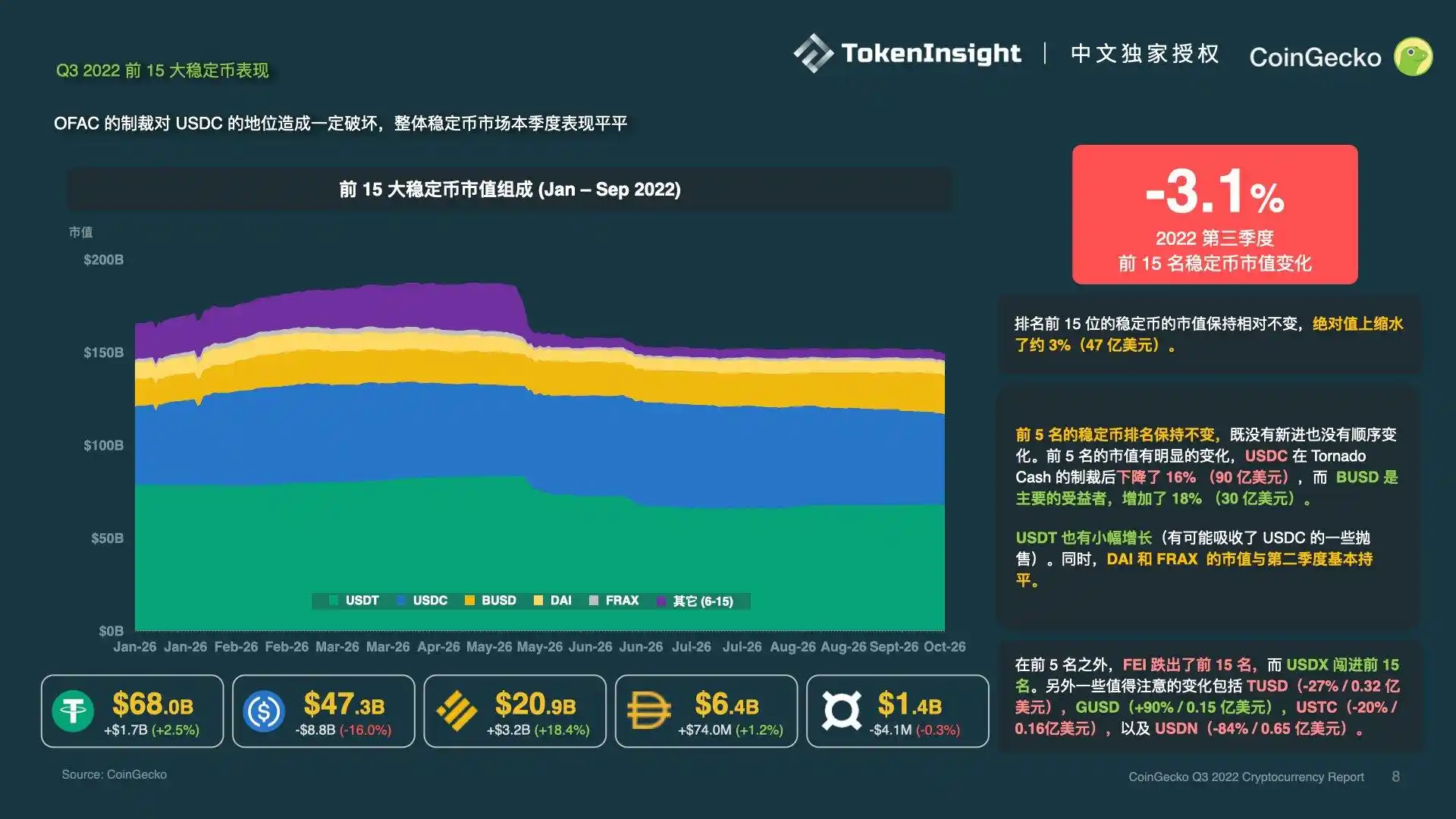
At the end of the third quarter, the market capitalization of Top15 stablecoins was similar to that at the end of the second quarter, shrinking by about 3% (US$4.7 billion) in absolute terms.
Top5 Stablecoin Tether (USDT) , USD Coin (USDC), Binance USD (BUSD) Dai (DAI) and Frax (FRAX) The ranking remains unchanged, neither newcomers appear nor order changes. The market capitalization of Top5 has changed significantly, USDC dropped by 16% ($9 billion) after OFAC sanctioned Tornado Cash. BUSD was the main beneficiary, with an 18% increase ($3 billion) in market capitalization, likely due to USDC inflows and Binance’s announcement of an automatic BUSD conversion feature.
USDT also saw a small increase in market cap (possibly absorbing some of the USDC sell-off). At the same time, the market capitalization of DAI and FRAX is basically the same as in the second quarter.
Outside of Top5, FEI Dropped out of Top15, while USDX broke into Top15. Other notable changes include TUSD (-27%/$32 million), GUSD (+90%/0.15 billion USD), USTC (-20%/US$16 million), and USDN (-84%/$65 million).
3. The dollar dominates
< br>
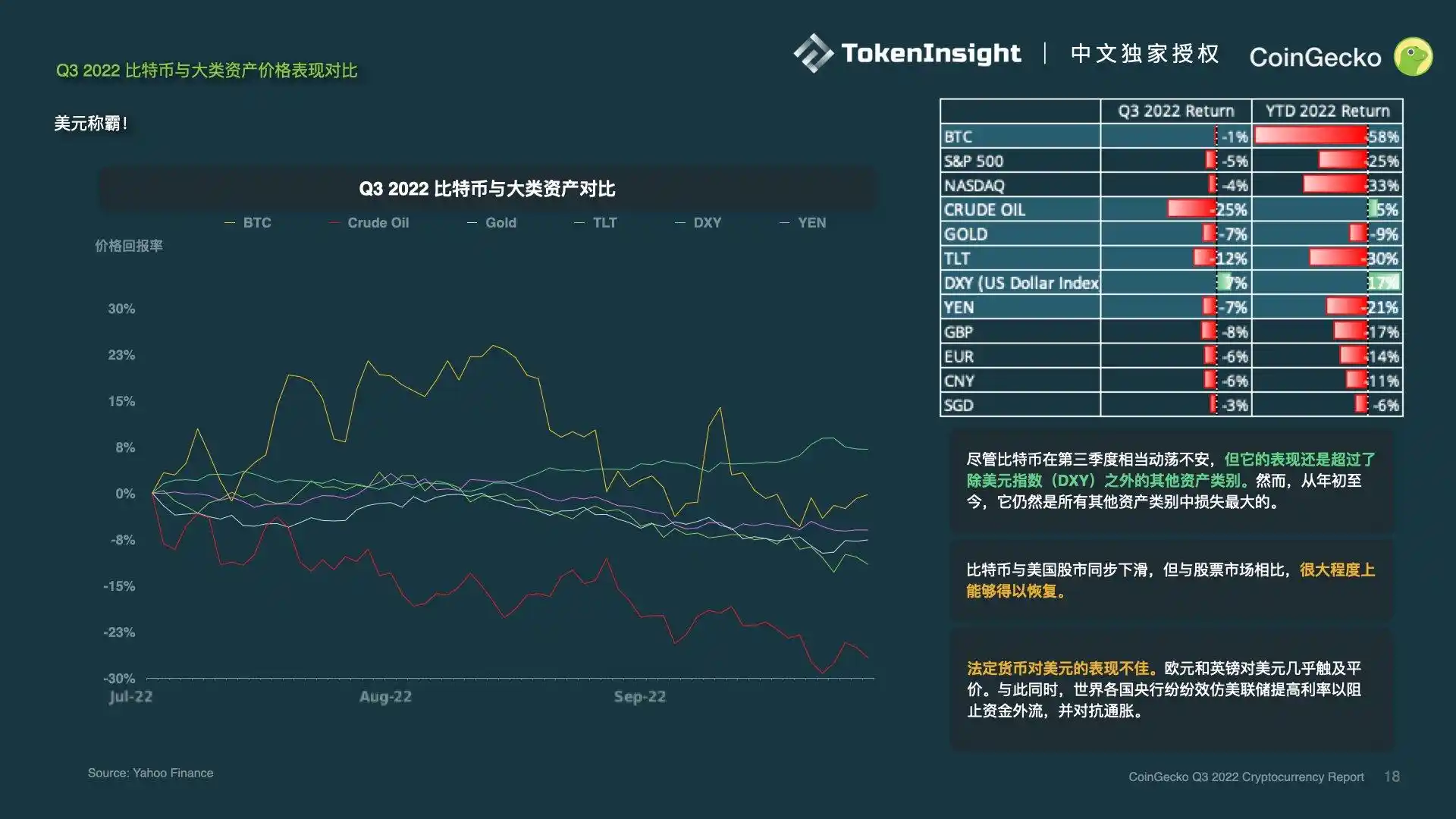
Despite being quite volatile in Q3, Bitcoin has outperformed all asset classes except the U.S. Dollar Index (DXY). However, if you look at the year-to-date performance, Bitcoin still has the largest decline of all asset classes, or 58%.
Bitcoin fell in tandem with U.S. stocks, but compared with the stock market, the price of Bitcoin at the end of the third quarter fell only 1% compared to the beginning of the quarter %.
Fiat currencies generally underperformed against the US dollar. The euro and the pound were almost at parity against the dollar. At the same time, central banks around the world have followed the example of the Federal Reserve and raised interest rates to prevent capital outflows and combat inflation.
4. The pessimistic macroeconomic haze drowned out the dawn of the successful merger of Ethereum

ETH finally rebounded in the third quarter, but failed to break through the $2,000 mark. It peaked at $1,982 in mid-August before falling back again.
At the end of August, 2 weeks before the merger, the price of ETH started to climb again. But despite being hailed as the greatest milestone in the history of Ethereum, the duration of this rally was quite short-lived.
High CPI, expectations of aggressive FOMC rate hikes, traders touting "insider information" all mean the sell-off started days before the merger was done here we go. With these pessimistic macroeconomic conditions dominating the market, the general consensus is that the Ethereum merger was a “success without splashes.”
Although ETH is not yet a deflationary asset, the combined average daily net release has dropped by a massive 95%. While the merger was not intended to improve the scalability of Ethereum, it is interesting to note that despite a small spike in on-chain transaction volume after the merger, the average gas fee has remained low (~10-20 gwei).
Overall, ETH ended Q3 with a positive price return of +26% - compared to H1 2022, with Visible improvement. But ETH has returned -64% this year, which is still pretty bad.
5. DeFi rebounded in the third quarter, with a quarterly growth of about 31%

DeFi rebounded nicely in late 3Q 2022 as most categories of projects managed to arrest their decline. Overall, the market capitalization of DeFi has increased by about 31% quarter-on-quarter. Although ETH plummeted 33% from its quarterly high in mid-August to $1,330, it is still up 26% from the end of Q2, which is in line with the upward trend in DeFi market capitalization.
DEX not only maintained its position as the largest category of DeFi, but its market value also increased by 36.8% to $10.9 billion. Notably, liquidity staking protocols nearly tripled in market capitalization to $1.54 billion in Q3, largely driven by events surrounding the Ethereum merger. The price of the native token LDO of the leading protocol in this category, Lido Finance, increased in Q3 264% to $1.6.
The market cap of fixed-income agreements has increased by 90%, mainly due to the launch of BarnBridge v2, but it is still the smallest category in DeFi, accounting for only DeFi market cap 0.3%.
6. In the winter of the NFT market, the quarterly transaction volume decreased by 77%

The NFT market took a heavy blow in Q3, with the total trading volume of the top 5 exchanges OpenSea, MagicEden, LooksRare, X2Y2 and CryptoPunks falling More than 77%.
The latest data for September 2022 shows that about 85% of the trading volume on X2Y2 may come from swiping, which gives it a ranking compared to Advantages of OpenSea. Likewise, while LooksRare’s transaction volume is already low, it is clear that about 87% of the transaction volume is accounted for by scam transactions.
MagicEden was the only NFT to see growth in September In the trading market, its monthly transaction volume and market share have doubled compared with the previous month, while its competitors have continued to decline. Benefiting from the recent entry into Ethereum and the release of the y00ts project, which has become the focus of the market, MagicEden (9% increased to 22%) continued to capture the market share of OpenSea (90% decreased to 60%) in the third quarter. But whether it can maintain that momentum remains to be seen.
Original link
Welcome to join the official BlockBeats community:
Telegram Subscription Group: https://t.me/theblockbeats
Telegram Discussion Group: https://t.me/BlockBeats_App
Official Twitter Account: https://twitter.com/BlockBeatsAsia

 Related Articles