


Email Quick Login
Verification Code
Get Verification Code
Join
Forgot Password
Verification Code Login
/
Register
Partnered With:

Thousands of Musk's chat logs reveal plans for Twitter's Free Bird
Read this article in 22 Minutes
"the bird is freed"
Original title: 40 Pages of Silicon Valley Rich Chat Reveals Elon Musk's Idealized Twitter
Original author: flowie, ChainCatcher
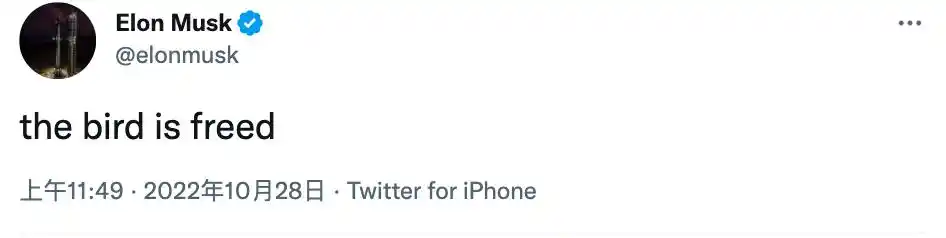
"the bird is freed."
This is Musk's latest tweet, which also means that the half-year long tussle over the acquisition of Twitter has basically come to an end.
The biggest deal of the year has gone through three reversals:
The first was in March, when Musk was invited to join Twitter's board after increasing his 9.2% stake in the company. Soon after, Musk declined to join the board and declared that he wanted to take Twitter private.
The second was in April, when Musk proposed to buy Twitter for $44 billion, only to pull the plug on the deal just after it was signed.
For the third time this month, Twitter shareholders sued Musk in July, forcing Musk to face a $1 billion breakup fee, and after months of wrangling, Musk announced that he would honor the contract until the acquisition is officially completed.
Despite many reversals and name-calling, Musk's acquisition of Twitter was widely expected.
Twitter founder & "Twitter should not be owned or operated by anyone. It should be a protocol public good, not a company. Musk is the only solution I trust to solve this problem," said former CEO Jack Dorsey, who has defended Musk for six consecutive years. .
On September 28th, as Musk talked about buying Twitter 40 pages of text message evidenceNearly a thousand private conversations between Musk and industry leaders have also surfaced. Oracle founder Larry Elliso, 8VC managing partner Joe lonsdale, and Musk's brother Kimbal. Musk and other industry leaders, as the earliest think tank of Musk's acquisition of Twitter, not only expressed the expectation that "we really need another Twitter", but also actively put forward suggestions for the future model of Twitter. Binance, a16z, Sequoia Capital and other giants have publicly pledged hundreds of millions of dollars to support Musk's acquisition.
Will Musk, who carries so many expectations, continue the founder? Jack Dorsey's original idea to transform Twitter with a decentralized protocol? We tried to take a look at Musk's original intention to buy Twitter from 40 pages of text message group chat testimonies and public statements, and analyze where Twitter might go from here.
Meanwhile, a group of Twitter revolutionaries such as Bluesky and Lens Protocol have been running for some time, but the progress is generally slow. Could Musk's Twitter act as a catfish to activate the Web3 social circuit?
From the beginning to the end, the preservation of free speech in the media arena has been Musk's core appeal. From Delaware court of chancery records revealed 40 pages of text messages, according to put forward the proposal on the eve of musk and twitter founder Jack Dorsey, the friend to chat, said the "freedom of speech is very important, even when you hate when people are talking about in the same way", "I might buy twitter, let twitter appropriate free speech."
Musk tweeted again yesterday to explain his motivation and vision for the acquisition of Twitter, saying he wants a world where there is healthy debate for a wide range of beliefs, at a time when unbribed freedom of speech has allowed a lot of money-making media to feed "extremely divisive social hatred". "Twitter clearly can't be called a free hell," he said.
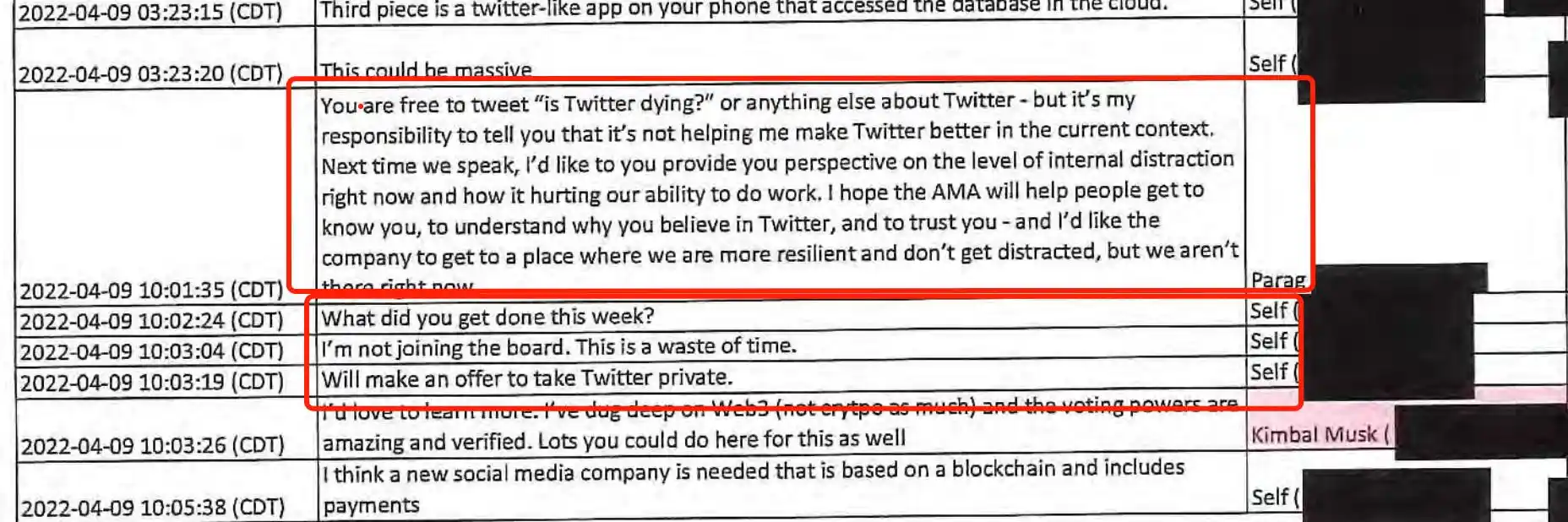
His commitment to free speech was also evident in his first broken conversation with former Twitter CEO Parag Agrawal. "Why are you tweeting 'Twitter is dying,' you're going to be on the board, you shouldn't be criticizing the company publicly," Agrawal asked Musk, according to a text message in the filing. "It's not going to help change Twitter." "This quickly angered Musk, who said he would not rejoin Twitter's board and would take Twitter private."
And how does Musk envision himself reinventing Twitter to defend his insistence on free speech?
The first idea is to try to do some decentralized innovation. In response to Jack Dorsey's comment that "instead of allowing Twitter to remain tied to a traditional corporate model, it should be funded by a foundation that has no control over the underlying public agreements." Musk said in a chat response that "the idea is very interesting" and that "there really needs to be some decentralized innovation to take Twitter in a better direction." Moreover, when the deal was first signed in April, Musk promised in a tweet to open source the algorithm to increase public trust.

In terms of payment methods, Musk proposed at the Twitter plenary meeting to integrate digital payment into Twitter to make it more convenient to send money. Notably, on October 25, prominent tech blogger Jane Manchun Wong revealed that Twitter is working on a cryptocurrency wallet, "a prototype of which already supports cryptocurrency deposits and withdrawals".
Twitter has already introduced crypto-related features, such as a Bitcoin/Ethereum "tipping" service and NFT avatar support. Twitter's previous partnership with the NFT market has also been officially confirmed with the launch of Tweet Tiles, which will allow users to display, buy and sell NFTS directly via Twitter.
In addition, Musk's biggest headache, spam bots, and Twitter's post-launch editing function, are also priorities for the revamp plan. Musk's brother Kimbal Musk mentioned that Web3 has an impartial voting system that can be applied to products to keep bots and scammers out.
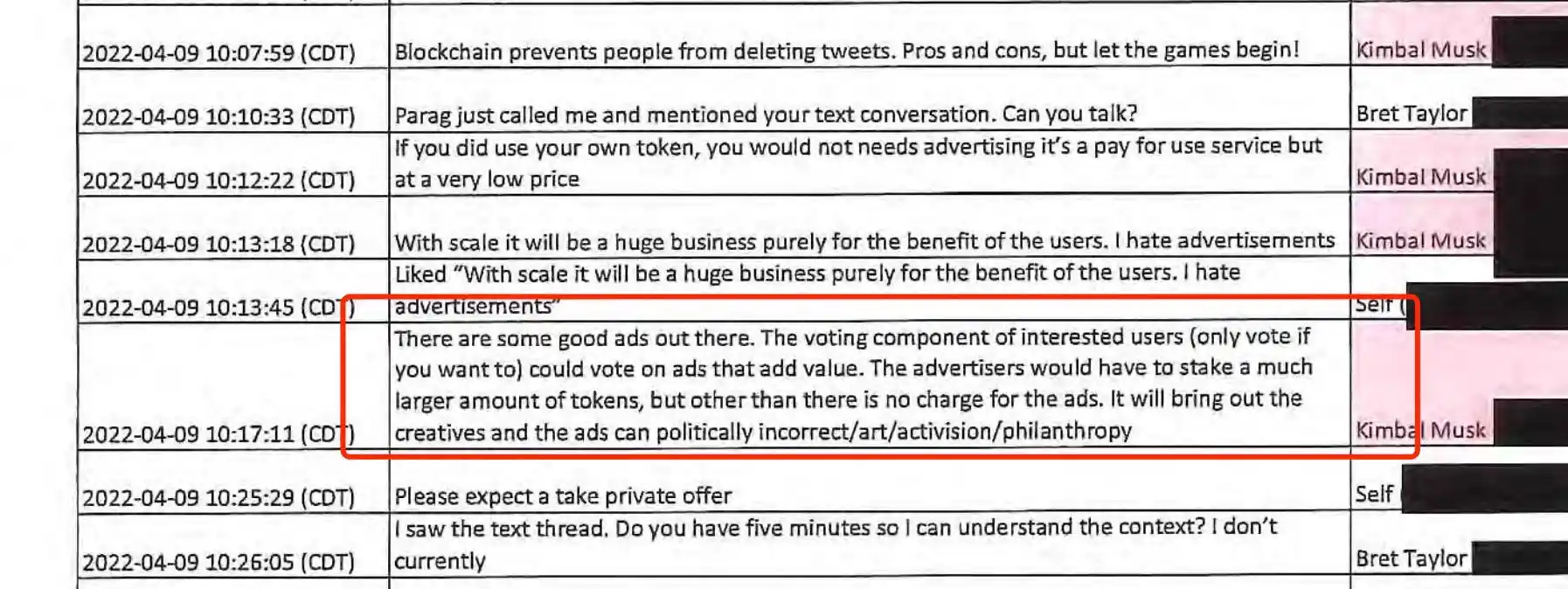
In terms of business model, advertising business is bound to have a big adjustment. In his letter to Twitter yesterday, Mr Musk focused on Twitter's advertising business, saying that if done well enough, it would be good for users and the ecosystem, and that he was equally committed to making Twitter a good "advertising platform".
But in text messages and public statements before the acquisition, Musk and Dorsey agreed that advertising should not be used, even though advertising accounted for 90% of Twitter's revenue last year. But the two men have different reasons for opposing it. Jack Dorsey thinks the advertising model will lead to governments and advertisers increasing their ability to control Twitter. Musk, on the other hand, believes that by relying on advertising to survive, companies will have too much power to dictate policy, which is not decentralized enough. Musk expects to reduce Twitter's share of advertising revenue to 45% in 2028 from about 90% in 2020, according to a plan he previously presented to investors.
In addition to the advertising model business, what will be expanded to increase revenue? In the text message, Musk mentioned the idea of charging for the distribution of content. "I once had a Plan B, which was a blockchain-based version of Twitter." Tweets "were embedded in transactions as comments, and users had to post or retweet comments with 0.1Doge.
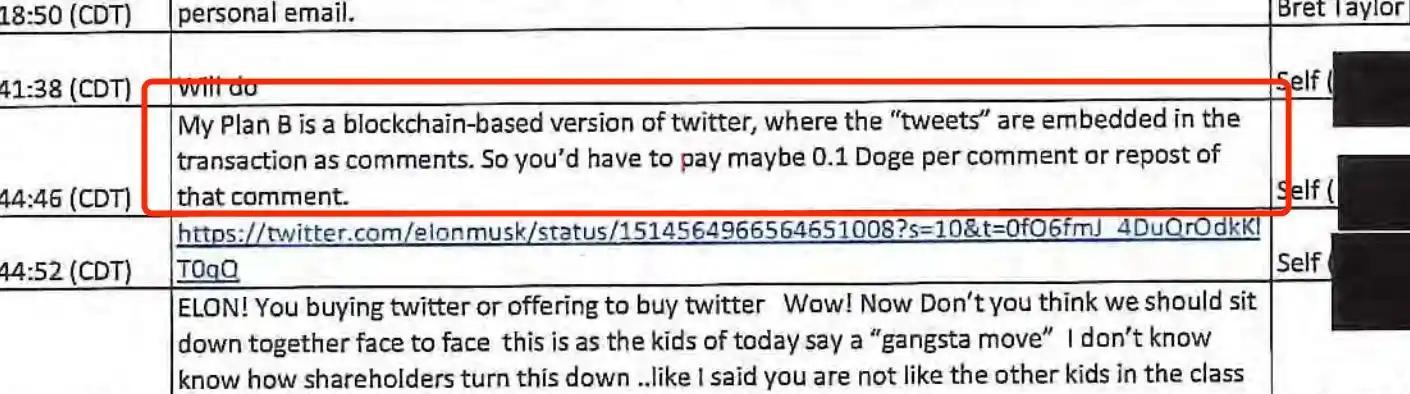
During the text chat, Musk also mentioned more ideas for a "blockchain version of Twitter," which could be used in Twitter in the future.
Specifically, Musk thinks the platform could be used to pay, tweet, and link just like Twitter. The difference is that making every message available on the blockchain, for which users pay a small fee, would cut down on most spam and fake accounts. At the same time, there is no "strangling" censorship to ensure freedom of speech.
Second, a huge real-time database needs to be built to hold copies of all blockchain messages, including all messages sent and received by users and information about followers and followers.
Then you need a Twitter-like app on the phone that lets users access the database from the cloud.
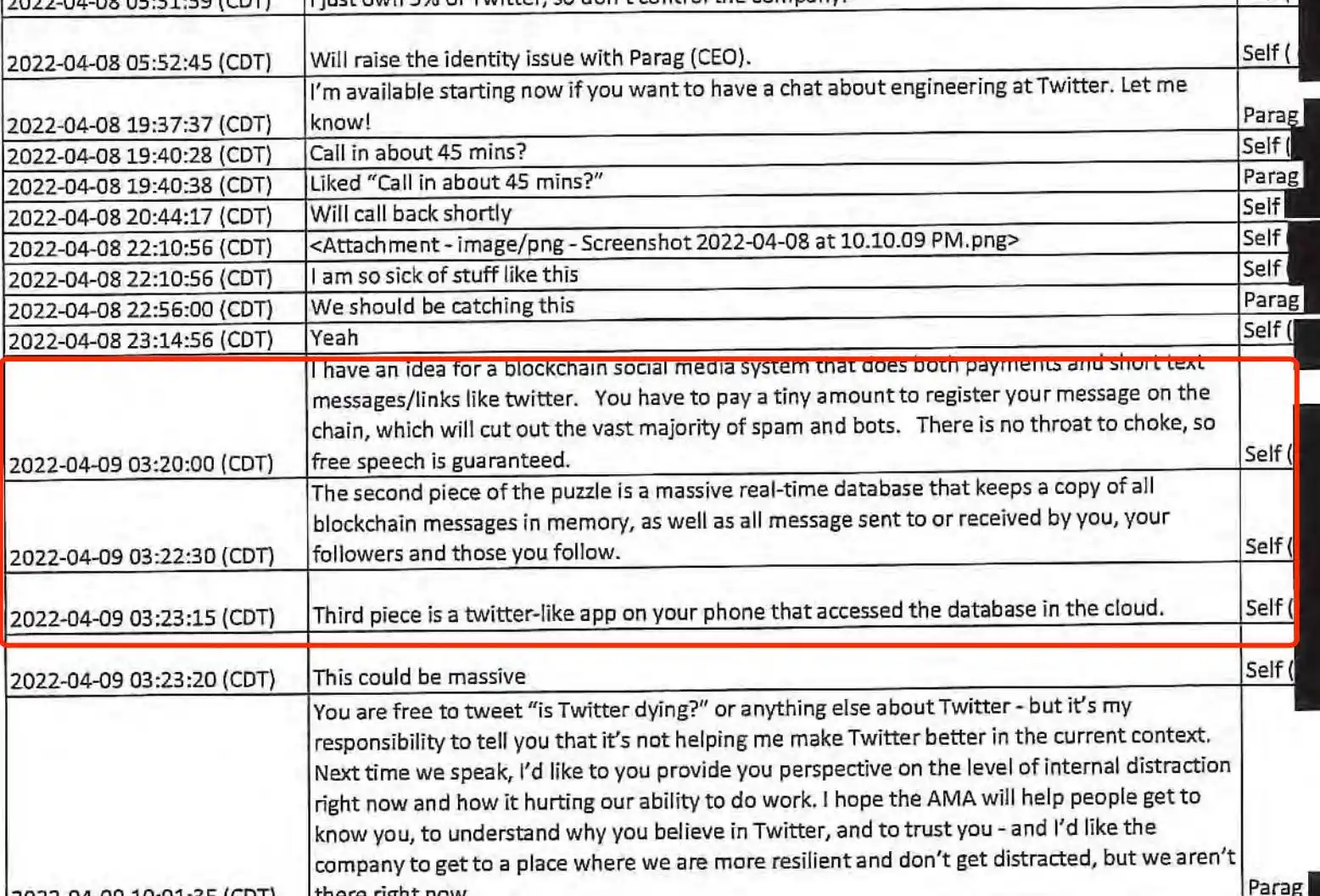
While Musk has come up with all sorts of ideas for how blockchain could transform Twitter, his brain trust includes others. Jack Dorsey, Kimbal Musk and other blockchain /Crypto/web3 evangelists, but Musk is not optimistic about the specific extent of implementation.
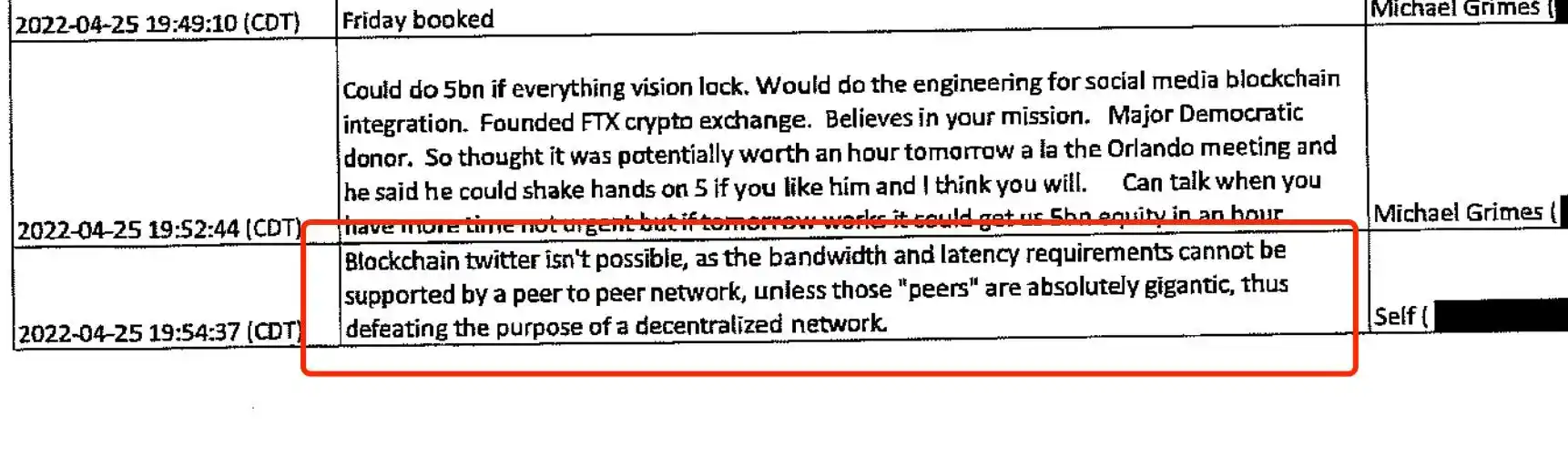
In a friend to introduce FTX founder SBF together to talk about the case for buying twitter, musk refused to join the block chain related debate, and express the pessimistic attitude, "when a point-to-point network bandwidth and speed of the Internet, chain block twitter almost impossible, if each point" packaging "is very big, and defeat the purpose of the decentralized network."
Who will run Twitter after it is acquired? Or a shake-up?
At press time, Musk didn't say explicitly, but Bloomberg reports that Elon Musk plans to become CEO of Twitter. CNBC financial reporter David Faber also tweeted that Musk is now in charge of Twitter, and that former CEO Parag Agrawal and former CFO Ned Segal have left the company's headquarters. According to The Spectator Index, Musk has fired Twitter's head of legal policy, who decided to ban Trump's account.
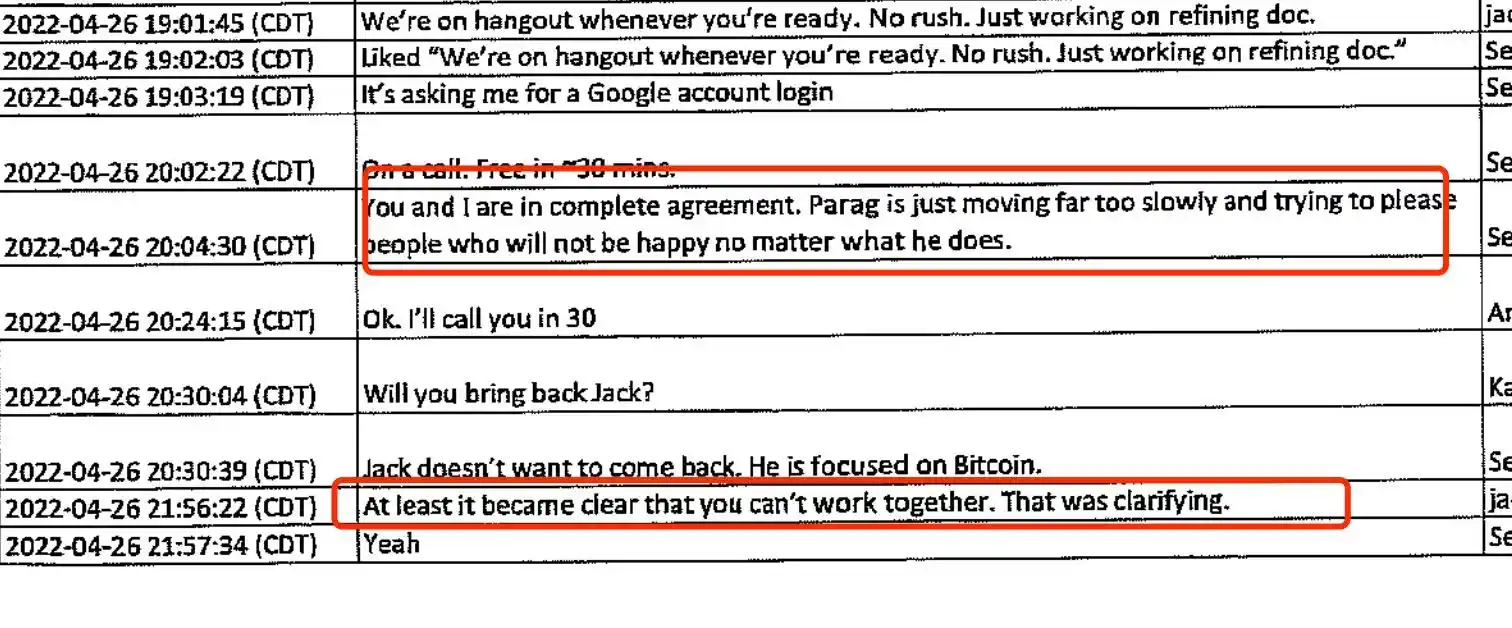
Parag Agrawal's departure from Twitter is not a surprise. To judge by text messages, Parag Agrawal and Musk are hardly at odds. Musk expressed Parag Agrawal's frustration with efficiency, "He's moving too slowly and trying to please people who are not happy anyway." After one meeting, Jack Dorsey said to Musk, "At least I can't get you to work together."
Twitter founder Jack Dorsey, who helped drive the acquisition and is a close personal friend of Musk, is also not expected to be involved in the project. When asked in a text message chat if he would bring Jack Dorsey back to Twitter, Musk replied that Dorsey is focused on Bitcoin and web3 and is not coming back.
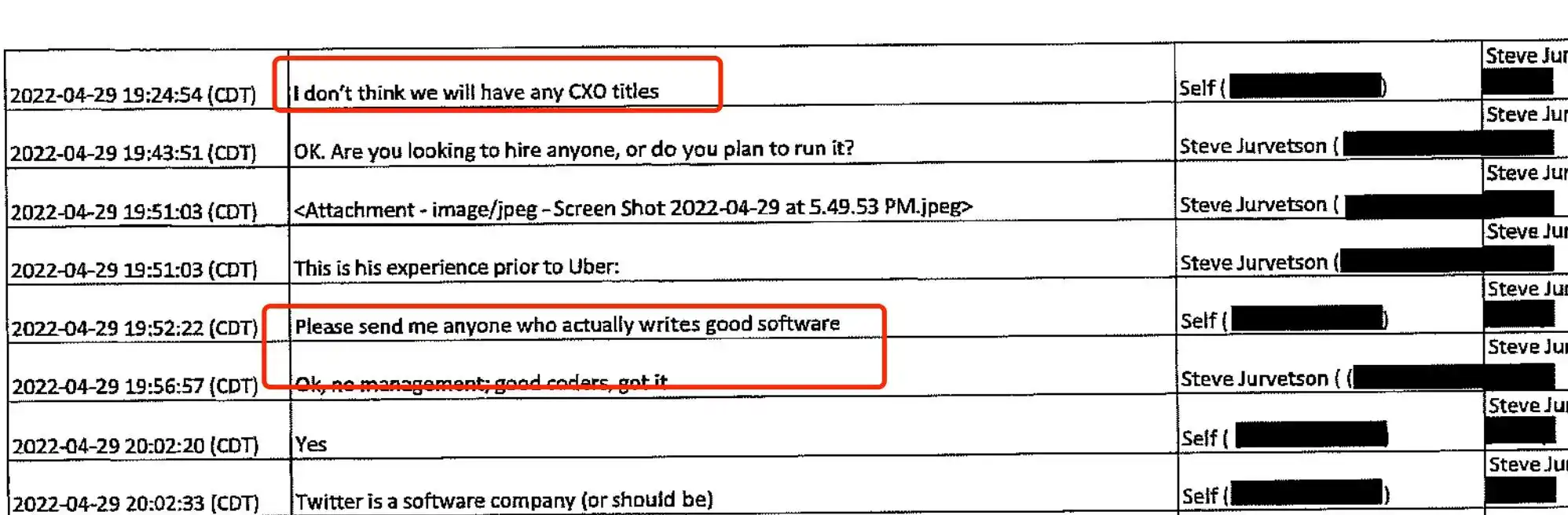
According to the disclosure text, Musk prefers to bring more technology to talent than management to talent. "I don't want to meet with any CXOs," Musk replied to a recruiter's recommendation for a career manager at Uber. "I need people who can write Good code. Hire Good Engineer, not management."
Aside from the core management team, have there been any major personnel changes since the acquisition? Earlier this month, The Washington Post reported that Musk had told potential investors he planned to lay off nearly 75% of Twitter's 7,500 employees, citing people familiar with the matter. In a Q&A with Twitter employees in June, he also said he needed to "rationalize headcount" and cut $800 million in personnel costs.
But soon after, Musk denied plans for significant layoffs inside Twitter, Bloomberg reported, citing people familiar with the matter.
How are the projects that want to revolutionize Twitter doing?
As Musk has inferred, it is not easy to practice decentralized "Twitter" based on blockchain. Voice launched by Steemit and Block.one were the first social media dedicated to decentralized, but most of them were either dissolved or forced to transform. Mastodon, which has achieved great success with a similar interface to Twitter, is still far behind Twitter in terms of users and activity.
Still, there are plenty of projects for decentralized social racetracks. ChainCatcher briefly described nine of these early projects, These include Lens Protocol, Bluesky, DeSo, Mem Protocol, Cyberconnect, Atem Network, BBS Network, 5Degrees, NFTychat, etc.
One of the most notable is Bluesky, a project started by Twitter founder Jack Dorsey. The project was originally started by Twitter, but is separate from Twitter. The project, which shares a soul with Twitter, may shed some light on Twitter's path to decentralization.
Bluesky's current mechanism design explicitly states that the development and adoption of decentralized protocols is the way to build a strong technical base and will be independent of any one blockchain.
According to the initial version of Bluesky's code released, Bluesky's moderation mechanism works at multiple levels through the system, including aggregation algorithms, reputation-based thresholds, and user selection. In addition, service providers are required to remove illegal content in accordance with local laws.
In terms of architecture, Bluesky combines the portability of self-certifying protocols with a user-friendly experience under delegated hosting to keep users from having to run their own infrastructure, At the same time, developers can build high-performance applications.
Bluesky has announced its first community projects, including a decentralized social network called Mastodon, manyver.se, Planetary, Iris, an encrypted chat tool called Element, a peer-to-peer browser called BeakerBrowser, a video conferencing tool called Meething, Video playback tool Watchit, music streaming platform Audius, and Web 3.0 privacy and data protection project Mask Network, among others. But there appears to be no substantial cooperation.
Despite its slow progress, Bluesky has been Posting updates in the run-up to Musk's deadline to buy Twitter.
On October 19th Bluesky plans to rename its ADX protocol to the Authenticated Transport (AT) protocol. The AT protocol will run on a federated network, which is a network configuration type with a central management framework that allocates shared resources among multiple connected networks or locations.
Bluesky explained the network model with examples, such as the fact that many sites run the protocol and users can choose among providers. In turn, individuals or businesses can choose to self-host. The effect is that the AT protocol enables the exchange of accounts between providers without any loss of data or impact on the social graph, giving users a greater degree of control over content and connectivity.
The project has an official website that is still under construction and will soon be released based on. AT Protocol's social-centric Bluesky app, said 30,000 people had been put on a waiting list to sign up for its app just 48 hours after the preview app was released.
But compared with Twitter's huge user base, Bluesky's progress has been slow. According to a blog post by current CEO Jake Graber, the lack of sophistication of Web3-based algorithms is a major hindrance. "The Web we use today cannot do without content discovery algorithms, but Web3 needs to refine its algorithms in order to improve the user experience," Graber says.
In addition, Web3's social graph, user profiles, identity and reputation verification, content aggregation, indexing and discovery, and curation and regulation methods are still immature, according to Graber.
Next, the field of social media presents a situation of parallel reform routes: the self-revolution of the old Web2 media Twitter, the route of Web3 social media based on the Token incentive model and the middle route of Bluesky, which compete and learn from each other, and a new social media paradigm may be born from it.
The original link
Welcome to join the official BlockBeats community:
Telegram Subscription Group: https://t.me/theblockbeats
Telegram Discussion Group: https://t.me/BlockBeats_App
Official Twitter Account: https://twitter.com/BlockBeatsAsia

24H Hot Articles







Choose Library
Add Library
Cancel
Finish
Add Library
Visible to myself only
Public
Save
Correction/Report
Submit