



Everything About Web3 Marketing

Original Title: "Everything About Web3 Marketing"
Original Author: PeterY (@yudeewxy), Founder of WXY Crypto Marketing Labs
Author Bio: Yudee, Founder of WXY Marketing Consultancy. With over 15 years of marketing experience, he has worked at Ogilvy, Tencent, 36Kr, Meituan, and other platforms. In 2017, he entered the Web3 space and founded his marketing consultancy, WXY, in Singapore, serving over 300 projects such as dYdX, Klaytn, Tron, KuCoin, and more.
Web3 is sometimes mysteriously representative of the future and at other times filled with darkness and deception. This is because Web3 is closely related to technology and finance, both of which symbolize the direction of today's world and human nature. Many people say that Web3 is about the transfer of data ownership, but I believe that beyond this, Web3 is a reconstruction of many organizational structures, relationships of interest, resource allocation, and more in society. In the current crypto space, Web3 represents a change in the relationships of nodes for capital, markets, users, investors, institutions, and more.
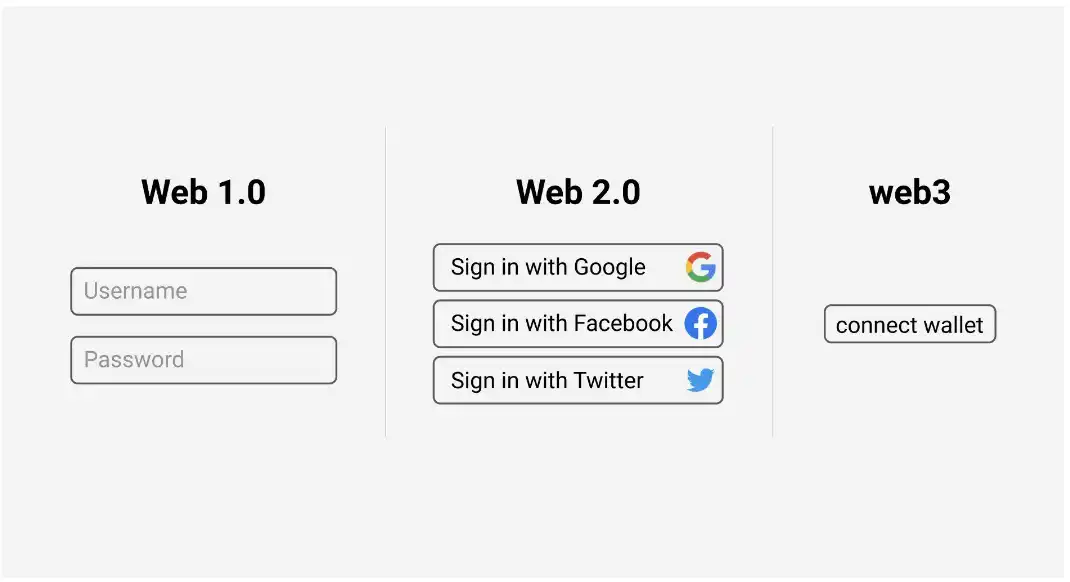
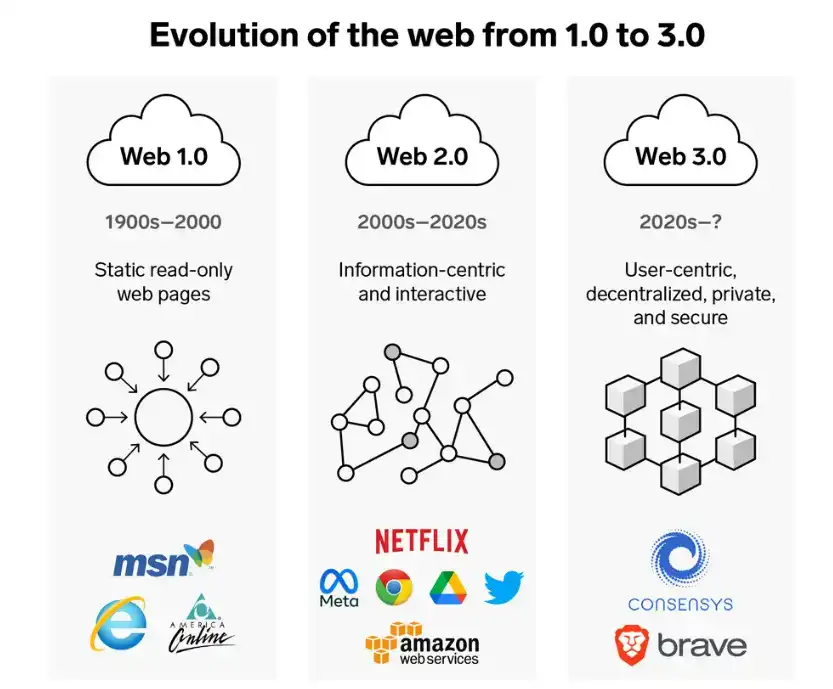
As Web3 is on the rise, various advocacy projects have emerged. Currently, most of these projects largely follow the traditional playbooks of the crypto industry for marketing, which are very templated and inefficient. On average, each project spends $100,000 or even hundreds of thousands of dollars on initial marketing, but most see minimal returns, not as good as the effects of being listed on a major exchange or conducting a hyped-up pump. This is a misconception or, more accurately, a business skill gap for most Web3 entrepreneurs. Efficient marketing can help projects achieve more with less effort, reducing the overall operating costs over the project's lifecycle. The author shares over 5 years of blockchain marketing experience, hoping to help project teams avoid detours and improve efficiency.
Let's Start with Mapping Maslow's Hierarchy of Needs in Web3
The classic Maslow's Hierarchy of Needs theory holds that people have five levels of needs, from bottom to top: physiological needs, safety needs, love and belongingness needs, esteem needs, and self-actualization needs. All marketing needs to carry out corresponding promotions based on the target audience's needs. However, in Web3, things have slightly changed. The logic remains the same, and human nature remains the same, but in the current mass market, 90% are focused on basic-level earning needs, while 10% are high-level needs, such as uniqueness, fun, and self-value realization. Consequently, entrepreneurs and marketing teams in the Web3 space today have to consider what needs their project truly satisfies in the target market, or if it satisfies all, then for which groups and in what communication manner.
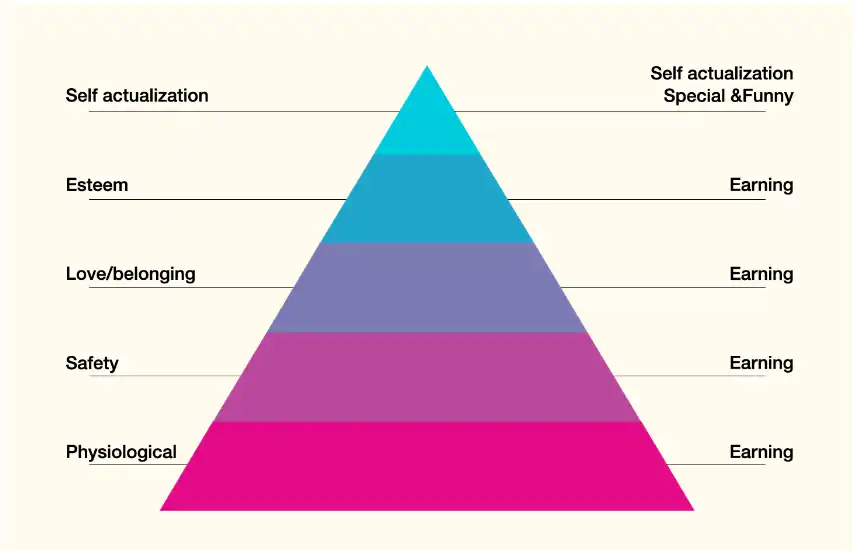
If there were no Tokens, no incentive to earn money, Web3 could not have developed so rapidly, and the talent in the industry would decrease by 90%. Therefore, when project teams are painting a grand vision for their projects, they should both look up at the stars and keep their feet on the ground. It is crucial to focus on how to allow some of the public investors to make money, while wrapping this story in a very appealing package to make it widely accepted. Only this way will the public spread the word and acknowledge the project.
Of course, there are many geeks and early adopters who always maintain an exploratory spirit towards new things. They are willing to continue experiencing various fresh and interesting things while also using it to showcase their differences from the traditional world, demonstrating a sense of superiority. This group is niche, but its presence density in Web3 is much higher, especially for project teams with special value and innovation. They must identify this user segment in their communication, incorporate them as early community members, as they will likely also be seed spreaders for the project.
This field has many young people, so young that they are still at the internship stage but can already write analytical articles for investment institutions. However, it is precisely for this reason that the communication in this field must align the sense of value and mission with the expectation of making money. Letting these young people empathize and believe that they can contribute to the industry, realize their self-worth, and at the same time, pave the way for an extraordinary transformation towards financial freedom. If a project can achieve this, it firmly grasps the fundamental needs of the target market.
Good Narrative
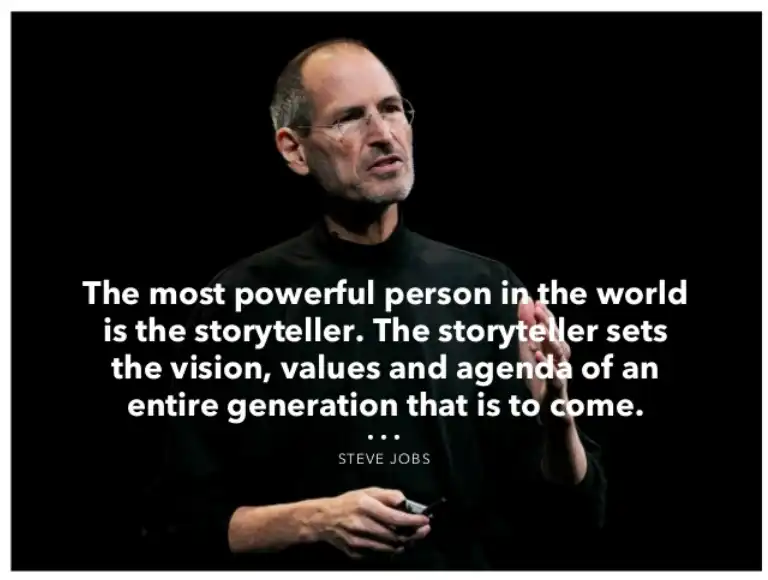
A good narrative refers to storytelling ability. However, here, "story" does not refer to a founding story, it does not indicate past events, but rather future expectations. A narrative is the better blueprint that a brand paints for the industry, for the market, as well as how to achieve it, commonly known as "painting a grand vision," making the market recognize the brand's ideas, mission, vision, and become buyers, users, and advocates of the brand. In all likelihood, every new project aims to be the most valuable brand in the industry, and to achieve this, it must do at least one of the following: pioneer a new track, be a good complement to the existing track, or outperform in a field of homogeneous projects. Throughout the project's lifecycle, founders need to make the market understand the project's macro narrative. In the initial stages of the project when no one is aware of it, a narrative is needed; when the project enters the second growth curve in the mid-term, storytelling is still required.
Chainlink is a great narrative template: in the early stages of the project, also when the DeFi ecosystem was gradually opening up, Chainlink's narrative angle was the "oracle," which is not a new term and is a well-established concept in traditional domains. The concept of an oracle can be viewed as a Turing machine connected to a predictor. The predictor is an entity that can answer a specific set of questions and often use a specific subset of natural numbers A to represent these questions. An oracle can perform many unique operations that are special for the general Turing machine and can obtain an answer to a specific form of the question "Is x in A?" by asking the predictor. It may sound complicated, but one of the critical logics within it is data connectivity.
Chainlink is a decentralized oracle project whose role is to provide blockchain with real-world data in the most secure manner. Initially complex and difficult for the market to accept all at once, Chainlink then simplified an industry application within the DeFi world that instantly made the market understand a prominent feature of oracles, price feeds. It even gradually led the market to believe that Chainlink was the oracle, equating the category with the brand, thus establishing a very high competitive barrier. Now Chainlink has become the top brand in the blockchain oracle race, but the business itself is expanding from oracles to a larger narrative.
From several cases, it can be seen that good narratives have several standards:
-Macro-level Logic. Enter a future-looking, seemingly very logical imaginative space, bringing the audience into this space where in a logical environment, the audience easily follows the brand's narrative thread and therefore identifies with the brand's concept.
-Good Brand Positioning: Positioning can be deduced from several perspectives, and there are many positioning theories in the market that can be referenced. Due to the experience at Ogilvy, the positioning theory I often use is the triangle positioning method, which means that the positioning strategy can be advanced from three angles: product, audience, benefit/value.
-Distinctive: A good narrative must be distinctive, challenging or different from existing brands. Uniform narratives or positioning that blend in will not be noticed, as people usually only remember the first or the best one.
-Inspiring or Thought-Provoking: A good narrative description will certainly be more inspiring, giving people a sense of enlightenment, a "Eureka" moment. For example, "Ethereum's distributed computer": the first time you heard it, it was that kind of feeling, "Although I don't understand it, I am greatly impressed and willing to accept it." It will attract the audience to think more and agree.
-Self-Propagating: My Ogilvy mentor warned us: "Mediocre creativity is like a sailboat on the sea at night, unknown to anyone." Narratives, like positioning, are the same: a mediocre strategy or description will only increase long-term operating costs, and short-term laziness will lead to long-lasting problems. Narratives, positioning, or strategies with creativity and propagating power undoubtedly require a great deal of effort from the founder to devise, rather than casually writing them on a PowerPoint slide.
-Technologically Supported/Feasible: This is also extremely important, otherwise, it would be a castle in the air or lack credibility. If the project's technology can partially explain the implementation path, the community's trust and dissemination efficiency will be greatly enhanced. Taking Ethereum as an example again, in the 2014 Ethereum whitepaper, it clearly marked future milestones: Frontier, Homestead, Metropolis, and Serenity, showing developers and the public a clear development path for Ethereum, making the world full of anticipation.
-There is a clear application in the current industry. Some projects already have some industry applications when promoting, and these applications are important for market positioning and are part of the factual basis.
-Mesh-scalable, can structurally drive the synchronous development of various collaborative fields, interdependent with each other.
Clear Values
A person without quirks is not trustworthy, and a brand is the same. Giving up a part of the community in order to gain the love of another part is necessary. The more cutting-edge it is, the more likely there is bias, which can easily be caused by the values advocated by the project. However, the project team should not deliberately please all groups because of the existence of this bias. Trying to please everyone means having no direction and will cause dissatisfaction in the community. At the same time, moderate bias is the foundation for believers in the community to make money. Things that are fully accepted without any bias, on the other hand, do not provide opportunities for ordinary people to make money. Therefore, some projects are very suitable for creating a unique, different brand flavor, from logo design, font style, visual system, external communication style, behavior, to a value system.
Identity, Belonging, Ritual
There are many ways to create these feelings in Web3, some through technical means, and some through differentiated operations.
-NFT Avatar. In 2021, the BAYC avatar became a symbol of wealthy Web3 elites. BAYC originated from a yacht club in Miami, USA, where most middle-class Americans who have worked all their lives hope to retire to Miami, buy sports cars, yachts, leisurely fish, and live the life of the wealthy. This way of thinking has also brought together a group of middle-class people with the same interests. In the NFT era, BAYC cleverly tapped into this emotion, using bizarre yet sophisticated design to represent the thoughts of this group of people. This aligns very well with human nature, whether in traditional society or the Web3 era. From the American Express Black Card, to the icon next to the Linkedin/Weibo avatar, to the NFT avatar, all validate the effectiveness of this approach. Project teams need to consider the emerging sense of identity and ritual experience in the industry and how their project can stand out and gain community enthusiasts.
-Built on a sense of identity is ritual, and appropriate ritual can also bring a sense of belonging to the community. For example, Binance VIP clients receive various gifts imprinted with the Binance logo during holidays. This carefully designed gift is actually a form of ritual, no different from spending time and effort to give gifts to a girlfriend. Occasional rituals make the community feel valued. In turn, they will pay more attention to the project and will actively engage with the project.
Facts and Emotions
Let's not be naive; mass communication has never been purely factual. Facts are merely the basis of communication, and the content that easily spreads is often in line with the public sentiment at the time. The logic and facts contained in the content are just threads that organize these emotions. Mass communication must always resonate with the emotions of the public or community. A good marketing team should constantly observe the micro-level community sentiment and macro-level market sentiment. Generally speaking, the difference between the two is not significant. Whether it's exaggerated hype about a project that can make you rich overnight in a bear market when the market sentiment is cold, or promoting a very stable product in a bull market, it is all considered inappropriate. People will think, "I've already taken off my pants, and you're showing me this?" Do you remember the marketing campaign "Escape from Beijing, Shanghai, and Guangzhou" in 2016? It gained popularity by tapping into the emotional strain felt by young people suffocating under the high property prices and soaring cost of living in first-tier cities.
Marketing Requires Leveraging
In the Crypto world, this is known as "going big with a small budget," while in the marketing field, it is more commonly referred to as "achieving great results with minimal resources."
-Good Creativity. In the traditional world, where competition has been fierce for a long time, brands heavily rely on agencies to design brand creativity. Every year, major advertising festivals and media like Cannes and One Show release the annual creative awards and showreel, many of which have helped brands achieve tremendous success and reputation in regional markets. Marketing in the Web3 space is still relatively grassroots and starts with communication within niche communities. However, as projects develop and mass communication increases, good creativity will become increasingly necessary for project teams. Currently, there are very few commendable and awe-inspiring creative ideas in the Web3 community, but this will be an area that project teams must focus on in the coming cycles.
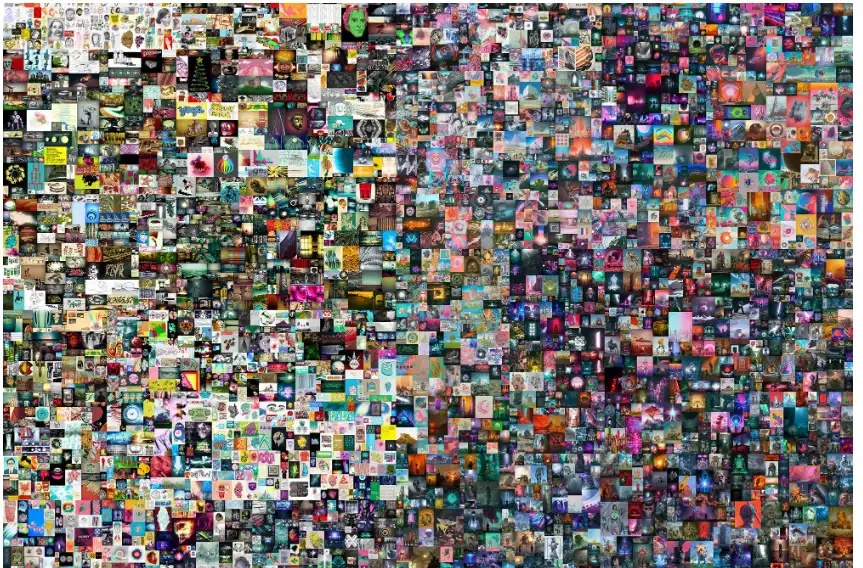
-Riding Coattails. The "coattails" can be a person, an event, or anything significant; the key is to latch on. A successful collaboration can bring a brand an effect where 1+1 is much greater than 2. In early 2021, when NFT sentiment was just starting to rise, an American artist, Beeple, collaborated with Christie's to auction off his artwork "Everydays" for a staggering $69 million, making it the third-highest price for a living artist's work at auction. Of course, Beeple's success factors are multifaceted, but one crucial factor is his collaboration with Christie's. Through this partnership with a renowned auction house, he brought a groundbreaking moment to the industry.
-Collaboration with Established Projects. Not every project team has the ability and opportunity to collaborate with top institutions and industry leaders. However, with effort, there is a great possibility to establish collaborative relationships within the industry. Good collaboration can help both projects tap into new markets simultaneously and set a feasibility case for the industry.
-Tracking or Creating Hotspots. Besides riding on hot trends, founders or marketing teams should also create their own hotspots. For example, when Elon Musk acquired Twitter, a normal acquisition would typically involve a smooth transition. However, a person with marketing capabilities like Elon Musk wouldn't miss such an opportunity. On the day of acquisition, he carried a sink into the company lobby and recorded a video of it, uploading it to Twitter. This action brought secondary spread to the already trending topic, and many netizens even created meme emojis, further pushing it into the spotlight. Of course, not every trend should be captured, and not all are suitable. When tracking hotspots, it's important to consider if it aligns with the brand's tone and to assess potential negative risks.
Lunch Trap
-What is Truly Being Sold? And What is Truly Being Sought After? Learn from the traditional IT and internet fields. In the early 2000s when the IT and software industry was just taking off, genuine software required a purchase. However, since Chinese people weren't accustomed to paying for software, rampant piracy emerged. Not only was the quality compromised, but there was also a significant risk of virus infection. As the mobile internet matured, the business model changed. Due to the substantial decrease in production costs, C-end hardware devices were often offered as free gifts to content and service buyers, while content and services could be consumed repeatedly and frequently, unlike hardware devices. Therefore, brands focused their business models more on the software part, using low-frequency, low-cost hardware as a free "lunch trap" to give to customers. Humans are visual and sensory beings, and with visible and tangible free hardware, they are willing to pay for content or services once or twice, forming a habit and loyalty. Over time, this transforms them into long-term paying customers. Traditional sectors such as mobile network operators have mastered this model. The same logic can be applied not only to hardware and service combinations but also to all business models that contain contrasting elements like "low-frequency vs. high-frequency," "low-cost vs. high-cost," "short-term incentive vs. long-term benefit." This approach is applicable to the Web3 domain, where most business models are based on the virtual world with hardly any hardware products. Therefore, this logic can be extensively pondered from financial, service, content, and other perspectives. Example: such as the experience funds on a contract trading platform and KOL commission system. As a contract trading platform that trades against retail investors, they clearly understand that 80% of their profits come from users' liquidations during extreme market conditions. This profit far exceeds their daily operational costs, so they are willing to provide high percentages of commission to KOLs who bring traffic to the platform daily, maximizing their gains from their fans. Additionally, these platforms often offer new users significant experience funds because they know these funds only incur a cost to maintain user engagement with the platform. Once addicted, the platform will eventually recoup all costs many times over through these users' liquidations.
-Product Operations Should Make Users Feel Like There's a Free Lunch. Human nature is inherently selfish, especially in a chaotic environment where "good news doesn't leave the door, but bad news travels a thousand miles." Positive and sunny things always require a high cost to promote, while gossip and rumors spread quickly under the table. When building products and conducting operations, it's important to give users a sense of opportunity, allowing them to see a "free lunch." The best hunters always appear in the form of prey.
Example:
Encourage early participants to spontaneously invite more people to join. This concept is derived from the traditional MLM (multi-level marketing) model. MLM itself is not a ferocious beast but is merely exploited by bad actors, and the model of recruiting people up to three levels below is legal and effective. Many Internet giants in the Web2 space have also applied this strategy, such as Toutiao's point system and Pinduoduo's "Help Me Bargain." The Web3 space is a more suitable environment for multi-level marketing because Web3 brings participants closer to money through tokens, aligns more closely with human nature, and incentivizes them to voluntarily help spread the project. This form takes many shapes, such as early bird ticket sales, referral programs, and more. However, the fundamental purpose remains the same: to provide early adopters with benefits, making it advantageous for them to help spread the project through incentives. They gain more influence, even receiving freebies and special profit zones. Example: XEN
-Simplicity. If a product targets the mass market, it must be simple. Although DeFi and similar fields target scientists and have very high entry barriers, the high average revenue per user allows each project and platform to thrive with the participation of a small number of high-net-worth individuals. However, each project and platform must assess its target market. If it targets the mass market, users need a simple experience. Even with compelling financial incentives, a straightforward experience remains a key competitive advantage. Complexity can be hidden in the background or part of a long-term, in-depth user experience, but the initial onboarding process must be simple to achieve economies of scale.
How to Excel at PR
-Concept. The core of PR content lies in its concept. What is the main idea of the PR content, at what level does this article aim, and who will validate it? Throughout each project's lifecycle, there are numerous PR articles from different perspectives. What is the logical thread and cross-support of these articles? Have they undergone rigorous planning, or is the marketing team deciding on content off the top of their heads? These are all matters that a good PR team must manage. PR content is just a means to an end and must ultimately serve a business purpose. So what is the business purpose, and what kind of PR articles at different stages can support the goals of each stage? Once these questions are clear, the approach to writing PR content becomes evident. As for the quality of the writing itself, that is another aspect to consider.
-Trust and Endorsement. The goal of PR is to make people believe. There are many ways to make people believe, some appeal to emotion, some appeal to facts, some appeal to "everyone is saying so," some appeal to strong background; you always have to choose some angles that make people believe in you, even if they don’t exist, you have to create them.
-Sponsorship is not necessarily effective; even with a lot of money, you have to spend wisely. Especially in a bear market, it is often seen that some well-funded brands spend a huge amount on brand sponsorship, such as OKX's F1 sponsorship, Crypto.com's NBA and FIFA sponsorships, Bitget's endorsement by Messi, and so on. These brands are industry leaders, rich and capricious, but in terms of sponsorship effectiveness, they may not necessarily achieve very good results. Before sponsorship, in addition to measuring the economic benefits, you must consider the relationship between the brand and traffic. Think about how to maximize brand awareness through sponsorship and make it lasting. At the same time, make sure to bind the sponsored party's traffic resources in the contract.
Generally speaking, sponsorship has several expected functions:
Brand leveraging
Acquiring the sponsored brand's fan base
Spontaneous spreading effect
-How to issue global media news
The Associated Press is a channel for coverage.
Founders need to maintain long-term contact with some Western journalists, regardless of whether there is a PR need, contacting them as friends, Twitter is a great way to find them.
When paying for PR distribution, it is recommended to select those exclusive channels that can be widely shared. After CoinDesk's content is first released, most other language media will directly repost it, and particularly promptly.
Of course, let's give ourselves an advertisement. Find WXY, established in Singapore in early 2018, serving over 300 projects such as dYdX, Klaytn, Tron, and more. Email: peter.yu@wxycon.com
-Invite Top KOLs to help write content. Firstly, most of these KOLs already have a certain amount of fan traffic and can be reached directly. Secondly, many of them have columns in top-tier media outlets, and their content is also likely to be simultaneously reposted by these major media outlets.
-Maintain Constant Exposure, from various angles, across various media/social platforms/communities, in multiple forms such as space/ama/PR/afterparty/poster/logo shown, permeating like water, staying around the community like air.
How to Build Community
Never has any field been so reliant on distributed community power as it is today. The propagation in traditional fields is more top-down, cold, distant, with users just being users. In the Web3 field, top-down still needs to be done, but more as official endorsement and the creation of authority. However, more emphasis is placed on mobilizing the community, making them embrace, making them earn, making them promote. The core fan base and its cohesive community are the primary productivity of Web3 marketing.
-Product Experience is Inextricably Linked to Community Building.
Friends With Benefits, a social DAO, originally started as a Discord group with token as the entry condition.
Loot, a game that started with content and then shifted towards gameplay.
Smoothie, a discover-to-earn reward platform that initially revolved around discovering content and community of Web3 startups.
-Utilize Community Aggregation Places with Web3 Properties, such as: Twitter, Discord, Telegram, etc. Twitter and Telegram are essential tools for posting announcements and holding public group discussions, but Discord has become the primary platform of choice for project leaders looking for maximum flexibility in managing communities.
-Clear Common Goal. When newcomers arrive, they should be able to easily find and understand the purpose of your organization (why you exist) by browsing through pinned posts and channel titles. Include relevant links pointing to your website, project documentation, or introductory blog articles or videos so that people have the opportunity to learn as much as possible. While this part can be addressed by bots, the project team, community managers, and community members should reach a consensus and emphasize it repeatedly.
-Shared Enemy. Every project has its own mission and vision, i.e., why did the founder spend a lot of opportunity cost leaving high-paying jobs on other platforms to do this? What problem does he want to solve? Since there is a problem, there must be obstacles before it is solved, and this obstacle should be the shared enemy of the community. Every founder can try asking their community whether there is enough consensus on this issue within the community, for example: IPFS's enemy is centralized storage, Uniswap's enemy is centralized exchanges, ENS's enemy is URLs, and so on.
-Clear Boundaries. Once a community embraces a certain culture, it is challenging to change, so clear boundaries for acceptable behavior must be set from the beginning. Specify which behaviors may lead to bans and consistently address violations promptly.
-Not Everyone is the Same. The brand must have varying degrees of closeness with different user groups. Overall, it can be divided into: close friends, friends, neutrals, competitors, newcomers to the market, and adversaries, encompassing these six major types. A mature community must differentiate these groups from the start and employ distinct communication strategies for each.
-The First 100 Community Fans are Vital. So crucial that founders must engage directly with the community, especially the initial 100 supporters. Founders should maintain constant communication channels and habits with each of them, listening to their feedback. These 100 individuals primarily consist of product testers, industry KOLs, research analysts, and external community managers. Through relentless communication and project optimization, earn their goodwill and organic promotion. As the community gradually grows in a snowballing manner to 1,000 active members, it can be considered to have taken shape, enabling conventional marketing methods to expand to the next scale. As Chairman Mao said, "A single spark can start a prairie fire," which still holds true to this day. Project teams must align with the norms and regulations of the target market region, strategically position the market, specifically targeting the initial 100 individuals in the local region. This sets the stage for global expansion, leveraging the "tailwind."
-Arm Them to the Teeth. When community advocates spontaneously promote externally, provide them with a handy arsenal of tools that match the project's characteristics. The more diverse the toolkit, the better. Here's a sample arsenal list:
· Meme expressions.
·
Community event posters that can be serialized, such as the beloved series of 2019 MEXC posters.
·
Periodic articles, not just PR content, but also founder analyses of the industry, community-hosted essay contests, and more.
·
Notices for each milestone achieved by the project.
·
Specialized designs tailored to the project, such as gameplay teasers for GameFi projects, daily technical knowledge points for tech projects, educational projects collaborating with platforms to issue certificates, or music projects conducting online singing competitions on social media.
·
It is recommended that the above arsenal should preferably come with a propagation attribute. After being disseminated to the community, third parties should be able to further redistribute it, with a mechanism to drive traffic back to the community.
- Clear Incentive System. Whether it is expanding your content to attract a larger audience, providing comments or feedback, testing new features before they go live, creating analytical tools, completing bounty programs, or engaging the community in spreading the word, incentive measures should be as clear as possible.
- Podcasting is a Powerful Tool. In the Internet age, due to the massive audience size most brands require and the abundance of convenient dissemination tools available, in Web3, most projects initially target a niche but highly knowledgeable group, especially early community members. These informed groups are early explorers, and podcasts have a broader acceptance and usage habit within these groups. Founders or core developers should leverage prominent local podcast platforms to regularly produce content, maintain early community engagement and activity.
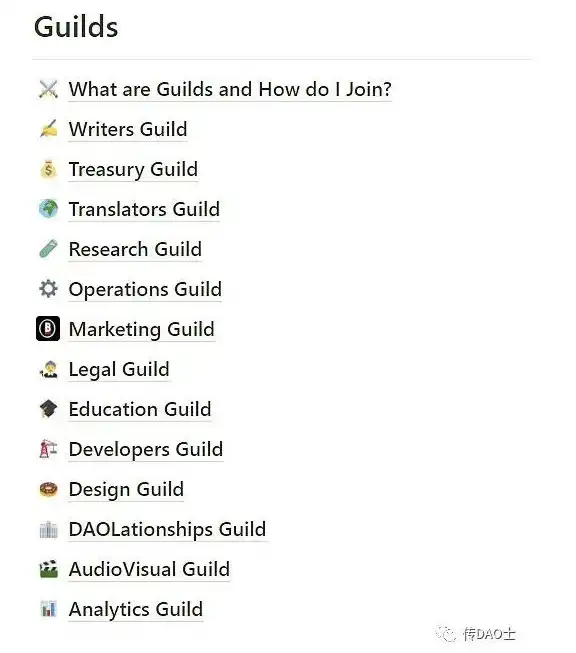
- Task Division System. Every community member should understand their role in the community and what rewards correspond to it. The best example of this is BanklessDAO. Built on Discord, they co-manage a community of over 30,000 members. Many members are not natives of the crypto circle, but ordinary people around us, such as cashiers, fitness trainers, lawyers, IT guys, etc. In a diverse community, mere vision is too abstract, and there are no clear KPIs to associate with. However, a common vision can bring everyone together. Based on their interests and abilities, members spontaneously form over a dozen guilds under the DAO. Guilds are like small departments in a company: design, development, legal affairs. Each department independently fulfills its responsibilities but collectively drives the development of the entire DAO forward. One word constantly appears in every corner of BanklessDAO - "action." It encourages action rather than empty talk, which is the fundamental part of their community culture. Based on this culture, 13 guilds have been formed, including writing, finance, translation, research, operations, marketing, legal, education, design, business development, development, video, and data analysis. (This analysis is from "The Tao of The DAO").
- Unified Identity. This is not a must, but with the development of DID, if there is a suitable platform that allows the community to bind with wallets, and each person has a community-specific NFT, where community benefits, functions, levels, etc., are all linked to the NFT, this would also be a great community cohesion and promotion tool.
- Cross-Community Promotion. Establish partnerships and collaborations that help in cross-promotion of the Web3 community. In a bear market, good news around collaborations is rare, so every relatively positive announcement is amplified. Whether through project partnerships, joint AMAs, or collaborative content plans, when you do have the opportunity to cross-promote and leverage your partner's marketing influence, be sure to make use of it.
Finding KOLs and Leveraging Their Value
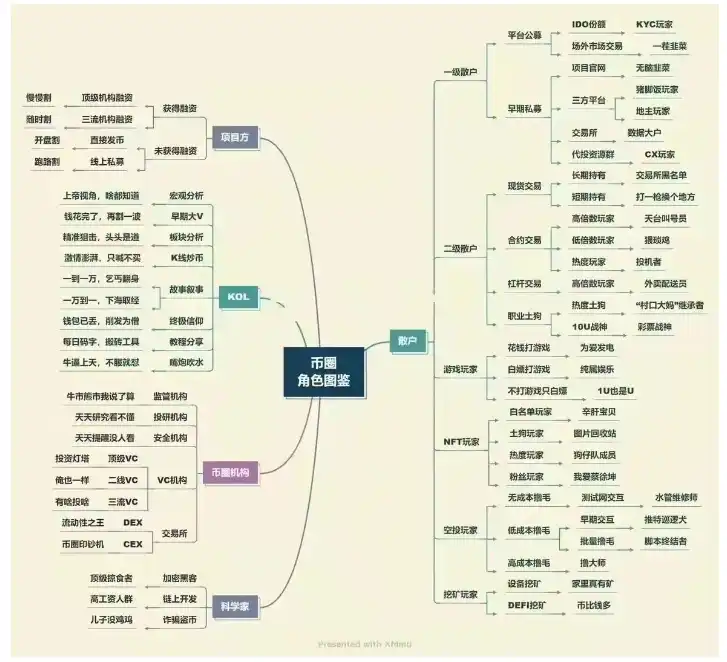
Where there are people, there is a hierarchy, and the same goes for KOLs. Not every KOL has genuine traffic and influence. When looking for KOLs, it is best to go for someone familiar, reputable, or with whom you have had long-term contact. KOLs are divided into many categories and they have their own hierarchy:
Industry Thought Leaders (e.g., Vitalik/CZ)
Major Institutional Partners (e.g., a16z/Paradigm/Arthur Hayes)
Mainstream Crypto Media Editors and Partners
Top Project Foundation Founders
Various Institutional Researchers
Various Social Media Influencers
Small Local Community Group Owners
Mastering User Growth
Although each project has a unique definition of growth, there are some common Web3 growth metrics that can be categorized as:
L1/L2 Protocols: Number of independent contributing developers, number of active wallets, number of interactions, transaction volume and scale
DeFi: Total Value Locked (TVL), number of active wallets, number of interactions
Game: Monthly Active Players, Transaction Volume per User, Guild Member Count
Market/Exchange Platform: Monthly Active Users, Number of Listed Assets, Trade Volume, Total Trading Volume
SaaS: Revenue per Customer, Customer Acquisition Cost (CAC), Customer Churn Rate
Startup projects have several great weapons to use in their Go-To-Market strategy:
- Core Team Members' Individual Influence. Each person should already be or have the potential to become an industry Key Opinion Leader (KOL). Therefore, they should maximize their influence on Twitter or other relevant social media platforms, first turning themselves into the biggest Sales asset.
- Industry KOL Resources Around the Core Team.
- Use Cases. While a startup may initially have none, the project team still needs to work hard to find several industry application examples, whether B2C or B2B. These cases are used to demonstrate the project's feasibility to the industry, while also leveraging the market influence of these partner projects to enhance self-brand awareness.
- SEO Optimization. This is something that can be done at very low cost or even zero cost. Through SEO optimization, make everyone's personal website/blog/PR content more search-friendly. This requires continuous investment and, over time, will help the brand gain higher search conversions and organic traffic growth in the long term.
- Airdrops are a great way to acquire users, seemingly simple but requiring careful planning and operation.
1. It's crucial to design the logic and ratio of Token inflation and deflation meticulously. Airdrops are clearly inflationary. If not designed well, the inflation brought by a large number of airdrop hunters can make it difficult for the project to take off at the beginning.
2. Most airdrops are recommended to be distributed through interaction/tasks. This can increase the threshold for airdrop hunters to some extent and design some interactive tasks that contribute to the project's growth, allowing participants to learn more about the project.
3. Combining Decentralized Identifiers (DID), previous airdrops rarely considered the identity of the receiving address and on-chain reputation. However, with the current boom in the DID field, many solutions for managing on-chain address CRM have emerged. Airdrops can consider partnerships with some DID projects. A single on-chain address typically aggregates investors, consumers, promoters, and multiple identities. However, through on-chain address data, such as Nansen data queries, address identities can be more clearly distinguished.
4. Similar to Airdrop, there are also some bounty platforms to consider. Bounty, in this context, incentivizes users to complete specific on-chain operations (such as transactions, staking, swapping, lending, engaging in social activities, etc.) by rewarding them with tokens. Some similar bounty platforms include: Flipside Crypto, Layer3, Project Galaxy, Rabbithole, Quest3, DappBack, Crew3, CoinList Karma
How to Plan a Successful Event
The main types of Web3 events are conferences, meetups, hackathons, and after parties. As the pandemic gradually subsides and most countries have reopened, we can see Web3 events flourishing globally. Organizing an event is a significant undertaking, but it can be partially standardized, and not every event needs to be done in an overly elaborate manner. Remember, an event is just one marketing tool, not the end goal. Therefore, it's essential to repeatedly consider the fundamental purpose of each event. Good event planning and execution should consider the following key aspects:
Local volunteers responsible for execution
Engaging and multi-dimensional guest lineup
Creating the right atmosphere
Appropriate flow of activities
Thoughtful and shareable takeaways
Comfortable timing
Event promotion ahead of time
Community outreach for promotion
Most importantly, the post-event goals expected by the brand and how corresponding event segments can assist in achieving them.
Token as an Operational Tool
-The project's internal tokenomics should be internally consistent
-Early token distribution should provide reasonable incentives. Free tokens may not always be appreciated, as most tokens distributed for free end up being sold quickly, resulting in downward price pressure. Therefore, relying solely on tokens to attract users can be considered "vanity metrics." To ensure effective distribution, it is essential to:
Allocate tokens to the right people, those who are truly interested in the project, provide valuable contributions, or at the very least, avoid rug pulling.
It is preferable to have tasks in a proof-of-work style to earn more tokens. For example, sharing, bug hunting, staking, and other such activities.
If these tasks inherently have viral characteristics, it will significantly increase the likelihood of secondary spontaneous propagation.
-Maintain a Proper Balance Between Inflation and Burning. Tokens distributed early on are likely to be for selling pressure, i.e., inflation. Therefore, it is best to consider a deflationary mechanism alongside it, not necessarily implemented simultaneously but definitely planned concurrently.
Hopefully, this article can assist every marketing-needing team in the industry, with a wish for less deception, more consensus in the industry, and for everyone to embrace the bull market amid "bias."
Welcome to join the official BlockBeats community:
Telegram Subscription Group: https://t.me/theblockbeats
Telegram Discussion Group: https://t.me/BlockBeats_App
Official Twitter Account: https://twitter.com/BlockBeatsAsia






