Understand ZkSync evolution and the future: ZkSync1.0, zkSync2.0, and Layer3
ZkSync Evolution and the Future: ZkSync 1.0, zkSync 2.0, and Layer3
原文作者: Sam Martin ,Blockworks 研究员
The Way of DeFi
Key points:
-ZkSync 1.0 has seen a poor adoption rate compared to other general-purpose L2 due to the lack of smart contract support, and the rollup has few utility features other than Token transfers and exchanges.
- The Matter Labs team plans to launch its alpha phase of zkEVM on its main network on October 28, making them the first team to launch ZK rollup, a general-purpose smart contract with EVM compatibility.
- The first team to launch zkEVM could gain a significant first-mover advantage, especially if Ethereum's transaction fees spike, forcing users away from the base layer.
- The zkSync team is an active participant in the proof process, believing that it has made a significant breakthrough in reducing hardware requirements.
-zkSync's ultimate goal is to have an L3 ecology where a hundred flowers bloom, powered by their proof technology, while maintaining the goal of focusing on expanding Ethereum.
ZkSync 1.0 由 Matter Labs 在 2020 年推出,是一个零知识 rollup(ZKR),依赖于以太坊的安全性,主要用于 Token 交换或转移。它不支持智能合约,所以今天 zkSync 1.0 上的产品是有限的,这也导致其相对于其他以太坊扩展解决方案而言,采用率较低。Matter Labs 团队希望通过在 10 月 28 日在主网上推出他们的 alpha zkSync 2.0,即 zkEVM 来解决这个问题。此外,Matter Labs 宣布它将在 2023 年第一季度在测试网上推出 L3。
ZkSync 1.0
尽管缺乏对智能合约的支持,ZkSync 1.0 也成功吸引了超过 5400 万美元的资金。zkSync 上的大部分 TVL 是 ETH 和各种稳定币,因为除了 Token 转移和交换之外,网络上缺乏实用性,此外,NFT 铸币也未能获得巨大的吸引力。目前,该 rollup 上的许多资金用户可能正在为不可避免的 Token 空投做准备,而这应该能抓住 zkSync 经济的未来增长。Optimism 和 Arbitrum 是两个最受欢迎的以太坊扩展解决方案,鉴于它们已经支持智能合约,所以其用户活动要多得多。虽然每天的交易量并不是一个完美的度量标准,但也提供了一些关于 zkSync 因尚不支持智能合约而错过活动量的洞察力。

All money on zkSync is secured in Ethereum's smart contract, and computing and storage take place off-chain. Several trades were bundled into one batch, settled on Ethereum to amortize the gas cost for all L2 traders, and then settled simultaneously. All state changes that occur during the rollup process are published to Ethereum as calldata, along with a SNARK certificate to ensure that the state changes are valid. calldata published to Ethereum gives anyone the ability to reconstruct L2 state and is much cheaper than storing the entire L2 state on EVM. SNARKs were able to validate high-volume transactions in a cost-effective and timely manner (instant confirmation, completed within 15 minutes) and resulted in a significant increase in zkSync transaction throughput compared to the Ethereum base layer (e.g., ~ 2,000 and ~ 15 tps, respectively).
ZKR offers many advantages over other extension architectures. For example, ZKR inherits Ethereum's security, while side chains like Ronin Network are subject to vulnerabilities in their own set of validators. ZKR also does not rely on proof of fraud such as Optimism or Arbitrum, where an honest third party must monitor a block for malicious transactions and requires a seven-day challenge period that delays fund withdrawals. In addition, funds on the ZKR can always be retrieved by their legal owners, regardless of the state of the verifier set, unlike the plasma chain, where the verifier is required to securely monitor withdrawals.
The chance of zkEVM
The zkEVM race has heated up between Scroll, zkSync and Polygon, but with zkSync planning to launch its main Web alpha at the end of October, it seems likely to prevail, after all, the potential impact that first-mover advantage can have on the team that crosses the finish line first is hard to underestimate. MATIC launched as one of the first EVM-compatible chains back in 2017, then changed its name to Polygon in February 2021, and was able to attract a large number of dApps and users amid skyrocketing Ethereum transaction fees. It is relatively easy to migrate applications onto EVM-compatible chains by redeploying similar code, so whichever team launches zkEVM first can see explosive growth in dApp deployments and user activity and build strong network effects, as Polygon did in 2021.
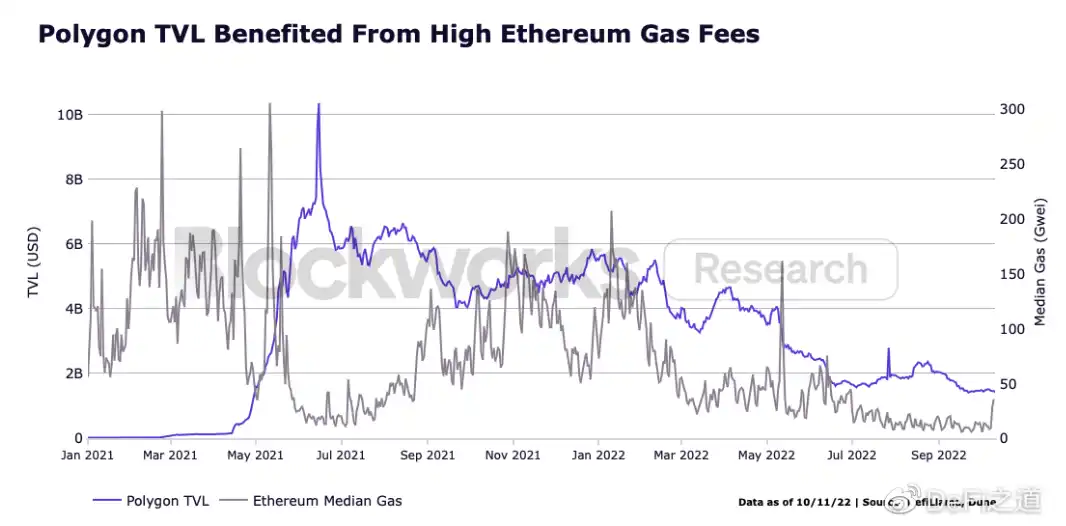
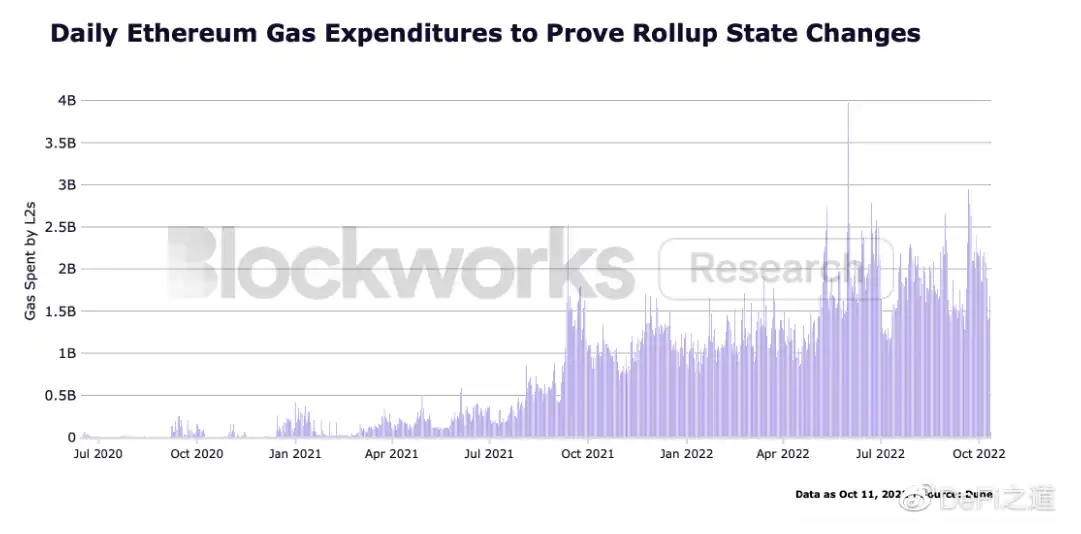
As mentioned earlier, side chains do not have the same security as ZKR, and the leading Ethereum L2, including Arbitrum and Modernism, belong to optimistic rollup, a class of rollup that requires a challenge period of 7 days to withdraw funds from the official bridge. Currently, L2 adoption has been dominating the narrative, and the total amount of gas L2 pays to Ethereum settlement has been on an upward trend. The launch of zkEVMs will serve as a booster for this trend, given that its security and user experience is superior to its Ethereum side chain and optimistic rollup counterparts.
ZkSync vision
The mainnet alpha release of ZkSync 2.0 will be limited to developers who have registered their projects to participate in the fair release. The exclusion of users was chosen to ensure that the dApp team had ample time to ensure that their product ran smoothly, users were not affected by any bugs, and to give the Matter Labs team more time to iterate on their zkEVM design. It's worth noting that Starkware's Starknet is another generic ZKR smart contract chain that is still in alpha. Starknet optimizes for ZKR using its own language, the Cairo language, rather than focusing on EVM compatibility. In addition, Warp is working on an adapter from Solidity to Cairo language, which may make it similar to zkEVM from zkSync. Developer tools, best safety practices, and open source libraries for Cairo will be a long way behind Solidity. In addition, Polygon launched their zkEVM on the beta network on October 10, although zkSync's zkEVM has been running on the beta network for about 9 months.
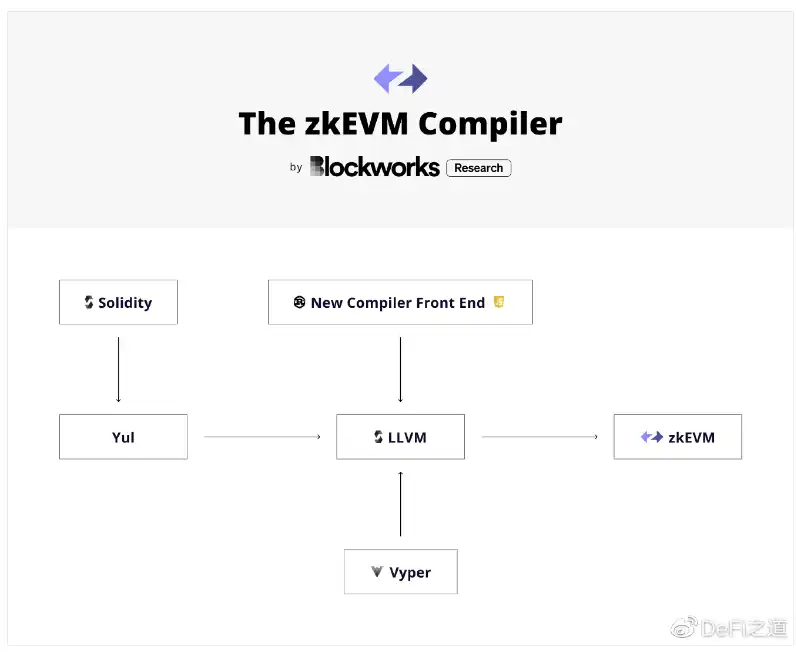
ZkSync makes EVM compatibility possible by taking Solidity (advanced smart contract source code for Ethereum) and compiling it into Yul (an intermediate language that can be compiled into bytecode for different virtual machines). The LLVM compiler framework is then used to recompile the Yul code into a set of custom, circuit-compatible bytecode designed for zkEVM of zkSync. This approach bypasses the zk proof for all steps of EVM execution by starting directly from the high-level code, making the proof process easier to spread out while maintaining high performance. Support for Rust, JavaScript, or other languages can be added in the future by building a new compiler front end, thus increasing the flexibility of its zkEVM architecture. It should be noted that zkEVM is EVM-compatible and not equivalent at the bytecode level. Thus, while almost all Ethereum smart contract code can be ported to rollup out of the box, there will be exceptions such as some code that needs to be changed, and reviewed, and debugging tools that are not compatible without minor tweaked. In response, the Matter Labs team plans to build an EVM bytecode compiler to run as a contract on zkSync to address these minor issues.
Account abstract
与以太坊的默认行为相比,正在 zkEVM 中实现的一个主要改进是账户抽象的想法。以太坊的核心架构支持两种类型的账户:外部拥有的账户(EOAs),是由私钥控制的公共地址,可用于签署交易(例如 Metamask 钱包),以及合约账户,根据底层代码操作,不能启动交易。这里的主要目标是将持有 Token 的账户与授权交易的签名者脱钩。
zkSync 的 zkEVM 中的 EOA 账户当然能够发起交易,但也能够像以太坊上的智能合约账户一样在其中实现任意逻辑。这就是所谓的 "账户抽象",与 EIP-4337 非常相似,只是稍作修改,为用户提供了更流畅的体验。可以补偿其他账户交易的账户被称为 Paymasters。在实践中,Paymaster 账户应能使协议以 ETH 或各种 ERC-20 Token 代表用户支付交易费用。随着用例的发掘,账户抽象可以为钱包提供商开辟一条新的创新途径。值得注意的是,这是一个仍在迭代中的新想法,用户应谨慎行事。
zkPorter
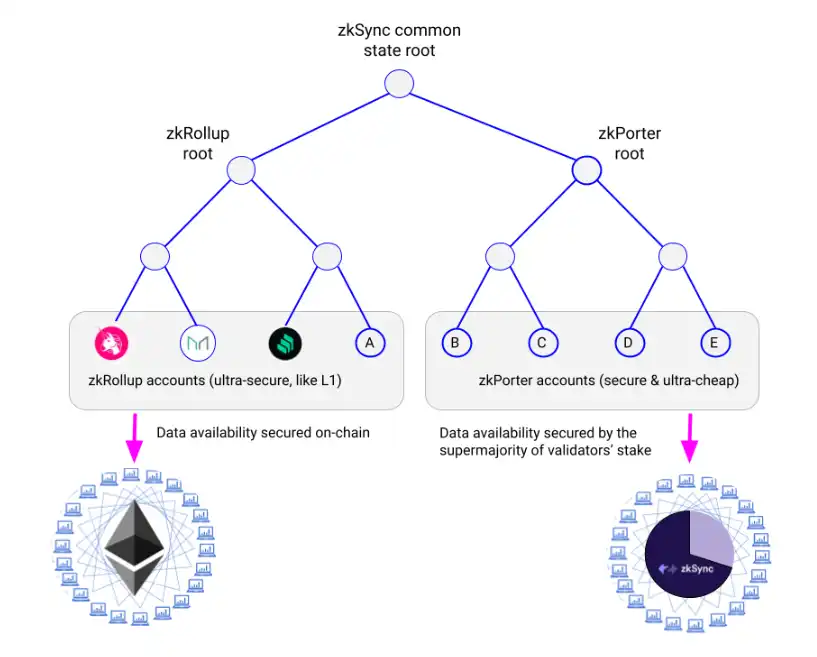
The zkEVM race is currently the dominant L2 narrative, but more notable is zkPorter from zkSync. While zkEVM will bring an order of magnitude of expansion to Ethereum, ZKR still needs to publish data onto the Ethereum base layer, which reduces their potential scale. The introduction of zkPorter will put zkEVM of zkSync firmly in the volition category, meaning that users can decide whether to store their data on or off the chain. Users who prioritize security over throughput and very low transaction fees will choose to conduct their activities on rollup to guarantee data availability. Users who prioritize throughput and lower transaction fees over security will conduct their activities on zkPorter, where data will be published and made available off-chain.
所有 zkPorter 交易数据将被发布到 Guardian 网络,这是一个由最终的 zkSync Token 担保的权益证明网络。Guardian 将通过签署区块来跟踪 zkPorter 方面的状态,以确认数据是否可用。恶意行为的 Guardian 将被罚没,从而为数据可用性提供加密经济保障。与 Optimistic rollup(如果数据移到链下,恶意运营商将能够窃取汇 rollup 上的任何资金)不同的是,邪恶的 Guardian 只能冻结 zkPorter 状态,而 zkPorter 状态反过来会冻结他们自己的资金。此外,购买所有未质押的 zkSync Token 来完成这样的攻击将花费大量的资金,并在这个过程中产生巨大的滑点。
zkSync's two-account approach to ZKR and zkPorter will provide users with a comprehensive destination to conduct their activities while retaining a high level of security assurance. Smart contracts and accounts on both sides of ZKR and zkPorter will be fully capable of combining with each other. For example, Aave can launch their contract code on the ZKR for maximum security, but users can still interact with the contract through their account on the zkPorter side for lower fees and higher throughput. The final design for zkPorter is still a work in progress, so plans are subject to change.
Layer 3
While not much information can be made public, Matter Labs recently announced its goal to launch L3 powered by its zkEVM in the first quarter of 2023. ZKR L3, dubbed "Opportunity, "may be the first L3 ever to be launched on a test network, with the vision of an infinite number of fully customizable" hyperchains, "all connected to each other via native Bridges, bringing the idea of secure interoperability to reality. This L3 would be highly experimental, but would also be a logical next step in the research and development of new blockchain extension architectures.
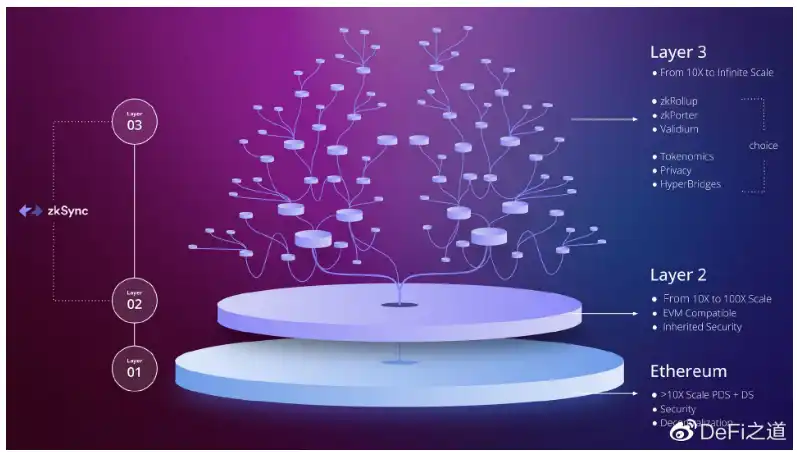
构建 L3 验证器的第三方将能够选择他们公开的数据,从而为用户实现隐私。这些团队也将被授权推出他们自己的 Token ,以捕捉他们正在建设的东西的上升空间。此外,这些 Token 也可以在去中心化其证明过程、排序器或数据可用性解决方案中发挥关键作用。在可定制性方面,可以在 Cosmos 的特定应用链和 zkSync 的 L3 之间进行比较,关键的区别在于以太坊的安全性支撑着后者,以及链间完全可互操作的资产,不需要像 IBC 这样的通用消息传输协议。
ZkSync hopes its breakthrough in reducing the hardware requirements for participating in the proof process without sacrificing performance will make them the industry standard. This would put their ZKR, zkPorter, and all other zkSync L3s on the same circuit and eliminate bridging attack vectors that are repeatedly exploited. While this vision is ambitious, it will be a 10-to 100-fold improvement in transaction costs and speed, developer and user experience, interoperability, and security. The remaining questions are mainly two: one is whether L2, which is different from EVM in terms of bytecode, can become an industry standard; the other is whether L2 and L1 teams competing for the share of users' minds can put aside their differences and extend blockchain to the masses.
A final thought
ZkSync has long been a pioneer in zero-knowledge cryptography and continues to pioneer the expansion of Ethereum. The first zkEVM they plan to launch on the main network before the end of October will provide them with a significant first mover advantage and allow them to build strong network effects. Its approach of using interoperable accounts on both sides of zkPorter and ZKR is a unique strategy that benefits both developers and end users. Also, Matter Labs' vision of creating a standard validator for all chains to adopt is very ambitious, but their vision will only be fruitful if they actually develop the most advanced validator to date. This will open the door to a thriving L3 ecosystem with a reasonable level of sovereignty, high performance, and secure interoperability. The main risk associated with their strategy is the underlying architecture they chose for their zkEVM: Ethereum compatible with ZKR at the high-level smart contract code level, rather than EVM equivalent at the byte level, or by creating a new programming language that gets rid of EVM compatibility altogether. Several teams are working on all three strategies, and only time will tell who is making the right bets in terms of scaling Ethereum.
The original link
Welcome to join the official BlockBeats community:
Telegram Subscription Group: https://t.me/theblockbeats
Telegram Discussion Group: https://t.me/BlockBeats_App
Official Twitter Account: https://twitter.com/BlockBeatsAsia

 Related Articles