Wallet 2.0 Era: MPC Wallet vs Smart Contract Wallet

Original title: "IOSG Weekly Brief | Wallet 2.0 Era: MPC Wallet vs. Smart Contract Wallet"
Original author: Chloe, IOSG Ventures
At the Devcon 6 conference held in Bogota, Tomasz Tunguz mentioned some statistics of Web3.0: the cumulative DAU of major public chains is about 2.5 million, while the DAU of traditional Internet is 5 billion, and the former barely reaches 0.05% of the latter. From the supply side, there are about 16,000 developers developing Web3.0, while the total number of developers in the world has reached 27 million, and Web3 developers account for less than 0.06%. Therefore, Web3.0 is still a long way from mass adoption.
As the entrance to Web3.0, the user experience of wallets directly affects when the crypto industry can usher in large-scale adoption. Although major wallets have made great efforts in this regard, in the eyes of ordinary users, the wallet experience is still unsatisfactory. Although custodial wallets are easy to use, security is a big hidden danger, and wallet theft incidents are endless. Although self-custodial wallets are relatively safe, the way to keep long mnemonics and private keys is much more complicated than the username-password system of the traditional Internet. According to a research report by Chainalysis, as of 2021, about 20% of the Bitcoin in circulation has been lost because the owner does not remember the private key. Many people may wonder, why can't we apply traditional verification methods to Web3.0?
Why can we only verify by private key? To answer this question, we need some background knowledge and concepts. The first is the account type on Ethereum. There are two types of accounts in Ethereum: external accounts and contract accounts. Contract accounts are smart contracts whose code is run by the Ethereum virtual machine. External accounts are wallet accounts that we usually use to initiate transactions. They are called "external" because they have no code and are therefore independent of the Ethereum virtual machine and controlled by the user through private keys.
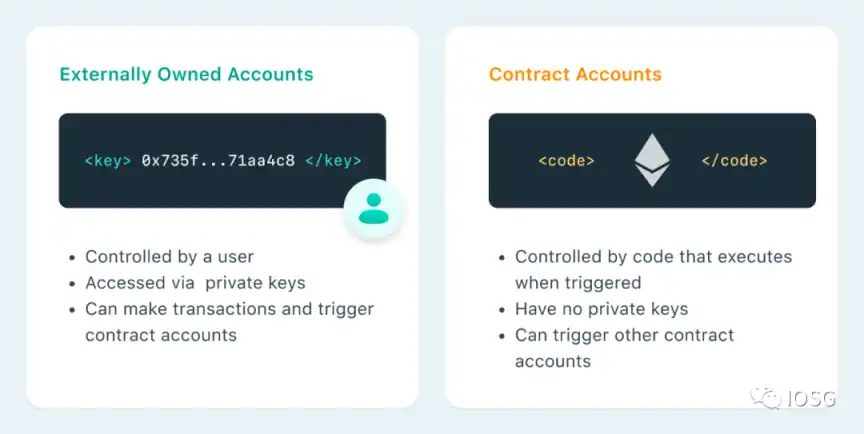
Image source: https://lh3.googleusercontent.com
Although the contract account has custom logic, it cannot actively initiate transactions. Therefore, any change in the contract status depends on the external account to initiate, and the external account pays Ether. So how to verify the legitimacy of the transaction? The verification method on Ethereum is to check that the initiator of the transaction and the owner of the asset (Ether), that is, the owner of this external account, are the same. Therefore, users need to sign the transaction through the wallet. The default verification logic of Ethereum is secp256k1 designed by Satoshi Nakamoto, and it is through this algorithm that the key pair is generated. The correctness of the signature can be verified by verifying whether the signature comes from the private key corresponding to a certain common key, so the user must master this private key. This is why no matter how to optimize the user experience of the wallet, the problem of private keys cannot be circumvented.
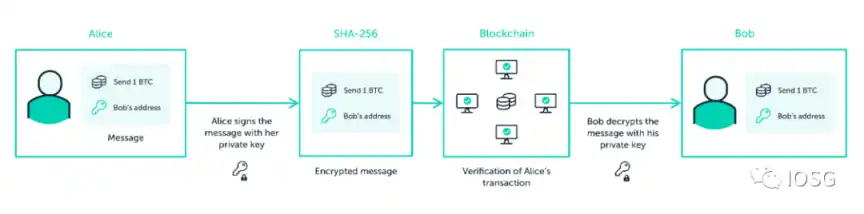
Image source: https://www.ledger.com/academy/blockchain/what-are-public-keys-and-private-keys
As mentioned above, external accounts do not have code logic. If you want to introduce more complex logic to implement other functions, such as multi-signature, etc., you cannot do it directly on the external account. So, what are the current ways to solve this problem? The author will introduce two solutions that are considered to be the most feasible and effective: MPC wallet and smart contract wallet.
MPC Wallet
MPC, the full name of Multi-Party Computation, is an important cryptographic security measure. It includes many technical solutions, and in the context of this article it mainly refers to MPC-TSS. The MPC wallet implements more complex verification methods such as "multi-signature" and "cross-chain" off-chain by performing multi-party calculations on private keys. Simply put, it is to break a private key into multiple pieces, and hand over the private key fragments to a decentralized network for calculation and encryption. When a private key signature is required, the fragments are pieced together to form a complete private key. The core idea of MPC is to disperse control rights in order to disperse risks or improve disaster preparedness, effectively avoiding security issues such as single point failure.
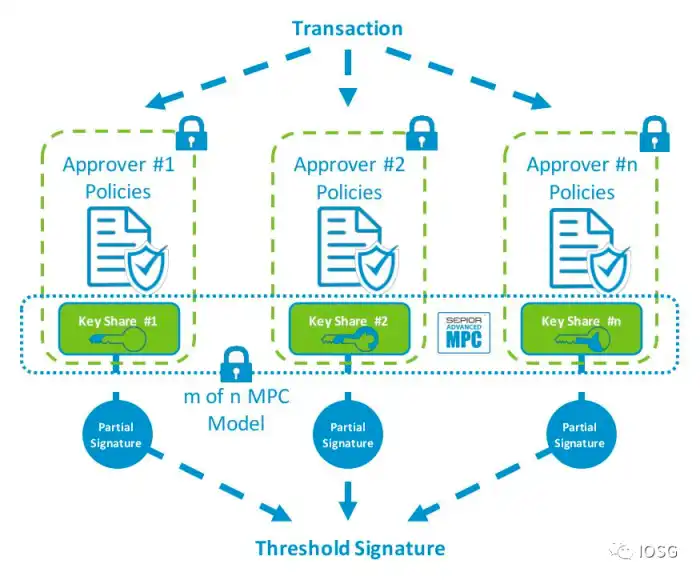
Image source: https://sepior.com/products/advanced-mpc-wallet
The concept of "multi-party participation" in MPC wallet is somewhat similar to that of "multi-signature wallet", but in fact, although both can realize the function of "multi-signature", the implementation methods of the two are different. The multi-signature wallets we are familiar with before, such as Gnosis Safe, are wallets built on smart contracts. The verification logic is defined in the contract. For example, if a transaction needs to be verified, more than one private key is required, or at least three of the five private keys are required for verification. This type of wallet belongs to a type of smart wallet that will be mentioned later. The MPC wallet, on the other hand, decomposes a private key into multiple fragments, and the verification process only involves one private key. In addition, the computing network is off-chain and has no connection with smart contracts.
Smart Wallet
Smart contract wallets, as the name suggests, are wallets based on smart contracts rather than external accounts. There are already many smart contract wallets on the market, but because these smart contracts are customized, lack unified industry standards, and have contract vulnerabilities and compatibility with other contracts, they have not been widely used. Recently, smart contract wallets have once again become a hot topic due to the significant progress of the "account abstraction" proposal EIP-4337. So what does account abstraction mean? After implementing account abstraction, what kind of new experience can it bring to users? Before understanding account abstraction on Ethereum, we first need to understand the concept of abstraction in CS.
"Abstraction" is one of the most important concepts in computer science. It means hiding the implementation details of its background while providing the necessary key information to the outside world, so that developers only need to focus on this abstract layer when dealing with tasks in an abstract layer. Let's take an example close to life: when we as viewers want to use a TV, we only need to be familiar with the operations that TV viewers need to know, such as how to turn the power on and off, adjust the volume, switch channels, connect other devices such as game consoles, DVDs, etc. Viewers do not need to understand the internal implementation details of the TV, such as how the TV receives signals through cables, how to convert signals, how to present these signals on the TV screen, etc. These implementation details are what the TV makers need to know. As viewers, we only need to control the TV through external interfaces, such as the power button, remote control, DVD, etc.
Account abstraction Similarly, as wallet users, we still need to consider many factors, such as gas price, gas limit, transaction blocking and other complex cost logic. The fundamental reason is that wallets based on external accounts cannot be "abstracted" well, which directly leads to users having to deal with many problems that should not be handled by users. So how to solve it? The logic is very simple. We can abstract external accounts and contract accounts to make external accounts closer to contract accounts, so that wallets can be given more complex logic through smart contracts. Smart contract wallets can achieve more than just "multi-signature" scenarios.
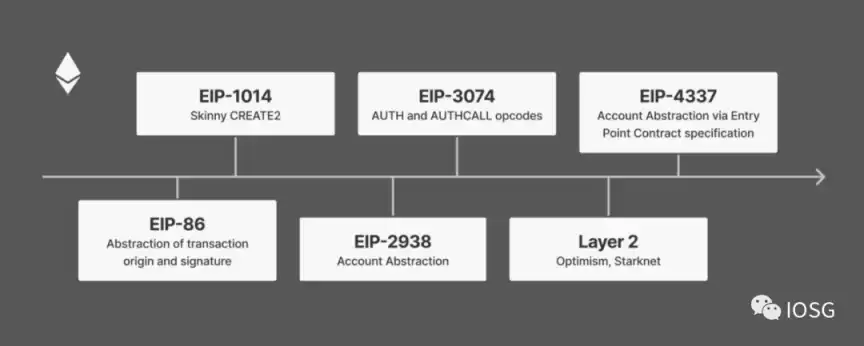
Image source: https://miro.medium.com/
If EIP-4337 can achieve a systematic upgrade of Ethereum accounts, what new experience can we get as users? In theory, any function that can be defined by smart contract code can be achieved. First of all, smart contract wallets can be verified by non-secp256k1 verification algorithms, and users do not need to face long key pairs and mnemonics. At the same time, smart contracts can also give keys more logic. For example, in a multi-signature scenario, different permissions are defined for each private key: transactions below 50USDC require private key A to sign, transactions above 50USDC require private key B to sign, transactions above 2000USDC require private key ABC to sign together, and so on. In addition, it will be easier to interact with the blockchain through mobile terminals. We can authorize a key dedicated to the mobile phone, and we can define this key with restrictions, such as only being able to interact with a fixed number of smart contracts, or smart verification of transactions with a small amount. Other functions that can be realized include one-click authorization of batch transactions, transaction blacklists, etc. In short, the imagination space of smart contract wallets is very large.
Summary
After introducing the two wallets, readers may have questions, which of these two solutions is better? I think it is difficult to compare because MPC wallets and smart contract wallets do not solve problems at the same level. MPC wallets are off-chain solutions that can control both ordinary wallets based on external accounts and smart wallets. The two have their own use cases and do not conflict. Therefore, I will list the opportunities and challenges of the two solutions for you.
As an off-chain solution, MPC wallet does not involve changes to the Ethereum consensus layer or contract layer. The user's usage cost is lower and it is more feasible in the short term. In addition, it has more advantages in some special use scenarios such as cross-chain keys. Smart contract wallet is a systematic upgrade of Ethereum, which can bring more new experiences and use cases to users. However, account abstraction is a major project that requires "mobilizing a large number of people", requiring other smart contracts, developers, and Ethereum architecture to cooperate in upgrading. The excessive difficulty of practical operation has prevented the vision proposed in 2015 from being fully implemented to this day. For users, the most direct problem of smart contract wallets is that the cost of using wallets will increase, and fees need to be paid from the beginning of creating wallets.
The author believes that smart contract wallets are our ultimate vision, and MPC is a more feasible solution in the short term, and it has more advantages in some special scenarios. Due to cost issues, the feasibility and possibility of smart wallets on the Ethereum mainnet in the future are low. Readers can pay more attention to the progress of account abstraction and smart wallets on Layer2. Currently, EIP-4337 is the most feasible account abstraction solution. Many smart contract wallet projects are exploring this path. The full implementation of smart wallets may be closer than we think.
Part.2 Investment and Financing Events
Celestia completed US$55 million in financing, led by Bain Capital and Polychain, with participation from IOSG Ventures and others
* Infrastructure
Delysium Completed 1000 10 million US dollars strategic financing
* Web3 chain game
Web3 chain game project Delysium announced the completion of 10 million US dollars in strategic financing, led by Anthos Capital, and participated by Immutable, GSR, Blockchain Coinvestors, Leonis Capital, Antalpha Ventures, Perion and Formless Capital. The strategic funds will be mainly used to develop content, realize unique artificial intelligence experience, and build Delysium Multiverse, an open source and decentralized publishing structure for Web3 games.
Delysium is an MMO (massively multiplayer online) game led by rct AI, a game-AI company incubated by Y-Combinator, which supports players to create various personalized physical assets, narrative assets and native AI virtual images.
Previously in March, the Web3 chain game project Delysium completed more than 4 million US dollars in financing, led by Galaxy Interactive, Republic Crypto, and Alameda Research.
Tapio Completes $4 Million Seed Round Financing
* Synthetic Asset Protocol
Polkadot synthetic asset protocol Tapio has completed a $4 million seed round of financing, led by Polychain, Hypersphere and Arrington, with participation from Spartan, LongHash, 0xVentures, CMS, D1 Ventures, 11-11 DG Partners, Genlock, Valhalla, PAKA and Double Peak. Tapio aims to improve the efficiency of staking and crowd-lending derivatives on the blockchain protocol Polkadot.
Shardeum completes $18.2 million in seed round financing, led by Spartan Group and others
* Public chain
The public chain project Shardeum completed $18.2 million in seed round financing, led by Jane Street, Struck Crypto, Spartan Group, Big Brain Holdings, DFG, Ghaf Capital Partners, and Foresight Ventures, with participation from Coingecko Ventures, WeMade, ZebPay, JSquare, Nestcoin, Veris Ventures, Tupix Capital, Mapleblock Capital and NetZero Capital, as well as Balaji, former CTO of Coinbase Srinivasan and Kraken Chief Marketing Officer Mayur Gupta and other individual investors participated in the investment. The funds raised will be used to strengthen the company's marketing and develop the development team to further strengthen Shardeum's dynamic sharding technology and ecosystem development.
It is reported that Shardeum was created by Nischal Shetty, co-founder of WazirX, an Indian crypto trading platform under Binance. It is a Layer 1 blockchain network that uses sharding technology. It is currently in the form of a test network and aims to provide low transaction fees. Earlier today, it was reported that Shardeum will be launched in the first quarter of the next fiscal year.
Stability AI Completes $101 Million Seed Round Financing
* Metaverse
Stability AI, a company developing metaverse and digital media tools, announced the completion of a $101 million seed round of financing, led by Coatue Management and Lightspeed Venture Partners. According to an unnamed person familiar with the matter, this round of financing values Stability AI at $1 billion.
It is reported that Stability AI has built an AI tool "Stable Diffusion" that can make digital art. The tool can design applications in the metaverse and may also create PowerPoint presentations. Unlike its competitors, Stable Diffusion is an open source software that can be used by the public. Users can build applications related to design, film, augmented reality, video games, advertising and even e-commerce based on its code.
Web3 Builders Completes $7 Million Seed Round Financing
* Security Company
Smart contract and NFT security company Web3 Builders has completed a $7 million seed round of financing, with Road Capital, OpenSea Ventures, Sparkle Ventures, Picus Capital, ACME, TTV, G20, Global Founders Capital, Haven Ventures and Greylock participating. The financing will be used to develop products, add new artificial intelligence and machine learning methods, and expand the team.
Web3 Builders was founded earlier this year by Riccardo Pellegrini, former product head of Amazon Web Services, to provide anti-fraud tools. Web3 Builders also launched a free Chrome browser plug-in TrustCheck that detects fraud in the background and notifies users.
Stardust completes $30 million Series A financing, led by Framework Ventures
* Chain Games
Stardust, a platform company that provides developer tools for chain games, has completed a $30 million Series A financing, led by Framework Ventures, with participation from Acrew Capital, Blockchain Capital and Distributed Global.
Stardust is headquartered in California and was founded in 2018 by CEO Canaan Linder. It is reported that Stardust has cooperated with game publisher Tilting Point to help its developers build blockchain games.
Bolster Completes $15 Million in Financing
* Security Company
Security company Bolster announced the completion of $15 million in financing, led by Cheyenne Ventures, Cervin, Liberty Global Ventures, and existing investors Thomvest Ventures and Crosslink Capital. The financing will drive the company's further development to help more global customers detect and repair threats on the Internet, social media and app stores. Following this round of financing, Cervin general partner Shirish Sathaye and former Zscaler chief strategy officer Manoj Apte will join Bolster's board of directors.
Bolster is an automated digital risk protection company that automatically detects and quickly remediates threats in digital media and Web3 networks, monitors and combats fraudsters on the Internet, and provides the most effective protection against fraudulent websites and content across the web, social media, and app stores.
Mercury Completes $7.5 Million Seed Round, Led by Multicoin Capital
* Web3 Experience Platform
College sports fan experience platform Mercury has completed a $7.5 million seed round of financing, led by Multicoin Capital, with participation from North Island Ventures, Crosslink Capital and Brevan Howard Digital. The new funds will be used to expand their partnerships with new schools and continue to grow their student-athlete roster. Leadership recruitment will also be increased.
Mercury was co-founded in 2021 by Porter Grieve and Justin Johnson to connect college sports brands with fans through a hyperlocal fan experience platform that is currently leveraging the Flow blockchain.
Milkomeda completes $3.1 million in financing, led by Archetype
* L2 Protocol
The second-layer network protocol that provides EVM functions for non-EVM-compatible chains Milkomeda has completed $3.1 million in financing, led by Archetype, with participation from Sora Ventures, Algorand Foundation, Arrington Capital, SOSV, Circle Ventures, Borderless Capital and Coinbase Ventures. Currently, Milkomeda has deployed EVM-compatible second-layer networks for Cardano and Algorand.
Spindl completes US$7 million in financing, led by DragonFly Capital and others
* Web3 e-commerce
Miami-based Web3 startup Spindl announced the completion of US$7 million in financing, led by DragonFly Capital and Chapter 1, with participation from Polygon Ventures, Tribe Capital, Multicoin, Solana Ventures and others. The new funds will be used to expand recruitment.
It is reported that Spindl aims to rebuild the basic infrastructure of Web2 e-commerce backend for Web3 and provide strategies for Internet companies to track users and acquire customers. For example, by analyzing Discord posts, Reddit forums, advertisements and other Internet links, this data is paired with on-chain behaviors such as purchases, sales and transactions to create profiles that help protocols understand the source of traffic.
Welcome to join the official BlockBeats community:
Telegram Subscription Group: https://t.me/theblockbeats
Telegram Discussion Group: https://t.me/BlockBeats_App
Official Twitter Account: https://twitter.com/BlockBeatsAsia

 Related Articles