A&T Capital: The Development Status and Prospect of Upstream and Downstream Gamefi in the History (Part 1)
Original title: "A&T View: The Most Complete History of Gamefi Upstream and downstream Development Status and Prospects (Part 1)"
原文作者:Grace Deng, A&T Capital
01 the
gamefi will have more web2 users, more interactions and better performance than other web3 tracks. Moreover, the assets on the chain are highly homogeneous and large in number. Therefore, more vertical web3 infrastructure is needed, and this trend has already appeared.
At present, most of gamefi's decentralization degree only stays in the chain of core assets (core NFTS, game coins), and the upstream of the production and research category still uses web2 tools, with a very low degree of decentralization. In the future, the degree of game chain will be increased, including the game rules, game data chain, and even a lot of full-chain games. Therefore, although not all upstream industries need to be decentralized, this infrastructure has yet to be developed on the road to web3.
When the next round of gamefi bull market starts up, there will be a large number of web2 games that need to be quickly linked up (the time, capital and labor cost of making a web3 game from the ground up is too high), and the mature gamefi sdk will have explosive demand, which is quite promising.
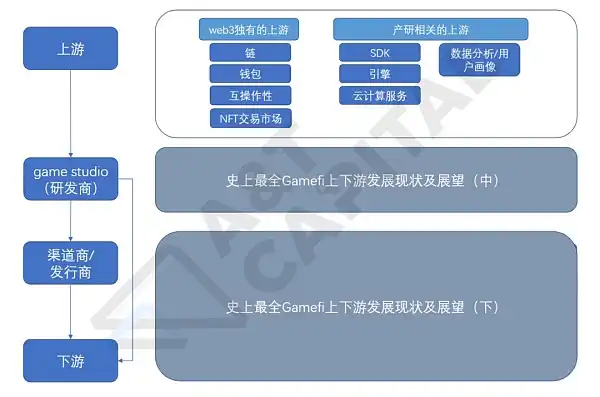
02 Text: Upstream Gamefi
web3 exclusive upstream
Chain of # #
Requirements:
The game can allow in-game items to exist in the form of tokens or NFTS through the chain, allowing players to freely trade or rent
For players, their specific needs for chains are high TPS and low GAS; For the project side, there is a lot of fast interaction, and latency and Gas need to be reduced; In addition, the concept of metaverse and AR/VR has been added to the roadmap of many games, which puts forward the demand for chains with high scalability
Development Status:
Ethereum and other old public chains no longer occupy an absolute dominant position. Solutions to Gamefi's pain points (mainly the high requirements of TPS and Gas) have emerged in the market, and there are three major models:
General purpose common chain:Ethereum, Solana, Polygon, for example, support all categories of applications
Ethereum is no longer dominant. The Top 10 chains are Splinterlands and Alien Worlds. However, the user base, stability and ecological maturity that Taifang can provide are unmatched by other chains.
Existing mature Layer1, such as Solana, Avalanche and BNB Chain, try to provide solutions in terms of expansion in the face of the big triangle problem of blockchain. They sacrifice security and decentralization to reduce gas and improve transaction speed to varying degrees, and serve Defi and Gamefi applications. However, the existing layer1 has many problems such as fake pan, PI xiu pan and frequent security accidents, so it can only attract part of chain games.
Layer2 solutions, such as op and starknet, provide expansion solutions for Ethereum, which benefit from Ethereum's interoperability, security, EVM compatibility and other advantages while improving speed and reducing gas; The main feature of starknet is to lay the foundation for the development of full-chain games, that is, state storage and logic execution are also completely on the chain, and it has the advantages of decentralization, license free, composability and interoperation.
Next generation layer1, such as aptos, sui: The new move language combined with the new blockchain architecture makes the chains of the move ecosystem high throughput, low latency and asset oriented. sui and aptos are working to build a high-performance blockchain that can reach billions of people, and faster TPS will greatly expand gamefi's experience.
Special chain for chain tour:Dedicated chains deployed specifically for Gamefi, dedicated to building a whole ecosystem around NFT/Gaming that meets the specific needs of game development, WAX, Immutable X, Flow, etc
The focus is still on TPS, i.e. WAX can reach 8000 TPS
Ecological comparison is supported by game projects with high quality, active users and large user base. It has a snowball effect -- more and more popular games are released, providing user base for emerging chain games
Highly susceptible to fluctuations in Gamefi's overall performance.
Chain game application chain:The chain is specially created for a certain chain game. One chain serves one product. In this way, the problem of blockchain capacity is solved and more room for improvement of picture quality and fluency of the game is provided. for example, Ronin for Axie Infinity, DFK Chain for Defi Kingdoms
A single chain of processing power. Application chain because of fewer nodes, performance over the ordinary public chain, a day to handle tens of millions of transactions, support chain travel to reach millions of daily live; Games are very different from other applications. They have very high requirements for the strength of the hardware and the experience of the software. For a chain game with a large number of users, still choosing to share the network is obviously not ideal, because the game experience is easily affected by other applications on the chain.
It is usually a chain that follows the success of a game, so it is mainly suitable for games with a large player base, high DAU and long lifetime;
One application per chain means there are cross-chain requirements, so there are asset cross-chain and cross-chain bridge security issues
View:
In the short term, the mature general public chain is gradually solving the pain points of TPS and gas in chain games, and has mature supporting facilities, but it is not easy to be replaced; WAX, a special chain for chain games, ranks first in the number of players on the chain. Looking forward to the performance of immutablex and flow on the main network in the future. Game specific chain is faced with the difficulty of overcoming cross-chain security and game singleness. In the long run, with the increasing playability and complexity of games, move ecology that combines ecological diversity with high performance may have certain advantages.
Wallet # #
Existing needs/pain points:
The earliest web3 wallets provided portal services to access funds and interact with DApps. With the continuous development of web3 ecology, increasing public chains, expanding asset diversity, and facing the new needs of web2 users, web3 also has new demands and pain points for wallet, including but not limited to:
Different Dapps have different chains, so it is inconvenient to add and switch multiple chains
The wallet cannot fully display NFT assets and some assets that are yield-farming
The web2 login method cannot be used to easily register and log in
Wallet theft incidents are frequent, security concerns
The interaction between the wallet and the dapp is not smooth enough and requires multiple confirmations
The current state of wallet usage in games:
The majority of gamers still use major plugins such as metamask and coinbase wallet.

Mainstream wallets interact with different Dapps by browsing different websites and manually connecting to the wallet. Rainbow Wallet, Trust Wallet, and Metamask have already tried to combine wallet and DApp features, allowing users to exchange tokens directly within the app, providing a one-stop solution for users, but not yet able to log in directly from the wallet to the game.
The wallet onboarding of traditional web3 games is very complex for web2 players.
Some games offer in-app wallets to reduce this friction.

Only used within specific games
Not decentralized enough, mostly managed wallets, the private key is not in the hands of the user
The interactive experience is very convenient
After logging in, you can directly recharge legal currency to buy in-game assets, similar to the experience of traditional games
Vertical wallets have emerged in other areas, but there is no game wallet yet.
At present, there are wallets for specific areas in other fields. By building a specific wallet for a specific user group, developers can build features that are more useful to that audience and serve them more effectively. For example, DTTD, a wallet that focuses on social NFTS, can directly DM wallets with different NFTS and share their newly purchased NFTS
The mainstream EOA wallet is part of the core network protocol. Due to the limitations of the underlying core protocol of Ethereum, it is unable to support users' strange Web2-level account experience requirements. Smart contract wallet is emerging.
smart contract Wallets for gaming circuits are likely to emerge in the future, such as Argent, which is building a single application for DeFi and Web3 and is actively exploring new features and verticals including virtual real estate, gaming, DAOs, and NFTS.
The smart contract wallet is accessed and controlled by code, allowing almost unlimited functionality, including the ability to retrieve lost accounts, adjustable gas fee payment method, no need for mnemonics, prespecified execution logic, etc.
Smart contract wallets for consumers have been rising rapidly since 2019.
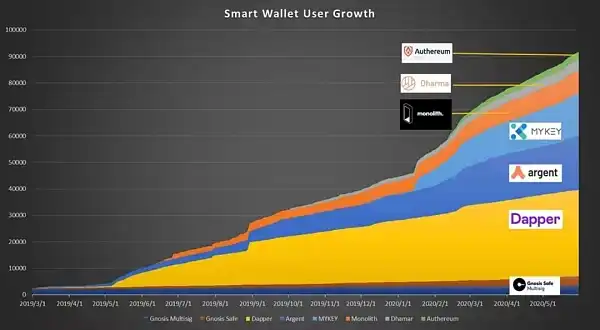
Photo source: https://smartwallet.substack.com/p/smart-wallet-new-paradigm-for-blockchain
Outlook/Views:
As a product that every web3 user interacts with, web3 Wallet still has a lot of room for improvement in terms of ease of use, security, integration and so on. At present, the experience of web3 wallet is still poor. in the short term, more and more gamefi will adopt the in-App wallet to quickly lower the threshold of web3; In the long term, as the number of web2 players increases in the future, we are looking forward to a consumer smart contract wallet that integrates the advantages of various wallets.
# Interoperability #
Requirements:
For the game project side, the interworking between games can bring natural initial liquidity and more utility to the in-game assets, improve the utility and value of NFT and game tokens, and promote the circulation and promotion of in-game assets. In addition, introducing third party goods into their games can help reduce development time and cost to some extent.
For players, inter-game interoperability enables players to directly transfer the time and experience accumulated in some games to new games, which reduces the friction between different games and improves the game experience of players.
Status:
NFT interoperability
There are only a few projects that offer NFT interoperability services, but most of them are games developers that add interoperability features along the way. The current interoperability of NFTS in games can be divided into the following two categories:
Experience gained in one game can give the player more power or a higher level in the other
Theoretically, it can prolong the life cycle of NFT, but it needs the game platform to continuously put new games on the shelf, which has high requirements on the publishing ability of the game platform.
Simple 2D maps are technically simple and can be implemented quickly; The introduction of 3D requires a unified development standard and model, which requires a long time and manpower and material resources
It can empower the content-starved PFP community and drive more users and traffic to your game
Generally, well-known PFPS are introduced, such as cryptopunks and azuki
A core game + can introduce other NFTS
NFT interoperability can be achieved between games within a game platform with multiple games, eg mobox
Token interoperability
The token revenue of different games is intercommunicated through DEX/CEX

View:
At present, NFT interoperability between games is still relatively "chicken chicken", and game NFTS interoperability is just icing on the cake, without any significant improvement in player experience. The interoperability of tokens makes more sense, allowing players to monetize and transfer some of the time and effort they have spent in the game. I believe there will be continued development in interoperability in the future, but absolute interoperation means excessive standardization, which is neither possible nor necessary.
# NFT Trading Market #
Requirements:
One of the most notable features of GameFi is that users' assets become equipment or tools in DeFi games. For players, they want to have the freedom to trade game assets, and NFT's permissionless transaction and transfer meets the needs of players. The exchange is one of Gamefi's core infrastructure, providing liquidity for users' gaming assets.
Status:
Generic NFT secondary market, such as Opensea, Magic Eiden;
The majority of transactions still take place in third-party NFT secondary markets, such as OpenSea, which are established secondary trading platforms with prominent traffic and brand advantages.
But in terms of Gamefi's trading needs, the general-purpose platform is problematic because the third-party marketplace is not designed for trading game assets. Game NFTS usually require frequent updates to metadata. General-purpose platforms such as opensea do not currently support updating metadata through the API. There is also some game data that cannot be displayed with regular on-chain Metadata.
Embedded in-game marketplaces, such as stepn's built-in marketplace for buying and selling shoes
Enable developers to own and customize UX through game-specific processes and interfaces
Reduced friction on the player experience, directly within the game can be bought and sold
Project parties can charge fees to expand their income sources, and can also bypass secondary taxation in the third-party secondary market
Vertical NFT marketplace, such as Fractal, Lootex, DMarket.
An nft marketplace for games could theoretically provide additional services, such as providing data on games, reviews, ranking of different game categories, the use of censorship to improve content quality, the use of DCF model pricing for game NFTS, and cross-selling
More open than the in-game market; Compared to the general type, more refined
In the web3 world, the GMV of the game NFT trading market can be significant because one trading market can cover the NFT assets of multiple games
For the project side, the vertical NFT marketplace will also provide more specific services than the generic marketplace, such as additional purchase promotions. In addition, the percentage is currently less than the universal marketplace
View:
In the short term, most games will have both an in-game marketplace and a mainstream third-party marketplace. In-game marketplaces are irreplaceable in terms of user experience and project-side revenue, but in the future, as the vertical NFT marketplace offers more valuable refinements, more games are likely to move to the new vertical marketplace.
Upstream related to production and research;
# gamefi SDK #
SDK, the full name of software development kit, is a tool kit provided by a third-party service provider to realize a certain function of product software. The main difference between the sdk and the game engine mentioned in this section is that the gamefi sdk's function is to link up web2 games, while the game engine's function is to make games.
Requirements:
For gamefi project side, it is very difficult to make a game from scratch, and the cost is very high. Chain change is a good choice. SDK can speed up the chain change
For traditional game companies enter the Web3 the biggest difficulty lies in the block chain development personnel lack of universality, and has a certain threshold, such as intelligent development contract personnel contrast to a serious shortage of market gap, the cost is high, for most of the game makers, in the short term it is difficult to recruit a team of experienced fast block chain development team, A good sdk can save them a lot of manpower, material and financial resources
For developers, the overall process of designing economic models, developing and auditing smart contracts, operating trial and error is expensive and the barriers to entry are high. sdk can help developers to focus on the game development itself without understanding the blockchain, reduce the probability of error, and one-click deployment chain game
Status:
The gamefi sdk providers on the market can be divided into two categories: those who have made web3 games and become sdk providers; The gamefi sdk is attached to the game platform
sdk from chain game developers, eg mirror world, canoe
Seamless web3 Sign-in
At the same time support mobile terminal, web terminal
One-click generation of NFT assets
Support multiple chain
Generate your own marketplace
There is usually a link game developed using this sdk to prove it works
Generally, it provides the following functions:
The difference between different sdk service providers mainly lies in their different emphasis. Some focus on providing SDKS in NFT in detail (such as blind box sales and NFT upgrade), while others focus on sdk convenient for defi (such as token economy design).
Platform provided with sdk, eg voodoo,game space
Tend to provide customized services, the price is relatively high
The main features provided are similar to those of chain game developers
Compared to chain game developers, it will provide chain change services for more heavy games
View:
gamefi sdk is not difficult for gamefi project parties. Those who have done a forming chain game, or even a certain part, can provide sdk services. It is easy to see that there are more shovels than soil in bear market. In the long term, there is a need for a gamefi sdk as more and more traditional games are introduced. However, due to the low technical threshold of gamefi sdk, in the short term, gamefi sdk providers may form competition on different chains in strategic positioning and products and services. In the long term, there should be a dominant oligopoly of gamefi as a service supporting multiple chains.
# # engine
Requirements:
There are already many mature game engines available on the market, including the familiar Unreal engine, unity, etc. The current business model is also friendly, mostly free to use and paying a 5% licensing fee once revenues reach a certain scale. However, some web2 game companies have chosen to develop their own game engines (analogous to the need to develop a web3 game engine) for the following reasons:
Features that want to focus more on the characteristics of their game. Eg:capcom is a hit engine. A general-facing, all-purpose engine might not be as detailed
More in line with your habits, you can save a lot of time and create a positive cycle of having the right engine -- better, faster product quality -- better engine
The player doesn't care if the creative process takes place on the chain
Status:
gamefi currently uses traditional game engines, and traditional game engines will be more compatible with blockchain game creation in the future. For example, Venly's Unity plugin will be able to manage in-game items as blockchain assets compatible with Polygon. The solution also allows you to edit NFT contracts and tokens visually through the Venly Manager window.
There's also a native engine for gamefi, eg, Fragcolor, which features a creator-centric game-revenue economy. In this model, each game asset is considered a "shard" that can be used with others to form a final NFT. The revenue from each sale is then distributed to the respective creators of that NFT segment to receive royalties. However, this kind of native engine emphasizes the characteristics of decentralization, but for the project side is very practical, the current development situation is not optimistic.
View:
Gamefi's game development process is largely the same as web2 games, and the genre is the same. There is no need to develop an engine from scratch for gamefi at this point, or in other words, a GamefI-specific engine doesn't make much sense for the time being.
# Cloud Computing Services #
Cloud computing can obtain required resources (such as networks, servers, storage, applications, and services) from the shared pool of configurable computing resources anytime, anywhere, conveniently, and on demand. Resources can be quickly supplied and released, which minimizes the workload of resource management and interaction with service providers. Cloud computing is a broad concept that encompasses all IT infrastructure resources that can be accessed on demand.
Requirements:
The demand for the cloud in games:
Game release time is short, online speed is fast, and the cloud server can dynamically adjust the resources, in the peak period, can prepare a large number of cloud hosts to cope with; After a few months, the game is stable, need to be combined, the rest of the mainframe released.
Cloud server vendors can provide a full range of solutions, including computing, networking, storage and database, middleware, containers, security, etc.
The need for decentralization in cloud services:
Centralized cloud services cannot meet the requirements of Web3 users for security, openness and anti-censorship. Most of today's Dapps are only decentralized at the logical level, while a lot of data storage and computation are still running off-chain.
Status:
Almost all games currently use traditional cloud computing services such as AWS and google cloud
Few gamefi currently use web3's decentralized cloud computing service
By leveraging idle resources from end users, private data centers, or enterprise infrastructure, decentralized cloud platforms can theoretically provide users with decentralized computing, storage, and networking resources at a lower cost, making application deployment more affordable than traditional vendors.
Currently, decentralized cloud platforms can be divided into the following categories
Store large or static data, eg Filecoin and Arweave based on IPFS, etc
History of eg a database that specializes in storing data
For cloud computing and hosting, eg Fluence, Livepeer, graphics rendering platform Render Network, etc.
Comprehensive cloud computing solution platform, eg, Dfinity
Reasons for not using a decentralized solution:
Compared with the centralized cloud platform, at present, the decentralized cloud platform is still in the early stage, with high development cost and even higher price than the centralized cloud platform, and the delay problem has not been solved
View:
At present, services provided by decentralized cloud platforms are far less than those provided by centralized cloud services in terms of price, adaptability and maturity. Gamers don't care if data is stored in a decentralized way. In the short to medium term, gamefi will still use a centralized cloud service. In the long run, some gamefi projects may opt for a decentralized cloud platform if, ideally, it offers a more competitive price, but due to usage habits and migration costs, the centralized cloud platform should still dominate.
Data analysis/user profile #
Requirements:
For the game project side, they need to understand the effort of players in the game to adjust the distribution of tokens, give the reward to real players instead of fast in and out of the gold users, and also need to understand the user portrait of more players to understand the needs of players, so as to carry out the next step of game development, adjustment and promotion
Traditional game data analysis tools such as AWS data services fail to recognize some Web3-specific features, such as some on-chain interaction information
Status:
Data will be buried during beta and other open beta phases to determine player characteristics based on the data obtained during the open beta
The data and user profiles obtained are not real-time
Limited information is available
The data and information obtained is usually just a few pieces of player behavior data, which need to be combined to get the final result
Does not include the information off the chain
In the market, projects such as eg carv and dequest have begun to "profile" players by aggregating game data on and off the chain
In addition to creating value for the project owner, these projects also provide value to the user, giving the user a "certificate."
It is usually sent to the player in the form of NFT/SBT
It's common to aggregate both on-chain and off-chain data
View:
In contrast to the intuitive on-chain behavior of defi users, each player of gamefi has a large number of game behaviors and interactions in multiple games and off-chain games. If the data can be aggregated and analyzed organically, it is of practical value to the project.
In the short term, the existing user profile/data analysis platform for web3 players is still lacking in product maturity and completeness and has room for development. It needs a period of time to accumulate player data and improve the analysis model.
The original link
Welcome to join the official BlockBeats community:
Telegram Subscription Group: https://t.me/theblockbeats
Telegram Discussion Group: https://t.me/BlockBeats_App
Official Twitter Account: https://twitter.com/BlockBeatsAsia

 Related Articles