BitMEX founder: The global economic pressure behind "printing money"

Original title: "Arthur Hayes Blog: After the Central Bank Restarts Printing Money"
Original author: Arthur Hayes
Original translation: Wu said blockchain
Humanity is now fighting on two fronts. The anti-epidemic war, and the war between the United States and Europe and China and Russia. The starting point of current fiscal and monetary policies is to try to mitigate the economic impact of these two conflicts.
Given that all politicians - whether elected or not - are focused on short-sighted policies, they usually default to solving almost all problems by printing money. There are very few problems that cannot be solved by printing money, which usually makes printing money the simplest and quickest solution; it can be done immediately without much discussion or deliberation. The alternative - a long-term restructuring of our global economy - will cause great pain to certain stakeholders and require an honest dialogue about the true state of our civilization. Neither of these demands work for our short-sighted political friends, so no matter what your government’s doctrine is, they inevitably turn to “printing money” to cover up any and all problems.
As we all know, when you stimulate demand with free money, prices go up, and that’s called inflation. Every country in the world is experiencing inflation of some kind of commodity, food, and/or energy. When the latter two subsets of inflation increase rapidly, the once docile populace wakes up and demands action. What are you willing to do to feed a crying child?
The world’s major central banks—the Federal Reserve (Fed), the People’s Bank of China (PBOC), the Bank of Japan (BOJ), the European Central Bank (ECB), and the Bank of England (BOE)—all came to the rescue. They all feared the inflation that would ensue, and have since pledged (and sometimes acted) to remove fiat liquidity and tighten money.
The worst-hit market was the sovereign debt market, and the bond market crash was nearly the worst in recorded human financial history.
Meanwhile, the undeclared World War III is intensifying, with recent attacks on critical gas pipelines making headlines. This situation is weighing on the global economy, and the financial impact of withdrawing credit is clear. Major central banks have begun to renege on their inflation-fighting promises, and the next epidemic - the yield curve (YCC) virus - is spreading rapidly. On a long enough time horizon, all central banks will succumb.
The BOE - which recently reverted to quantitative easing (QE) to save its financial system, which will soon transition to YCC - will be covered more later.
BOJ – Continue their YCC policy to save their banking system and allow governments to borrow at affordable rates.
ECB – Continue to print money to buy bonds of vulnerable EU member states, but has promised to start quantitative tightening (QT) soon – more on that later too.
PBOC – Restart the printing presses to provide liquidity to the banking system to prop up the falling residential property market.
Fed – Continue to raise rates and shrink its balance sheet via QT.
80% of the significant central banks have given up and are engaging in some form of money printing. Only the Fed has stood firm in the face of the bloodbath in financial markets, determined to see through its desperate efforts to quell the inflation for which it is at least partly responsible – the culmination of decades of horrific economic policies, with the advent of a world war.
Of all the types of money printing, the most disastrous to the value of fiat currencies – and therefore society – is YCC. That’s because it essentially requires central banks to try to fix the price of trillions of dollars in bond markets. Central banks that participate in YCC are essentially committing to expand their balance sheets indefinitely so that a particular interest rate target does not exceed a ceiling set by the central bank. The market always wins, and wins by inflicting devastating inflation on all of human civilization.
The Bank of Japan has the longest history of YCC policies. The Bank of England has actually just joined them, and the subject of my paper this week, the ECB, is not far behind. The ECB moving to YCC would mean that most (60%) of the major central banks would be participating in this horrible policy. I would say that number is actually 80% because the People’s Bank of China operates within the Chinese financial system. The Chinese often target a certain amount of economic activity and will provide whatever amount of credit is needed to reach that number.
The Bank of England suddenly reversed course – from a bank determined to curb inflation by raising rates and QT to buying unlimited quantities of UK bonds in just a few trading days. This is all built up to the Fed finally giving in to YCC and joining its compatriots.
In response to the pandemic, the Bank of England did what all good central banks do when faced with a crisis: it printed money. To give you a little historical perspective, here’s a chart showing the Bank of England’s total assets as a percentage of GDP since its founding in the 1700s.
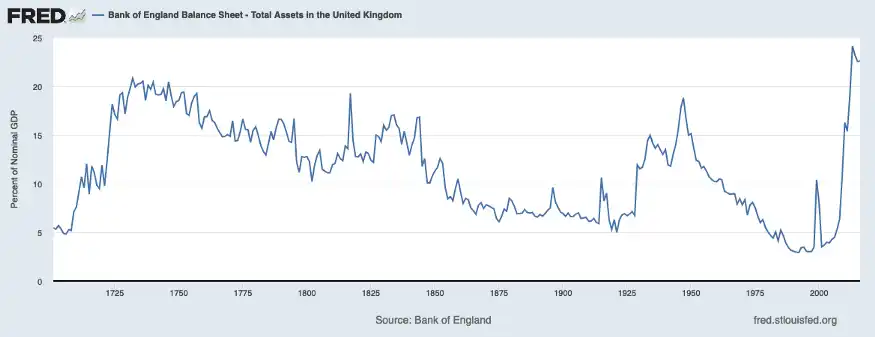
Britain has been through some bad stuff over the past three centuries. Pandemics, Imperial Wars, Civil Wars, World Wars, etc. But even taking all of that into account, you can see that the central bank’s most recent round of money printing is the most aggressive ever!
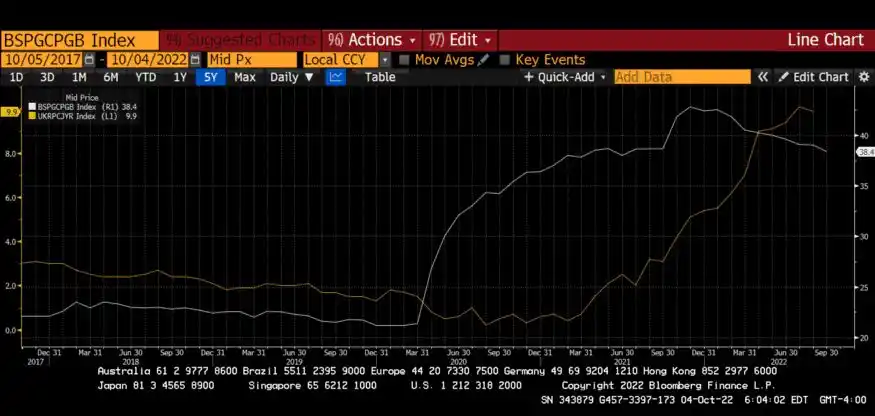
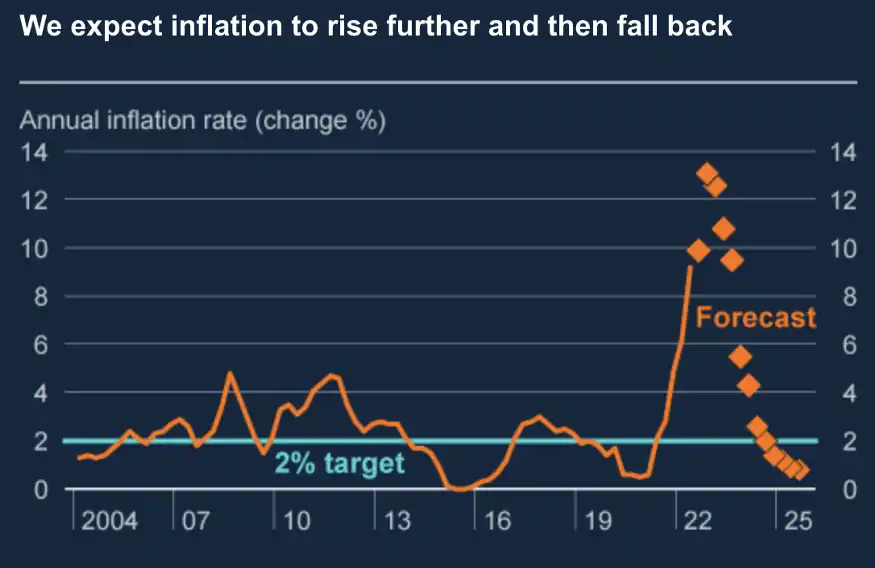
Back to the present, here’s how inflation has responded – with a bit of a lag – to the most aggressive monetary easing in the bank’s history. The Bank of England recognised earlier than its peers that it had to do something about the runaway inflation it was igniting with its money printing. The bank even forecast in its August 2022 report that inflation would rise to a high of over 13% by the end of the year before tapering off sharply in 2023 and 2024.
To improve the situation, the BoE was the first major central bank to start shrinking its balance sheet and raising its policy rate.
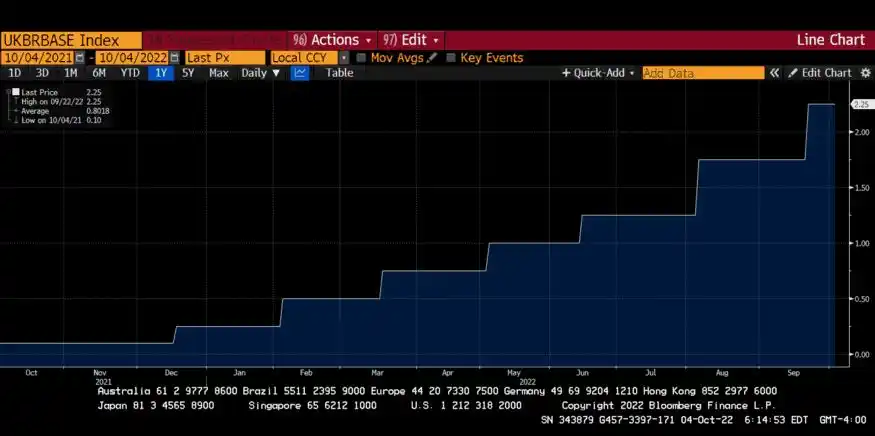
The first Bank of England rate hike is in December 2021.
British policymakers, like most of their brethren in the developed world, believe in the energy fairy tale. That is, developed countries can run entirely on less energy-dense wind and solar power by 2050. The UK has coal, oil, and potentially trapped shale oil in the North Sea – but these independent energy sources have been set aside, and the UK’s energy import bill is growing.
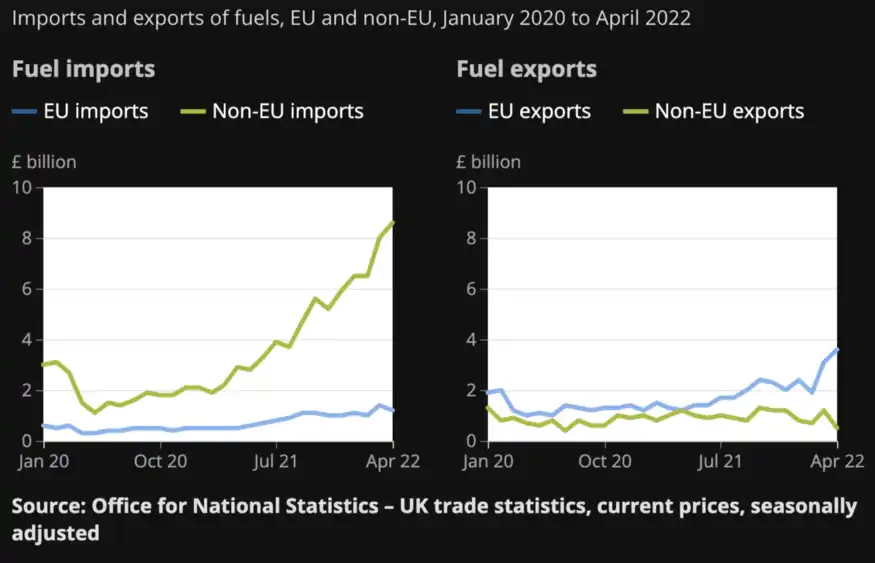
World War III is currently an economic war, resulting in a split in energy markets that have been and will continue to be highly inflationary. A country that both pursues the most aggressive money printing in its history and must import energy simply cannot escape the clutches of inflation.
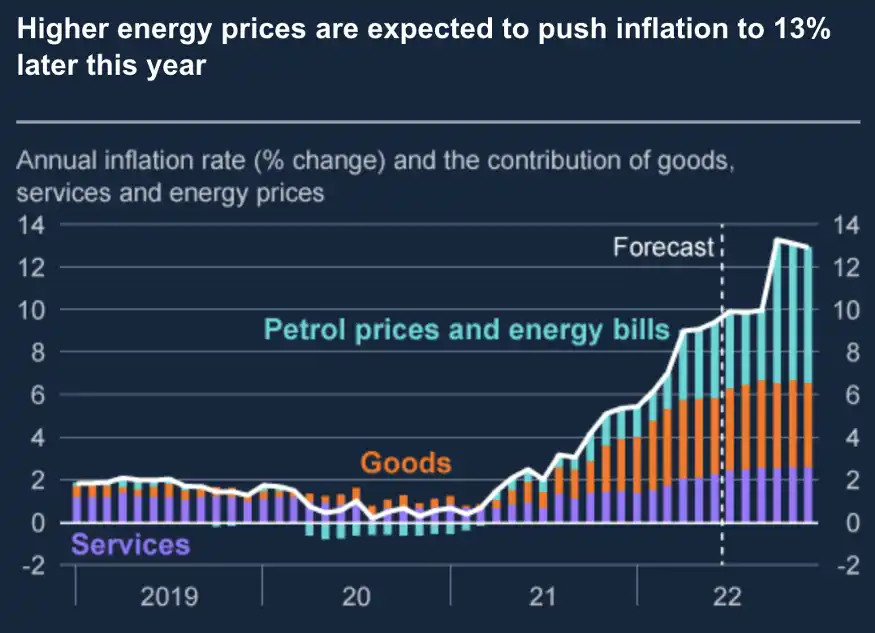
The above chart clearly shows that energy inflation is a big contributor to the overall misery of the civilian population.
The UK is suffering from a double whammy: not only has the Bank of England had to remove credit from the system to reduce demand, but energy prices have also had to rise due to the inflationary factor of World War III. This is not a recipe for economic growth.
Boris Johnson announced a new budget last week that contained measures to stimulate the economy. For the rich, she cut corporate and personal tax rates. For the poor, she plans to give out vouchers to cover increased energy bills.
And so, the bond market went haywire.
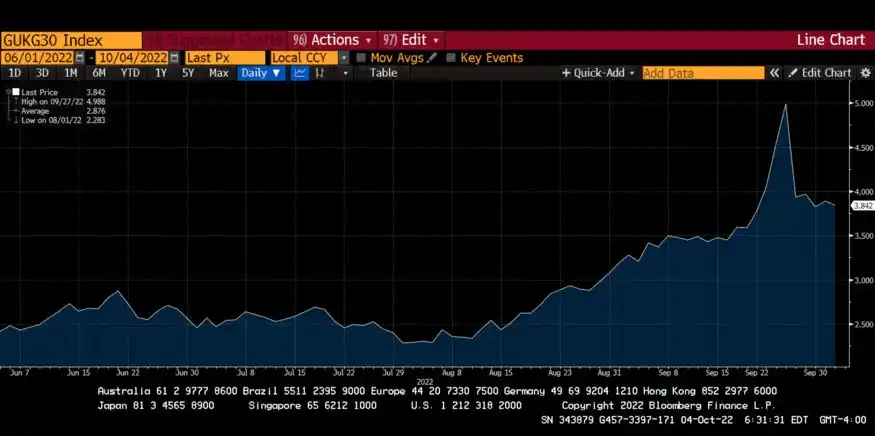
Here is a chart of 30-year gilt yields. As you can see, in the days after Truss announced her budget, yields soared to all-time highs. Remember – the gilt market is the longest-running bond market in the world, so we’re talking about hundreds of years of history.
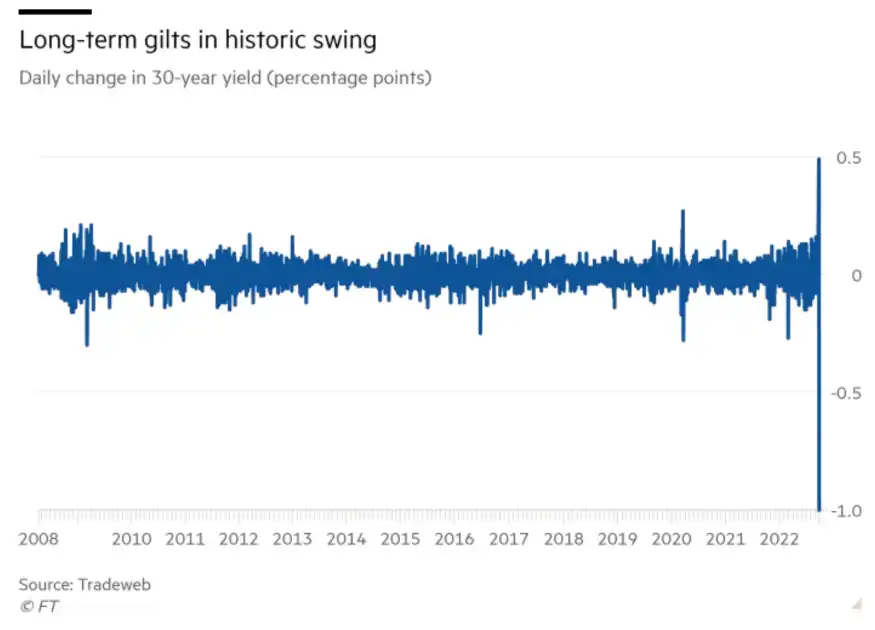
Before this happened, the Bank of England was said to be committed to fighting inflation. To their credit, they are actually raising short-term rates and shrinking the size of their balance sheet. But a rapid rise in yields threatens to destroy the entire highly leveraged UK financial system overnight – forcing them to change direction.
So, to avoid financial disaster, the Bank of England immediately began buying unlimited quantities of long-term gilts to drive prices down.
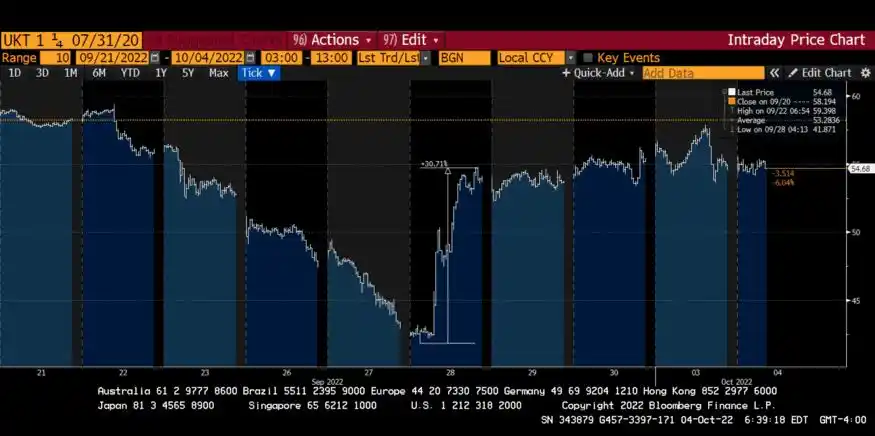
The above chart is the current run of 30-year gilts. On September 28, after the central bank turned the printing presses back on, the bond rose 30%. Thirty fucking percent! This is an unheard-of daily move for developed market sovereign bonds.
The political need to hand out goodies to the people to help them fight the current dire economic situation entered into financial reality first. Given that – like all modern economies – the UK financial system is debt-based and highly leveraged, the central bank did what it was supposed to do: protect the financial system from asset price deflation. Remember this: As bad as it is right now, inflation is not their number one priority. In a matter of hours, they abandoned nearly a year of prudent monetary policy to save the financial system. And in the process, they ushered in the end game (YCC).
Now let's move on to the EU and the ECB. The ECB is working hard to fight inflation, but for many of the same reasons as the BoE, it will soon succumb to the YCC virus.
Economically, the only two countries in the EU that matter are France and Germany. The entire goal of modern European history has been to prevent Germany and Russia from joining forces. From a geopolitical perspective, the Germans’ manufacturing prowess combined with cheap Russian goods could be a game-changer.
France is pursuing this strategy to suppress Germany, and the Germans only agree to it because of their guilt over World War II. The United States, which shares common interests with France, is also ready to prevent any real alliance between Germany and Russia. A weak EU is very much in the political interest of the United States, which must prevent the unification of Eurasia at all costs.
As with everything in life, unpacking Germany’s energy policy is the best way to understand why the German economy is fundamentally screwed, and why it means doom for the entire European Union. Germany – the only real economic engine of the European Union – is impotent due to a lack of affordable energy, and as a result, the European Union is about to go into depression. In the face of this economic malaise, the “union” is at serious risk of breaking apart. In order for the ECB to keep the EU intact, it may have to abandon any plans to shrink its balance sheet and quickly move to outright YCC to save the unholy political union that is the EU.
To their credit, France – there are few geopolitical things to be credited for – actually did the sensible thing and went all-in on nuclear. About 70% of their electricity generation is nuclear. So their manufacturing base can withstand a stop in the flow of Russian gas. Germany, on the other hand, cannot.
The chart below details how badly Germany fares when cheap Russian gas is removed from its industrial economy.
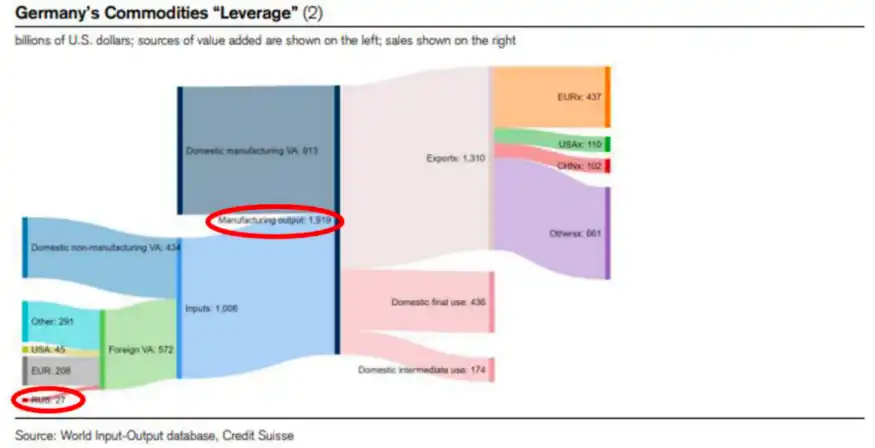
$27 billion worth of Russian gas powers nearly $2 trillion of German economic output – an effective energy leverage ratio of nearly 75x. The German public has overwhelmingly allowed the Greens to sabotage any efforts to establish a functioning nuclear energy ecosystem over the past few decades. Thus, unlike France, the sabotage of the Nord Stream pipeline leaves Germany with little choice but to import expensive US and Qatari liquefied natural gas (LNG) via supertankers.
The mainstream media touts the Americans’ unlimited ability to deliver cheap gas to Europe. However, gas is cheap only because the United States is not the swing producer in the Western world. If this were to happen – and it would lead to higher gas prices in the US – citizens would agitate to stop imports so they don’t pay more to heat their homes.
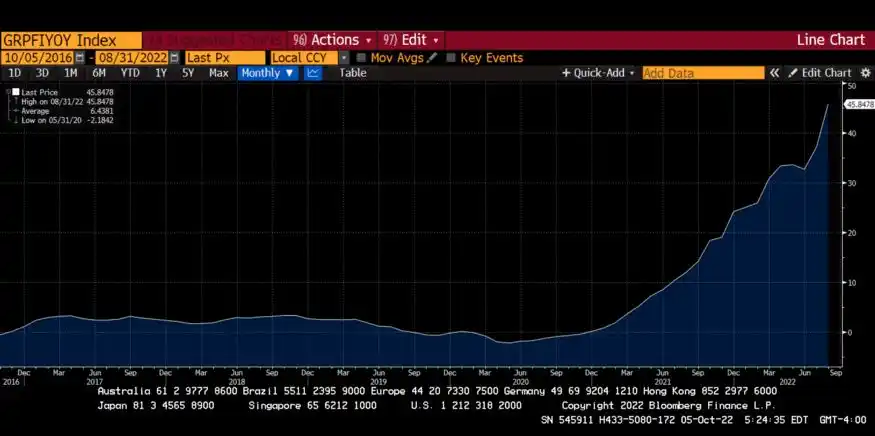
In this case, German goods would be much more expensive (if they could be produced at all). We can already see the impact of rising German producer prices, which are up 46% year-on-year according to August data. As a result, the German current account is rapidly heading towards zero and will enter negative territory shortly thereafter.
German Producer Price Index Year-on-Year Percentage Change
German Current Account
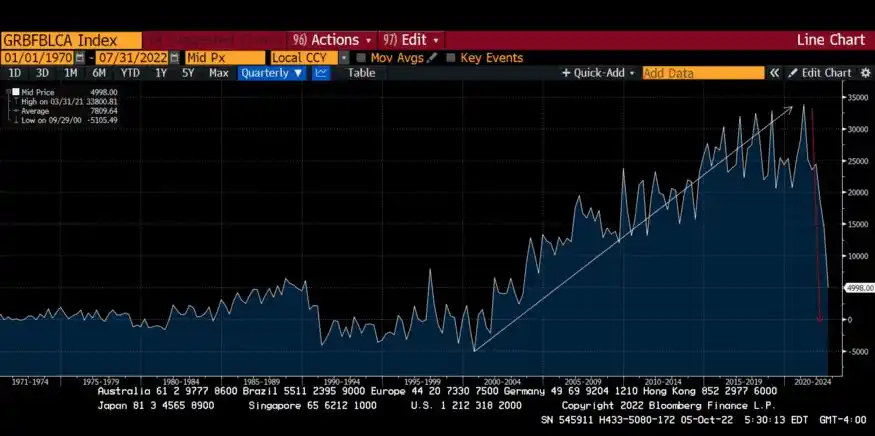
The reason this is important is a strange structure called TARGET2. TARGET2 is a real-time gross settlement (RTGS) system owned and operated by the Eurosystem. Central banks and commercial banks can submit euro payment instructions to TARGET2, where they are processed and settled in central bank money (i.e., money held in accounts at the central bank).
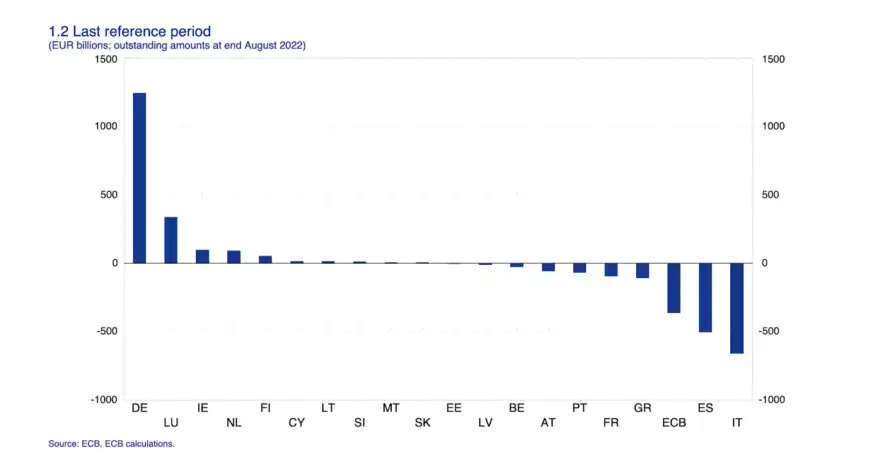
The above is a graph of credits and debits between members within the European Union. This is TARGET2. Because Germany is the powerhouse in Europe and has a trade surplus with other member states, it is "owed" money.
All the debt that EU countries normally owe to Germany will suddenly instead be owed to foreign producers such as the United States, China, South Korea, Japan, etc. And because these countries are not in an uneconomic alliance for politics, they will need a "hard" fiat currency like the dollar, not the euro.
For a politician educated in Keynesian economics, there is a very simple solution when you can't afford the market price of a good. As a government, you can issue debt and force production to continue. The debt is used to cover the difference in costs between what companies can afford and the price on the international energy market.
Germans are very conservative in monetary policy due to institutional memories of the hyperinflation of the Weimar Republic. The only thing stopping the ECB from further profligacy is the Bundesbank. But without cheap energy, Germany will have to try to print its way out of the problem. Just like every other country, they will issue more bonds to pay for the fiscal transfers.
As the supply of Bunds increases, prices will fall. This is a problem for the entire EU because without German monetary discipline, the Euro would have long since become a junk currency, similar to any other emerging market that imports energy and food and whose labor is uncompetitive in the global market.
All other EU bonds are priced relative to German Bunds. In fact, the ECB's money printing operation is specifically designed to keep the spread between weak EU member state bonds and German Bunds at reasonable levels. If Bunds fall, everyone falls.
Similar to the UK, the people driving the Bund sell-off will most likely be German politicians seeking re-election. They will promise benefits to industry and individuals to mitigate the impact of the lack of cheap Russian gas on the economy. Just like in the UK long-term gilt market, long-term German Bunds will be dragged down with them. As Bund yields soar, the ECB will be faced with a large number of extremely leveraged financial institutions that will go bankrupt immediately if they price their fixed income derivative books at higher Bund yields.
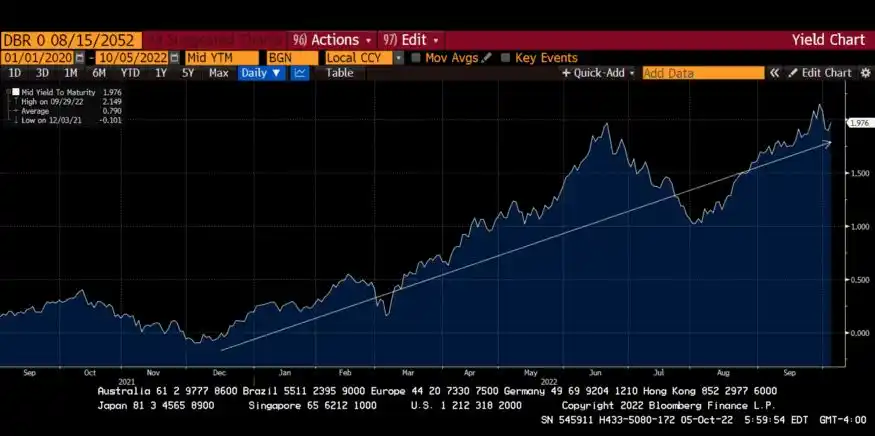
As the German economy implodes on itself, the 30-year Bund market has begun to gain traction. Look at the rapid rise in production starting in 2021.
30-Year Bund
With 80% of the world’s major central banks either doing QE or moving towards full YCC, will this be enough to overcome Powell’s hawkishness on alternative risk asset prices?
Gold and Crypto Tokens are alternative global risk assets. A gold bar is a gold bar whether you are in New York, London, Frankfurt, Tokyo or Shanghai, and the same is true for Satoshi Nakamoto.
As more Euros, Yen, Yuan and Pounds are printed, at some point people will start moving their savings from these currencies into USD or other stores of value. This means that as long as the Fed continues to raise rates and shrink its balance sheet, the dollar will continue to strengthen. However, strong buying is also likely to occur in gold/euro and bitcoin/yen.
Given that the size of the gold and crypto token markets is much smaller than the trillions of fiat that will be printed, these assets will appreciate in non-USD currencies. Now, because we care about global prices, or USD prices, from a trade perspective, these flows only work in a specific instance. If the BTC/EUR price appreciates faster than the EUR/USD price falls, then the arbitrage exists. Here is how it works:
A USD-based investor notices the high price of BTC denominated in EUR.
The investor borrows USD and then sells it instead of buying BTC.
They then sell BTC vs. buying EUR.
They then sell EUR vs. buying USD.
The investor repays the USD loan and the rest is their profit.
This triangular FX arbitration will drive the global/USD price of BTC in line with the EUR, JPY, CNY, and GBP prices of BTC rising.
As non-Fed central banks get serious about their money printing mandate, even if the Fed continues QT — which I don’t think they will be able to do for much longer in early 2023 — a small store of value asset like gold could still rise in Bitcoin.
This process will not be immediate. The economic and political coercion functions I discuss will not happen overnight. But it is clear from the Bank of England example that once politicians initiate the policies needed to appease voters, bond markets will have nothing to lose. There is no immediate solution to decades of bad energy policy decisions. Therefore, printing money will be the only political expedient.
Once the bond market sees what is coming, yields will rise as more and more stimulus budgets are added, and the over-leveraged fiat debt-based financial system will quickly collapse—followed by an equally rapid monetary bailout.
The United States is self-sufficient in food, fuel, and people. China, Europe, Japan, and the United Kingdom are not so lucky. Therefore, the Federal Reserve is able to prioritize domestic political concerns about inflation rather than providing the world with an endless supply of dollars. The continuous flow of dollars allows the rest of the world to print their currency and still buy energy in dollar terms. This is a relative game, and if the strongest player gets his way, everyone else suffers.
Original link
Welcome to join the official BlockBeats community:
Telegram Subscription Group: https://t.me/theblockbeats
Telegram Discussion Group: https://t.me/BlockBeats_App
Official Twitter Account: https://twitter.com/BlockBeatsAsia