What are the risks and opportunities arising from the rise of application chains?
原文标题:《应用链的兴起将带来哪些风险和机遇?未来将会如何发展? 》
The original article was written by Dmitriy Berenzon, 1kx analyst
Bai Ze Research Institute
While the initial applications of blockchain revolved around money and finance, the past few years have seen a surge in applications in areas such as art, games and music. At the same time, the number of aggregated users in these applications has been growing linearly, straining the underlying infrastructure and degrading the user experience. In addition, as these applications expand, they increasingly require more customizability and more powerful business models.
One emerging business model to address these issues is to build application-specific blockchains, called "AppChains." An application building AppChains can customize multiple layers of its stack, such as its security model, fees, and write permissions.
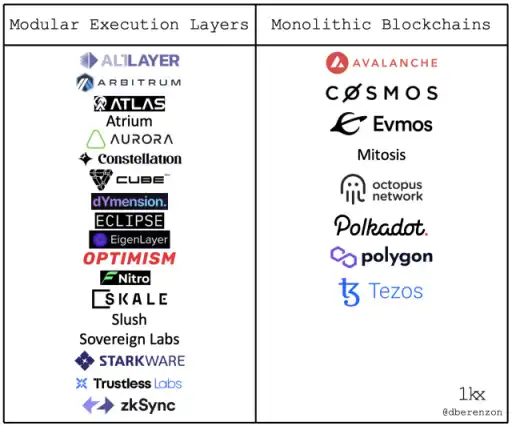
AppChains is not a new concept; Bitcoin can be thought of as an application-specific blockchain for digital gold, while Arweave can be used for permanent storage. In other words, the design of AppChain includes not only a monolithic blockchain (Osmosis, for example) but also a modular execution layer (rollups, sidechains, plasma) that handles application state transitions, but relies on a separate settlement layer or consensus layer to achieve finality.
In fact, "layers" (such as L2, L3, etc.) are, for the most part, just trust-minimization blockchains with bidirectional trust-minimization cross-chain Bridges.
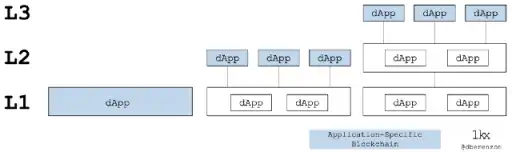
In this article, I will:
Overview of the history of AppChains Explain the advantages and disadvantages of AppChains Describe the future AppChain market structure Overview of AppChain How does AppChain design compare different existing Appchain solutions
The past life of AppChains
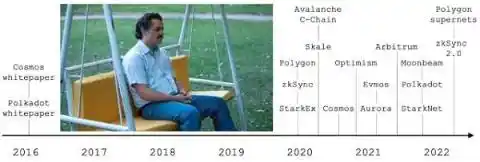
AppChain took years to emerge. While Cosmos and Polkadot proposed and popularized the concept back in 2016, they didn't fully launch their network (with IBC and parallel chain capabilities, respectively) until early 2021. Meanwhile, on the scalability front, application developers are crying out for alternative solutions as ETH transaction fees become surprisingly high by the end of 2020 due to increasing demand from users on Ethereum. Meanwhile, Ethereum off-chain scalability research is slowly being implemented in the form of "L2s," with Polygon, Skale, zkSync (1.0), StarkWare (StarkEx), Optimism, and Arbitrum all launching in 2020 and 2021.
Other base layers (" L1 ") have also recognized the importance of supporting EVM (Ethereum Virtual Machine) as part of their business development efforts; Avalanche (C-Chain), NEAR (Aurora), Polkadot (Moonbeam), and Cosmos (Evmos) all launched EVM-compatible chains in 2020 and 2021.
In terms of application-specific design, Celestia launched in 2019 (originally as LazyLedger) a novel modular design that separates the execution, settlement, and data availability layers of traditional monolithic blockchains, thereby allowing application-specific blockchains without rebuilding the rest of the stack.
Today, multiple platforms offer AppChain infrastructure. While some of them currently offer only public block space (e.g., Optimism, zkSync), they will likely roll out implementation layers that support dedicated implementations if there is enough developer demand.
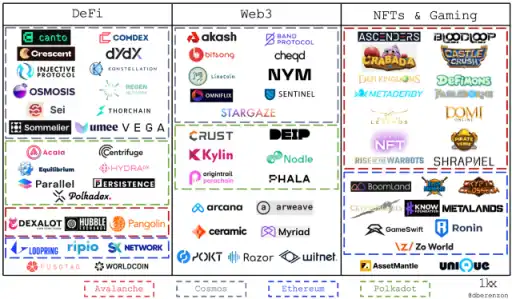
Moreover, while start-up and interoperation issues with AppChains have historically been difficult, adoption of AppChains by both developers and users has accelerated over the past few years. Axie launched their Ethereum side chain Ronin in early 2021, DeFi Kingdoms announced a move from Harmony to Avalanche subnet in late 2021, Apecoin community around 46%. Members of the Cosmos SDK still support building ApeChain, and dYdX announced that their V4 version of the protocol will be built on L1 using the Cosmos SDK. Today, there are countless applications built on AppChains.
Why AppChains?
There are three main reasons why developers are increasingly turning to building AppChains instead of starting smart contracts on public blockchains.
performance
Because Dapps compete with each other on the same network, a popular dApp usually consumes a disproportionate amount of resources, which increases transaction costs and delays for other dApp users. AppChains provides the ability of stable transaction cost and low delay for projects, so as to bring better user experience for users.
customizability
As Dapps become more popular, developers need to continue to optimize their Dapps for users. Large DApps require trade-offs of certain design choices, such as throughput, finality, security level, licensing, composability, and ecosystem consistency. For example, the validator may have high performance hardware requirements (such as running SGX or FPGA to generate zero-knowledge proofs). For traditional organizations, AppChains provides a way to access the Web without authorization; For example, a company could ask KYC verifiers to select developers who want to build on their network and select which chains they want to connect assets to over a cross-chain bridge.
Value capture
虽然通用的可扩展性解决方案的确降低了交易成本,同时保留了安全性和开发人员体验,但它们为开发人员提供的货币化机会很少。另一方面,AppChains 有很强的商业案例,因为 dApp 能够在其生态系统内分叉现有协议并将其货币化(例如,来自 AMM 或 NFT 市场的交易费用)。他们的Token受益于被用作安全模型(即质押 Token 或 Gas Token )的额外 Token 。此外,应用程序能够通过运行自己的排序器或验证器来捕获 MEV,这可以为新的加密业务模型创造机会;例如,dYdX 的验证者(可能是做市商)可以为用户提供低费用或免费费用,但给他们的执行价格略低,类似于 Robinhood 使用的按订单付费的模式。再举一个例子,许多成功的游戏都有大量的模组、皮肤等,并积极尝试尽可能多的调整。但大多数时候,建模是由难以赚钱的业余游戏玩家完成的。如果该游戏构建在 AppChain,那么模组可以在 rollup 之上扩展该 IP,并通过使用该链获利。
The problem of AppChains
However, everything is a double-edged sword:
Limited composability and atomicity
AppChains insulates infrastructure and users in other ecosystems to some extent. While this doesn't break composability (you just need a good enough bridge on the same VM), it does break atomicity (an "all or nothing" property where all of the suboperations in a single transaction are either executed or none of them are).
That said, while atomicity is a special property that all applications reside in the same settlement layer, it is not important for many applications (for example, P2E games do not rely on flash loans to keep the economy running).
Reconstruction of Walled Garden
As a thought experiment, if all Appchains had read/write permissions, the resulting market structure would limit developers' permission-free and combinatorial innovation, as well as users' ability to trade freely, bringing Crypto back to the very problem it was designed to solve.
Dispersion of liquidity
Liquid assets from other layers or chains will need to be connected to AppChains across the chain Bridges, and while this can be done through the bridging infrastructure, it adds an additional "friction" for users.
Reflexive security model
如果使用应用程序 Token 作为安全模型,则存在一个边缘情况,即如果 Token 的价格下降到 0,应用程序将不再具有经济安全性。
Waste of resources
AppChains can be a waste of resources (physical or economic) if the application is not used enough. If AppChain has dedicated validators, those validators can deploy their resources elsewhere more efficiently.
Additional complexity
Because it is not as simple as deploying smart contracts, there is additional complexity in managing additional infrastructure, such as sorters or validators.
Limited ecosystem tools
There may not be "out of the box" resources such as block browsers, RPC providers, indexers, prognosticators, and ecosystem funding.
The emerging AppChain market structure
Due to the many drawbacks of building in a more isolated ecosystem, AppChains is best suited for applications with the following characteristics:
Achieving scale (e.g., number of users, protocol revenue, TVL) and product market fit performance can bring significant advantages to the product with fewer security and atomicity requirements (e.g., P2E gaming, NFT, crypto social).
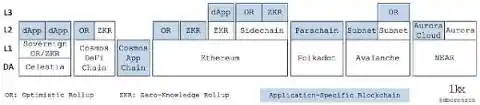
Therefore, it is reasonable to assume that most applications will continue to launch on public L1 and L2. Moreover, as the L2 landscape is still quite fragmented, we will see DeFi protocols continue to roll out on L1 due to their security, mobility, and atomicity properties. In addition, if non-DEFI applications have a large enough ecosystem and network effects, they may start on generic L2 and move to application-specific L3 or application-specific L1. We can roughly imagine this sequence of operations as follows:
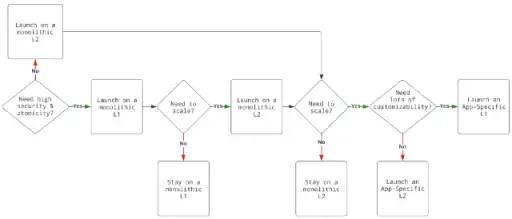
还有一个原因是,大多数启动 AppChains 的应用程序将选择模块化执行层(特别是 rollups)而不是单片链,因为它们没有吸引大型验证器群所需的资金。此外,高质量的验证者不太可能选择将他们的资源用于 Token 价格低且不稳定的 AppChain。
Still, as the crypto industry matures and spreads, more apps will continue to launch their own AppChain, and the future AppChain market structure will take many forms:
- AppChains connected by various cross-chain Bridges;
- An application-specific side chain connected to L1
- application-specific that does not use the settlement layer; rollups
How is AppChains designed
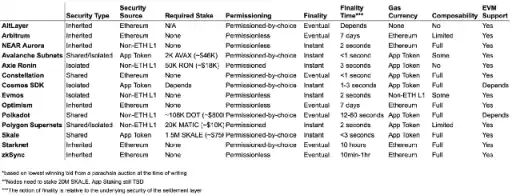
When deciding on the infrastructure to build AppChain, there are several design trade-offs to consider:
Security Types: How hard is it to change state by attack?
Shared: State protected by multiple heterogeneous validators, possibly run by different parties (e.g. Polkadot parallel chain, Skale)
隔离:应用程序本身提供的安全性;可能使用应用程序拥有的验证器或排序器,并使用应用程序的 Token 来获取经济利益(例如 Cosmos 链、Axie Ronin)
Inheritance: Security provided by the underlying settlement/consensus layer (e.g., zkSync, modernism)
Security Source: Where does security come from, and where does settlement come from?
Ethereum: Use Ethereum as settlement layer for fraud proof, validity proof, and general double flower protection (e.g. Arbitrum, zkSync)
Non-ethereum L1: uses non-Ethereum security and may have a completely different consensus model (e.g. NEAR Aurora, Tezos rollups)
应用 Token :将应用程序的 Token 用作加密经济安全(例如 Avalanche 子网、Cosmos 链)
Permissions: How are nodes selected, and who can read/write status?
Permissed-free: Anyone can read/write the contract and verify state transitions (e.g., Optimism, StarkNet)
Selective licensing: Only whitelisted verifiers/developers can read/write/validate chains (e.g. Polygon Supernets, Avalanche subnet)
Composability: Can mobility and state be easily and securely moved between other applications in the same ecosystem?
All: Move to any application with minimum latency and maximum security (such as Polkadot XCMP, Cosmos IBC)
Limited: Limited in connectivity, latency, or security (e.g. Avalanche subnets, Polygon Supernets)
Finality: When is a transaction considered final?
Immediate: Common use of BFT consensus mechanisms (e.g. NEAR Aurora, Evmos)
Final: Usually using rollups, once the block is published to L1 (and assuming data is available), the transaction can be considered final (e.g. Arbitrum, zkSync)
Gas Token :用户使用哪种 Token 支付交易费用?
非应用程序 Token :通常是构建应用程序的 L1 或 L2 的基础资产(例如 Ethereum、Evmos)
应用程序 Token :通常应用程序的 Token 本身运行在特定于应用程序的 L1 或 L2 上(例如 Avalanche 子网、Osmosis)
无 Token :L1 或 L2 验证器或应用程序为用户提供成本补贴。(例如 AltLayer、Skale)
There are several other, more immediate factors:
Required interest: The amount of interest an application needs a verifier to protect its chain
Transactions per second (TPS) : A subjective measure of throughput, since transaction sizes may vary (i.e., larger transactions will result in lower TPS and vice versa)
EVM Support: The ability to support Solidity and EVM opcodes simultaneously without developers modifying their code base
We can map existing AppChain solutions based on these factors:
conclusion
Despite the problems with AppChains, their continued growth is indicative of the need for developers. As Apple has demonstrated, vertical integration generally leads to a better user experience; Similarly, blockchain developers will seek to provide fully optimized Web3 applications supported by AppChains. That said, AppChains is not for everyone and developers should thoroughly consider/weigh the needs of their applications before committing resources to start them.
AppChains has many implications for security model economics, monetization strategies, platform defensiveness, overall value accumulation across the stack, and for crypto market structure that we will observe over the next few years.
The original link
Welcome to join the official BlockBeats community:
Telegram Subscription Group: https://t.me/theblockbeats
Telegram Discussion Group: https://t.me/BlockBeats_App
Official Twitter Account: https://twitter.com/BlockBeatsAsia