The review and prospect of the cycle change melody of blockchain circuit industry

Original title: Taking History as a Mirror to Know the Vicissitude of Blockchain Track Melody Review and Prospect
原文作者: Frank Fan&Don, Arcane Labs
Original article edited by Charles, Arcane Labs
The innovation and development of anything cannot be separated from iterations on the basis and problems of predecessors. This paper will start from the three big cycles experienced by the industry, according to the observed industry phenomenon and details, analyze the change law of the evolution direction of the industry track. Then the next cycle of the industry will reach the stage and the hot track to make a prediction.
"Blockchain"It has been 13 years since the white paper on Bitcoin was created in 2009. From an obscure noun to a well-known industry, it has spawned numerous leafy ecologies and racetracks. After several rounds of changes, the industry has grown from nothing, allowing many early players who focus on each circuit of the industry to take advantage of the situation and reap huge wealth. Looking back at the changes in the industry over the years, it is not hard to find hidden patterns.
First of all, it is well known that the blockchain industry has been one with particularly notable cyclical behavior. In the bull market cycle, the industry is extremely prosperous, constantly generating bubbles. And in the bear market cycle, the industry is very cold and bleak, fast clearing. Time has been half of bitcoin as a time node, accompanied by a lot of crazy influx of funds into the market and the lonely exit to cut meat, formed a four-year cycle for a bull and bear industry rules.
In each cycle, in addition to the constant narrative that Bitcoin has halved, we can also find that each cycle has a unique industry change as the main line of industry development.
Like the three we've had before:
First, the discovery of value in decentralized commodity currencies, led by bitcoin;
Second, from simple decentralized currency to decentralized smart contract platform value discovery;
The third is when users start to shift to on-chain behavior and value discovery in decentralized infrastructure applications.
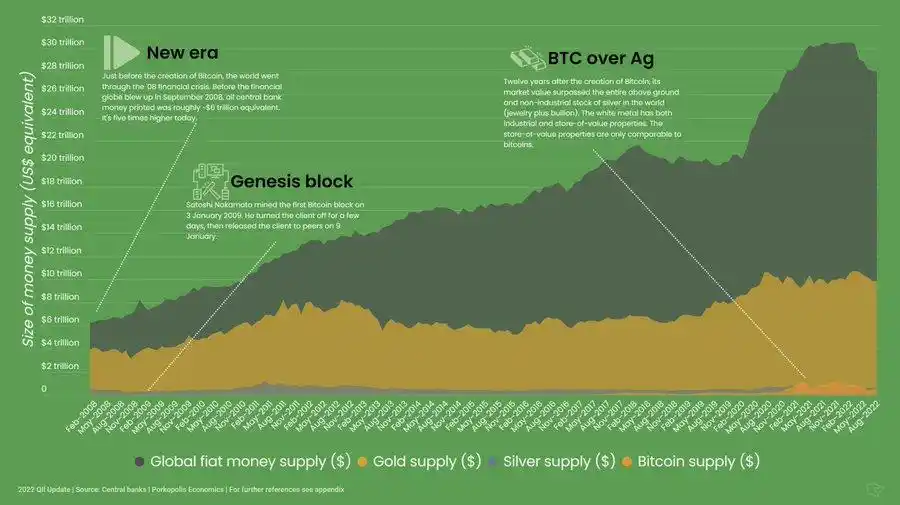
Figure 1: Size of money supply
#1 The first three cycles experienced by the blockchain industry
1.1 Enlightenment Stage of Decentralized commodity Currency (2010-2013)
In retrospect, in the first crypto cycle, Bitcoin, as the originator of the whole industry, began to gradually enter people's vision due to its anonymity, decentralization and scarcity of fixed amount. Its cross-border transfer and the narrative value of digital gold were gradually recognized by more and more people. "Bitgold, Lightsilver" is the best interpretation of the enlightenment stage of decentralized commodity currency.
It is also due to the 2008 financial crisis, people have a crack in the trust of traditional finance. Early stage cryptocurrency market participants tend to be more hardcore geeks, and demand and belief in a degree of decentralization is extremely high compared to the current market where capital has been extensively involved.
This stage is more of an initiation stage of decentralization.
1.2 The Embryonic stage of Smart Contract Platform (2014-2017)
In the second cryptography cycle, it is mainly the value discovery of the blockchain smart contract platform represented by Ethereum in the era of initial coin offering. From the birth of Ethereum to the first discovery of its financing value, followed by a number of Ethereum killers, such as well-known projects EOS, Tron, ADA, etc., this stage is a wild period dominated by the term "blockchain", and only a few currencies of the blockchain smart contract platform, coin, have consensus value. However, there are only a small number of applications on the platform, and the token value of the application cannot be recognized. Users quickly exchange the application tokens they get into the platform's currency coin. And the activity on each chain is extremely cold, most users still in the central exchange "speculation trading" as the main activity. The search for the killer Dapp was the theme that many blockchain practitioners talked about most at various industry conferences at the time.
This stage is the real sense of the concept of blockchain began to enter the stage of history in the embryonic stage.
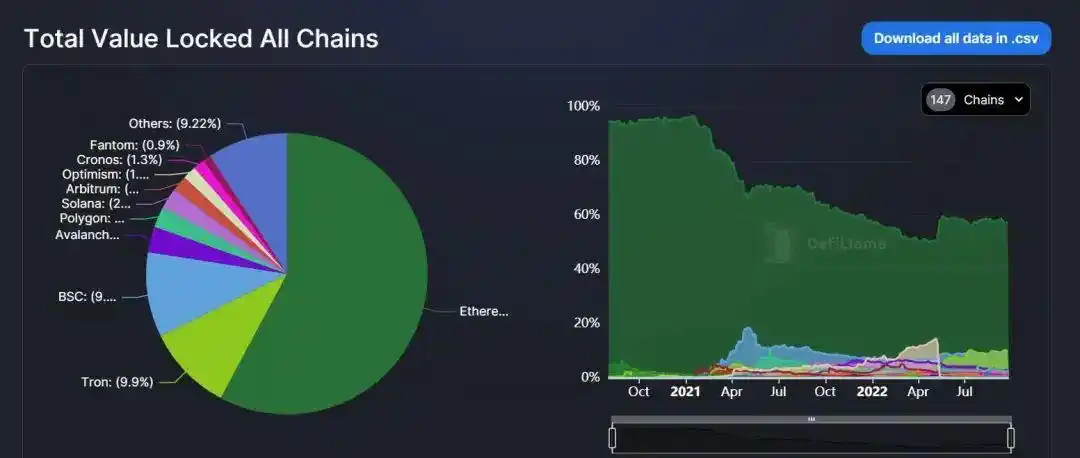
Figure 2: Total Value Locked All Chains
1.3 & have spent Foundation Phase of Dapp Application (2018-2021)
The third encryption cycle, the one closest to us. The most obvious change in the market in this round is that the on-chain ecology and user activity on the chain have clearly flourished. The most intuitive feeling is that many trading users, when it comes to a token they are not familiar with, no longer ask which centralized exchange they can trade on, but the address of the contract on the token chain. What sounds commonplace now would have been unthinkable in the last cycle.
Thanks to this cycle, some of the decentralized infrastructure applications on the chain began to improve. Since the beginning of the well-known DeFi Summer, the AMM automated market maker mechanism and liquidity mining have completely opened the era of prosperity on the DeFi chain. The following story is sure to be remembered by all of you. In the whole year of 21, DeFi, NFT, GameFi and other chain applications successively became the hot spot of the bull market. In addition, a short meme craze started by Doge and Shiba and the wealth effect brought by air drops such as Dydx and ENS are also important driving forces for the prosperity of on-chain activities in this cycle.
At this stage, the DeFi infrastructure in the chain has been basically set up, and the trading circulation, lending and other products have been born. DAO is still in the embryonic stage of an ideological trend, and the product is still not mature. On the other hand, NFT is between DeFi and DAO. PFP avatar has been explored as a mature success path, but it needs to expand more success scenarios to further develop. This is the current state of what used to be called the three horse-drawn carriages of blockchain applications.
At present, the on-chain applications in this round of cycle have reached a bottleneck period, and most of the subsequent related applications are micro-innovation and sewing on the basis of predecessors, and the homogeneity is quite serious. In addition, in the later stage of this crypto cycle, the hot spots of market capital speculation began to tend to some more grand narrative concepts, such as metaverse and Web 3.0, which is a typical product side innovation has begun to be weak. Of course, we are still in the early stages of the blockchain industry, and if we use the analogy of a person growing up, it is more like a teenager. Everything is still in the foundation, just began to have various subdivisions of the path.
This stage lays a solid foundation for more diversified Dapp applications in the future. It was also in this cycle that the word "track" began to take on real meaning.
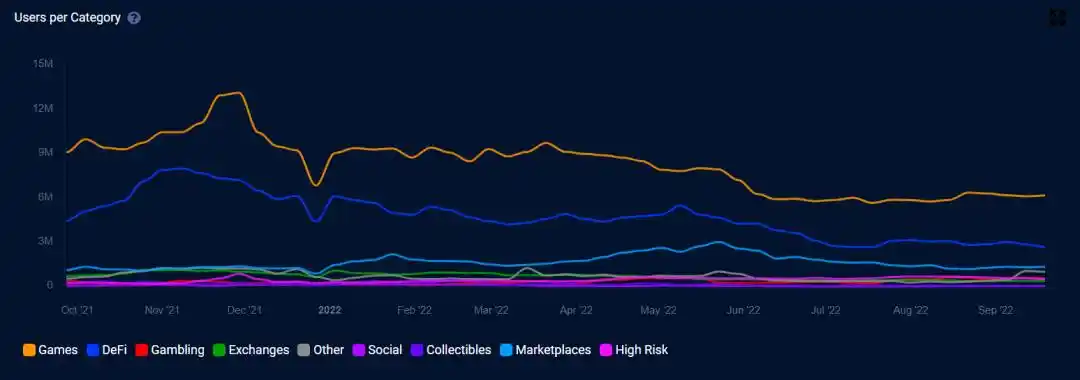
Figure 3: Dapp Users per Category
#2 The initial stage of the full explosion of blockchain applications
The next cycle will be the initial value discovery of the full application of blockchain.
The comprehensive development of applications will make the blockchain industry more mainstream, and only the continuous mainstream can bring exponential user growth to the industry. Under the background of the current macroeconomic downturn and the disappearance of demographic dividend in the Internet industry, with the popularity of Web 3.0, a new synonym of blockchain industry, the industry has also received unprecedented attention from new and old capital. In addition, some public chain platforms that have been settled in this cycle, new capital-intensive new public chain, Rollup and Danksharding after Ethereum Merge and other narratives, with the emergence of capital and precipitation of technology, let us see the dawn of large-scale application of blockchain in the future.
To further mainstream the industry, we need to strengthen the following three aspects:
a. More scalable blockchain underlying technology and platform to process and run more complex blockchain applications
b. Regulation and compliance policies more aligned with the crypto industry bring in more mainstream capital and funding
c. Further reduce the threshold for newcomers to enter the crypto industry and optimize the experience of entry products to facilitate bringing in more mainstream users
Of course, Rome was not built in a day. Looking back at the bursts of cyclical industry narratives, it is also a spiral of evolution around several dimensions.
2.1 Products and Concepts
Excellent popular products are the premise of the outbreak of the corresponding track, and the fast growth data of the product itself is also the best story. For example, Uniswap, Compound for DeFi, quickly increase TVL on the chain by an order of magnitude; For GameFi, Axie Infinity made more money than the top mobile game on the Web 2, Honor of Kings, in a short period of time; The Sandbox, Decentraland for the Metaverse; CryptoPunk, Bored Ape Yacht Club for NFTS, etc. On the other hand, many tracks have yet to explode, mainly because there is no popular or market proven product on the track. Of course, in a bull market where liquidity is rampant, many immature concepts of products will be hyped in turn. In fact, the hyping of concepts will help attract more people to participate in the development of products, and eventually the waves will wash away the sand, leaving better products.
And really can be called paradigm innovation products, each round of the cycle so far only one. Bitcoin in the first cycle, Ethereum in the second cycle and Uniswap in this cycle.
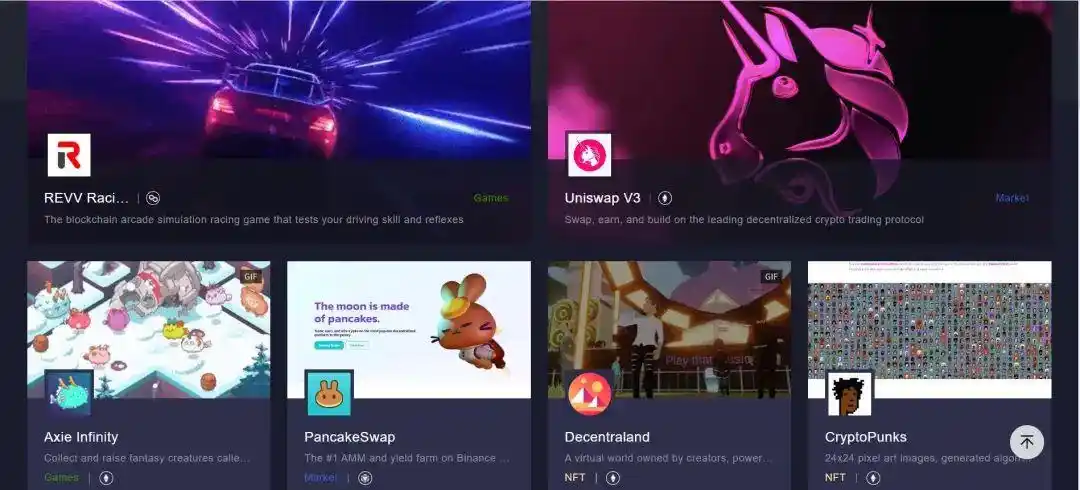
Figure 4: dapponline. IO
2.2 Applications and Infrastructure
The development of the application and the development of the underlying infrastructure must be compatible and mutually successful. The development of application cannot be separated from the continuous optimization of the underlying infrastructure technology and the middleware that provides certain service guarantee. Infrastructure, on the other hand, depends on the flourishing of applications built on top of it or as a service. For example, The rapid development of DeFi and the demand for DeFi fund security not only make Ethereum stand firm in the No.1 position of public chain, but also make middleware and tools like ChainLink and The Graph enjoy explosive growth. Apps like GameFi are better suited to be built on new public chains like BSC, Avalanche, or Solana that offer lower fees and faster transaction processing. While today's apps are mostly simple logic applications, I believe the next cycle will see more apps that can handle more complex logic, and the infrastructure to match it.
2.3 Distribution and circulation
The biggest difference between Web 3 and Web 2 is actually the Token (that is, the essential difference between assets and information). The issue and circulation of tokens and the economic model are the inescapable problems for every Web 3 entrepreneur. In so many years of industry development, the issuance and circulation of tokens has also been changing. In terms of issuance, from the earliest POW/POS and other consensus mechanism mining, to the later ICO, IEO and other financing issues, and then to this round of DeFi liquidity mining and GameFi gold mining, as well as various public offering platforms IDO and airdrop token issuance popularity. During the entry of more and more venture capital, but also now the project Token issue and the company's multiple rounds of financing IPO listed issue has been almost undoubtedly, the issuance of tokens presents a diversified state.
In terms of circulation, from the earliest decentralized OTC trading model, to the centralized centralized exchange matching trading circulation, and now to the decentralized exchange, the trading model has also sedimented two mainstreams: centralized order book trading and decentralized AMM.
It is not clear whether the final form of the industry's Token issuance and circulation model will be so. However, issuance and circulation as the most basic two demand attributes of assets, every change of Token issuance and circulation mode can cause huge changes in the industry and produce huge wealth effect. We also hope that in the next cycle, we can continue to see innovation in this dimension.
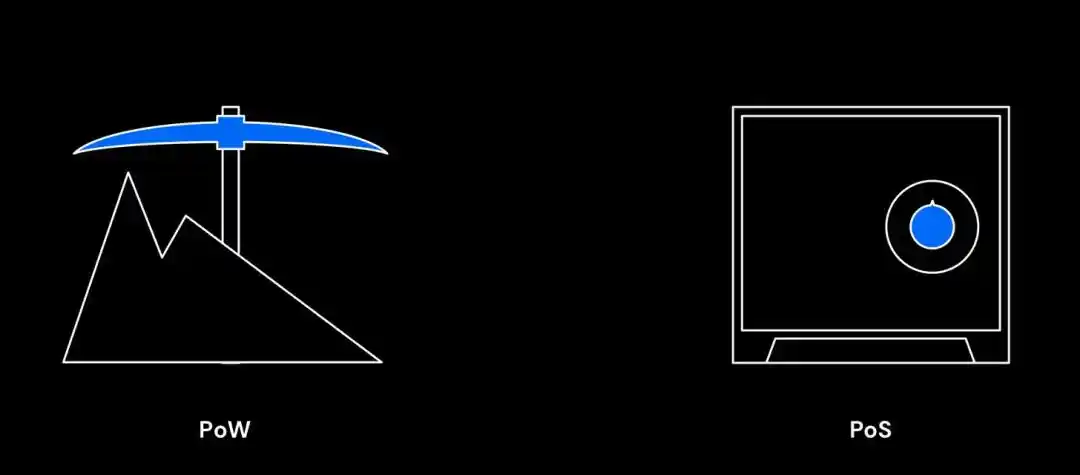
Figure 5: PoW & PoS
The initial value discovery of the full adoption of blockchain also points to some possible trends: in the next cycle, firstly, the extent and regularity of the industry change will be more complex, and many things that were once regarded as laws in the industry will also be likely to be broken. I believe that in the secondary market, a lot of investors through the chain of data "carving a sword" have experienced; Second, it may take longer than before for products and technologies to mature and innovate. Therefore, it is also suggested that colleagues in the industry should be fully prepared for long-term building and have sufficient capital reserves.
#3 Prediction of the industry's hot track
3.1 & have spent Rollup and other expansion solutions
In terms of blockchain expansion, there are many technical solutions and teams that have been building. From the previous improvement of the consensus algorithm alone, to the fragmentation scheme of L1, and now to the hierarchical design of L1, L2, and L3, the most mainstream hierarchical scheme is Rollup. At the end of 2020, V God published the article "Rollup-centered Ethereum Roadmap". In 2022, ETH Shanghai Summit reaffirmed the development status of the Rollup route. Danksharding and other technologies are also specially prepared for Rollup. The Rollup is currently divided into Optimistic Rollup and ZK Rollup.
Optimistic Rollup is easily compatible with EVM and supports generic contracts, but it takes a long time to exit the network. As can be seen, Arbitrum and Modernism, the representative projects of Optimistic Rollup, have done a good job of ecology, and there are many projects on it. At the same time, because of its exit characteristics, many third-party cross-chain Bridges have a good market.
In the primary market, Zero-Knowledge Proof technology can be described as a race track for capital investment at present. Technically speaking, ZK is a verification technique in which a prover can confirm that a proof is valid provided that the prover does not reveal any information other than the proof itself. ZK's technology was first used for privacy, and in recent years has been used for capacity expansion.
ZK Rollup launches the network much faster than Optimistic Rollup, but it is relatively poor in EVM compatibility and general contract support, so the current representative projects ZkSync and StarkWare are still in the preparation stage.
ZK Rollup is slightly higher than Optimistic Rollup in performance, and Optimistic Rollup is easier to ZK Rollup in ecological migration difficulty. This also makes God V openly express that she is Optimistic about the short-term Rollup, while she pays more attention to the performance of ZK Rollup in the long run.
In fact, the ultimate goal of any scale-up platform is to build a thriving ecosystem on top of it by providing a better experience for users and developers. The expansion debate is far from over, which is why I define the next cycle only as the initial phase of the full explosion of blockchain adoption. We believe that the next generation expansion plan led by Rollup will continue to present a diversified pattern, and diversified infrastructure is more conducive to the application and ecology of letting a hundred flowers bloom.
It will be interesting to see how different native apps will grow based on new scaling solutions or architectures, especially in the areas of derivatives and games. For example, Arbitrum Nova and other special chains.
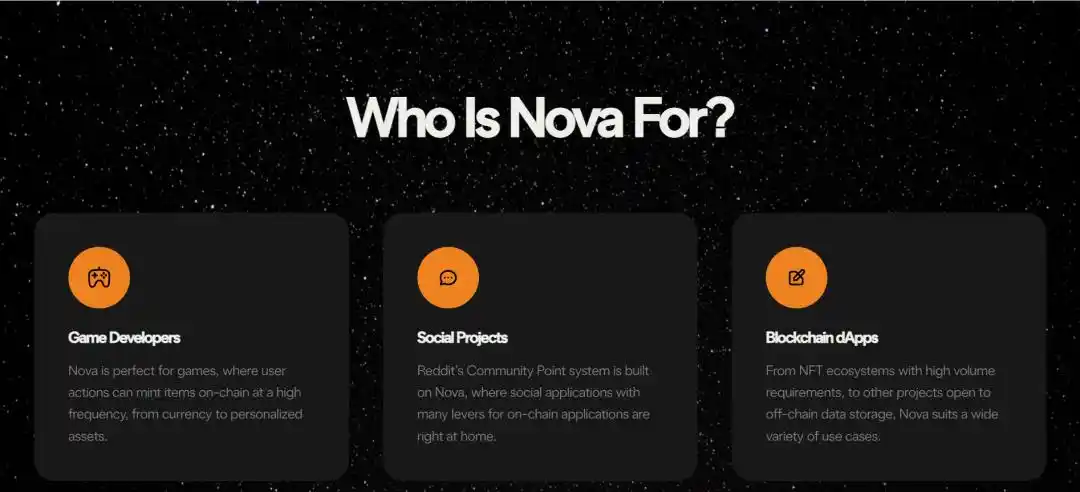
Figure 6: Arbitrum Nova
3.2 DID
DID, the decentralized digital identity. This concept has been proposed for a long time, and this year V God put forward the concept of SBT soul binding token, Binance also launched the "soul binding token" BAB. These two events once again brought the concept of DID to the forefront of market attention.
Its characteristics will not be described in detail. Purely from the perspective of narrative and practicality, a mature and widely used DID product may be the necessary infrastructure for the whole industry to become more mainstream in the future.
For the construction of decentralized social networking, on-chain KYC, on-chain credit system, unsecured lending and compliance with regulatory requirements, etc., it is possible to have some wonderful sparks with DID.
On DID products, it is absolutely impossible to directly transfer the KYC scheme and experience of Web 2 to Web 3. The project side needs to pay more attention to the organic integration of the data such as the interaction behavior of users on the chain. Capture the user through some materialized requirement.
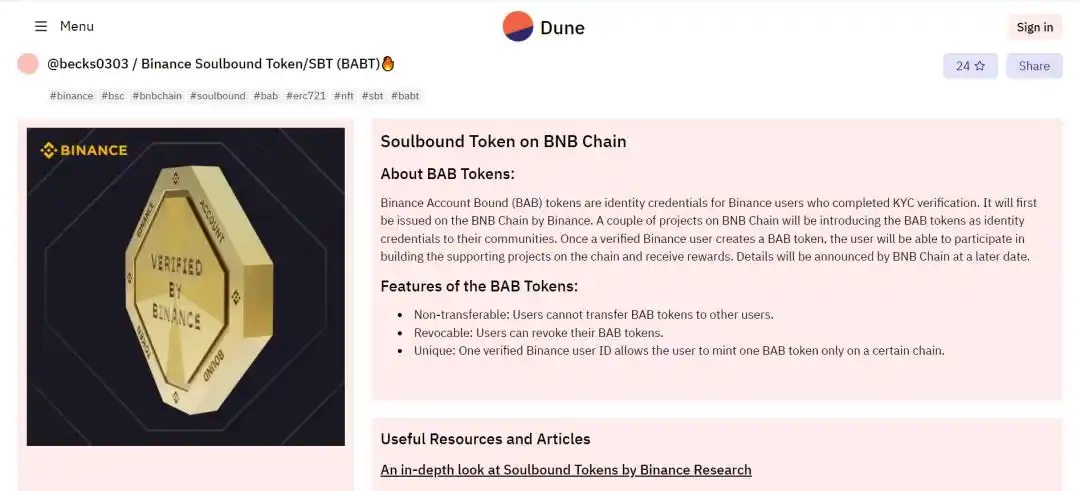
Figure 7: Binance Soulbound Token/SBT (BABT)
3.3 GameFi
GameFi was an exceptionally hot track in the second half of last year. But not for long, with retail crazy, chain swim also became the last stick in this round of bull market. Nowadays, investment in game track is also the most controversial track in institutional investment. Looking back at chain games, it's now clear that GameFi 1.0 was really DeFi mining in Game disguise, and even ponzi. Due to the fact that GameFi has a lot of guilds (mining pools), for non-Web 3 savvy players, GameFi has a much lower entry threshold than DeFi, where they only have to trust their funds to their guilds. But the conflict of interest between escrow agents and investors has hurt many GameFi users.
For the games industry alone, the nature of games is that they have to be fun. This kind of fun, in addition to beautiful graphics, is more important through the design of complex gameplay, interesting game modes or game backstory, etc., gradually addictive or addicted to the game players, which involves a lot of game or psychological aspects of the method.
All of last year's chain games were definitely not fun, purely based on high gold returns to attract players, especially in the late stage of the chain game craze, participants have reached a point of pure competition who has a shorter payback period. When the currency price starts to collapse and the revenue starts to drop until the income is so low, chain game participants can no longer "indulge" in it.
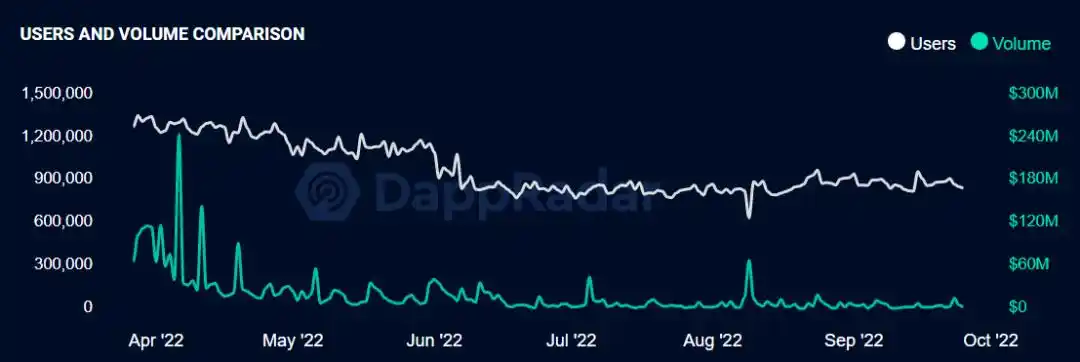
Figure 8: GameFi Users and Volume Comparison
This is not just a matter of some projects, but of the overall disconnect between the needs and experiences of Web 2 users and Web 3 users. Web 3 users pursue high capital returns, while Web 2 users pursue entertainment needs, these two parts of the people are not completely without intersection, Web 3 there are a large number of people who love to play games, Web 2 users also have the need to make money, these needs are not a beautifully made game, and then set a token can meet. In essence, we need to formulate different strategies for different users, break through from a certain point, and combine them organically.
Back to the original intention, our recognition of the value of blockchain games is that it can solve the problem of the ownership of game assets, users' assets in their own hands. Secondly, it can participate in the governance through tokens, so that the game official is not a one-word word. These are the values that blockchain can provide to a game after it has already been accepted by players. Given the current level of blockchain use among Web 2 users, a chain change in this sense is a little premature. For Web 3 native games, motivation is important. So what happened last year was a necessary stage for the first radicalization of the early incentives.
The next stage, perhaps, is the one that shapes the game's assets: NFTS. This is because the NFTS themselves are the most relevant and consumable features of the game, rather than the "mining machines" that GameFi 1.0 used only NFTS as a barrier to entry. With the increasing playability of blockchain games and the development of many NFT protocols, the mobility of NFTS has increased. Nft-oriented value games may be the next round of chain games.
Of course, token incentives will still be there, but economic models and values will tend to be more stable, and not as the main means.
# epilogue
The crypto industry has been up and down for ten years, from the idea foundation to the underlying technology foundation, and then to the improvement and construction of the application foundation. We believe that we are on the eve of the full application of blockchain outbreak. In addition to the above mentioned Rollup, DID, GameFi and other popular circuits that have been discussed more recently, there will be some outstanding projects like DeFi derivatives, NFT liquidity, decentralized middleware, cross-chain basic protocol, blockchain security, mobile blockchain application products, DAO and other circuits. As a unique incentive mechanism in the industry, Token itself is also a special business model. No matter how economic models are designed, they all have their own financial properties of periodicity. When Token business model innovation and product maturity and resonance of application narrative innovation come, we will again usher in the next big cycle opportunity in the future.
Reference Materials:
1.https://twitter.com/DocumentingBTC/status/1574421976298332160
2.https://DeFillama.com/chains
3.https://dappradar.com/industry-overview
4.https://dapponline.io/dapp
5.https://twitter.com/viv_three/status/1574003545283891200
6.https://dappradar.com/topic/games
7.https://twitter.com/BMANLead/status/1520488056599457792
8.https://nova.arbitrum.io/
9.https://dune.com/becks0303/binance-soulbound-token
The original link
Welcome to join the official BlockBeats community:
Telegram Subscription Group: https://t.me/theblockbeats
Telegram Discussion Group: https://t.me/BlockBeats_App
Official Twitter Account: https://twitter.com/BlockBeatsAsia