Will the Ethereum ecosystem's new engine be Layer3?
Original author: LuozhuZhang
Crush, Biteye
Some of my ideas for Layer 3 are inspired by application-specific blockchains, such as DYDX.
There are many dApps (both existing and future) that require a blockchain, not a contract. (such as 100% on-chain game Dark Forest and Topology)
Dark Forest is a decentralized real-time strategy (RTS) game based on ZK-SNARks, a zero-knowledge proof technology. The Topology as StarkNet Ecoproject, dedicated to building protocols for on-chain gaming, NFT, and decentralized innovation. Fountain engine. The application chain can be found in theApplication chain opportunities and risksPlease read this article for more information.
01 dApp selection
一个 dApp 想要成为一条区块链,可以有以下几种选项:
1. You can choose to develop a Rollup (ZK Rollups or   Optimistic Rollups)
The advantage is that you can inherit Ethereum's ecology (users) and its security, but Rollup's development costs are clearly prohibitive for a dApp team.
2, you can choose   Cosmos, Polkadot or Avalanche
Development costs will be lower (Dydx chose Cosmos, for example), but you will lose Ethereum's ecology (users), as well as security.
Let's make the worst case scenario that you choose to develop your own Layer 1 blockchain, which is expensive (because you need to design your own decentralized mechanism to ensure a sufficient number of nodes without sacrificing efficiency) but has the highest level of sovereignty.
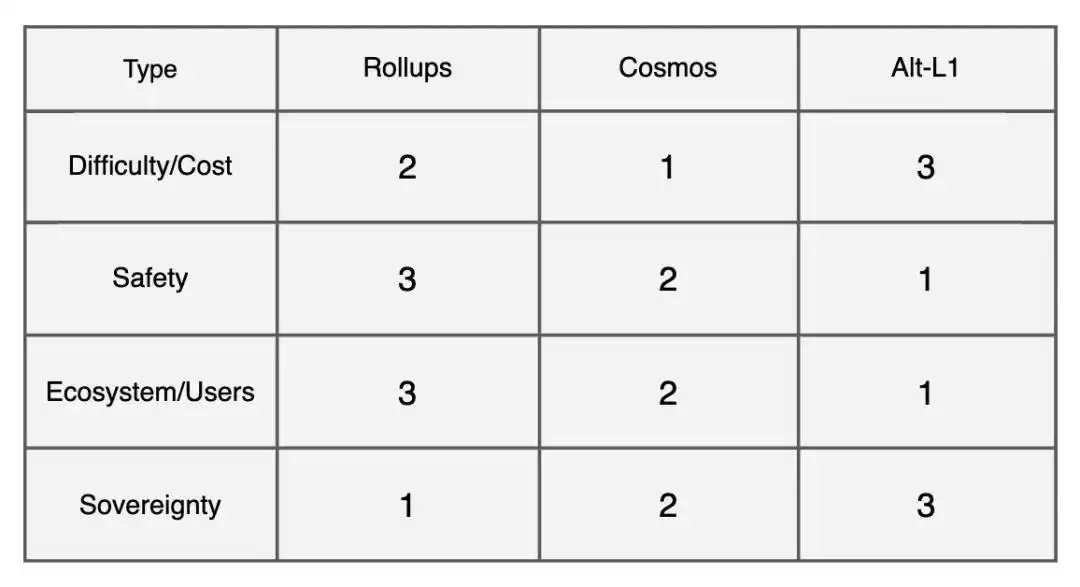
Let's compare these three scenarios:
Difficulty/Cost: Alt - L1 & gt; Rollup > Cosmos
security: a Rollup & gt; Cosmos > Alt-L1
Ecology/User: a Rollup & gt; Cosmos > Alt-L1
The mainThe right to: Alt - L1 & gt; Cosmos > Rollup
Alt-l1 refers to the alternative Layer 1, the public chains that want to become Ethereum killers, such as Solana, Avalanche.
02 Layer 3 possibilities
让我们来思考一下这个情形:作为一个 dApp,我现在希望继承以太坊的生态(用户),以及它的安全性,但是同时我又不想只做一个合约,那该怎么办呢?
First of all, I'm not going to choose Cosmos or Polkadot, I'm not going to choose AlT-L1, so I'm going to have to choose Rollups.
But developing an L2 rollup is expensive, so how do you solve this problem?
The first idea that popped into my head was to use the L3 SDK to develop an application-specific Rollup (application-specific Rollup), namely Layer 3.
Note: SDKs of Layer 2 and Layer 3 discussed here are mainly based on ZK Rollups rather than Optimistic Rollups.Because Optimistic Rollups For fraud verification, there is a 7-day access waiting period, which increases the technical complexity.
I think Layer 2 is good for general-purpose extensions, while Layer 3 is better suited for purpose-specific applications.
Vitalik, the founder of Ethereum, recently wrote oneThe articleTo explore the significance of the existence of Layer 3.
文章提到了 Starkware 的「分形扩容(Fractal Scaling)」概念,Vitalik 同样也认为 Layer 3 存在以下三种类型是合理的:
1. Custom function.The simplest example is to add some privacy requirements;
2, specific purpose of the application (custom expansion).Examples include non-EVM processing logic (some games are completely on-chain), compression optimization for specific data, etc.
3. Different security assumptions (custom security).For example, Validium (weak trust extension) uses ZK-Proof, but Data Availability is not on the chain. Doing so loses some security, but achieves a higher TPS (9000 TPS).
Validium, like Rollups and side chains, is an Ethereum scalability solution. And & have spent ZK Rollups keeps data availability on the chain differently, Validium keeps it off-chain to achieve fairly high transaction throughput. Immutable. That's the Validium model.
03 summary
无论如何,我自己是一直在思考 Layer 3 的可行性的,因为有太多的 dApps 更适合成为一条链,而不仅仅是一个智能合约。
So Layer 3 is likely to open up a new space for Ethereum, or blockchain, just like Rollups. But there are still a lot of technical details to be worked out and it will take time.
For example, if we have Layer 2, do we really need Layer 3? How to design the mechanism of Layer 3? (provers, data availability, sequencers, etc.), and finally how to design a super easy to use Layer 3 SDK?
The original link
Welcome to join the official BlockBeats community:
Telegram Subscription Group: https://t.me/theblockbeats
Telegram Discussion Group: https://t.me/BlockBeats_App
Official Twitter Account: https://twitter.com/BlockBeatsAsia