How DeFi banks can help ease the lending problem?
Original title: "How Defi Banks Can Help Alleviate Lending Problems?" "
Original text by Dragon Horn
1.7 billion people around the world do not have access to a bank account.
20% of small business loans in the U.S. will be rejected by 2021.
How can Defi banks help alleviate these problems?
Web3 lending is not perfect, but we are making progress.
Here are some key trends you must know.
1/ How does traditional banking work?
Generally speaking, the bank's profit = loan - deposit
Risk assessments play a vital role as they directly affect a bank's profitability.


2/ How to measure risk?
Depends on human judgment - your credit score, age, income, current home address will affect your ability to borrow to how much money.
Banks may underestimate the risk of assets with hidden profit potential. For example, the housing bubble back in 2008.
3/ Why choose DeFi loans?
- 24/7 open access to anyone with collateral, no more human subjective bias.
- No KYC, privacy preserved.
- High transparency, you can see the status of the agreement in time.
- Leverage without the need to create a taxable event on the collateral.
4/ We have OG lending and borrowing protocols like @@compoundfinance and @AaveAave but there are still obstacles ahead.
- Cryptocurrency prices fluctuate 24 hours, users are easily liquidated when the value of their deposit collateral drops.
- Infectious money pool.
- The choice of collateral assets is limited.
5/ Just to clarify, when there is a severe downturn in collateral equity:
- Liquidation Failure
- Other "healthy" assets in the same pool are infected (leaving bad debts).
The protocol restricts the listing of its collateral for security reasons, but at the same time, it also limits the expansion of the currency market.
6/ There are other ways to solve this problem:
@eulerfinance divides assets into isolation layer, cross layer and mortgage layer (from the largest risk to the smallest), which makes Token be borrowed, lent or used as collateral while also restricting Token Borrowed, lent or held as collateral.

7/ This is a great initiative, but the assessment of asset risk is still people-oriented. Also, misclassifying assets can still lead to the problems we outlined earlier.
@SiloFinance allows users to fund any Token Create a money market (Silo).

8/ For example, if Token A collapsed and only the bridge asset of Silo A was affected. Risk is isolated and all other types of assets remain safe.
But isolated currency markets are still vulnerable to oracle manipulation.
Such as Rari Fuse Market Vulnerability:
https://medium.com/rari-capital/fuse-explained-3ef2e0747953
9/ In addition to the redesigned money market, new collateral types have emerged.
For example, @BendDAO allows users to borrow ETH against blue chip NFTs as collateral.
< /p>
Additionally, @PineLoans is experimenting with a "mortgage" feature that would allow users to get help buying NFTs.
10/ However, due to the illiquidity of NFTs and even more instability during bear markets, borrowers may be liquidated more often than crypto-collateral depositors . Bad Debt > Fear > Bank Runs.
(from the second half of 2021, the reckoning starts to become more serious)
< /p>
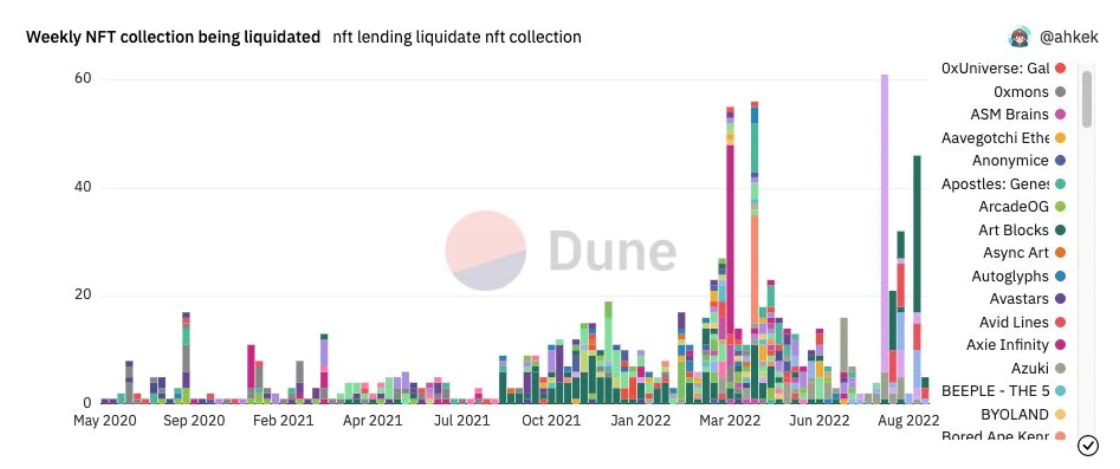

11/ But with NFT The cooling of the hype and the possible invention of new auction mechanisms, they still have the potential to help improve the capital efficiency of the NFT market.
@centrifuge is putting real world assets (real estate, cars, etc.) as collateral in the form of NFTs into DeFi.


< /p>
12/ Their product unlocks new opportunities as a bridge between the real world and cryptocurrencies.
However, legal NFTs as proof of real-world assets are still a problem.
There are many more categories, here is an ecosystem diagram of Web3 lending, courtesy of @ClearChainCap.

13/ According to the figure below, the OG protocol led by MakerDAO and Aave dominates the lending market.
Isolated money market, NFT-collateral oriented protocols are still fairly niche in the space.
We are still in a nascent stage.
(The total loan amount of NFT is only 174k)

14/ Key points:
Trusting code instead of human judgment opens financial access to another billion users.
There is a great deal of malicious intent and behavior. But instead of blocking directly, we came up with smart mechanisms to stop them.
Things change quickly. Be vigilant.
Original link
Welcome to join the official BlockBeats community:
Telegram Subscription Group: https://t.me/theblockbeats
Telegram Discussion Group: https://t.me/BlockBeats_App
Official Twitter Account: https://twitter.com/BlockBeatsAsia