AVAX "Ace" Trader Joe: "Liquidity Ledger" Upgrade and "Big Ecology"

Written by: Cookie, Rhythm BlockBeats
Each public chain has its own star DEX. On Ethereum, there are UniSwap and SushiSwap; on BNB, there is PancakeSwap; on Solana, there are DOOAR(StepN), Jupiter and Orca. And on AVAX, it's Trader Joe's.

Introduction of the official Twitter - we are the No.1 DEX of AVAX
As the most influential DEX on AVAX, since July 2021 Since its launch, Trader Joe has facilitated a trading volume of more than US$88 billion, generated more than US$265 million in revenue and distributed 100% to liquidity providers and their Token holders, and the peak daily trading volume was close to US$1 billion , and is currently stable at the level of tens of millions of dollars. The total lock-up amount exceeded US$2.5 billion at the peak, and currently stands at US$156 million, second only to AAVE and Benqi on AVAX.
With the development of DeFi , Trader Joe believes that the v1 version urgently needs improvement in terms of capital utilization and liquidity flexibility. On August 23, Trader Joe announced that the v2 version will be launched soon. The new AMM design "liquidity book" of this version has aroused widespread discussion. This article will sort out the "liquidity account book" and introduce other ecological components other than Trader Joe DEX.
"Liquidity Book"
The main features of "Liquidity Book":
1. Use the same "centralized liquidity" concept as Uniswap V3 to improve capital utilization .
2. Use "Price Box" to discretize liquidity and then aggregate to achieve "discretization and centralized liquidity" and reduce slippage.
3. Use the Volatility Accumulator to track changes in the Price Box over a fixed time interval to Detect price volatility, realize “variable handling fee”, and reduce impermanent loss.
“Centralized Liquidity”
“Centralized Liquidity "It means that liquidity providers can decide to provide liquidity specifically for a certain price range. Being able to freely set the scope of liquidity provision greatly improves the utilization rate of funds.
Trader Joe v1 adopts the traditional "x*y=k" design, and the liquidity is evenly distributed on the entire price curve . Take the stablecoin trading pairs with relatively small price fluctuations as an example to see the problem of low capital utilization in this design.
Assume that the relative price of the USDC-USDT trading pair fluctuates within the range of 0.99~1.01 under normal circumstances. Then, for a USDC-USDT pool worth $2,000, the two extremes of the distribution of the two Tokens in the pool will be 1005USDC/995USDT and 995USDC/1005USDT. Due to the even distribution of liquidity, only $10 worth of pool funds are actually used for actual transactions, leaving a significant amount of funds sitting idle.
Conversely, if liquidity can be provided for this narrow range "concentrated place", then the funds worth $2,000 in the pool will all If it is used in actual transactions, the utilization rate of funds will be greatly improved. For liquidity providers, they will get more fee income.
Of course, this efficiency improvement also comes at a price. According to a study by Bancor Network, 50% of Uniswap V3 liquidity pools lose money due to "impermanent loss".
Continuing the example above, If the relative price of the USDC-USDT trading pair is out of the range of 0.99~1.01, the users who provide liquidity for this range will stop earning fees. Not only that, but their positions will also become 100% USDC or 100% USDT. For ordinary players, the common situation is to provide liquidity for the "earth dog" with high short-term popularity. The "earth dog" suddenly fell sharply unilaterally, causing the position to become a 100% "earth dog". Such position changes will lead to more serious losses, which completely exceed the fee income, which is to magnify the user's "impermanent loss".
"Price Box"
Assuming the price of AVAX is $20, in Uniswap V3 , it can correspond to multiple ranges of liquidity pools, such as 19-21 US dollars "and" 15-25 US dollars. But in the "liquidity book", it can only correspond to a specific "price box", such as "$19.99" or "$20.03". The distance between two "price boxes" is also called "step size", and in this example, "step size" is taken as 0.2%.
Each "price box "is a pool with a fixed price and adopts the "constant sum formula x+y=k", and the "liquidity book" will aggregate the liquidity of all "price boxes", that is, "discrete centralized liquidity".

In the picture above, P14 as the "active price box" contains both Token X and Token Y, and the "price boxes" above the current market price of Token X are all "inactive" and only contain Token X Assets, the "price boxes" above the current market price of Token X are also "inactive", and only include Token Y as an asset.
Once the liquidity of the "Active Price Box" is completely exhausted (contains only one asset, Token X or Token Y), The "price box" enters the "inactive" state, the adjacent "price box" is activated, and the current market price moves accordingly. Since the "price box" uses the "constant sum formula x+y=k", as long as the transaction only utilizes liquidity within one "price box", there will be no slippage. The current market price only changes with the "Activation Status" of the "Price Box".

Different colors represent different Liquidity Provider
As shown in the liquidity structure diagram above, users can choose any number of "price boxes" and deposit any amount of liquidity, This allows users to more flexibly formulate their own liquidity provision strategies. As shown in the figure below, users who are willing to take risks in order to obtain the most handling fees can choose "Concentrated" to store all Tokens in a "price box", or choose a more balanced liquidity structure for other goals, such as "maximum Minimize handling fee APR", "minimize impermanent loss", and "fluctuation capture" in anticipation of price fluctuations.

"Variable Fee"
The transaction fee of "Liquidity Book" consists of two parts: "Basic Fee" and "Variable Fee". Variable Fees increase when price volatility is high. This does not rely on external oracles to feed prices, but on "volatility accumulators".
The Volatility Accumulator tracks changes in the Active Price Box at regular intervals. If the price fluctuates sharply in a short period of time, correspondingly, a large number of "price boxes" will enter the "active" state in a short period of time. At this time, the "variable fee" will increase to compensate for the impermanence suffered by liquidity providers loss.
When volatility drops , the Volatility Accumulator will gradually decrease according to a pre-specified rate until a new equilibrium is reached. The Volatility Accumulator will reset if the transaction frequency drops to a very low level. Each "Price Box" has an independent "Variable Fee" capped cumulatively to prevent it from growing disproportionately.

under "Variable Fees" The impermanent loss/gain of . It can be seen that within a considerable range of price changes (x-axis), even considering impermanent losses, swinging liquidity pools can still make a profit
The greater the volatility This is also the time when market depth is most needed. Encourage more liquidity providers to update their settings around price movements through "variable fees", which is conducive to obtaining liquidity injections when market depth is most needed. As shown in the figure below, for any liquidity pool whose price range spans less than 60%, the "liquidity book" is within 1% of the depth of Uniswap V3.

「Flexibility」
In UniSwap V3, liquidity positions are represented by ERC-721 NFT, which makes liquidity management positions difficult . For example, when the UniSwap V3 pool exceeds the scope and needs to be changed, all assets in the pool must be withdrawn first, and then a new pool must be reset, which is time-consuming and gas-consuming.
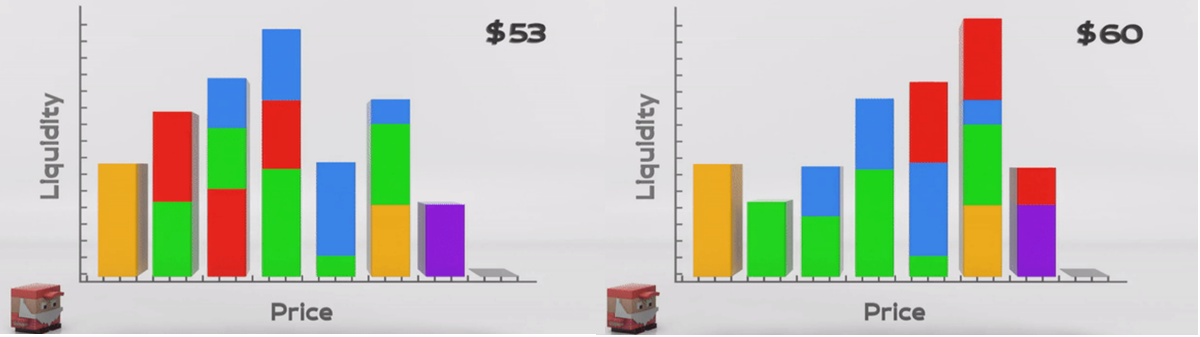
"Liquidity Book" Then package the liquidity position into a more general custom contract similar to the ERC-1155 standard, making it "substitutable" and able to act like a regular ERC-20 Token. These positions can be seamlessly stacked on top of each other to form a new "vertical liquidity" structure. This structure and the "fungibility" of positions allow users to easily complete a series of fine operations, such as transferring assets from a single "price box , add assets to a single Price Box, or move assets between Price Boxes:

Other ecological components
In addition to the proud DEX, Trader Joe has three other business segments:
The lending platform "Banker Joe"
Banker Joe supports the deposit of 13 kinds of Token and the loan of 11 kinds of Token.

Currently, the total value of deposits on the platform is close to 21.29 million US dollars. The top three deposit tokens are USDC.e, WBTC.e and WETH.e. The total borrowing value is close to 4.62 million US dollars, and the top three borrowing tokens are USDC.e, USDT.e and AVAX.

IDO platform "Rocket Joe"
Since the first project launched in early February, 7 projects have been launched IDO was completed on Rocket Joe, and the more famous ones include the turn-based card chain game Heroes of NFT and the Metaverse Economic Guild Fief Guild.
Participating in IDO requires two tokens, rJOE and AVAX. rJOE is obtained by staking JOE, which is non-transferable, and access to the IDO project startup pool can only be obtained by virtue of rJOE. Every time 100 rJOEs are submitted, corresponding to unlocking 1 AVAX startup pool deposit quota, rJOEs will be destroyed after submission. In other words, rJOE is a kind of "credit score" that determines the user's subscription amount.
NFT trading market "Joepegs"
Since its launch on May 5, Joepegs has It has 9,106 users and generated a transaction volume of nearly 88,000 AVAX, which is about 1.816 million US dollars.
Joepegs has its own NFT Lanuchpad - "LaunchPegs". LaunchPegs has issued 39 projects so far, and 28,579 NFTs have been Mint through LaunchPegs. The total cost of Mint is close to 34,500 AVAX, or about $714,000. As the NFT market itself, LaunchPegs includes one of the few features of Joepegs, that is, it supports multiple sales methods, especially auction sales methods, such as Dutch auctions, English auctions, etc.
AVAX’s NFT Market Size Smaller, mainly because the popularity of the project determines the popularity of the NFT market. Judging from the daily trading volume of each AVAX NFT trading market since June, it can be said that Joepegs, CHIKN and NFTrade are three points in the AVAX world. Among them, CHIKN is the ace NFT project on AVAX, with a built-in trading market.

CHIKN has been on the rise recently, In terms of daily trading volume, there is no absolute king in the AVAX NFT market
Conclusion
Trader Joe v2——"Liquidity Ledger" is the most direct manifestation of Trader Joe's choice of DeFi as the main direction , after all, DEX is Trader Joe's largest "traffic entrance". Coupled with the emergence of the NFT trading market "Joepegs", it can be seen that Trader Joe has a clear development idea-strengthen the "traffic entrance", do a good job in the iteration of the main product, and at the same time expand to other business areas to try to convert traffic, from DeFi to "Big Ecology" evolution.

In terms of the number of weekly active users of the AVAX project, Trader Joe has always been alone.
Some people replace " It's a pity that the "liquidity account book" still doesn't get enough attention. But for the AVAX and Trader Joe fans, it is not such a pity. It was AVAX that made Trader Joe in the first place, and Trader Joe also expressed in the recent AMA that he would keep his talent in AVAX.
Welcome to join the official BlockBeats community:
Telegram Subscription Group: https://t.me/theblockbeats
Telegram Discussion Group: https://t.me/BlockBeats_App
Official Twitter Account: https://twitter.com/BlockBeatsAsia

 Related Articles