Discussion on the internal driving force and evolution logic analysis of the digital asset industry

Original title: "Discussion on the Internal Driving Force of the Digital Asset Industry and Logical Analysis of Evolution"
Original Source: Arcane Labs
Digital The asset industry has experienced more than ten years of development. From a social practice of a small group of geeks and idealists, it has experienced several rounds of ups and downs. Begin to pay attention to, understand, and participate in the emerging industries, which are full of idealism, doubts and denials, wealth creation campaigns, bubble bursts, financial innovations, regulatory compliance and other forces. Coupled with the influence of the overall social macro-economy, technological development, and regulatory policies, an emerging market that is diversified, vying for the throne, and self-iterating has been formed.
From the perspective of native encryption practitioners, this article expects to initially discuss the direction of industry investment through research and analysis of the core factors driven by the industry, as well as the process and direction of self-iteration Models and frameworks, and try to sort out preliminary investment return analysis tools in order to more objectively and rationally predict investment returns and effectively control extreme risks.
# Contents
Part 1: Internal and external driving forces for the development of the digital asset industry
p>
1.1 External driving forces
1.1.1 Crisis of confidence in sovereign currency
1.1.2 Social needs of an open financial system
1.1.3 Social Practice of Financial Product Innovation
1.2 Intrinsic Driving Force
1.2.1 Attraction to Idealists: Declaration of Independence of IT Geeks and Financial Investors
1.2.2 The pursuit of an ideal society: democracy, openness, autonomy, consensus, privacy
1.2.3 The underlying needs of human nature: greed and speculation
< br>
Part Two: The Evolution Logic and Direction of the Development of the Digital Asset Industry
2.1 Driven by Performance and Efficiency
2.2 Driven by Financial Assets and Models< /p>
2.3 Liquidity and Narrative Drive
2.4 Security and Privacy Drive
Part III: The Core of the Digital Asset Industry Risk Law
3.1 Trust Risk
3.2 Liquidity Exhaustion Risk
3.3 Compliance and Regulatory Risk
Part Four: Law Summary and Model Construction
#1 Internal and external driving forces for the development of the digital asset industry
#1 h3>
The digital asset industry is such a controversial industry. The bottom of each cycle is accompanied by doubts and ridicules, and then reflects its tenacious vitality. In the next cycle, It can further develop and grow, bring greater wealth effect, and further attract more people into the circle. What are the core internal and external driving forces that promote the industry's continuous self-iteration and self-development?
1.1 External driving force
1.1.1 Sovereign currency Crisis of Confidence
Since the 2008 financial crisis, central banks of various countries have opened a new era of money printing, and Bitcoin has therefore been used as a hedge against central banks. Alternative assets that print money and cause currency depreciation have gradually entered people's field of vision. Although there are various voices of doubt in the early stage of development, and the sharp rise and fall of Bitcoin price also makes everyone doubt whether it can really become a tool for value storage or trading, but with the growth of the miner group and the condensation of consensus, Bitcoin has become The value reference for benchmarking in the industry, and the subsequent emergence of stable coins such as USDT has further strengthened certain digital assets as a tool for value circulation.
In recent years, with the severe inflation in some countries, such as Turkey, Argentina and other countries, leading to the depreciation of local sovereign currencies, more and more local residents choose to The fiat currency is converted into digital assets, which are used as global liquid assets for value preservation. The currency depreciation caused by some national governance issues has indirectly promoted digital assets as an important means and tool for value storage.

Figure 1: Turkish encryption Currency trading grows under inflation and currency devaluation
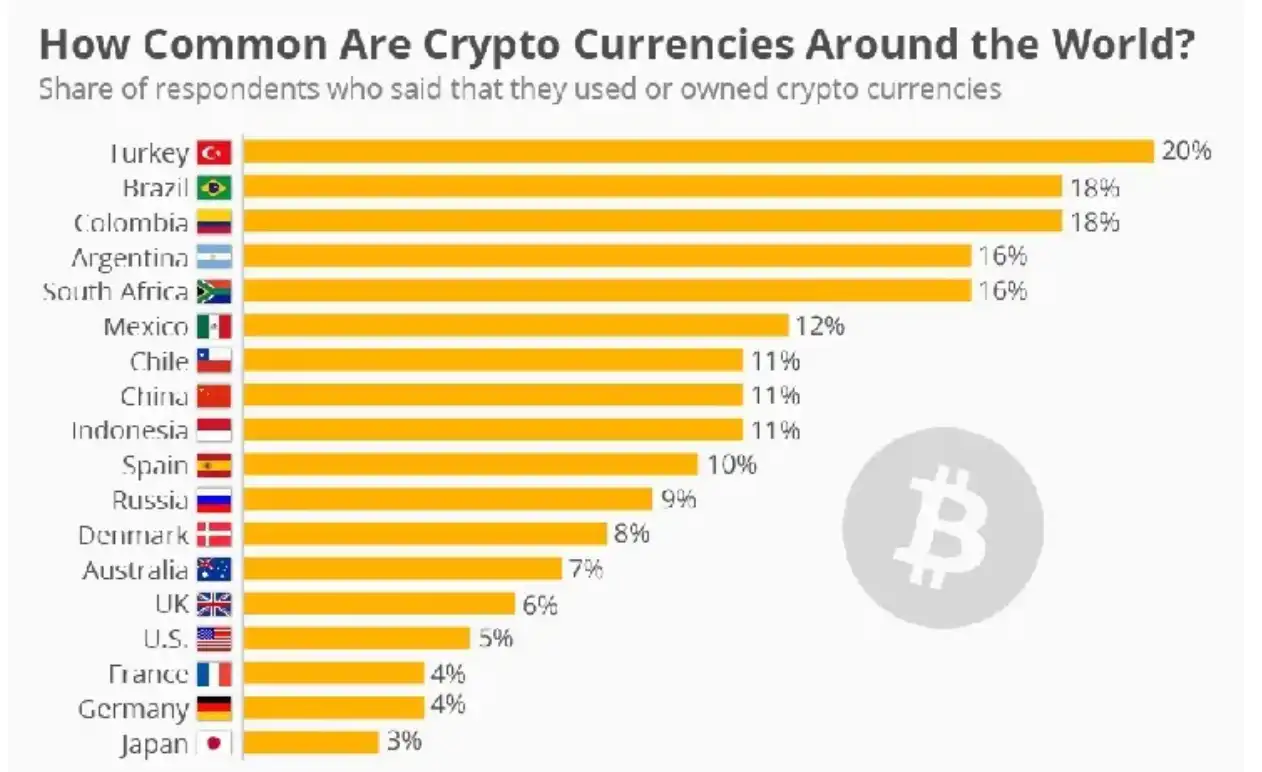
Figure 2: Turkey is the country with the highest proportion of cryptocurrency use in the world
1.1.2 Social needs of an open financial system
Since the birth of the blockchain, for decentralization and centralization The choice of culture has become a topic of repeated debate. With the development of the industry, the current open financial system, or Permissionless, is more suitable to represent the definition of an open and free blockchain system without authorization.
Only by being open and Permissionless, can we better promote multiple innovations, bring about a fairer infrastructure, and promote the circulation and prosperity of the ecology on the chain.

Figure 3: Permissionless VS Permissioned matrix
At the same time, with the recent rise of populism and geopolitical conflicts, the process of deglobalization has begun, in disguise It significantly hinders the flow of capital and information between global markets. Digital assets and blockchain continue to promote the interaction of capital and information from the perspective of finance and technology, and better meet the spiritual and emotional needs of users in the virtual space. This is also the reason why virtual scenes such as various DID digital identities, SBT soul binding Token, and Metaverse have begun to attract the attention of the world.

Figure 4: Metaverse market Project Map
The world of the future will present scenes of multivariate fragmentation and virtual coexistence. The real world will begin to divide due to factors such as the epidemic and geopolitics, but the elites will create a new open financial system through the online world, and then create a virtual nation (country). The state (province) where interests are gathered together, everyone continues to create new infra and DApps, open up the connection between the nation and the state and enrich the user's application scenarios.

Figure 5: DApps project Map 2021
1.1.3 Social needs of an open financial system
The digital asset industry has gone through the development of traditional finance for hundreds of years in just over ten years, and is still catching up with the geometric iteration speed . The development history of traditional finance meets the needs of social and economic and cultural development, and the policies of various localities and countries will also lead to differences in financial regulatory policies in various regions. However, the digital asset industry is practicing how to create a new financial system and ecology on the blockchain, while creating a global uninterrupted financial market. From OTC to trading platform, from spot to contract, from lending to AMM, from DeFi to GameFi, SocialFi, CreatorFi. Various new financial products are constantly emerging, which of course need to adapt to the development level of the industry's infrastructure and the maturity of the industry's current basic financial products.
If the design of financial products is too advanced, or the basic financial products are not yet perfect, then such products will stay in the conceptual stage more and are far from the formal application It will take some time. Of course, the innovation of financial products is one of the core drivers of the industry. We can compare the current products of the traditional financial and digital asset industries, explore areas that have not yet been laid out and developed, predict the development cycle, and deploy in time when appropriate signals appear.
1.2 Inner driving force
1.2.1 For The Attraction of Idealists: A Declaration of Independence for IT Geeks and Financial Investors
Native crypto asset industry practitioners mostly have certain Idealistic colors. They have a certain degree of professionalism, the ability to promote changes in things, and a certain spirit of adventure and innovation. From the innovative practice of a small group of people, it has gradually evolved into a broad social practice. If such social practice does not have continuous incentives, or if there are no factors that continue to attract more idealists, then it will gradually become depressed. However, on the contrary, because of Bitcoin’s deflation model, which is halved every four years, coupled with the Tokenomics design of various Tokens, on the one hand, it gave early participants enough incentives and rewards, and on the other hand, it also opened up opportunities to attract more Many idealists join, contribute talents, and continue to create new infrastructure scenarios. It is precisely because of such a wave of self-contributing Builders, they have no organization, do not rely on wages, and spontaneously form a DAO organization, so that they can go through the bull-bear cycle, continue to develop new infrastructure and applications, promote new financial product innovation, and bring More funds and a broader market continue to promote the development of the industry.
Therefore, investing in these idealistic geeks and entrepreneurs is more likely to grasp the real development direction of the industry and accompany them to grow together.

Figure 6: DAO project map
1.2.2 The pursuit of an ideal society: democracy , Openness, Autonomy, Consensus, Privacy
All kinds of dissatisfaction in the real society will prompt human beings to go to a virtual world through non-violent communication way of expression. Everyone has formed a tacit understanding, anonymity, PFP avatar, ENS domain name, plus Twitter, Telegram and Discord, constitute the standard identity configuration of participants in the encrypted world. Human beings seem to be re-opening a new world, building a new avatar, filling their Metamask wallet with ETH, and then starting to roam in various virtual spaces and platforms, chat and share on Twitter Space, anywhere in the world When being a digital nomad, your work, communication and cognition will no longer be affected by the good or bad of the real world outside. At the same time, you can participate in some matters of decision-making, have the core ownership of Web3.0, and at the same time protect your privacy. This kind of living and working status deeply attracts idealists of all ages, and also attracts the millennials. The new generation, who have been accustomed to the online world since childhood, are more likely to accept the game rules and life attitudes of the encrypted native world. Their participation also represents the vitality of the industry and the continuous driving force for the development of the industry.

Figure 7: Blockchain ecosystem panorama< /blockquote>1.2.3 The underlying needs of human nature: greed and speculation< /b>
The development of any technology is accompanied by two sides, the technology itself is neutral, but different people will use the same technology to make different things. The development of the Internet is like this, and so is the development of digital assets. Starting from the good social world at the beginning, here represents the original ideal of the fundamentalists. However, with the development of the industry, speculators have seen digital assets become an important financial market speculation tool in the context of anonymity and unregulated. In fact, speculators also know what they are doing, and they also know the risks involved. Even if they experience losses and liquidate their positions, the memory of leeks is only three seconds. When the price starts to rise again, all previous losses are thrown away. back. Here, digital assets meet the lowest needs of human nature: greed and speculation, which are unchangeable things in the depths of human nature. Borrow money to think about paying back. Although countries have begun to protect general investors, the needs of greed and speculation are engraved in everyone's genes, which is why DeFi, GameFi, etc. have grasped the core needs, which in turn led to the development of a new round of bull market. Therefore, all models that can inspire greed and speculation attract more users to enter the market to some extent.
Therefore, the underlying needs of human nature drive the digital asset industry to go through bull and bear, and to amplify human nature in the next round of bull market, attracting more funds and users field.
#2 Evolution logic and direction of digital asset industry development
Experienced the beginning of the industry The ups and downs, seeing the ups and downs of various concepts and tracks, and the stories of various idealistic colors in the bull market one after another, everyone let go of the last ounce of caution in the stories of various wealth effects. The fans kept shouting, and the new leeks also happily shared the latest "successful investment experience", as if such a happy time could last forever. However, before the newcomers had time to reap the investment income, the market began to take a turn for the worse. The cruelty and bloodiness of the financial market had an even more magnified effect in the digital asset industry. In an instant, the assets shrank by 80%, the liquidation returned to zero, and the profit even lost the principal. endlessly. Of course, when the next round of bull market starts, there will be new narrative logic, and new leeks will enter the market, one after another, and it will start again and again.
However, after several rounds of bulls and bears, we have to ask ourselves: what is the evolution logic and law of the industry? What are the hype themes? Which are the core value-driven laws? Only by thinking deeply about these issues can we better predict and plan for the next cycle. Therefore, this article attempts to answer and summarize the following logics and laws.
2.1 Driven by performance and efficiency
The blockchain impossible triangle has always been an industry Constantly strive to find the breakthrough direction of the optimization scheme. Compared with decentralization and security, the optimization benefits of scalability are more prominent, because it is directly related to user experience, transaction efficiency on the chain, etc., and also directly affects the cost of developing, deploying and operating large-scale applications in the industry. Therefore, the continuous improvement of performance is the direction of tireless efforts of industry technicians, and the increasing demand for on-chain transfers and transactions drives the continuous improvement of infrastructure performance. Since Ethereum opened a new era of smart contracts, the new public chain has been constantly competing with TPS, Gas Fee, consensus mechanism, scalability, etc. The upsurge of new public chains from 2018 to 2020 has hatched a new generation of public chains such as Solana, Avalanche, Near, Polygon, Cosmos, etc., including Aptos and Sui, which are popular among the top capitals in the United States, and the underlying MOVE language, all of which represent The industry's confidence in the continuous investment and improvement of the underlying infrastructure.
Figure 8: Three types Public chain technology comparison
Of course, higher-performance infrastructure can span bulls and bears, generate cash flow, and have more The imagination space can become a Fat Protocol, which can carry more data assets and value storage. These are in line with the investment logic of institutions and capital, so they have become the most important investment track.
The drive of efficiency is reflected in asset transaction speed, handling fees, user experience, etc.
Figure 9: Block The value capture ratio of the chain ecosystem over time
From the perspective of CeFi, for example, the evolution of the trading platform reflects the market's focus on efficiency continuous pursuit. From the offline OTC market at the beginning, to the primary trading platform with only a few digital assets, and then to the subsequent large-scale and high-concurrency trading platform, it is constantly carrying more and more industry participants and transaction volume. The trading platform has become the core of the industry's value ecology, and has become the core platform for assets, funds and users to match and bid. Good user experience. In this way, related subdivision tracks and products that conform to the above logic have won the choice of the market and users, and Binance, FTX, OKX, Kucoin, Bybit, Huobi, etc. have achieved certain leading positions in their fields and markets.
From the perspective of DeFi, UNI from V1, to V2, to V3, all reflect the pursuit of liquidity efficiency, automatic market maker agreement The development of (AMM), including the smart pool Aggregator, and the development of lending such as AAVE, all reflect the industry's pursuit of efficiency. Therefore, we can continue to explore the pain points that currently affect the DeFi market and liquidity efficiency, and carry out track layout.
Figure 10: AMM and AAVE market size (as of 2022.03)
From the perspective of the wallet, it was originally a complex Bitcoin wallet, and later it was Metamask, a DAPP entry that is more convenient for interaction. Multi-chain Trust, SafePal, etc. As the entrance of web3 traffic, the wallet pays more and more attention to user experience and convenient interaction. And these successful wallets have also become an important infrastructure for the industry, forming a stable cash flow income. At present, how to better open up the payment and exchange channels of fiat currency and digital currency under the framework of meeting regulatory requirements is still one of the key tracks for industry capital and professionals.
2.2 Driven by financial assets and models
< /p>The continuous enrichment of digital assets and the continuous innovation of financial models are also a core development logic of the industry. Digital assets, from the original BTC assets at the beginning, to Altcoins brought by ETH, to stablecoins, and then to various financial derivatives, are the direction of industry evolution. At present, new digital assets are also seen in the market, including various underlying treasury bond assets, on-chain index products, interest rate derivatives, fixed-income products, etc. Of course, regulatory requirements may be involved here, and the next round may see more innovative on-chain native assets.
Figure 11: From CeFi Ecological transfer to DeFi
Financial model innovation is also a catalyst for industry development and acceleration. From the earliest simple over-the-counter spot transactions, to centralized bidding and matching transactions, to contract products, to lending, pledge, DeFi, and derivatives. Every new round of bull market can see the continuous enrichment of financial models. The contract trading that started in 2018 and the DeFi trading that started in 2020, these are through the innovation of financial models to quickly provide users and investors with high leverage and liquidity. Then quickly create a wealth effect and attract more investors to enter the market.
Of course, part of the reason for the end of the bull market is also because the financial model is overused, and the leverage multiple is too high, which leads to insufficient liquidity in the end, which leads to a crash and a bear market. Some investors lost money. DeFi in 2020, GameFi in 2021, and the Luna/UST crash in 2022 all originated from financial model innovation, and the failure was also due to excessive model innovation.
DeFi's rich lending, leverage, and liquidity markets have further boosted leverage efficiency. Many DeFi projects started to attract users with an initial rate of return of more than 10,000%. With the addition of more users and funds, coupled with the behavior of mining, selling and withdrawing, and the advantages of large miners in the early stage of capital volume, many DeFi projects have become The financial Lego model has gradually become a game of seeing who can run fast. Early farmers can earn the first pot of gold, and the investment income of later entrants continues to increase, from the initial 3-5 days to pay back, to 1 month to pay back, and then to dozens of months to pay back, so Model innovations that do not generate real value do great harm to market participants.
Of course, DeFi's model innovation also brings good industry infrastructure, such as DEX, lending, AMM, machine gun pool, derivatives, etc., and also allows everyone Users can better access new applications through the chain wallet, further reducing the cost of transactions and intermediaries. DeFi has also begun to provide some traditional financial services, whether it is providing payment channels for some projects or providing liquidity funds for projects. At the same time, in some areas where the financial infrastructure is not yet perfect, such as Africa and other places, through DeFi and digital wallets, local villagers are provided with small loans to support the development of the local economy and industry. This is a very socially meaningful and valuable DeFi Landing application.
Figure 12: Solana and Ethereum's DeFi ecology
Later, GameFi opened up a new way of playing DeFi, which is actually the emperor's new clothes, only adding some more Participatory operations and interactions, but the core essence of GameFi is actually to compete for the sustainability of the Tokenomics model, the user acquisition capabilities of the project party, and the manipulation capabilities of the secondary market. Of course, with the reduction of macro liquidity and the lessons learned from the losses of users participating in various GameFi games, the new round of GameFi games needs to find a way to truly and sustainably attract users, and to truly balance the number of new users and continuous unlocking. The core problem between token selling and pressure, otherwise, it will soon lead to the emergence of a death spiral. The survival period of most GameFi during the last round of bull market was no more than three months, which is very similar to the life cycle of most of the traditional circle projects.
At the same time, when the GameFi project produced a death spiral, the project party was powerless and unwilling to save the market. The cost of restarting a new game was relatively lower, and at the same time, it did not accumulate effective Most users quickly transferred to new projects after seeing that GameFi games lost Play-to-Earn incentives. Therefore, GameFi games are extremely risky, and very few games like Axie ran out It is also the sum of opportunities of various macro and micro factors, and it does not have the ability to be universally replicated.
Of course, the industry is still constantly reconstructing the basic settings of GameFi, such as game distribution, chain game publishing studios, open metaverse co-construction theme games, etc. The teams of traditional game manufacturers continue to launch games with higher quality and content, but the core point is to be clear about the contradiction between the token incentive model and the flow of new users into the circle. After this round of market cleaning, we look forward to the next You can see GameFi projects that continue to create user stickiness and have a more robust economic model.
Figure 13: GameFi market User growth trend
The collapse of Luna/UST is a symbolic event that this round of bull market finally officially turned bearish. In fact, from the apex of the last round of bull market to the outbreak of the Luna incident, BTC and other mainstream currencies have fallen by about 50%. Most of the funds were spent to buy BTC, which led to being targeted by short-sellers, who seized the loopholes in the additional issuance and destruction mechanism of LUNA/UST, and shorted LUNA/BTC at the same time, causing UST to break the anchor, which in turn caused the market to flee in panic. In addition, the lack of reserve funds of the project party led to a run on all at once, which was then transmitted to the entire system. LUNA was issued infinitely, and investors suffered huge losses.
Actually, LUNA has already been regarded as a rising star of the new public chain, and many new development applications are also being expanded. It is basically the light of the Korean project party, but, No matter how good the technology is, no matter how many VCs and market makers support LUNA, Genesis Trading also suffered serious losses because of saving UST. As long as the leverage is too high, liquidity is in crisis, the growth of the model is unsustainable, and there is not enough awe in the market, the collapse seems to be a matter of time. It took only 72 hours for the entire LUNA/UST to go down from the altar. The clearing efficiency of the financial market is so high, which also reflects the bloody capital and the vulnerability of the mechanism.
Figure 14: Luna’s Crash
So, in the next round of the market, how to balance financial model innovation and liquidity risk control is also a very important direction.
2.3 Mobility and Narrative Drive
Mobility drive is divided into three aspects, including macro Liquidity, capital liquidity and asset liquidity. Only when these three work together will a big bull market truly form, and only individual liquidity drivers will only cause a staged or partial bull market. Therefore, liquidity drivers are an important driver of the industry , is also an important symbol of bull-bear transformation.
Macro liquidity represents the development cycle of the global macro financial market. In a cycle with sufficient liquidity, such as 2017-2018 and 2020-2022, it will be accompanied by With the outbreak of the bull market. When starting to raise interest rates and reduce liquidity to control inflation, the digital asset market is currently strongly correlated with the US financial market, and as a risk asset allocation, it is also affected by the investment preferences of institutional investors. Therefore, at the end of 2021, when the market expects that the new crown pandemic will come to an end, and the Fed will raise interest rates about 6 times in 2022, it has basically marked the end of the last round of bull market. Therefore, November-December at the end of 2021 is a better time node for realizing the last round of bull market.
Figure 15: Macro flow The liquidity will reach its peak at the end of 2021
Fund liquidity includes the volume of new funds in the market and the activity of existing funds. When hot money starts to flow into a certain track or project, it is likely to be accompanied by a phased or partial bull market. For example, the hype of some model currency projects in 2019 also caused some local hot spots in the last round of bear market. New funds Start pouring in. When DeFi Summer in 2020 brought in new funds and activated stock funds, the liquidity of market funds was very sufficient. Coupled with the boost of model leverage, more liquidity was created out of thin air, which in turn triggered a new round of big bull market.
Asset liquidity includes the number of new financing projects, the activity of entrepreneurs, the activity of communities, the number of coins listed on trading platforms, etc., which represent new assets in the industry The supply of the project also represents the amount of active materials for the new narrative logic. Only when the number of these new assets is sufficient, the liquidity of the assets will be abundant, and the primary and secondary markets will have enough investment themes to accommodate the funds for the new round of bull market. Offers a wide variety of options to choose from.
Narrative economics is also an important marketing and publicity tool for the digital asset industry. Consensus conferences in the industry, traditional listed companies, well-known applications, and even sovereign countries have also joined this narrative trend: Paypal accepts Bitcoin merchant payments, El Salvador announces that Bitcoin is accepted as legal tender, and Central African Republic issues Sango tokens in countries to attract investment. Traditional entities improve efficiency by accepting and using digital assets, while digital assets are endorsed by traditional entities, and the two complement each other and promote each other.
Whether it is a narrative of utopian utopia or a narrative driven by realistic technology, it needs a grand social development background to solve the pain points of industry development. Build a more fair, autonomous and open financial system. Investors, users, and the community all need these narratives to drive the hype and rotation of various hot topics. Of course, a good narrative attracts the influx of traditional capital and talents, promotes the development of the industry, gives everyone confidence in a bear market, and creates hot spots for the market in a bull market. Narrative also has the need for self-iteration and market evolution. It needs to meet the expected management role of the project party in different cycles, and also needs to meet the needs of maintaining market stability and continuing to create hot spots. Of course, many narratives will be abandoned by the industry and users after they are falsified. Therefore, for narratives that have been falsified, they should be withdrawn or stopped in time.
As an investor, you need to have a profound ability to distinguish true and false narratives. Here you need to have all-round knowledge and ability reserves, as well as certain market and time verification.
Figure 16: Robert · Shiller's "Narrative Economics"
2.4 Security and Privacy Drive
Security drivers include the continuous improvement and improvement of asset security, account security and transaction security. The security of the digital asset market has always been the biggest concern of investors. Witnessed too many security incidents, from the loss of coins on the centralized trading platform Mt.Gox, to the Rug & Pull of various DeFi protocols, and to the hacking of various cross-chain bridges. It attracted many investors and also affected the entry of large funds. Therefore, the industry is constantly correcting itself, eliminating the false and preserving the true, and creating more secure asset custody solutions, wallet solutions, transaction protection solutions, etc. It can better provide investors and large funds with a safe, transparent, and auditable security infrastructure, and it is also an important guarantee for the introduction of traditional capital in the next round of bull market.
Privacy is also an important direction for industry participants, from the initial anonymous coin Monero, to Zcash, Tornado Cash, and then to the privacy of the second layer ZK rollup Project Aztec reflects the needs and concerns of industry participants for privacy. After all, the fundamentalists in the digital asset world want to be anonymous, to respect privacy more, and to create value in a free and open financial world. However, with the intensification of regulation, such as the sanctions on Tornado Cash, many people in the industry are worried about whether the next regulation will fall on them. Therefore, how to counter sanctions and how to protect the autonomy and privacy of the encrypted world has also been discussed recently. The future privacy drive will be a process of integration and progress. On the one hand, supervision will carry out more KYC/AML for trading platforms and wallets. On the other hand, the industry's original privacy encryption protocols will continue to come out, and eventually there will be some agreements Accept certain supervision, and at the same time protect the privacy and autonomy of users to the greatest extent.
Figure 17: Monero & ; DASH & Zcash privacy function comparison
#3 The core risk law of digital asset industry development
< br>
The end of each bull market or industry change is due to the emergence of some core risk events. By summarizing and analyzing these issues, we can better predict the turning point of the market or industry and prepare in advance , to protect their own investment income and asset security.
3.1 Trust risk
Trust risk includes trust in the platform, trust in the project trust, and trust in assets. Due to the initial brutal growth of the industry and the lack of regulatory constraints, the industry's trust cost is extremely high, and the cost of breach of contract is extremely low. This leads to bad money driving out good money, which affects the normal development of the industry. It is also an important risk consideration for investors and institutions.
The trust risk of the platform includes a comprehensive assessment of the platform's asset management capabilities, reputation levels, and risk control capabilities. From the running away of the trading platform, which caused small retail investors to lose their money, to the bankruptcy and liquidation of asset management companies such as PayPal and Celsius, which caused the assets of large investors to be damaged, all reflect the trust risk of the platform. Of course, some investors do not have enough professional level and ability to investigate the trust risk of the platform. Therefore, in the next regulatory process, there will be custody services, audit services, and insurance services similar to traditional finance, in terms of mechanisms and models. Try to avoid the evil of the platform, so as to protect the rights and interests of investors. Investment institutions and individuals should also consider cooperation with platforms with strong capital, good reputation, and high level of risk control management.
The trust risk of the project includes a comprehensive assessment of the project party's operational capabilities, moral standards, and entrepreneurial spirit. Since the private placement stage, the market has been constantly filtering and screening project parties. The first is the due diligence screening of investment institutions, the second is the screening of listings on trading platforms, and the third is the screening of retail investors in the secondary market. The project parties that can survive these three screenings and continue to develop, after each round of bull-bear conversion, there are only a handful of them. Therefore, as a market participant, in each round of screening, you need to keep a clear mind, so as to better reduce the risk of running away due to the trust risk of the project party, the secondary market crash, and the return of the project to the community, etc. operate. The collapse of the star project Luna at the beginning of the year is also a lesson for the old and new leeks in this round of the industry. The core problem lies in the operational capabilities of the project side, and the overly aggressive trading style has laid the groundwork for the collapse in this year's bear market environment. Investors do not have an in-depth analysis of the project mechanism, resulting in no timely stop loss or exit. Such learning costs are huge, and it also hurts many retail investors who have just entered the industry.
The trust risk of assets includes the comprehensive consideration of the authenticity, realizability and tradability of the underlying assets. If the underlying assets are not real, have no practical application value, and are not even linked to the chain, then they are just a series of numbers that can be reset to zero at any time. Many projects that rely on market-driven belt models are similar. Realizability is reflected in whether there is a suitable channel to exit, and whether the project party or the trading platform has enough acceptance assets. If the platform or the project party does not operate well, it cannot be realized, which will cause huge losses and psychological harm to investors. Finally, tradability is reflected in whether digital assets can be exchanged for other assets on the chain, whether there is liquidity, if there is no counterparty, then even if you hold 99% of the Token of the entire project, it is basically equal to an unrealizable number , is worthless.
3.2 The risk of liquidity depletion
Liquidity depletion is an important factor for the bursting of financial bubbles One of the parameter indicators. The high point of each round of bull market is based on the exhaustion of liquidity as an important assessment basis. The evaluation indicators of liquidity depletion are reflected in: 1. The amount of new market funds has begun to decrease; 2. Most of the stock market funds have entered the market; 3. Market user activity and transaction volume indicators have reached their peak; when these indicators all appear Therefore, investors must look at the market cycle objectively and rationally, and carefully evaluate the changes in market funds, users and trading volume, so that they can realize cash in a timely position and keep profits.
3.3 Compliance and regulatory risks
Compliance and regulation also lead to changes in the industry structure, Track changes, important factors for personnel changes. The need for compliance and supervision has led to traditional capital chasing Coinbase, creating a model of a global compliance trading platform. Changes in local and regional compliance regulations have led to the regional transfer of the entire industry, and going overseas has become a helpless choice for domestic industry practitioners. The regulatory requirements for energy and carbon neutrality have also led to a reasonable moral explanation for the transfer of POW to POS, but at the same time, it has also sparked controversy and debate that switching to POS may be regarded as a security token that meets the Howey Test. The intensification of KYC/AML supervision has also led to the closure of many project parties and trading platforms, and they have withdrawn from certain markets. At the same time, some practitioners are also facing personal safety issues, which has further led to the shutdown of some mining platforms, users cannot withdraw coins, and investors are facing an indefinite wait. Of course, compliance regulation is an overall trend, and future projects need to consider how to better realize their own development within a reasonable regulatory framework system.
Figure 18: KYC & AML regulatory intensification
#4 Law summary and model establishment
For the above digital assets The underlying logic of the industry, the law of evolution, and the analysis of risk factors. Finally, this article attempts to summarize and extract an overall framework and map of the analysis of industry laws. For industry development and investment as a model basis for empirical analysis.
Figure 19: Industry as a whole Analysis Framework Model of Driving Force and Evolution Law
Preliminary construction of macro multi-factor model of investment return:< br>
Among them:
Alpha -influence factor of subjective initiative
Beta —influence factor of macro liquidity
Gamma —Risk Influencing Factor
—Management Level Influencing Factor
Expected Return on Investment E( r) = [1*performance and efficiency variables + 2*financial assets and model variables + 3*security and privacy variables]*[1*macro liquidity and narrative variables]*[1- 1*trust risk variables-2 *Liquidity risk variable- 3*Compliance regulatory risk variable] + *[investment research ability + project acquisition ability + team stability variable]
The above models reflect The internal and external driving force is the core basis for the project to obtain long-term benefits. Only projects that meet the long-term development needs and trends of the entire industry can obtain sustainable benefits. Of course, macro liquidity and financial market sentiment are the accelerators and levers of yield. The exit yield of a project in a bull market is much greater than that of a project in a bear market. Of course, core risks also need to be considered. Otherwise, the project team will run away, Rug-Pull, leveraged liquidation, the overall market liquidation, and the arrest of key project personnel may also lead to the risk of zero returns. Of course, the professionalism of the investment team or individual, project acquisition ability, and stable and continuous market participation are also important factors for obtaining excess returns.
The above model analysis is only used as a reference for macro analysis. In the later stage, more data from the industry will continue to be collected, and different influencing factors and influencing factors will be continuously tracked and studied.
# Conclusion
The industry development of digital assets has its own endogenous driving force, plus The promotion of the social environment and the financial system makes the development of the industry present the overall characteristics of cyclical fluctuations and upward development. However, with the pressure of various trust, liquidity risks and compliance regulations, it will also affect project investment or industry development. Therefore, as an investment institution or high-net-worth individual, it is necessary to consider the layout of the track that conforms to the laws of industry development, and also At the same time, it is necessary to consider various external risks, and at the same time improve its own investment research capabilities and project acquisition capabilities, in order to achieve long-term returns that exceed the industry's average return, while avoiding extreme risks.
Next, we will continue to explore investment themes that conform to the above analysis ideas, as well as the analysis of the industry's current mainstream tracks. We will start digging from the bottom layer, then analyze the technical architecture, middleware, and finally analyze the native applications that may produce phenomenal products. We will also take this as the leading direction of our investment incubation, and at the same time promote the sustained and steady development of the industry, support excellent entrepreneurial teams, and personally promote the social practice of digital assets and blockchain technology.
This article is from a contribution and does not represent the views of BlockBeats.
Original link
Welcome to join the official BlockBeats community:
Telegram Subscription Group: https://t.me/theblockbeats
Telegram Discussion Group: https://t.me/BlockBeats_App
Official Twitter Account: https://twitter.com/BlockBeatsAsia