How does LayerZero define the new Omnichain connectivity standard
LayerZero Defines a new standard for Omnichain Connectivity
Original source: 0x1, IOBC Capital
Connectivity is an unsolved need
In blockchain, if each blockchain is compared to an independent ledger, there is no interconnection between different ledgers, and the data and user assets on each chain are in a relatively independent state.Individual blockchains are like islands,Interoperability is poor, which greatly limits the development potential of blockchain.
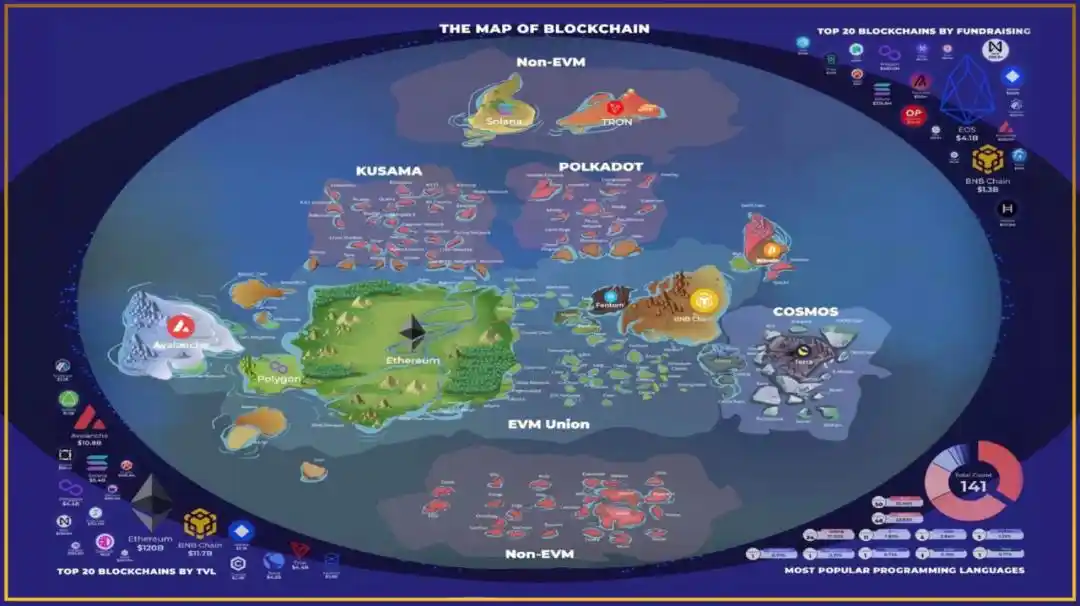
Full-chain interoperability is the new paradigm of connectivity
1. Trusted repeater:This scheme sends transactions through the source chain, and the relay chain verifies the transactions and reaches a consensus, and finally sends the transactions to the target chain.
2. Light Node mode:In this scheme, the light nodes of the other chain are deployed between the two chains to synchronize the complete block header of the other chain, so as to verify the transaction of the other chain.
The first solution is not decentralized enough, and the final result is often not an open cross-chain ecology, but a new closed ecology, which also has the risk of being attacked by a single point. The second solution is too expensive, such as running an on-chain light node on Ethereum, which costs a lot of money per target chain per day.
Regarding the development status of blockchain interoperability,LayerZero proposes a new solution:
Ultra light node mode:The solution is to deploy an Endpoint on each chain that runs an ULN (Ultra Light Node) and then stream the block headers containing the cross-chain information via Oracle on demand (instead of transmitting all the block headers sequentially, And then transmits Proof information through Relayer to verify each other so as to ensure the correctness of information.
LayerZero enables local cross-chain transactions through the ultra-light node pattern.
How LayerZero implements full chain interoperability.
LayerZero is a full-chain (Omnichain) interoperability protocol. LayerZero builds a new ultralight node pattern to provide a secure and reliable infrastructure for a variety of cross-chain protocols.
LayerZero is an ultralight node that runs the entire chain. LayerZero relies on Oracle and Relayer to transmit information between LayerZero endpoints on different chains. Oracle passes the block header (block header contains transaction information, message M, etc.) and Relayer passes the Proof information to verify each other to ensure security.
The following figure shows the flow of A User Application (UA) on Chain A sending messages to A User Application on Chain B via LayerZero:
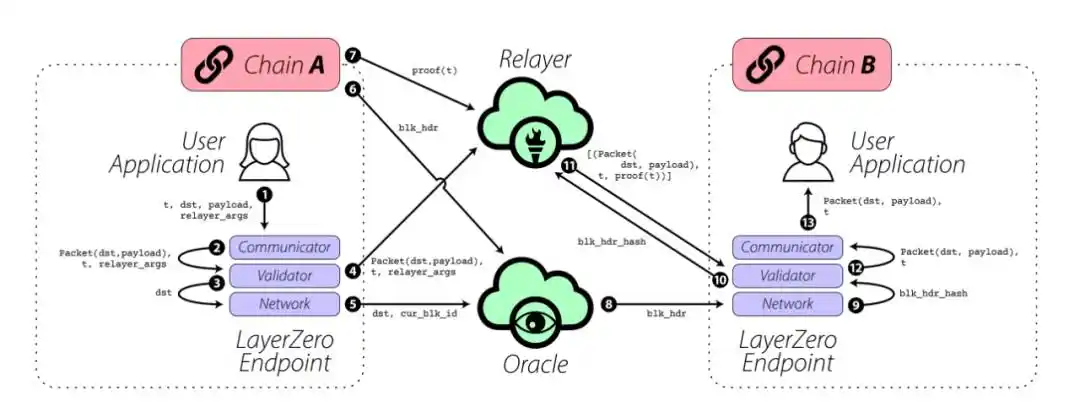
3. Relayer: The repeater is responsible for obtaining and transmitting the Proof information of the specified transaction. Currently, LayerZero serves the Relayer. In the future, a Relayer can be served by a specific business party. Relayer earns most of the cross-chain processing fees.
Full chain interoperability based on LayerZero has many advantages
Full-chain (Omnichain) interoperability has outstanding advantages over interoperability achieved by cross-chain protocols. In addition to the security and low cost results of different solutions, making cross-chain and full-chain applications based on LayerZero also has many benefits for the application layer protocol itself.
Application layer protocols can focus more on their own business development.Applications built on LayerZero can worry less about the development prospects of the underlying public chain and focus more on developing the business of the project itself. When there are more and more applications of the whole chain (Omnichain), it may even change the current situation of "fat protocol, thin application" in the industry to a certain extent, so that more entrepreneurial teams can develop application-layer products that attract a large number of users.
Global state sharing of Omnichain can be realized.Old application layer protocols, if they exist on multiple chains, are actually running isolated applications. Let me give you an example: if Uniswap is deployed on three separate chains, and a typical cross-chain scenario requires a bridge between each of the two chains, then you need three Bridges on three chains, so you need to code for three Bridges, and you end up with three separate interfaces and three different security attributes. If you need to deploy more chains, the amount of work will be even greater. But with LayerZero, you only need a single interface and codebase for all cross-chain pairs.
Unified mobility bridge can be achieved.General bridge protocol of the efficiency of funds is very low, still in Uniswap deployment in three chain, for example: in accordance with the general cross chain solutions need to have 3 bridge, and the three bridge in the chain of each source and target chain need to have a pool, pool that needs to be 6, each pool need filling liquid, capital efficiency is very low; But if you do this based on LayerZero, you only need to make one bridge, and you only need one pool on each chain. With the same amount of capital, the depth of the pool can be more secure, more capital efficient.
Full chain interoperability based on LayerZero can run a lot of businesses that were not easy to implement in the past, such as:
Full-chain cross-chain bridge;
Cross-chain transactions;
Full-chain revenue aggregator;
Cross-chain lending;
Full-chain Token/ full-chain NFT;
Full-chain NFT cross-chain bridge;
...
In short, in solving the island problem of blockchain, LayerZero achieves dimensionality reduction with the whole chain (Omnichain) thinking.
The Ecological Development of LayerZero.
LayerZero is less than two years old, three or four months into the main web, but it's already doing very well.
As for platform data,Within two weeks of the launch of the main network, TVL was worth $4.4 billion, a multi-billion dollar deal.
In terms of ecological development,More than 700 smart contracts have been deployed on LayerZero since the testnet period, and over 4,300 smart contracts have been deployed as of August, of which more than 600 are active.
In terms of blockchain coverage,LayerZero is the absolute guide and explorer on the road of Omnichain. Initially supported only seven EVM-compatible chains (including Layer1 and Layer2 chains), it is now expanding to non-EVM public chains such as Solana, Aptos, and SUI, with plans to cover most of the industry's header Layer1 and Layer2 chains.
Not only is LayerZero's own data pretty good, but the header projects within its ecosystem are doing just fine. Such as:
1. Full-chain cross-chain bridge & NBSP; Stargate
Stargate is a full-chain cross-chain bridge based on LayerZero, which focuses on the cross-chain of assets of USDC, USDT and ETH, with unified liquidity and fast transaction finality.
At the beginning of its launch, TVL was worth $4 billion, and it is still worth $590 million. It has been invested by FTX, A16Z, Sequoia, Binance, Coinbase and many other front-line institutions. When FTX made IE0, its valuation was as high as $1 billion. It is a demonstration ecological project by the LayerZero founding team based on the LayerZero full-chain interoperability protocol.
2. Cross-chain DEX Hashflow
Hashflow is a LayerZero-based bridging cross-chain transaction service. Total trading volume to date exceeds $9 billion, with $23.6 million in the last 24 hours and 1,335 daily active users. Hashflow announced A Series A round of funding late last month, valuing it at $400 million and raising $25 million.
Most famously, Hashflow helps professional market makers better manage liquidity pools through the use of RFQ models, as well as MEV protection.
3. Full-chain NFT GH0STLYGH0STS
Launched on April 4, Gh0stly Gh0sts is the first LayerZero-based full-chain NFTS set and has quickly attracted widespread market attention with its Free Mint and Omnichain features.
Gh0stly Gh0sts can mint and transfer to any of seven chains. The background color of the NFT is affected by the original chain and the border color is affected by the current chain, so it is easy to tell the NFT's past and present lives. However, there is also a controversial point -- the so-called "mint on any chain" of the NFTS set is actually assigned locally numbered NFTS on each chain, not in the real sense that any NFTS can mint on any chain. Gh0stly Gh0sts founding team to set this point, is it possible that the global finality and global consistency of each chain is not very well resolved? However, this type of cross-chain Omnichain NFTS is actually achieved by using the LayerZero protocol.
After Gh0stly Gh0sts successfully launched its Omnichain NFT based on LayerZero, Holograph, Tiny Donos, Yakuza Pandas and others launch Omnichain NFT based on LayerZero.
The future of LayerZero and Omnichain
"LayerZero will become the industry standard of full-chain cross-chain and the definition of full-chain in the future. As an important infrastructure for the development of Web3 industry, LayerZero will make outstanding contributions to the development of the industry. Like great companies like Tesla/DJI, LayerZero is a company that defines a sub-industry, a race."
"There are a lot of cross-chain Bridges and applications out there, but the experience is still fragmented. & NBSP; LayerZero's Omnichain is really aimed at a user experience where the user is no longer aware of the cross-chain, while seamlessly interacting with all assets."
-- NGC Ventures, Zi
"LayerZero defines a new standard for Omnichain connectivity and will be an Omnichain infrastructure with strong network effects that has long-term value in the blockchain industry and fits well with our long-termist investment approach."
-- Alva Xu& NBSP, Managing Partner, IOBC Capital;
The original link
Welcome to join the official BlockBeats community:
Telegram Subscription Group: https://t.me/theblockbeats
Telegram Discussion Group: https://t.me/BlockBeats_App
Official Twitter Account: https://twitter.com/BlockBeatsAsia

 Related Articles