Stablecoin backed by real estate, DeFi has discovered a new continent?
Original author: @DeFi_Made_Here
Original compilation: 0x711, 0x214, BlockBeats
Since the second half of the year, more and more DeFi projects have chosen to introduce real assets into their ecology. Both Aave and MakerDAO are advancing plans to issue Stablecoins using real assets as collateral. On August 25th, TangibleDAO announced the release on the Polygon Network of real estate-backed, anchored The stablecoin USDR is set in US dollars. USDR can be exchanged for DAI at a ratio of 1:1 at any time. USDR will issue Token through over-collateralized real estate and distribute the proceeds to holders.
Whether real assets are related to DeFi is a new continent or a Pandora's box, and the community has a lot of discussions. DeFi researcher @DeFi_Made_Here gave a detailed interpretation of RWA assets and USDR on his social platform, and BlockBeats compiled and translated it as follows.
First, what is RWA?
RWA stands for "Real World Assets" (Real World Assets), in my opinion, this is exactly what is missing in the crypto world and DeFi. Because many cryptocurrency projects are solving "problems that don't exist."

Integrate RWA into the encrypted world The number of projects has been slowly increasing, but overall, the number of such projects is still very small. Instead, this article will focus on Stablecoins backed by RWA.
RWA Supported Stablecoin
July 8, MakerDaocommunity vote approved the proposal to add the RWA-009 (HVBank) vault to the Maker protocol, which would allow banks to deposit off-chain loans as collateral on their balance sheets Then borrow DAI. This marks the first time Bank of America has integrated collateral into the DeFi ecosystem.
Acceptable collateral includes:
- Commercial Real Estate Loans
- Commercial and Industrial Loans
- Government Loans
- Consumer Loans
- Residential Real Estate Loans
- Capital Call Line
Recently I discovered a Stablecoin that is full backed by RWA (real estate) reserves .
So how does this Stablecoin work?
Real-World Asset-Based Stablecoins Backed by Real Estate, Crypto-Collateralized Stablecoins, and Currency-Backed What are the differences between Stablecoins?
What are the associated risks and potential upside?
USDR
On August 25, TangibleDAO announced that it has The stablecoin USDR is issued on the Polygon network, which is mortgaged by tokenized real estate that can generate income.
Relevant white papers released by Tangible show that USDR can be exchanged for DAI at 1:1 at any time, and USDR will be backed by over-collateralized real estate Token is issued and the proceeds are distributed to holders to offset the depreciation of its linked currency and realize the Tokenization of real estate.
As long as 88% of DAI and real estate are stored in the USDR treasury as the minimum support, Tangible’s native Token TNGBL can mint USDR at a value ratio of 2:1, that is $2 worth of TNGBL is exchanged for $1 USDR.
Whenever the price of TNGBL increases by more than 1% of the average coinage price, the treasury will destroy 1% of TNGBL, so that the protocol can always use 2 times TNGBL Mints 12% of treasury reserves.
This agreement is a safety mechanism to prevent arbitrageurs from buying low-priced TNGBL mints USDR and redeems DAI, which creates a sort of bank run.
Once USDR is minted, DAI will be used to purchase real estate which will be tokenized converted and rented out. Rental income is exchanged for DAI and paid to the treasury. New USDR will be minted as the treasury grows and will then be distributed to USDR holders in a daily rebase. (Each rebase will change the Token holder's wallet balance and the total Token supply in proportion.) Note: In the initial stage, in order to simplify the process, all purchased properties are in a rental state.
As the value of the property increases, the overcollateralization ratio of USDR will increase. As real estate prices rise, once the treasury reaches 130% overcollateralization, new USDR will be minted and paid to stakers in the form of a rebase, increasing APY.
In the event that the USDR mortgage rate is lower than 100%, such as the sharp collapse of the real estate market In this case, the treasury will retain the rental income, bringing the mortgage rate back to 100%.
What are the advantages of real estate support?
So what are the advantages of a Stablecoin backed by real estate assets over a Stablecoin backed by a common currency or cryptocurrency?
Generally speaking, the former represents the dollar in the general sense. And we know that holding dollars is a poor strategy in the long run.
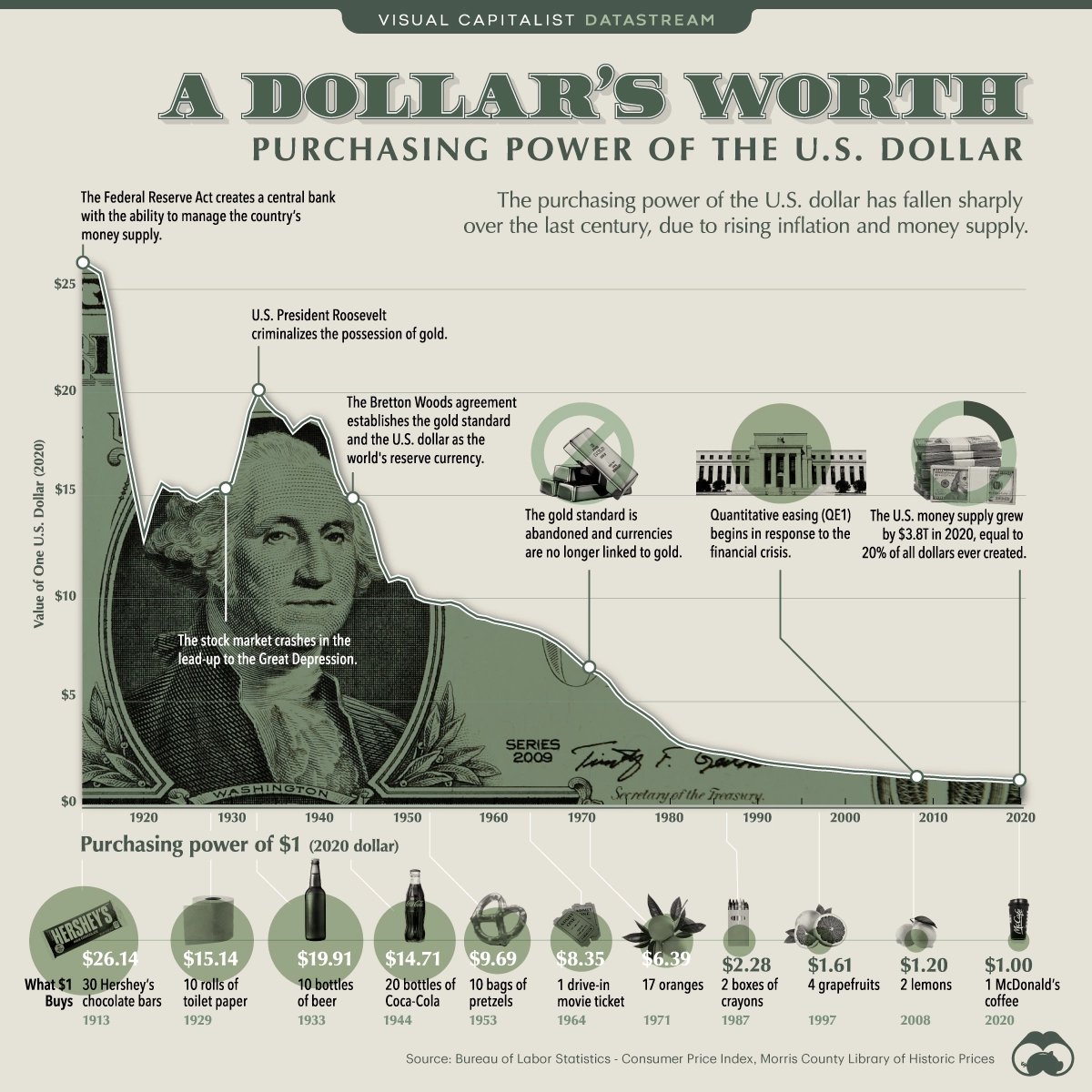
At the same time, compared to the US dollar, the value of real estate assets increases over time. As you can see from the chart below, the average home price in the United States has surpassed its pre-financial crisis peak in 2008.
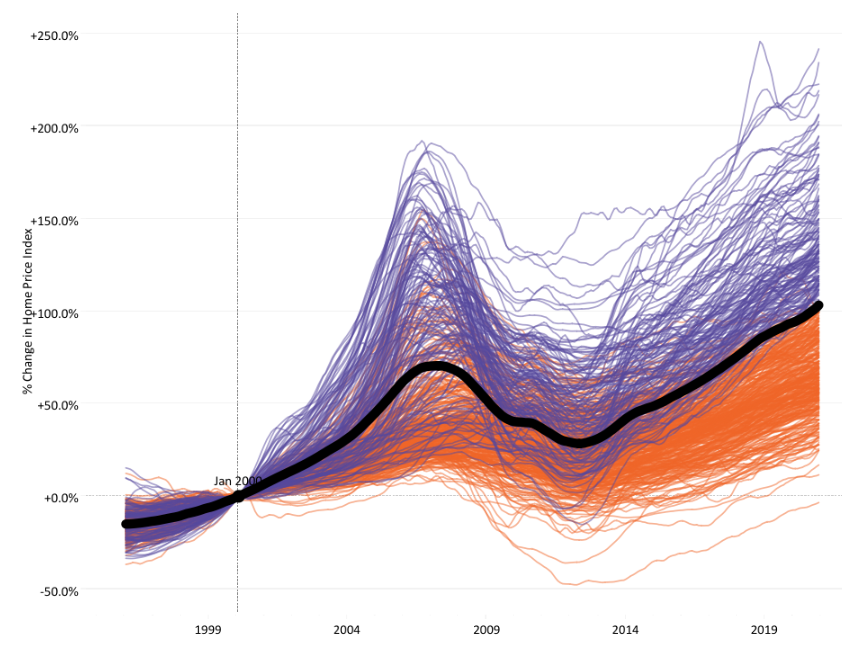
From this we can say that Stablecoin backed by real estate assets is used as a stable unit of account and exchange While serving as a store of value (just like a traditional dollar-pegged Stablecoin), it can maintain value and yield consistent with real estate (historical).
What are the risks?
So what risks do we need to consider?
1. Real estate is less liquid (and less volatile);
2. Currently there is no suitable tokenized real estate market;
3. It will take some time for purchase, document confirmation and asset tokenization;
4. A large amount of redemption may not be completed in a single redemption.
Basically, the above risks are linked together. Since there is no way to purchase fragmented properties, Tangible must purchase properties in full in DAI. However, if fragmented properties are available in the native trading market at a reasonable price, the treasury will give priority to buying them.
The asset redemption liquidation is similar, but the Tangible treasury will hold a large amount of DAI to ensure that it can undertake large redemption without selling at any time assets.
In the extreme case of no DAI reserve, any user wishing to redeem USDR will receive pDAI in a 1:1 ratio. pDAI authorizes users to receive DAI at a ratio of 1:1 after the real estate is sold, and the remaining proceeds are transferred back to the treasury as DAI.
The above reduces the APY for USDR stakers, but based on historical data it will still yield 5-10 as real estate price growth plus rental yield % APY.
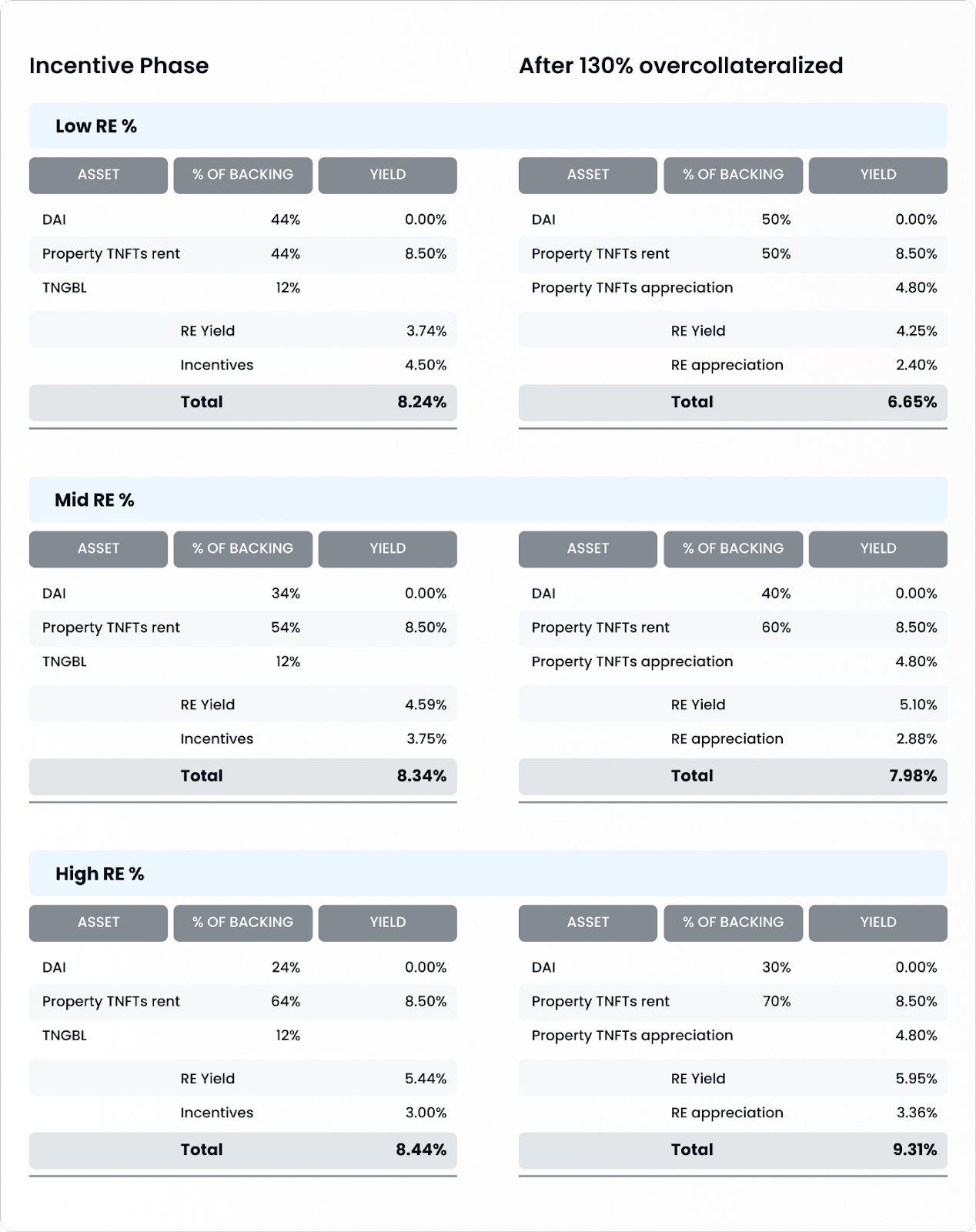
I expect APY to grow with the fragmented real estate market, and therefore with the protocol itself , there will be a more liquid market to allow treasuries to hold less DAI.
The centralized nature of RWA
There is another key that I have not mentioned, That is centralization.
This is due to the nature of RWA and cannot be stripped from RWA. At this stage, we cannot naively think that DeFi can decentralize everything it involves.
Encryption requires real-world empowerment and vice versa. There is no way around centralization on this issue.
The market value of the global real estate market is 330 trillion US dollars, and 1% of it will be tokenized and imported into the chain to increase the total market value of the encryption market 4 times. Applying DeFi tools can basically allow anyone in the world to gain wealth preservation and real estate investment income.
< /p>
Welcome to join the official BlockBeats community:
Telegram Subscription Group: https://t.me/theblockbeats
Telegram Discussion Group: https://t.me/BlockBeats_App
Official Twitter Account: https://twitter.com/BlockBeatsAsia