Value discovery and psychoanalysis for DID in the context of DeSoc
Original Title: "Value Discovery and Psychoanalysis for DID in the Context of DeSoc"
Original Author: Spike, Researcher at ThePrimedia
< br>
When we search for the word DID in Google, the first thing that pops up is its medical explanation - "multiple personality disorder", not the concept of decentralized identity that we are familiar with. Compared with concepts such as DeFi, GameFi, NFT, and DAO, DID is an extremely neglected field that has not attracted enough attention from investment institutions and technology developers.
In the context of calling a richer and more diverse ecosystem based on Web 3 a decentralized society (DeSoc), we believe that DID is The key link in building DeSoc - realizing Web 3 native applications. Previously, we had hoped that the unique characteristics of NFT "Non-homogeneous Token" could complete the confirmation of user identity and asset rights in Web 3. But in fact, some NFT artists and creators are suffering from plagiarism and fraud - for example, the NFT platform Rarible auctioned the work of Marvel's Super Hero Adventures designer Derek Laufman, and the designer himself did not know about it. Not Web 3.
Creating a shared, flexible, and resilient identity layer is imperative: the DID is the backbone through which all digital elements flow. As DID is adopted by more users and Dapps, the processing authority of all digital elements must be in the hands of individual users. Users will not be limited to a single application ecosystem, and users do not need to be trapped in multiple applications. In the fog of individual account and password records; and only on the basis of DID empowerment, Web3 applications such as DeFi, GameFi, NFT and DAO, as well as grand future scenarios such as DeSoc and Metaverse, will bloom more exciting and even are great narratives—a topic to be discussed in the next article.
We will send out the full text in three parts, first, middle and second.
Part 1: The only way
All links are DID. This is an infrastructure where users control their own identity and asset permissions, and it becomes the only way for users to enter the Web3 era.
We can regard the decentralized network world as an established "black box", assuming that there is already a Web 3.0 network, and we now want to interact with it . According to the experience of surfing the Internet in the past, we will pick up the mobile phone or open the browser. In this process, we have completed a brief review of the history of the Internet. From the 1990s to the beginning of this century, smart devices, especially mobile terminals such as the iPhone, directly occupied all the doors of the "mobile" Internet.
DID Category

So, it's time to explore what form of DID product will be the entry point into the Web 3.0 world. Judging from the current development of the DID track, many projects are still in the exploratory stage, and the DID-based ecology is also in the initial stage. The analysis of ThePrimedia is not limited to those projects that claim to be DID. The DID here is an expansive concept, which can be regarded as a DID if it can be used as an interactive entry. We hope that we can throw bricks and spark jade to give you more thinking and inspiration.
Front-end interface: Take MetaMask as an example
The reason why the wallet is classified as DID, This is because the wallet has already completed address verification, on-chain identity authentication, application signature authorization, and even real-person KYC information before interacting with the Dapp.
Although the wallet itself does not store these sensitive information, the process of performing the above operations is enough to constitute all the functions of a DID application. We only need to put DEX, etc. DeFi applications can be switched to social, NFT and other Web 3.0 applications, which is technically feasible.
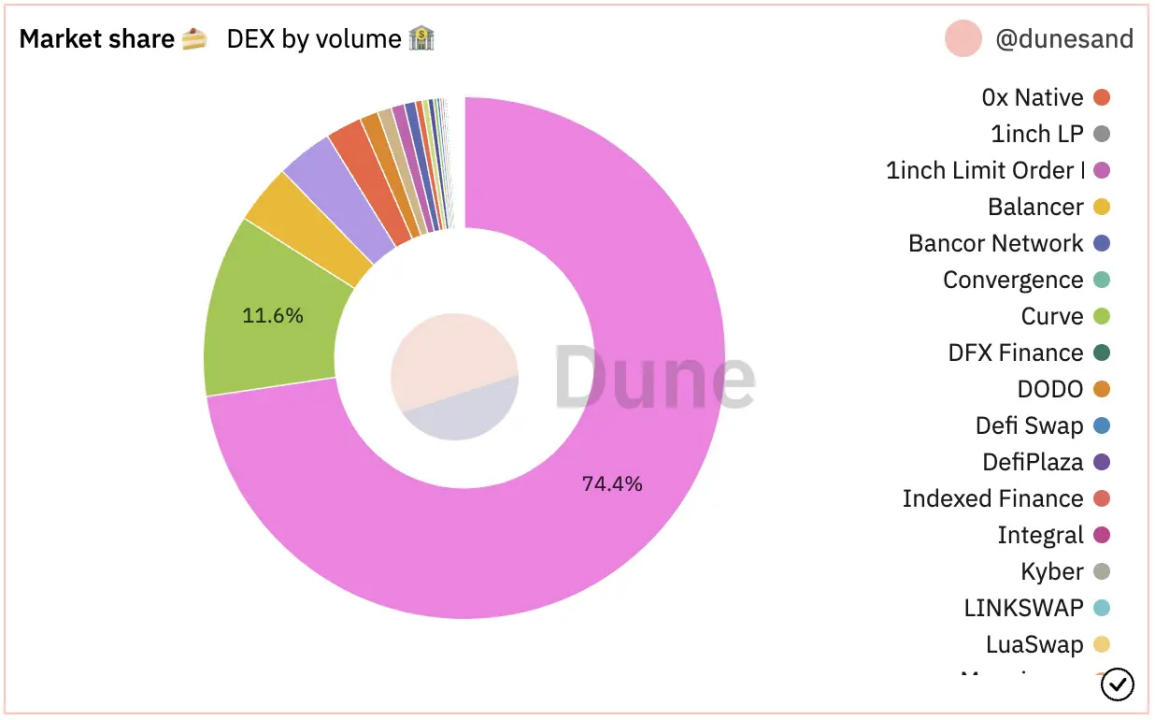
Metamask Volume
Image source: Dune
The question is do we have to do this?
In fact, the biggest problem with the wallet as a log-in device is the sensitivity of censorship, which comes from two points. First, the main interaction object of the wallet is still the DeFi application , the regulatory pressure is increasing day by day, a regulated portal may allow us to avoid the next UST-Luna crash, but this is obviously not the mainstream direction of Web 3.0 social; Russian and Belarusian IP addresses are blocked, if we embrace DID and Web 3.0 because we hate Facebook's invasion of our personal factors, then again it is not logical for us to choose a same species.
Let's continue to deduce, if a pure, anti-censorship wallet is possible to integrate DID function?
Metamask and other wallets are basically the default login tools for all Web 3.0 applications
< br>
First of all, wallet service providers have the internal motivation to develop towards DID. Because the battle for traffic is still going on, a typical example is that Metamask launched Metamask Swap, with 1,246,780 independent addresses, and Metamask directly supports the purchase of cryptocurrencies with fiat currency, which is actually robbing the interests of DEX and CEX. If Web 3.0 continues to develop, there is no reason for wallet applications not to grab this part of the traffic.
Secondly, as the direct "wrapping" layer of the address on the chain, the wallet itself has a natural expansion tendency to carry all the entrances. From the experience of Web 2.0, the success of the expansion of the platform economy is inseparable from the richness and integration of functions, and the address on the chain does not belong to the wallet, so it may not be impossible to take the essence and discard the dross.
Finally, the biggest problem with the current DID track is that the functions and boundaries are not clear, and it is still in the exploratory period-the problem is that the wallet integrates DID, Or will there be a new DID product form?
Continuation of thinking on Web 2: social media accounts
Human beings have the inertia of historical thinking Biological beings, if a mind exists in the past, it is also likely to live in the present and future. This kind of thinking does not seem new at all, but in fact this kind of situation exists widely in real life, such as the TCP/IP protocol, which is the earliest Internet infrastructure, but it is difficult to directly replace it when we enter the Web 3.0 world. kind of agreement.
Based on the possibility of such a situation, we expect social media to be the DID of Web 3.0. Under the guidance of this idea, it can be divided into two paths:
Web 3.0 native social media represented by lens protocol;
< br>
Lens Protocol can be said to be deeply popular. It has attracted everyone's attention since it was born without physical products. This Web 3.0 social application created by the Aave team will be launched in February 2022. It is closer to the concept of the B-side base layer. It is hoped that other social applications can build their own dapps based on the Lens Protocol, such as the official demonstration application - LensFrens, which can basically be regarded as a decentralized Twitter, where users can Follow users similar to yourself.

LensFrens main interface
If when As the number of users increases, social networking will bring about a snowball effect, and it is natural to become a mainstream DID tool in an instant. The problem is that social applications have a considerable degree of user stickiness. Musk has announced his withdrawal from Twitter many times, but then he will "return" and even buy Twitter instead of the lens protocol.
Essentially, the promotion of DID and Web 3.0 social tools is a philosophical question of whether the chicken or the egg comes first, and users will not just because you are Web 3.0 Choose your Twitter opt-out. However, quantitative changes lead to qualitative changes, and there will always be a critical point. At present, it is necessary to complete the dual education of users and the market before it is possible to truly see the formation of DID. From this point of view, the exploration of Lens Protocol is of pioneer significance.
A plug-in social media aggregation tool that "combines" Web 2.0 and Web 3.0 represented by Mask network;
Mask Network is not a representative of new forces. We mainly absorb its ideas. If it is time-consuming and labor-intensive to directly promote Web 3.0 native applications, then directly integrating existing social applications and promoting Web 3.0 based on them It is possible to come true.
This line of thinking is very flattering at first glance, it is equivalent to "stealing" a little from Cheng Xin's five-kilogram universe, everyone from Twitter, Facebook, and Instagram In the end, people and content add up to attract people into the new Web 3.0 world, and Mask Network will become the de facto DID, and it will be a double entrance and exit linking the two worlds.
However, there are problems in the aggregation tool itself. The user population and content orientation of different social tools are not the same. Generate real users who are willing to contribute content to the new platform.
Compared with the two, the native DID application is more likely to be successful—it may not necessarily be a certain DID application, but it must be a native DID track .
The name matches the reality: the logger Unipass
ThePrimedia puts the logger that best fits the concept of DID The arrangement in the middle chapter is intentional - I hope that DID will not be talked about DID, and we will not stick to the list of applications and slogan-style "sermons", but focus on the functions of the product. Starting from the wallet, then talking about the DID of the social tool itself, and then advancing to the logger itself, it expresses the idea that DID is more attached to Web 3.0, which is a consistent view.
If you don't have property, what's the use of having a family? This section mainly takes Unipass as an example, because it is a relatively mature product form and has a good representativeness.
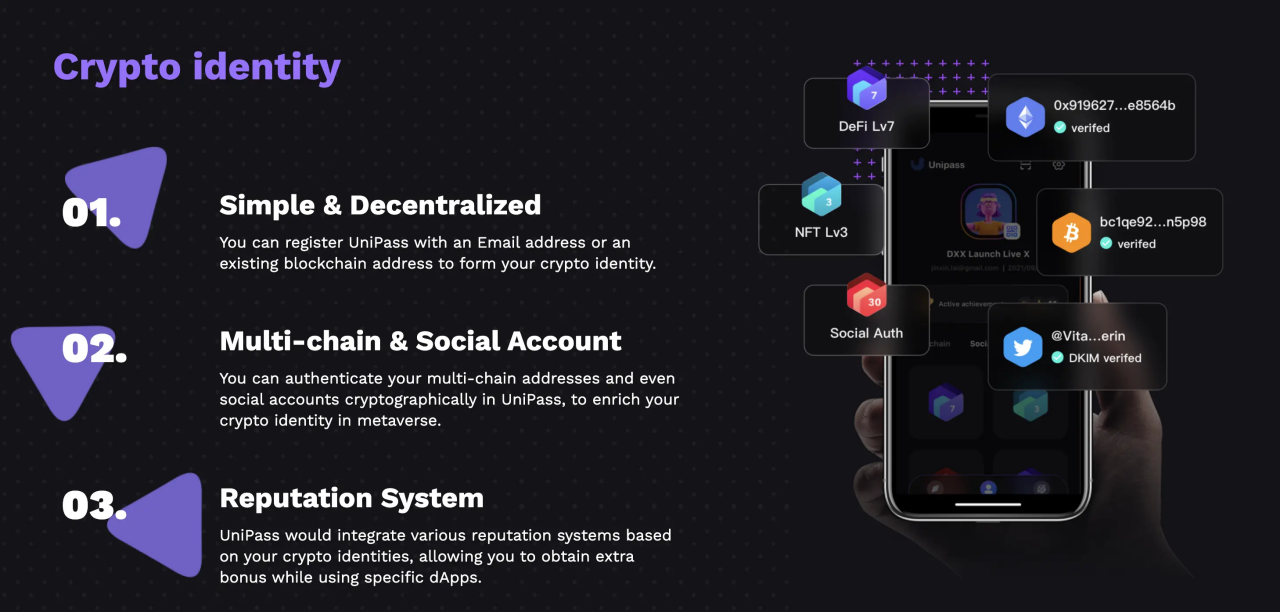
Source: Unipass
Simple In terms of Unipass, it can be regarded as a decentralized version of Microsoft Authenticator, which is the product that best meets the definition of DID. It firmly starts with personal identification and login functions to build its own products.
You can look at Unipass from these two perspectives. The first is do individuals need an independent DID tool that is different from the address on the chain? There is actually a problem with the address on the chain as an identity identifier. Different chains may be different. The most typical is that Bitcoin and Ethereum need two. Many users have had enough of account and password record books. In the future, entering an interoperable and integrated Web3 ecosystem will inevitably require an identity center, which has the central function of mastering all digital elements of users. From this perspective, it makes sense to use a separate DID as an entry.
Second, can the new DID form replace the wallet as the default login tool? If the first point is optimistic, this one is pessimistic. The growth of wallets, especially Metamask, as the default login tool is the result of fierce market competition. The starting point is that everyone has the need to safely hold their own assets away from the trading platform. This is a real and widespread need.
But the lander does not have the function of depositing assets. There will be a difference between a user using a certain landing device alone and many Web 3.0 applications uniformly supporting a certain landing device. To solve this problem, the only way to solve this problem is that the landing devices must communicate with each other first, or support a unified , Standard interactive protocol. From the current point of view, we can only say that there is still a long way to go for marketing and user habit cultivation.
Moreover, the lander needs to strike a balance between light and heavy. If the product form is too simple, it can be replaced too much, and it is difficult to really form users. Quantity precipitation; but if it is too heavy, adding additions to the login, such as increasing support for assets and social content, will directly create a conflict of interest with these applications. This is an open topic, and we look forward to seeing more intelligent developers give effective practices and explorations.
Others: domain name, email
As the end of this section, briefly discuss the ENS Whether it is possible to develop a DID based on personal identity and email.
What is the main function of ENS?
Domain name of personal Web 3.0 website
Twitter suffix
This is of course a joke, the main reason is that building a personal website is actually a technical job, even when various SaaS tools such as cloud are very complete, still It is time-consuming and labor-intensive, and after deployment, continuous maintenance is required, including the ENS domain name itself. It is like buying a luxury car but finding that the maintenance fee is still unaffordable.
This feature determines that the domain name is only suitable for users such as institutions and geeks. The technical threshold prevents most people from using this product freely. If it is to be used as a DID, it is more suitable for institutional users to communicate with individuals interact.
What about the mailbox?
There is no problem with the login function of the mailbox, but it is only suitable as a peer-to-peer communication tool. Sending emails and sending Twitter itself are different usage scenarios. Mass emails are recycled Information is not suitable for everyday communication, but more suitable for formal actions and marketing tools.
After talking about so many possible entry points, let's understand why a DID is necessarily required -- or is it necessarily correct to assume that a DID is an entry point? At present, we use social software such as WeChat and e-commerce platforms such as Taobao. These software and the ecology formed by them have brought us into the real Web2.0 era by virtue of their convenience.
But these are the present, not the future. Web 3.0 is the application scenario of DID. To clarify the importance of DID, we need to consider the entrance function of DID from a higher dimension, as well as the ecological status and future trends. Stay tuned for "Volume: A History of DID".
Part 2: History of DID
The following concepts and designations are essentially for convenience The vocabulary weaving of the narrative, even if you have a different opinion, it doesn't matter, because it doesn't affect our understanding at all. The focus of this part of the discussion is "a look back at what constitutes our use of the Internet", in order to explore the context of DID's future development.
The Beginning of It All: The First Web
Web 1.0: The World Wide Web WWW and the browser. First of all, we have to admit a basic fact. It is the concept of Web 2.0 that first existed, which gave the World Wide Web this "title" like respecting its ancestors.
After network communication technology went out of military laboratories and scientific research institutes, we have the concept of the so-called Internet, and at this time, the entrance is the browser and The World Wide Web basically constitutes the entire concept of the network, while RSS and BBS are the main scenarios for subsequent data precipitation. The IDs at this time are mainly email addresses, personal domain names, and forum IDs, and the components are very clear.
The Historical Origins of Internet Privacy: The Growth of Personal Data
Web 2.0 and UGC, Blogging , iPhone, 5G, XR
Blog to Tik Tok, starting from the right of personal expression, going through a continuous decentralization stage, from the initial elite personality to the universal media , from middle-aged social elites to teenagers accessing the Internet, the Internet has become a priori existence in the Z era, and its status is unquestionable. Like water, electricity and coal, it has become an infrastructure that is as ubiquitous as air.
Facebook reselling personal data broke out in the 2016 US election, and Cambridge Analytica used these data to "sway" the US election to some extent. There are two prerequisites for this to be possible. The first is that people will leave a large number of digital traces about their privacy on the Internet; the second is that people will leave their personal data on certain applications, such as Facebook, on Twitter.
It needs to be clear that the concept of personal data first appeared, and the debate about privacy came second. At this time, IDs are gradually migrating to social tools. This does not mean the demise of mailboxes, but the change of people’s usage habits. More appropriately, Facebook has also become an optional login tool other than mailboxes. The implicit premise here is Everyone uses Facebook by default.
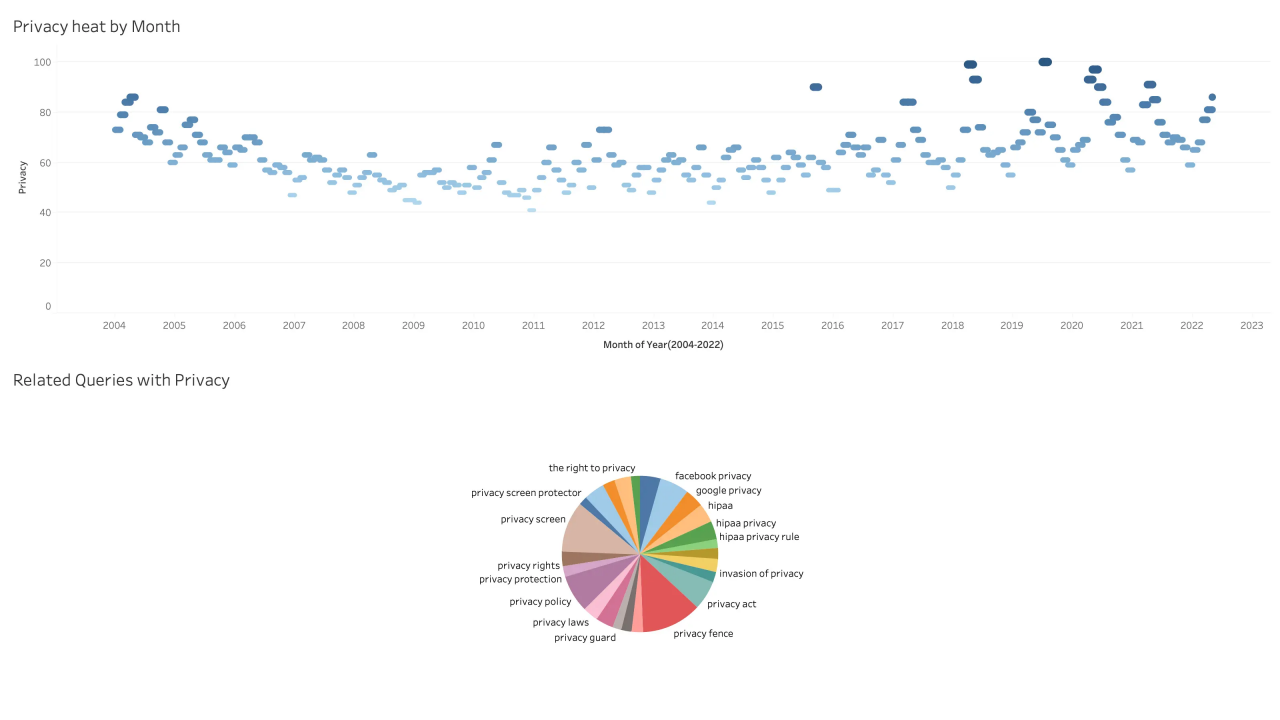
But in the final analysis, the disadvantages of this situation are becoming more and more obvious today, our Personal data is deposited in applications such as Google and Facebook. It seems that we are discussing our privacy, but we are actually talking about our relationship with these applications.
DID under Web 3: a portal
Web 3.0 is the intersection of concepts, the self is still in search. The concept was proposed from 2004 , experienced the transformation of the traditional Internet, and gradually got in touch with the blockchain. This connection is not in one step, at least after the (public chain) Bitcoin, Ethereum and EOS era, trying to replace the WWW World Wide Web with a public chain. At present, this is actually a failure. The so-called parallel chain in the Polkadot era is actually admitting that it is not feasible to unify all chains.
When When we talk about the blockchain, the direction of each era is different. From the initial Bitcoin to the later DeFi, NFT, and now to Web 3.0, it does not mean that the latter replaces the former, and there is more between them. It is a relationship of gradual superposition and development.
Just as ordinary people do not need to understand the TCP/IP protocol, compiling principles, and computer composition principles to use equipment to access the Internet, in In the technology incubation stage of building Web 3.0, we don’t know which ones will become the final components, and which ones will be discarded and become the floating dust that the wheels of history run over. But human beings will eventually advance towards the digital age in the process of using Web 3.0 , growth, then we will now firmly believe in the importance of DID - there will always be an entrance, and it will not be an entrance.
In Satoshi Nakamoto In my idea, it is better for people to use one address per transaction, which can maximize privacy. But in fact, except for hackers and people who forget mnemonics, no one will do this every day, which is really anti-human Logic—we are used to using a single address for a long time, rather than using a single address every time; more importantly, the development of the blockchain has surpassed the "blockchain" of Satoshi Nakamoto.
But in the coordination of interactivity and decentralization, the number must be limited. This is similar to social tools, real infrastructure will form a strong user stickiness, especially the aforementioned importance of the value and meaning carried by an identity in the decentralized world.
Web 3.0 will include many ways to play in practice, absorb the concepts of blockchain, DeFi, and NFT, and jointly form the next generation of the Internet, and DID will become the most direct interactive entry. Then, according to the current ecological status, it is necessary to sort out the path that DID may become the most direct interactive entry:
L1: Identifiers and Standards (Identifiers and Standards)
Standards, identities, and namespaces (namespces) work together to build a common trust layer that ensures standardization, portability, and interoperability.
This part also stipulates the method of registering and using management DID, and provides developers and users with rules and environmental standards for accessing the network identity system.
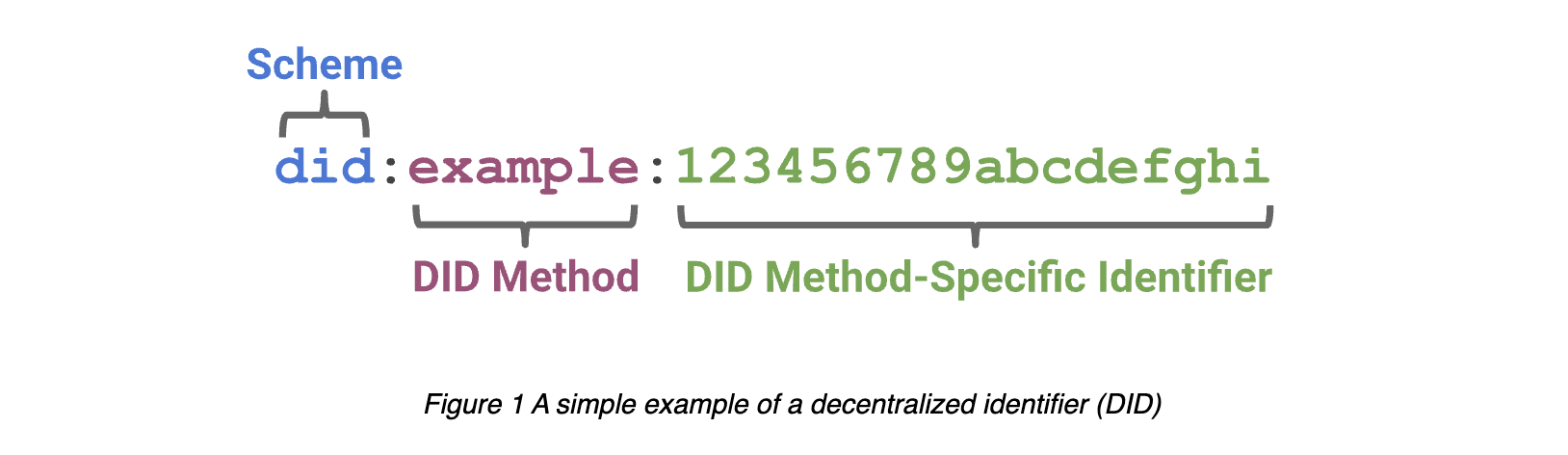
Image source: W3C
here The most typical is the DID standard drafted by W3C, which can be traced back to 2019. The draft document stipulates that "each DID document can represent encryption material, authentication method or service endpoint (service endpoint). These documents provide a set of A system that enables a DID controller (DID controller) to prove control over a DID. And, a service endpoint enables trusted interaction with a DID."
Overall , this is a milestone event in the history of DID. For the first time, we admit that DID is feasible and try to outline its general direction and framework. The specific details thereof will not be repeated.
L2: Infrastructure
After realizing the importance of DID, We started to explore how DID is designed, but one thing is certain, DID will become a basic construction, closer to the underlying concept of API or SDK.
This is because, as an infrastructure and proxy framework, DID can allow two-way or even multilateral interaction between applications, and even DID can interact with DID , interconnection, data and information are opened up from the protocol level, and applications can also directly interact with the verifiable data registry.
DID under this concept must at least include communication, storage, and key management. If it goes further, it can be "de-encrypted" while retaining Login function and authentication function.
Here you can refer to the idea of "traditional" Internet to see what such an infrastructure will look like with a high probability.
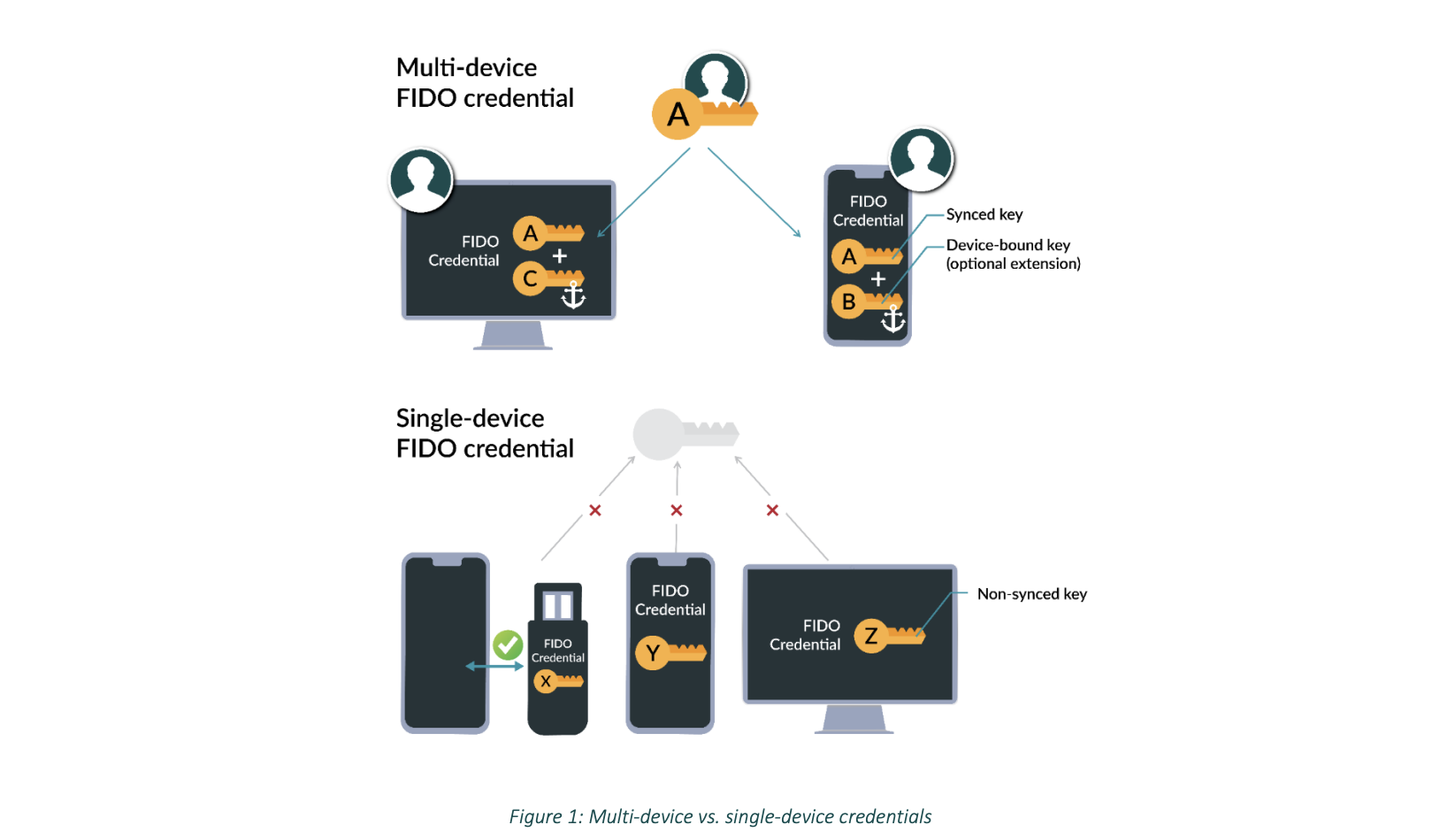
Source: FIDO
For example FIDO, Apple officially began to support this concept at WWDC 2022, we briefly introduce its usage steps:
Using your phone as a roaming authenticator as a roaming authenticator
Multi-device FIDO credentialMulti-device FIDO credential
In theory In other words, FIDO can also be used in the future Web 3.0 network. This kind of encryption technology with one-time authentication, password abandonment, and multi-device transfer is very suitable as the future network infrastructure.
L3: Credentials
FIDO is the product thinking of the Web 2 era after all , does not necessarily fully adapt to the needs of the Web 3.0 era. We need to manage and update identity credentials, and they need to be interchangeable - this layer aims to solve how DID determines the "proof of control" and "proof of authentication" ( proof of authentication), and how to securely pass data between identity owners.
In fact, some explorers are already trying this concept, such as DAS (Decentralized Account Systems), which does not depend on a specific public chain and supports multiple public chains , A decentralized account system with multi-protocol interaction.
The idea of DAS is to map personal addresses to the unique account system ending in .bit. These accounts themselves are decentralized and can be directly used as account addresses Collection and login, of course, can also be used as the access entrance of Dapp, which is essentially a secondary innovation based on the concept of DID, and it is envisaged that this is a lower-level protocol-level identity system than applications such as wallets.
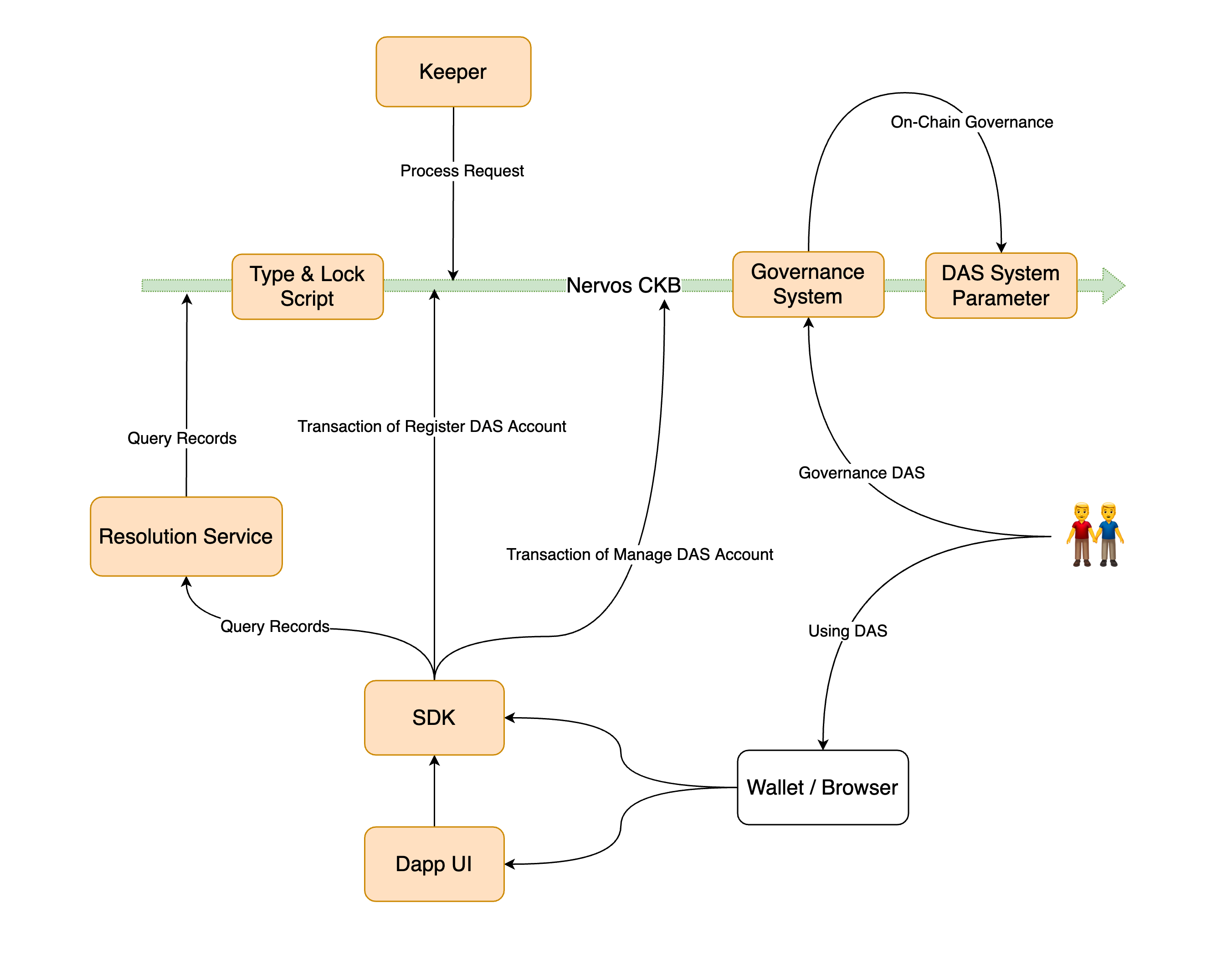
Image source: DAS
However There will be a question, is this a DID, or what is the difference between this and a wallet? You should know that although the wallet address is difficult to remember, the Dapp login and interaction in the wallet are very smooth. Therefore, this can be used as a reference for ideas, but it is difficult to become mainstream.
L4: Wallet and Dapp
This layer is the most familiar to everyone. In addition to the aforementioned MetaMask, there are some projects, such as Goldfinch (unsecured loans), that use proprietary and unique entity checks, but this will not be used until the DID technology matures, in other words, it is waiting for the DID system An idea that is mature enough and has a large enough user base to be effective. In contrast, other applications are already using existing DID technology, such as TrueFi (unsecured loans using on-chain credits), Gitcoin (fundraising for public goods), and Ethsign (decentralized electronic agreement).
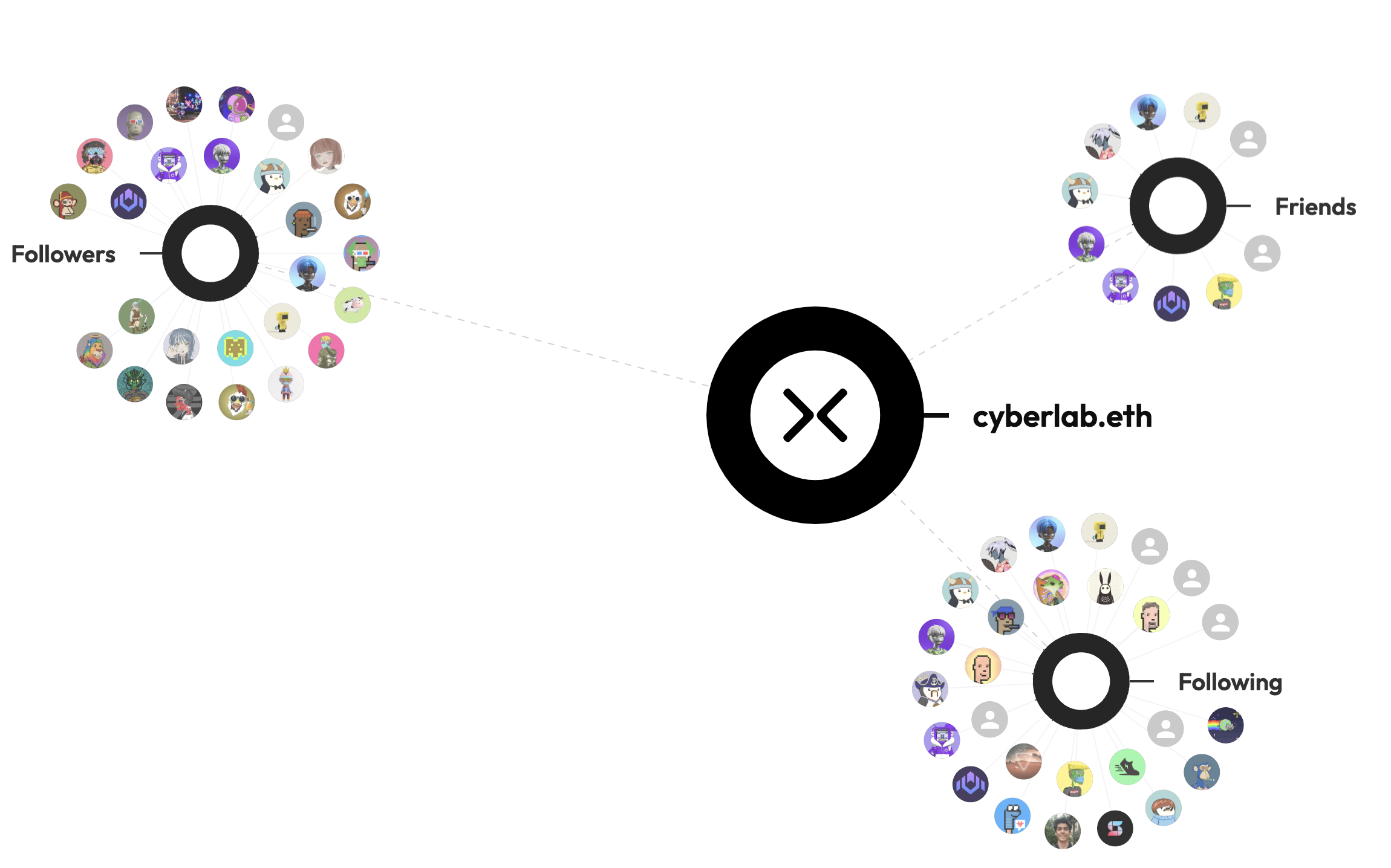
Source: CyberConnect
Updated The most feasible idea is CyberConnect, which is well-known. This is the development idea of WalletConnect similar to wallets. "What if I can't beat MetaMask, but there are other wallets at the same time?" Very simple, gather them at the protocol level. Together, Dapp developers only need to reserve development time for MetaMask and WalletConnect.
CyberConnect is exactly this way of thinking, "I don't know what social products people will use in the future Web 3.0 era, and what they will do on the Internet, but In short, they need such a protocol."
This will become a DID + aggregator, forming the social graph information of a certain address, and these information are The data from the chain finally becomes a more advanced aggregator, while avoiding competition with specific Dapps. For example, we can use addresses and ENS to retrieve information about a person, and at the same time, we can check our own situation.
Is that all?
Of course not, when we gradually deepen and fall into the design logic of specific products, we still need a more macro perspective to look at the future of DID.
LX: DID for DeSoc
Beyond the scope of a single layer, for multiple layers All applications have an impact, which may be a direction worth looking forward to in the future. A current reference is Europe's GDPR, the General Data Protection Regulation, which affects all areas of the ecosystem.
In the field of Web 3.0, the more intuitive may be "soul binding", and DID will be its direct instance. Regarding this part, ThePrimedia will elaborate in the next article, so stay tuned for "Part Two: Another Attempt to Find Yourself".
Part 2: Another attempt to find yourself The medium is the message, and the soul is the identity.
Decentralization brings the return of personal value, and DID is a supporting measure of DeSoc from a broader perspective. In the context of the future world that Vitalik talks about is a decentralized society (DeSoc), a richer and more diverse ecosystem can be achieved through DID, and key decomposable property rights and enhanced governance can be empowered mechanism.
Of course, there is still a long journey on the way to the Web 3.0 world based on the governance and development of a mixed reality society that mirrors the physical world. In this mixed reality society that is mapped to the physical world, DID will become a unique personal identifier, which will not only be used in the Web 3.0 network world, but will have a wider use space.
If everything is to be decentralized, then identity should be decentralized. If a decentralized society continues to use Twitter and Facebook , obviously not a long-term solution. When Web 3.0 becomes a new infrastructure, it is also possible to feed back the real world. For example, Debank has achieved certain results by displaying on-chain activities around the on-chain address as a personal display page.
DeGenScore goes further - focusing on scoring personal on-chain activities, and credit records have shown their power in the real world, from official credit records From Alipay Zhima Credit, the informatization of credit records has shown a more effective side than traditional risk control.
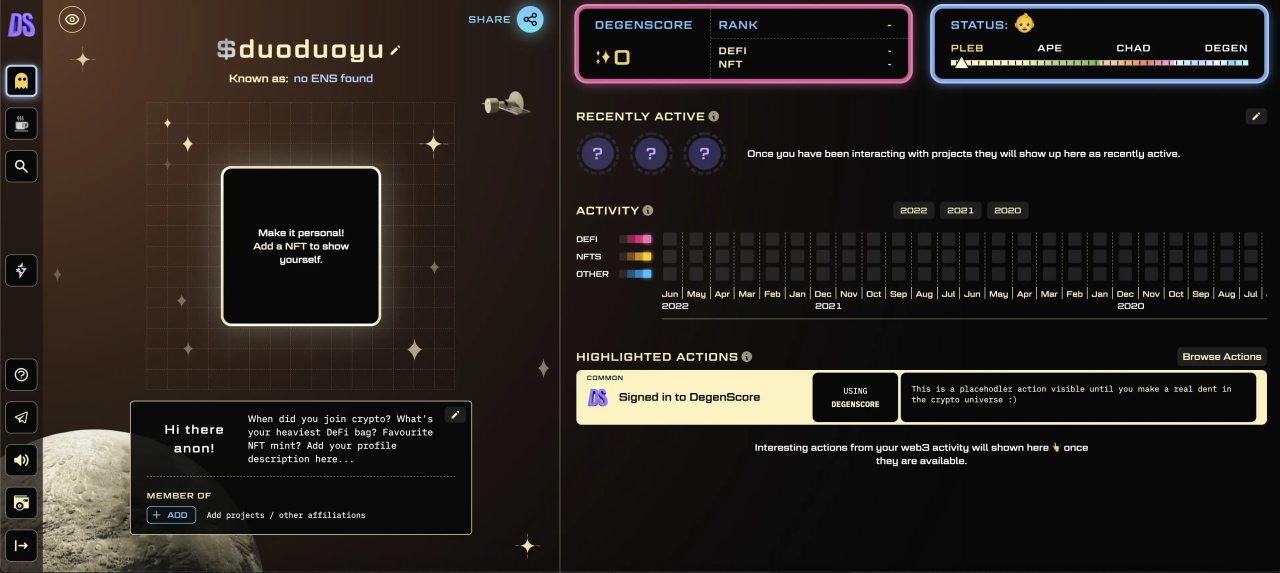
To a certain extent, this kind of discussion departs from the idea of DID as the entrance of Web 3.0, and becomes Nodes of lower interaction, interaction between Web 3.0 and Web 2.0, and interaction between people can be regarded as a kind of thinking divergence, and DID is regarded as a kind of "soul" in the process of human society's advancement to digital DeSoc Physical representations, which are broader than the concept of entry.
Towards a further digital society
ThePrimedia tries to revisit the concept of metaverse here— —Gathering the power of technology and industry to construct the metaverse space, reconstructing the digital society with Web3 decentralization, Token incentive mechanism and DAO governance structure. This is an upgraded version of Zuckerberg’s metaverse—if the metaverse space is just a digital space for games, entertainment, and office work, we need to use high-end chip technology, integrated circuit systems that may break through the Moore effect, and more efficient Network communication technology (5G/6G) and VR/AR/MR/XR hardware and development of advanced virtual engine and interactive technology, wearable biosensor hardware and adaptation of precise motion capture software and hardware to realize virtual space in the metaverse world Somatosensory response, movement rules and highly immersive experience, is it worth it?
Therefore, to reconstruct the digital society with Web3 decentralization, Token incentive mechanism and DAO governance structure, to provide a better social system and governance structure for human digital evolution It is worthy of mankind to gather the power of technology and industry to build a digital space and look forward to the metaverse world. Therefore, this metaverse scenario will be even grander than V God’s decentralized society (DeSoc).
Only when DID is implemented as the entry function of Web 3.0, the so-called link can be realized in a larger time scale. Decentralized society (DeSoc ) will be able to complete the reconstruction of social order and rules in the Metaverse world.
The role change of DID: from entrance to link
Privacy is actually the promotion of early DID projects As long as there is enough data on an address on the chain, it is not difficult to find out who you are. Just like the smart money tracking function of various products, it has become a basic configuration and can even be monetized as a subscription function.
So the core of DID is the interactive ability. L2 and bridges can be used to link public chains. DeFi assets can be stored through wallets. Through trading platforms, DEX to realize and trade. However, DID and the Web 3.0 network behind it are essentially the next generation of Internet covering consumer applications. Excessive gas fees are an unsustainable business model. Cross-chain and cross-Dapp interactions must become basic functions, otherwise they will become information islands , which needs to solve some problems:
It is necessary to avoid the problem of too high Gas Fee, if it cannot be free, it must be low enough, so that ordinary users can migrate and the motivation to try DID;
The product story needs a new narrative system, or privacy, or token, or trendy, first of all to achieve consensus in the encryption world, It is possible to promote it externally.
DID is like a door, there can be enough to ensure decentralization and prevent some gatekeepers from charging tolls, but after pushing the door to enter There is content to watch, otherwise users will never be retained, and DID will also become a water without a source and a tree without roots. Our discussion of DID itself is based on our belief that Web 3.0 is the trend of the future.
The logic of our value discovery and psychoanalysis for DID is that the great value opportunity is in the promised land of DID—from the entrance to the link node; but it At the same time, it covers the spiritual pursuit of human evolution to the digital world, which must be a higher-level existence than the rules and orders of production, life, wealth, freedom, and social governance in our current physical world.
In order to achieve all this, whether it is value opportunity or soul pursuit, we need to realize that DID itself cannot exist independently, and must be mutually promoted with Web 3.0, mutual growth.
Repeating our discussion at the beginning of As DID is adopted by more users and applications, individual users will not be limited to a single application ecosystem; users do not need to be troubled by multiple accounts and password records; the processing authority of all digital elements is in the hands of users On the basis of the empowerment of DID, more grand scenarios such as DeFi, NFT, GameFi and DAO, as well as decentralized society (DeSoc) and Metaverse will bloom more exciting narratives.
Original link
Welcome to join the official BlockBeats community:
Telegram Subscription Group: https://t.me/theblockbeats
Telegram Discussion Group: https://t.me/BlockBeats_App
Official Twitter Account: https://twitter.com/BlockBeatsAsia