Dialogue with the core developers of Compound: Sort out the latest version of Compound
Original title: " Special issue - A deep dive into Compound III, an interview with Jared Flatow of Compound Labs "
Original author: Eitan K.
Original compilation: Kxp, BlockBeats
Welcome to today's The State of DeFi Lending's article, this series of newsletters mainly focuses on the highlights of the DeFi loan market.
This article mainly consists of two parts:
· Compound III Overview
Interview with Jared Flatow, VP of Engineering at Compound Labs
Data source: DeFi Llama
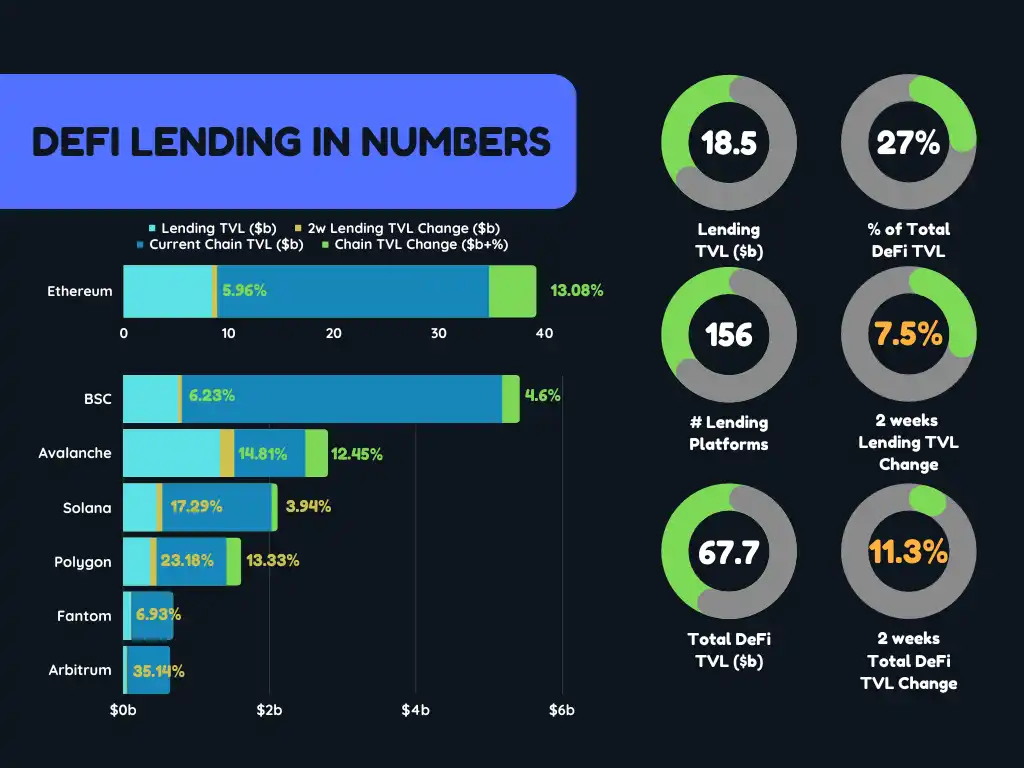
Even though Arbitrum's borrowing lockups recovered 35% in the past 2 weeks (after falling 76% in the 2 weeks before that), Ethereum's total on-chain lockups are up 4.5 billion USD, but the total loan lock-up still only accounts for 27% of the total DeFi lock-up.
Compound III Overview

Demo version user interface of single basic asset market on Compound III
On June 29, Compound Labs made its code repository public to support Compound's multi-chain strategy. After Compound successfully deployed many forks on other chains, including BSC, Avalanche, Tron, Polygon, etc., it began to explore chains for users with lower prices than Ethereum mainnet.
However, this announcement did not mention Compound Labs in its multi-chain strategy The Gateway project. We later spoke with the Compound Labs team and learned that due to the rapid growth of the DeFi multi-chain landscape in the past year, the work on Gateway has been temporarily put on hold.
In Compound III, there are several changes worthy of our attention:
Single underlying asset - In Compound III, only one asset per market can Participate in lending, so it is also called a single underlying asset market. In this market model, other assets can be used as collateral to provide a loan line for the account (according to the accumulated loan collateral coefficient of the assets provided). At the same time, in Compound III, only this single asset can generate income, and it is the only asset that users need to pay interest (mortgage assets will no longer have APR).
Single underlying asset divides Compound users into two categories - Lenders and Borrowers . Lenders can make money by providing a single underlying asset, while borrowers need to provide other collateral before they can borrow the underlying asset (and pay interest on it).
Double Collateral Factor - Comet proposes two collateral Collateral coefficient, one is the borrowing collateral coefficient, and the other is the liquidation collateral coefficient, where LCF>BCF.
Adam Bavosa, Head of Developer Relations at Compound Labs, explained further in the chat :
In Compound III, borrowers need to focus on two collateral coefficients. The Borrowing Collateral Factor represents the percentage of collateral value (in USD) that a user can borrow. Users can borrow the entire amount at once and will not be liquidated in the next block, and it will be the same in Compound V2. The liquidation collateral coefficient is always higher than the borrowing collateral coefficient, and only when the user's loan balance accumulates high enough to reach the liquidation collateral coefficient, the account can be liquidated. Therefore, you can think of the difference between these collateral coefficients as the "no new borrowing" period, during which the borrowing is still repayable and cannot be liquidated.
Recently, Yaron Velner, the founder of B.Protocol and the main contributor to Risk DAO, is here The correct setup is evaluated and described in this Medium article The complexity of CF and other risk factors associated with multiple debt markets
The study concluded that controls for Borrowing assets for specific collateral, as in Compound III, can help lenders better control risk while also improving capital efficiency for borrowers.
Supply Cap - Unlike Compound V2, in In Compound III, the governor can set the maximum supply (supplyCap) of each type of asset in each market. This practice mitigates the riskiness of specific collateral assets in the market, allowing for the option to list riskier assets as collateral when deploying in L2 and alt-L1.
Liquidation - Compound III introduces a new liquidation mechanism , a mechanism that splits the liquidation process into two steps: 1) Repays liquidated position liabilities from the protocol’s reserve fund while retaining seized collateral in the reserve fund. 2) Once the threshold is reached for that particular asset in the reserve, liquidation will start. At that time, the reserve assets will be sold at a discount.
This method of distinguishing the two steps reduces the related liquidation to a certain extent Risks: 1) It creates a buffer between current DEX liquidity and collateral that does not need to be sold immediately; 2) It transfers potential losses from bad debts from lenders to protocol reserves (and by borrowers to be filled by the reserve fund fee).
When browsing the Compound III file, I found that the call of the liquidation function will pass through the "clearing point" To achieve this, these liquidation points will be added to the Gas fee as Token rewards and will be distributed in a later stage.
Jared Flatow, vice president of engineering at Compound Labs, said that the cross-chain deployment of a single underlying asset market will also Bring more possibilities, waiting for the community to continue to explore in the future development.
The following table briefly summarizes the main changes of Compound III compared to V2:
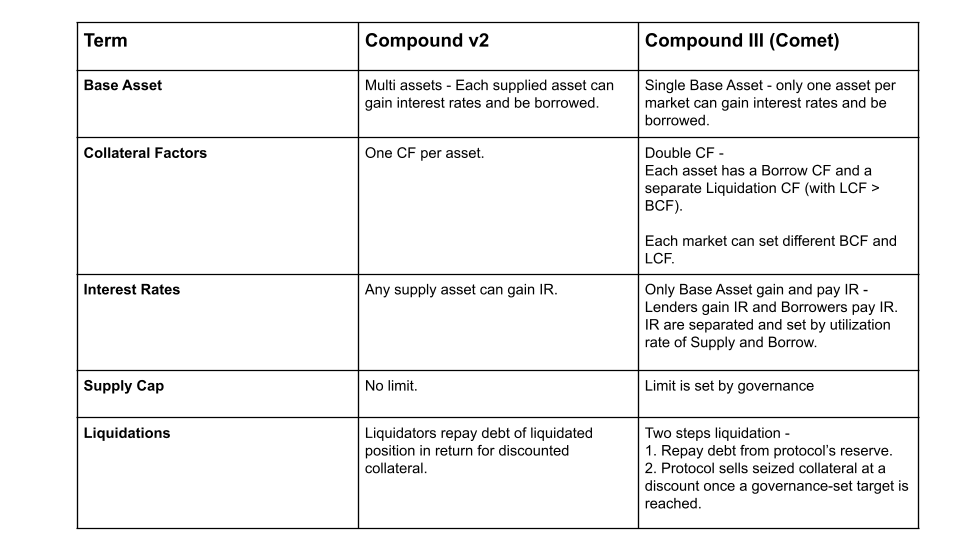
A brief comparison between Compound III and Compound V2
Interview
In this exclusive interview about Compound III, we are pleased to invite Jared Flatow, Vice President of Engineering at Compound Labs, will bring us more Compound III updates today.
Q1: As part of Compound’s multi-chain strategy, Comet’s multi-chain main contributing factors are What? Given that most of Compound's multi-chain forks are more affected in bear markets, why bother with a multi-chain strategy?
Comet protocol contract is a basic building block that can be deployed on multiple chains to support common use cases and composability. This contract is versatile and simple in structure, so it is also easy to manage. Its capped supply, dual collateral coefficient, and single underlying asset allow governors to safely deploy and control independent markets. We have also built new tools in the repository to help the community safely and efficiently manage various situations on Comet’s different chains. We don't want the bear market to last forever, nor do we want the cost of the Ethereum mainnet to remain high forever. So we believe that the protocol should really meet the needs of users and provide them with faster and more affordable services (although there will be some trade-offs in doing so).
Another key part of Comet's multi-practice strategy comes from having a single "foundation" in each market assets". Since the basic Token positions can be transferred through cross-chain bridges, as long as the same basic asset (such as USDC) has a high-liquidity interest rate market on multiple chains, it is possible to merge multiple markets into a unified liquidity pool.
Q2: The Commercial Open Source License (BSL) gives the Compound community the option to franchise the brand, which Meaning that the new deployment is either independent and pays some fees, or is used to contribute to the Compound community, but it is also possible to just map Compound's voting rights to the new chain and give the Compound community full ownership of the new deployment. of control. Which of these situations is more applicable to Comet? Which option do you think would be more popular?
For additional purpose grants, they are more specific and require explicit governance approval to Deployments and are not directly managed by the DAO. While we'd love to focus on these grants to enable more flexible use cases in the future, we'd rather the community take responsibility for deployments of all kinds. Additionally, we want to figure out how these deployments are compatible with licensing agreements and formally adopted by governance. Right now, we're trying to showcase our vision today on some of the big networks.
Q3: A major change in Comet is that it only supports a single loanable asset. Can you explain to readers how this design strengthens market risk management? Why have you chosen to continue supporting the multi-collateral market? Do you think its main use is single collateral (other than borrowable assets) or single borrowing?
In the case of only one kind of borrowable asset, the collateral coefficient will be directly related to the underlying asset hook up. Compared with V2, since the price risk is only for specific assets, the coefficient of a specific collateral may be higher, while for stablecoins, its price risk will be completely determined by the collateral assets. In our opinion, the existence of multiple collateral assets can not only improve the flexibility of users, but also increase its composability to other contracts and agreements.
Not only that, in the single underlying asset market, users can decide what their collateral can be The proportion of each specified asset is borrowed, and the manager can also set a cap on the amount of each type of collateral that can be used to borrow each underlying asset. In this way, the risks of the underlying asset suppliers are also more controllable.
Q4: Another major challenge of multi-chain and L2 deployment is the relatively low liquidity of DEX clearing Low, and Comet introduced an upgraded version of the liquidation mechanism, can you explain to readers how the new mechanism works and its advantages?
It is true that when listing assets on any chain, we must consider the flow of DEX sex. In the new liquidation mechanism, this is still crucial. The mechanism splits liquidation into two separate steps: debt absorption and purchase of collateralized assets. Whenever an account's assets shrink, anyone applies to "absorb" it and transfer the position to the protocol. Afterwards, the protocol repays the debt in proportion to the seized collateral and provides additional reserves to the account. That way, liquidators can buy collateral from the protocol at a discount. Since the protocol always transfers debt onto its own balance sheet, its reserves act as a security for the protocol.
Q5: What new integration types and What about creative components?
In the new account management system, users can entrust their positions to another contract (or address) to manage. This mechanism is very flexible and allows various protocols to be built on top of the core protocol. Taking advantage of this, we have established our own "bulker" contract function, so that users can complete asset provision and borrowing in one transaction, and can package the submitted ETH into WETH. At the same time, we also no longer depend on the "msg.sender" function, which opens up more possibilities for integration: for example, users will have the opportunity to manage their positions off-chain through the L2 protocol. Alternatively, this system can also be combined with new on-chain/off-chain primitives provided or created by the service.
Q6: At present, people are interested in Compound Labs on Gateway (also known as Compound Cash) There is still some confusion about the development work and the upcoming Compound V3. Can you talk about the main differences between the two products, and what groundwork still needs to be done before Gateway goes live?
Original link
Welcome to join the official BlockBeats community:
Telegram Subscription Group: https://t.me/theblockbeats
Telegram Discussion Group: https://t.me/BlockBeats_App
Official Twitter Account: https://twitter.com/BlockBeatsAsia

 Related Articles