How much can your NFT lend? Two major NFT pricing methodologies
"NFT Alchemy: Pricing 101"
Source: IOSG wechat official account
By Sally, IOSG Ventures
Olivia, IOSG Ventures
tl; Dr:
How NFTS are priced is always an interesting topic. Because pricing is an inevitable intermediate operation, with both computable and uncomputable problems, it needs to be solved in any NFT Fi application scenario. To universally apply NFTS to DeFi and completely activate the liquidity of NFTS, we first need to make as realistic and widely accepted valuation judgment of the asset value of NFTS as possible.
However, NFT is difficult to be simply evaluated and calculated as traditional financial assets due to the following three aspects:
1.NFT is endogenous due to its non-homogeneitySubjectivity and illiquidity;
2. The NFTRarity is relatively ambiguous, and rarity is not completely positively correlated with price level;
3.NFT The price fluctuates wildly(There are frequent blow-ups and plunges due to team and policy issues).
If the pricing mechanism is not well solved, then NFT loan transactions and other activities will often be difficult to win the trust of the market due to high risk, which leads to two problems:
Lack of sufficient liquidity to support the depth of the trading pool;
It is difficult to construct diversified financial derivatives in the form of NFTS.
To solve this problem, more and more NFT pricing platforms and new approaches are emerging in the market. We can simply divide these pricing solutions into two categories:
Peer pricing category: and can be subdivided into & NBSP;(a) subject appraisal pricing and (b) flow pool game pricing;
Prediction machine pricing class: and can be subdivided into & NBSP;(a)TWAP pricing and (b) off-chain calculation pricing.
Peer Peer pricing
A.C rowds subject evaluation pricing
Subject appraisal pricing is a form of pricing with strong subjectivity at present. The liquidity lending agreement represented by Taker V1 can whitelist and price NFTS in the form of subject assessment and voting decisions by combining the interests of DAO and lenders, thereby reducing the risk exposure faced by lenders to a certain extent. At the same time, this approach has no restrictions on the quality of NFT assets and can be widely used for price discovery in long-tail and emerging NFT collections. However, this way is heavily dependent on its judgment ability, and it cannot provide real-time updated NFT prices, thus its overall efficiency is low.
Taker V1
Taker is a liquidity agreement for NFT assets that provides liquidity for NFT lending in the form of DAOs, supporting various forms of assets including NFTS, securities, synthetic assets, etc. After holding TKR Token, you can obtain DAO membership and participate in the decision-making of lending interest rate and fair pricing. At the same time, holding TKR can also gain additional income by pledging.
Taker DAO There Are Several Internal Tate DAO, each sub-DAO can control its own whitelist and the floor price of any NFTS on the whitelist to prevent borrower default. In addition, Sub-DAO members voted collectively to invest their own Treasury funds in certain types of NFT assets. For example, some sub-DAOs can only focus on Metaverse land assets, and some sub-DAOs can only focus on PFP art assets.
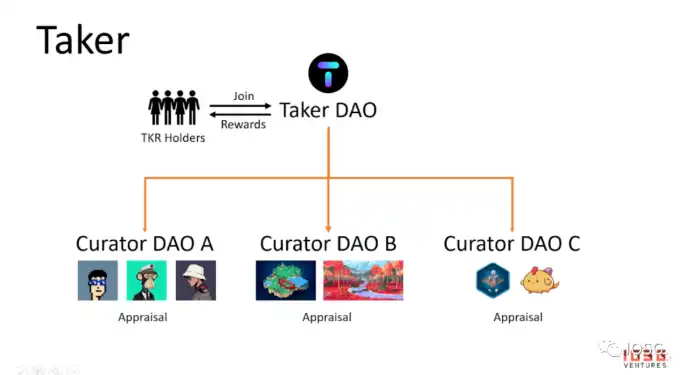
Under the Taker group pricing model, the complete lending process is as follows:
1.Taker community members (lenders) deposit funds into the DAO.
2.DAO mints DAO Tokens (TKR) to represent members' shares.
3. Karen Smith has subjectively priced NFT collections in the DAO she founded.
4. The borrower borrows money on the basis of the assessed price of the NFT.
5. The borrower repayments the loan with interest.
6.DAO members receive rewards (based on interest rate).
7. With the development and expansion of DAO, the benefits gained by DAO members will increase.
B. Spot flow pool game
The current pool game pricing mechanism is similar to DEFI,Mainly through the optimistic pledge voucher mechanism, that is, the liquidity providers pledge according to their expectations of the price, so thatThe valuation of the NFT is bound to the asset price in the current pool. This is also a pricing method that largely relies on the subjective decisions of the LP. The advantage is that it can realize the real-time valuation of the NFT, linking the transaction value with the true value, and releasing greater liquidity. However, its pricing mechanism is complex, and it is not suitable for the rapid pricing of a large number of low-value long-tail NFTS.
Abacus
Abacus is a simple and clear NFT valuation system that mainly uses optimistic PoS to create a liquidity pool-based NFT valuation method. Abacus' valuation methods are divided into two types, one is the group pricing we mentioned above, and the other is the liquidity pricing we discuss here. The value in the flow pool translated into ETH is equivalent to the value of the open-pool NFT. Under this mechanism,It is equivalent to developing a set of ETH/NFT trading pairs, which can reflect NFT prices in real time just like Opensea.
Based on its current pool pricing method, the complete lending process is as follows:
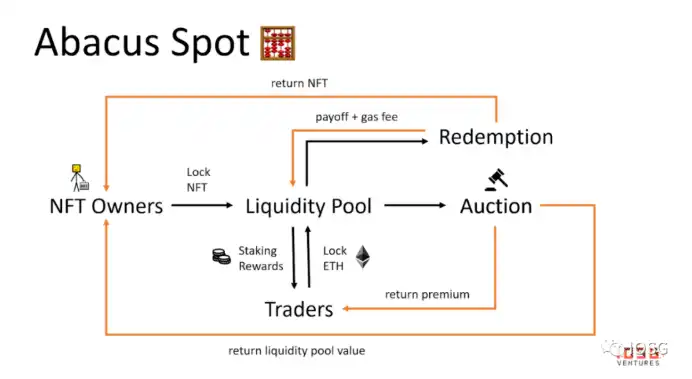
1. Open the pool:
A) The NFT is not managed and the owner is required to sign the pool as proof of life;
b) 所有者将收到一个 NFT(ERC721) Token 来代表他们的财产并赚取交易费。
2. Traders lock ETH in the pool
A) determine the number of ETH to lock in: if the pool is 2eth, but the trader thinks the NFTS are worth 2.5 ETH, the trader can put 0.5 ETH into the pool, which is now worth 2.5 ETH.
B) Decide how long to lock in: If the trader believes that the price will only stay at the current price for a short time, he can lock in for only 2 weeks. On the contrary, if the trader is confident in the floor price, he can lock in for a longer period of time and thus get more reward.
3. The NFT owner enables release.
4. The NFT owner sends a loan request.
5. Ownership is transferred to the lending platform.
6. The lending platform checks the spot size and lockup time.
7. Lending platforms issue loans.
8. NFTS are auctioned immediately if a borrower fails to make a payment.
Oracle Oracle machine pricing
a.TWAP
The typical way for the prediction machine to evaluate NFT pricing is based on the simple traditional algorithmic trading strategy. It calculates the Weighted Average of NFT selling Price and floor Price, and then obtains a TWAP(Time Weighted Average Price). As a simple example, if we want to calculate the TWAP price for an interval of 1 hour, we can take the difference between the cumulative prices P1 and P2 at the start and end, and the difference between the start time T1 and the end time T2, and divide the two to find the TWAP for the 1 hour. The best known TWAP prognosticators include Chainlink and Uniswap's V2.
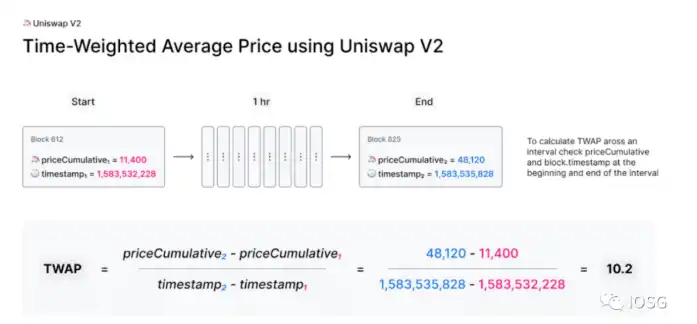
TWAP pricing is actually the easiest and most efficient way to implement itAs long as the price data of NFT trading platform is integrated, climbed and cleaned, the possibility of malicious manipulation can be reduced by selecting multiple prices within the set time series to take the mean value, and an acceptable and relatively accurate NFT price can be provided.
However, TWAP is not a perfect solution, because in extreme market conditions, when prices fluctuate wildly, TWAP prediction machines can be easily affected and become inaccurate. So TWAP is consideredIt is only applicable to the pricing of blue-chip NFTS with high market activity, good liquidity and relatively stable price.
BendDAO
BendDAO is a lending agreement to solve the liquidity problem of NFTS. Borrowers can borrow out ETH by pledging NFTS. Currently BendDAO can support the lending Of nine types Of blue chip NFTS including BAYC, Cryptopunks, Azuki, MAYC, CloneX, World Of Women, Coolcats, CyberKongz and Doodles.
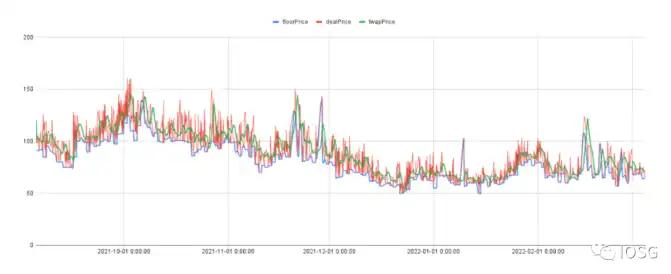
The NFT pricing adopted by BendDAO is typical of TWAP pricing.In collaboration with ChainLink, it uses multiple nodes to collect the floor price of the pledged NFTS on Opensea and LooksRare trading platforms, and uses the contract interface to feed the floor price to the chain and calculate the corresponding TWAP, thus filtering out the impact of price fluctuations on trading platforms. As can be seen from the following figure for cryptopunk this collection, the floor price provided by the prediction machine and the average transaction price, TWAP is consistent.
Similar to BendDAO, other protocols that use TWAP predictor for pricing include JPEG "D, DeFrag, DropsDAO, Pine, etc.
B. Off-chain computation chain computation
Off-chain computing based on AI and machine learning has also gradually become a new way to price NFT prediction machines. Because of the non-homogeneity of NFTS,Its main attribute classification, rare features, historical sales data and other value information can be used as model indicators through metadata decomposition. The protocol can then model and process based on this series of indicators and data sets to give a relatively reliable and accurate pricing or pricing range.
This type of valuation has high technical barriers and is relatively friendly to long-tail NFTS,It can be considered the solution with the greatest potential for large-scale application. However, the problem is that this method requires high computational power and metadata, because the algorithm is not public, we can not determine whether the training and fitting results are effective. In addition, once NFT attributes and characteristics change, the model is likely to fail, so it needs to be iterated continuously.
Banksea
The prediction machine protocol represented by Banksea mainly uses AI models to train NFT datasets, so as to generate accurate and efficient prediction prices for different NFT assets. The whole system consists of two modules: B layer and NFT layer.
At the acquisition level, Banksea collects on-chain NFT transactions and shelf records to calculate three types of prices in real time:Market floor price, AI floor price and 24-hour average price.AI floor price represents the lowest value of all AI valuations, and plays a role in risk control and stability maintenance when the market has drastic fluctuations or is attacked by prediction machines.
On the NFT layer, Banksea will extract the multidimensional features of NFT, train AI models based on time series, and generate them regularlyStandard valuation and valuation rangeTwo results. In addition, it will fit and regression the estimates calculated by the AI model to the real-time transaction prices to optimize the final results and narrow the error margin.
Banksea's off-chain pricing process based on AI model can be seen below:
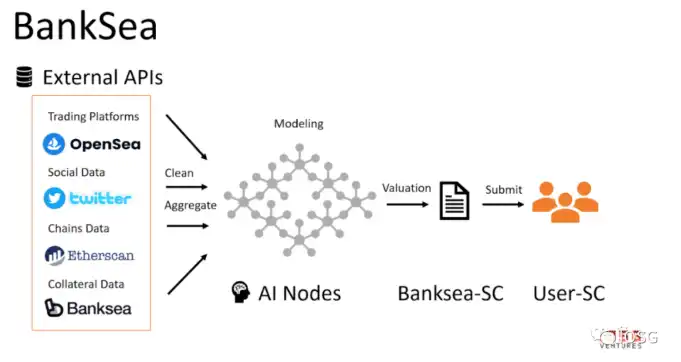
1. External API query: monitor and capture comprehensive NFT data from trading platforms, social platforms, public chains and mortgage platforms, etc.
2. Data aggregation: Clean the collected NFT data, extract feature attributes, and input them to the AI node;
3.AI modeling: AI node clusters train and deploy models based on the input dataset, calculate predicted prices and risk scores, and return the results to Banksea smart contracts;
4. Data submission: After the on-chain smart contract removes outliers, the data within a reasonable interval is extracted and submitted to a third-party program.
In addition to Banksea, Upshot and NFTBank, among others, offer predictive machine solutions that accurately price NFTS based on a more segmenced machine learning (ML) approach in AI. In addition, Defi Kingdom, Axie Infinity and other community tools integrate AI chain algorithm for pricing.
Sum up One More Thing
Finally, we can summarize the four specific solutions of the two NFT pricing paradigms in the market through the following dimensions:
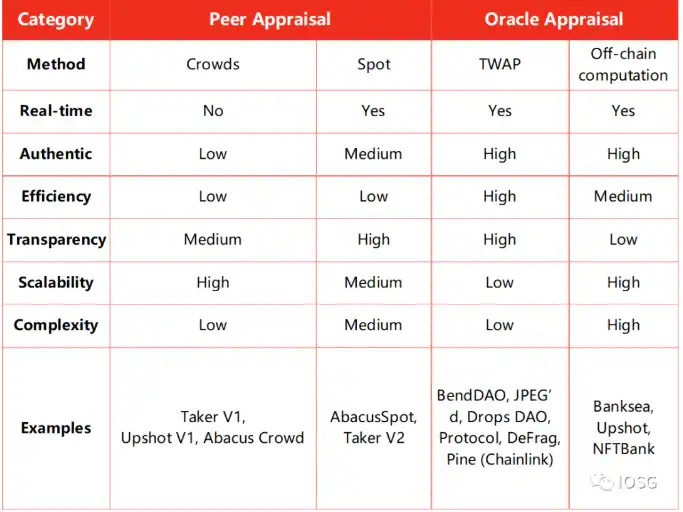
As can be seen, no matter which valuation method at present, there are certain advantages and disadvantages. We expect more emerging NFT pricing approaches to be explored and refined in the near future. In particular, we believe that with the development of technology and the participation of more quality project parties,More AI algorithm techniques such as deep neural network (DNN) can be put into the fitting evaluation function, so that the pricing decision tree can be more accurate and fast pruning.
NFT pricing, like Go, is a complex game that looks simple, a problem made up of a series of decisions. We can use peer intuition to judge the range, or we can use the predictor algorithm to predict the future.
And if you have to askWhat is a good pricing paradigm? I think the key is probably as Wu Qingyuan said,It is not how many times and how far, but how wide, how fast and how accurate.
Welcome to join the official BlockBeats community:
Telegram Subscription Group: https://t.me/theblockbeats
Telegram Discussion Group: https://t.me/BlockBeats_App
Official Twitter Account: https://twitter.com/BlockBeatsAsia

 Related Articles