With a total value of $600 billion, the origin and evolution of YC incubators
How YC incubator achieved a total Value of $600 billion!
Source: ReadTheGeneralist
Mario Gabriele
This article is from wechat official account:Old yuppie
Feasible insight
If you only have a few minutes, here's what investors, operators, and founders should know about Y Combinator.
Full-stack venture capital: YC is best known for offering three months of mentoring to startup founders. This mode of thinking is outdated. The organisation, founded by Paul Graham, now offers everything from start-up to pre-ipo.
Network Effects: YC is a venture capital firm with network effects. By dividing its portfolio into groups and connecting them through internal tools such as Bookface, it has created a structure that has become more powerful as it has grown in size.
Pricing power: As venture capital has become more competitive, startup valuations have risen. That's not the case at YC. The incubator tries to invest in start-ups at famously low valuations, a practice that has become fairly common relative to the market over the past decade.
Diversity issues: YC invests in more women-owned, black and Latino-owned businesses than the industry benchmark. And their numbers have increased in recent years. Many think YC could do more to increase the number of founders from marginalized groups.
Global presence: Of the latest batch of YC incubators, only 49 percent of the projects were from the U.S. With more pre-seed and seed funding available to entrepreneurs in the United States, YC has succeeded in attracting promising entrepreneurs from countries such as India, Mexico and Nigeria. But China is the only country that doesn't have a layout.
Y Combinator has more weapons than any other player in venture capital. No other investment firm has such obvious network effects, pricing power and brand equity (YC has all these qualities). Maybe that's because YC isn't really a venture capital firm, at least not a traditional one. Depending on how you interpret it, you can say it's any one of these five things:
A university that treats companies, not people, as its atomic unit
A startup that makes money through an unlimited revenue-sharing agreement
A for-profit university of scale (and not a scam)
One of the world's best social networks for entrepreneurs
An industrial venture capital firm
With a little thought, you can probably come up with a bunch of words to describe YC properly. That outsider assessment may be part of the reason why, nearly two decades after its founding, the tech world seems unsure how to position YC. Some see it as the Ivy League of entrepreneurship, the institution charged with catalyzing a wave of innovation that somehow makes the world a better place. To others, it is a top predator, imposing harsh conditions on naive founders.
Either way, it's an extremely powerful understanding of Y Combinator. It does not seem an exaggeration to say that it may have been one of the most influential entities in any industry over the past 20 years. YC has not only supported Airbnb, Stripe, Coinbase, DoorDash, Flexport, Rappi, Reddit, Vanta, and many others, it has also popularized the now-ubiquitous company-building philosophy." Do what people want ", "do things without scale", and "live by default" are all attributed to the spread of YC spirit. Over time, it has translated its success into a series of compound advantages that make it look very different from other investment firms in the market.
In today's post, we'll chart Y Combinator's history and evolution, and browse through the debates surrounding it. Read on to learn more:
Why: YC was founded in 2005 by Paul Graham, Robert Morris, Trevor Blackwell, and Jessica Livingston. Their new creations rely on the powerful, non-consensual beliefs of four people.
Product: YC has developed a library of tools to help startups use at every stage of their lives. This includes programs like Startup School and Work for a Startup, as well as tools like Bookface and Hacker News.
Investment: President Geoff Ralston hopes YC will help tens of thousands of start-ups each year. At its current rate of growth, how long will it take YC to reach those numbers? We analyzed the data to find out and better understand how the company's investments were evolving.
Terms: Are YC's terms fair to investors? A 7% stake of $125,000 represents a strong valuation squeeze on start-ups. But many supporters say YC makes up for that in other ways.
Risk: Accelerators like Entrepreneur First, Hyper, and Pioneer have found different ways to compete for early stage projects. Now giant funds such as Sequoia and A16Z are entering the fray.
Let's get started!
Origin: Fierce nerd
In 2005, a criminal, a painter, a marketer and a Canadian decided to start a venture capital firm. Over the next 17 years, it would transform from a small summer program into one of the industry's most powerful organizations, investing in 3,000 startups with a total value of more than $600 billion.
hackers
It has been seven years since Paul Graham, Trevor Blackwell and Robert Tappan Morris sold their company, Viaweb, to Yahoo in an all-stock deal valued at $49 million. It was a life-changing asset for the company's founders.
They formed an eclectic team. Robert Tappan Morris is arguably the most controversial executive. After being kicked out of Harvard for reconnecting with ARPANET, Morris moved to Cornell and began writing the Internet's first malware. Out of curiosity, the Morris worm spread to Harvard, Princeton, Stanford and NASA. Some statistical estimates suggest it affects up to 10% of the 60,000 computers connected to the Internet, although this estimate has been disputed.
There is a touch of irony in Morris's authorship. The worm exploits a vulnerability in the Sendmail program that runs on the Unix operating system Morris's father helped create. Morris sr. was working for the NSA at the time Morris Jr. was charged under the Computer Fraud and Abuse Act -- the first in history -- and was subsequently fined, sentenced to community service, and placed on probation for three years.
Morris's curiosity may have gotten him into trouble, but few doubted his genius. Among his admirers was his friend Paul Graham. Graham shared Morris's love of programming, but he had a strong interest in art, studying painting at the Rhode Island School of Design (RISD) and the Florence Academy of Fine Arts after earning a PhD in computer science at Harvard.
After Graham and Morris broke ground for Viaweb, Viaweb's third co-founder arrived.
The idea was to build the world's first "web application," though the term didn't exist yet. Functionally, Viaweb allows businesses to set up and host online stores. This was a radical proposition at the time. Although, according to Graham, Morris can "program as fast as typing" -- which he describes in C. But they need more firepower. When Graham asked Morris who the smartest person he knew in graduate school was, Morris replied: Trevor Blackwell.
The recommendation surprised Graham; He thought the Saskatchewan man was a "fool." Blackwell, he later discovered, was "one of those people who's a lot smarter than he looks," with amazing programming abilities.
In 1998, three years after yahoo was founded, it acquired Viaweb, which it later used as the basis for Yahoo Shopping. One of Graham and Blackwell's first acts after the deal was completed was to take Morris to a perforation studio. He promised Graham that if Viaweb made him a millionaire, he would have one of his ears pierced. The sale of Viaweb has done that and more.
First batch of
Seven years on, plenty of time for the piercings to heal and the thrill of financial freedom to fade. One afternoon in March 2005, Graham emailed his former co-founder, trying to find a new job. As a result, they don't have to wait long to find a new challenge. The impetus for this comes from outside the trio.
Graham, Morris, and Blackwell have found a hit project, but Jessica Livingston is still looking for hers. Raised by her grandmother and a single father in Boston, Livingston's career got off to a rocky start as a customer service worker at Fidelity before moving to Food & Wine magazine. A career in wedding planning and an "automotive consulting group" led to a marketing role at boutique investment bank Adams Harkness, where Livingston was invited to a party at Graham's house, where the two quickly hit it off and started dating.
As Livingston learned more about startups through Graham, she became more interested and decided to apply to work at a venture capital firm. True to the stereotype, the firm's hesitancy in making decisions gave Livingston and Graham time to reflect on the shortcomings of the current venture capital model. Graham was talking about it on a walk one night, and the idea occurred to him: Instead of Livingston trying to reform the venture capital firm from within, why not start one of his own?
When they returned home, Graham had agreed to invest $100,000 in a new entity, with Livingston at the helm. In the days that followed, Morris and Blackwell decided to join as partners, each committing $50,000 to what was originally named Cambridge Seed. Recognizing the geographic limitations implied by the name, the quartet quickly switched to a broader name: Y Combinator.
None of YC's founders had ever been venture capitalists before. To learn as quickly as possible, they decided to fund a batch of companies at once. Instead of learning from 10 start-ups over a three-year investment period, track that many in just three months.
That summer, YC welcomed its first group of entrepreneurs into its Summer Founders Program. Graham describes it as "a summer job, except instead of a salary, we give you seed money", and he expects few financial returns for the first batch of entrepreneurs. YC's founding foursome proved to be gifted at attracting and identifying talent. Graham points out that Livingston was particularly influential in this regard. After all, Livingston is known as "social radar," and she has an intuitive sense of the founder's personality that works well with the technical analysis of the three programmers.
In hindsight, many of YC's core innovations can be seen in this first class. The company has taken four non-consensus positions.
Investment terms need to be standardised. When YC started, seed funding was immature. As a result, there is no benchmark for typical trading terms. Founders often scrape together cash from family and friends. YC decided to regulate the process by offering $20,000 in exchange for about 6 percent equity.
Entrepreneurship can be taught. Innovation is often described as coming from a single act of genius rather than a coordinated process. YC's programme challenges this notion by teaching new founders how to build a business step by step.
Hackers make more founders than men in suits. YC is optimized for different types of entrepreneurs. It is not after white-haired executives preparing to leave the greenhouses of big companies, but young people with a flair for technology. This will be typical of tech entrepreneurs over the next 20 years.
Start-ups can be funded simultaneously. Venture capital firms traditionally fund one company at a time. Through an experiment that funded 10 companies at a time, YC discovered an important lesson: the value of connecting early-stage entrepreneurs. This marked the beginning of YC's network effects.
Reddit proved to be the breakout winner of this batch, although it took some time to fully play out. Several other startups, including Parakey and TextPayMe, have also been acquired.
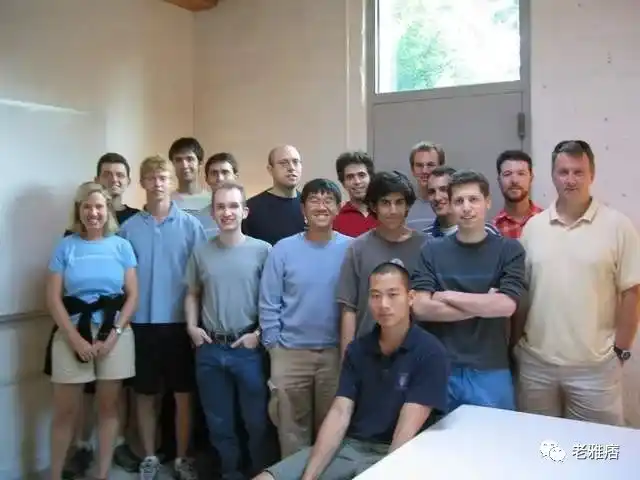
On an individual level, the level of talent YC has assembled is very impressive. Yc's summer 2005 batch (abbreviated as "S05") included Sam Altman, Alexis Ohanian, Steve Huffman, Aaron Schwartz, Garry Tan, Brett Gibson, Blake Ross, Joe Hewitt, Emmett Shear, and Justin Kan. Beyond Reddit, the founders have also been involved in the creation of now-famous companies and funds, including Twitch, Firefox, Initialized Capital, Seven Seven Six, and OpenAI.
In the dark
YC had already moved to Mountain View, Calif., for its second project. In the following years, the company continued to hone its curriculum. Airbnb, Stripe, Dropbox, and Mixpanel, among others, are funded from the balance sheets of Graham, Morris, and Blackwell.
Daniel Ha, who attended the accelerator in the summer of 2007, describes the atmosphere in the early YC incubators: "It was friendly and informal. It was more like an after-school program. They did whatever they wanted along the way.
Much of the day-to-day work of the program relied on Livingston's efforts, he recalled. "She's the core, she's in charge," he says. Graham was a source of wisdom. Ha describes listening to Graham trying to "keep in mind" everything the YC founder said. "He has a strange mixture of being very approachable and intimidating," Ha notes. I still quote him when I was 20." Ha's company, Disqus, raised money from Union Square Ventures and Felicis before being sold for $90 million in 2017.
Just a few months later, Adam Wiggins and his cofounders entered Y Combinator's "university. Their company, Heroku, will prove particularly important for accelerators.
Like Ha, Wiggins values the advice offered by YC's partners and outreach network. Highlights include Graham's opening monologue, in which he hints at participants to "drop your other jobs" and focus during the program. Evan Williams, who was building Twitter at the time, gave a speech about the importance of not trying to solve every problem, a lesson he learned the hard way while running Blogger. Marc Andreessen dropped in to share his excitement about his social media network Ning (" a good reminder that even great entrepreneurs with multiple successes can make bets that turn out to be wrong, "Wiggins says).
Wiggins also benefits from connecting with his classmates." Being around people who are going through the same struggles is an incredible blessing to get through tough times." When Heroku received an offer, Wiggins relied on the network, asking active and retired founders how they would handle similar situations and what the personal impact would be.
In late 2010, Salesforce announced it was buying Heroku for $212 million in cash. This is not only a transformative result for Wiggins and his partners, but also a landmark event for his backers. Y Combinator has been losing money for six years, and the Heroku sale has turned the corner.


At that critical moment, YC had already accepted its first outside funding. Sequoia Capital invested $2 million in YC in 2009, along with future partners Paul Buchheit and Geoff Ralston. After that, there seemed to be no shortage of LPs. Sequoia reinvested $8.25 million in YC in 2010. Less than a year later, YC's founders set the bar for a $150,000 investment, even though it came from outside sources. Yuri Milner and Ron Conway's Start Fund has indexed the money, giving entrepreneurs more room to grow.
Over the next decade, Y Combinator expanded the amount of capital at its disposal and the number of companies it funded. We will investigate how the number and mix of the firm's investments have changed. First, let's look at how Y Combinator innovates on the basic product of venture capital.
Products: Go end-to-end
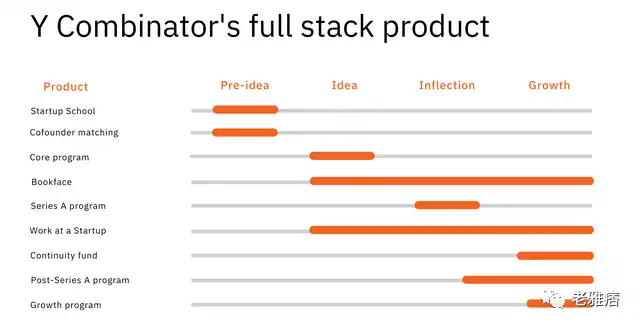
"YC is no longer just an accelerator," says Anu Hariharan. It's a full stack product.
The above sentence comes from the managing partner of Continuity, YC's growth-stage tool, and this description feels particularly apt. If you look at YC today, it's a company designed to support entrepreneurs from pre-idea to pre-ipo. Let's take a look at what they offer at each stage.
Preliminary design
YC's products begin in the vision phase. Earlier this year, YC announced that it was reviving the Startup School, a free, seven-week online course taught by partners and former founders. Although "business school" the first iteration of an application process, the course focuses on the entrepreneur, but YC has now made the course for free, and as the founder of "ambitious" provides a way to learn. From Sao Paulo to Singapore, global nearly thirty cities in the local party. Entrepreneurs can also contact through an online portal. Previous class sizes exceeded 40,000.
In July 2021, YC launched another product geared toward this stage: co-founder pairing. After filling out their profile, prospective entrepreneurs can connect with co-founders tailored to their interests and ambitions. So far, there have been more than 9,000 successful matches.
YC does not charge any fees for these services and does not accept equity. The company pays off by encouraging more and more capable start-ups to apply for its accelerator. At first glance, it seems to be working: 45% of the businesses in the W22 batch had previously applied through entrepreneurship schools. Some of the founders who were admitted met for the first time through YC's match.
conceived
Once founders get to the idea stage and have a business plan, they apply to YC's accelerator. The chances of being admitted are low, said to be between 1.5 and 3 per cent. Those who are accepted typically move to California within three months, with many taking up residence in an apartment building nicknamed the "Y-scrapers." The coronavirus has disrupted that practice, although YC recently noted that its next group of students must be physically present.
YC invested $125,000 for a 7 percent equity stake, and another $375,000 was SAFE with no upper limit and "Most Favored Nation" (MFN) terms. We will discuss how the provisions have evolved and their current impact later.
In exchange for this equity, the founders join the next batch and gain access to YC's wider network. As part of this batch, entrepreneurs can attend expert lectures and office hours with YC partners. For Malcolm Wiley, co-founder of Stairs Financial and a W22 graduate, direct access to expertise has been very useful. "I can feel the trajectory of our business change during these office hours," he says. He points to the value of partners like Michael Seibel.
As it grows, YC may not be able to give it the direct attention it once did. Ekaterina Damer, the founder of Acclaim and an YC alumnus, noted that the recent batches had become a bit "too transactional". She adds: "Without stepping on anyone's toes, I would say that 'deep coaching' is more useful than relatively shallow coaching, where there is less time allocated to founders."
By joining YC, entrepreneurs can also unlock a wide network of current classmates and alumni. Dimitri Dadimov, CEO of Modern Treasury, weighed in on this: "Probably the most influential people on our journey were our classmates and past YC founders... Founders of companies like Duffel, Titan, Rescale, Skip and others."
Many of the connections within the YC community take place on Bookface, an internal platform that grew out of one of the accelerator's creations, Hacker News. In 2006, Graham launched Hacker News (then called Startup News) as a way for YC founders to connect, connect, and ask for help. It was opened to the public the following year. Finally, in 2013, YC officially split the platform: the external forum kept the name Hacker News, while the internal version became Bookface. Today, it's a place for YC's 7,000 founders to connect, ask questions, and learn from each other, a private social network for some of the world's best entrepreneurs. Many end up forming partnerships, or selling their products to each other.
Zach Sims, Codecademy's founder, points to its value:
Bookface is great. While many other investors have their own corporate portals or email lists, Bookface has an incredible scale, so there's almost always someone working on your same problem who can help you.
Another YC graduate described it as "the most valuable network I have ever consumed".
YC's standard process ends with Demo Day, in which founders present their companies to an army of venture capitalists vying to fund the hottest startups. While it's designed to maximize options for entrepreneurs, the craze Y Combinator creates has a downside: it encourages shotgun marriages between founders and investors.
Traditionally, Demo Day is the end of YC's official participation. That changed in 2015 with the introduction of "YC Continuity," a growth fund managed by Ali Rowghani and Anu Hariharan. Continuity exercises pro rata rights in all graduating companies, with a value of up to $300 million, and selectively leads late-stage financing activities. It helps YC better capture the value it creates, enabling the company to redouble its efforts to enter winning businesses with which it has a strong relationship. Continuity also gives YC an incentive to develop programs designed for more mature enterprises.
turning point
Starting in 2018, YC began helping companies in what might be called the inflection point phase: raising Series A financing for them. According to Hariharan, YC helps founders assess their "readiness" for this round of funding, using their extensive data and expertise to gauge the product's fit with the market. Continuity provides detailed resources -- including sample files -- and measures the terms sheet. YC does not lead A Series A round, except to exercise its proportion, allowing the market to price its company's valuation.
WaaS, launched in June 2018, is a platform that makes it easy to apply for jobs at YC portfolio companies. Candidates create a single profile to apply for hundreds of open positions.
One YC graduate said: "The quality of the candidates is really strong. The really talented FAANG engineers just upload their resumes. Hariharan shared the impact WaaS has had on portfolio companies. According to her, 75 percent of engineers at startups like Brex, WhatNot, and Faire come from the program. Another service helps with executive recruitment.
At this point, it's worth reflecting on the vast amount of data at YC's disposal. Here's a non-exhaustive list of extremely useful things YC knows that most venture firms don't:
YC knows people who want to start a company before they have an idea.
YC knows which founders want a co-founder
YC knows who is open to a new job
Even if venture capital firms have some of this information, no one has it on a scale like Y Combinator. It is continuously collecting data on tens of thousands of current and future entrepreneurs and operators, their relationships, capital relationships, and hiring needs. As Hariharan says: "I'm not sure any other fund sees the same amount of scale as we do."
growth
This data set helps Continuity assess which businesses need support once they enter the growth phase, Hariharan says. Hariharan and Rowghani typically invest $20 million to $100 million in series B and above companies. In some cases, Continuity put in as much as $200m to $300m in investment rounds valued at up to $15bn.
Continuity only finances YC graduates, with two exceptions. Subsequent acquisition and Monzo. Hariharan does not expect these anomalies to become more common: "We don't spend any time outside YC." Continuity has made 35 investments to date, including Stripe, OpenSea, Coinbase, Webflow, Ironclad and Podium.
In addition to investing, Continuity offers two programs for expanding a business. If YC's core curriculum is like an undergraduate degree for entrepreneurship, Continuity offers a master's and doctoral program.
The first program, aimed at post-Series A companies, focuses on matching products to the market, speeding up programming, and getting ready for Series B funding.
The second programme, for real growth companies, revolves around the challenge of "scaling as A CEO", Says Hariharan, where founders are taught best practices in performance management, people leadership and financial planning. One exercise requires entrepreneurs to write a small S-1 document. YC is using its alumni network to bring tactical advice to the panel, with Doordash's Tony Xu and Rippling's Parker Conrad joining as speakers. Continuity has run the program 12 times so far, helping 200 companies with two courses a year.
The evolution of
It's worth noting that although YC's product looks coordinated today, it's the result of continued experimentation. Over the years, YC has experimented with different geographies, organizational types and funding models. By plotting the chronology of YC's most important launches, we can see which tests stuck and which didn't.
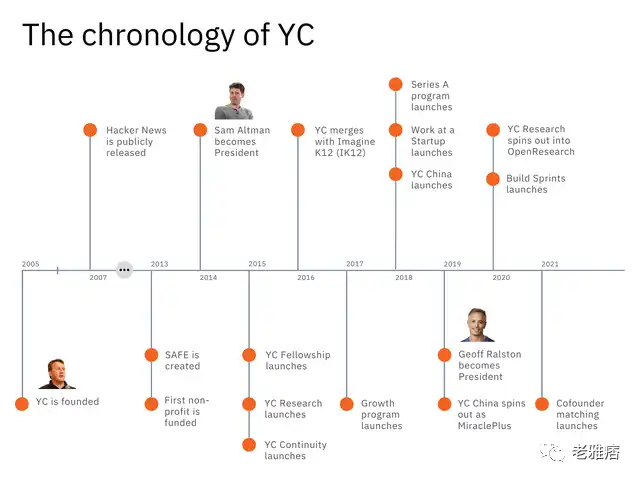
YC China was the most influential experiment to shut down. In August 2018, then-PRESIDENT Sam Altman announced that he had hired Qi Lu to lead YC's presence in China. The former Baidu COO was someone Altman had been trying to recruit for a decade to create a local branch of YC. The goal is not only to give the accelerator better access to China's best start-ups, but also to build links between Chinese and American technology companies.
A little more than a year later, YC announced its exit, and Mr Lu transformed the branch into an independent accelerator, MiraclePlus. Without offering any changes, the organization replaced Altman in May 2019 with Geoff Ralston. It may be as simple as that. With the closure of YC China and the spin-off of YC Research, Ralston does seem to have curbed some of the company's speculative impulses. (More reasons are not discussed here)
Investment: industrial venture capital
Y Combinator has grown not only its offerings, but also the size and scope of its investments. The accelerator began supporting 10 companies in the summer of 2005. Today, it supports businesses in nearly 400 industries and countries. "One day, tens of thousands of founders will graduate from here," says Geoff Ralston, its president.
With the help of our friend Shree Bhanderi, we analyzed how YC's investments have changed over time. Since this relies on publicly available data from YC, there may be some discrepancies. However, taken together, it shows the most important trends around batch size, geography, industry, results, and diversity. Further investigation will help to understand many of the interconnections pointed out in this paper. (You can explore the full notes here:
https://datastudio.google.com/u/0/reporting/57bb3b36-cb48-4545-8e06-3a73bdd1323c/page/p_mfs9lklfvc).
The size of the
YC's batch size expansion is widely discussed in the industry. Critics often argue that the accelerator has lost some of its value and prestige as it has grown, morphing from a community garden into a venture capital factory.
Ralston dismissed the claim, calling it "groundless criticism." "I like that our batches are getting bigger," he said. Those who think YC is too big to hurt the network are thinking the opposite.
He expects YC to fund unicorns on a percentage basis, as it has in the past.
On average, YC lots are growing by 20% a year, although this is not strictly positive. In 22 years, startups are down 52% from the year before; It jumped 40% in 2006, 2007, 2011 and 2021.
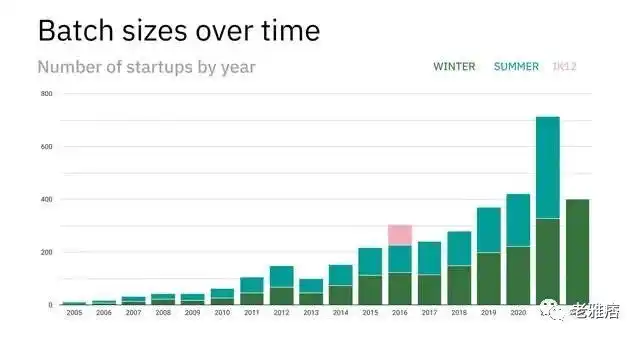
If it keeps expanding at its current rate, YC will support nearly 1,400 companies a year by 2025 and nearly 3,500 by 2030. It will take another six years to surpass Ralston's goal of 10,000.
Geographical environment
The best rebuttal to the argument that YC has lost its reputation by backing more companies is that it has also radically expanded its portfolio. Dimitri Dadiomov of the Modern Ministry of Finance underlined this point:
I think one misconception is that it's gone from 10 to 50 to 150 companies, all the same. In my experience, the growth in the number of companies has more to do with YC's entry into New Territories.
Dadiomov explained that these "territories" could refer to industries -- such as increasing coverage (or geographic areas) of hardware or ARTIFICIAL intelligence businesses. The data shows that YC has diversified countries, although the United States is still the dominant geographic area.
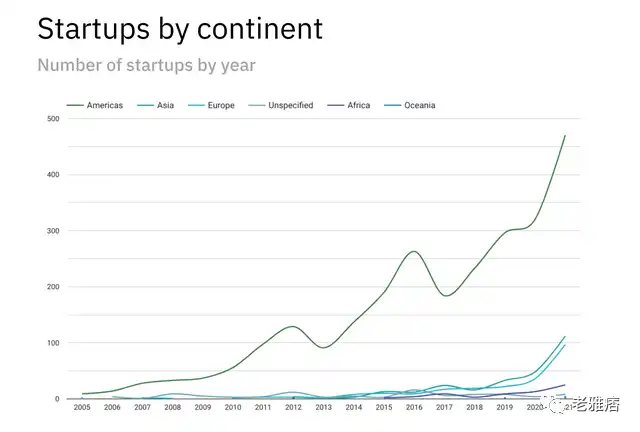
Excluding the United States from the analysis gives a clearer picture of which regions have stood out over time.
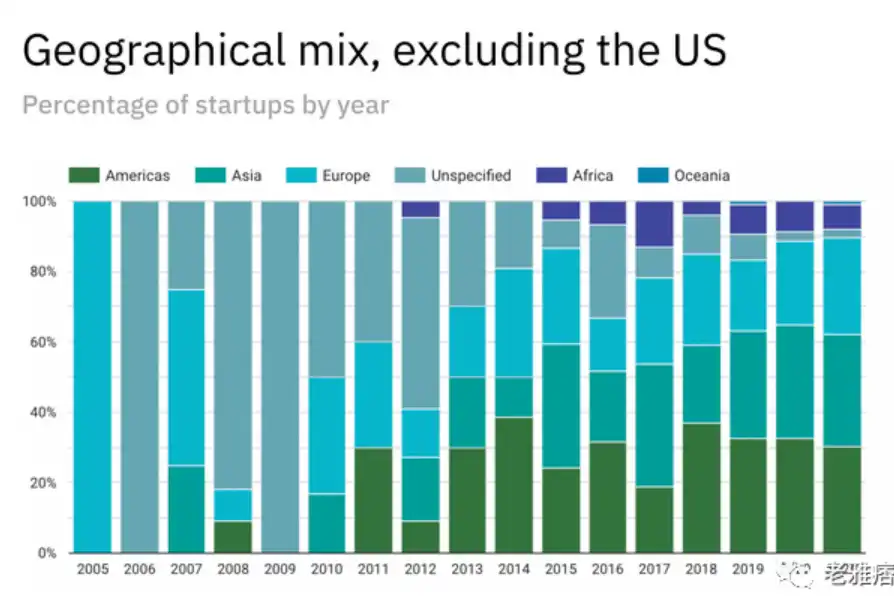
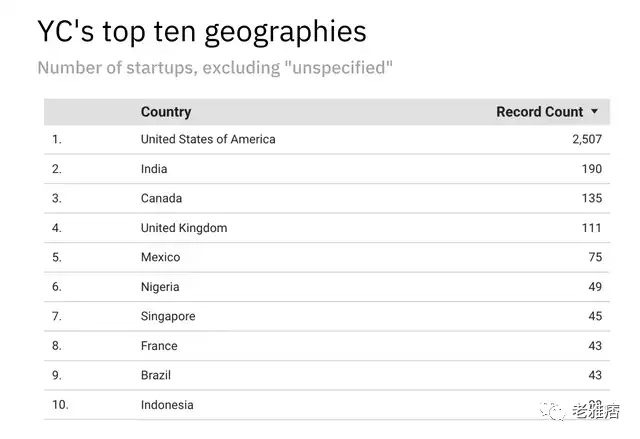
The "other" Americas have established a solid foothold, with South American startups proving popular in recent years. Asian firms, particularly from India, are also becoming more common. After the US, India is the second largest recipient, followed by Canada and the UK. Nigeria provides the most start-ups in Africa.
Africa's rise is evident in the latest batch, which doubled from 3% to 6%. In the W22 lot, U.S. companies accounted for only 49%; By 2017, they regularly tilt 80% of their capital to support these regions.
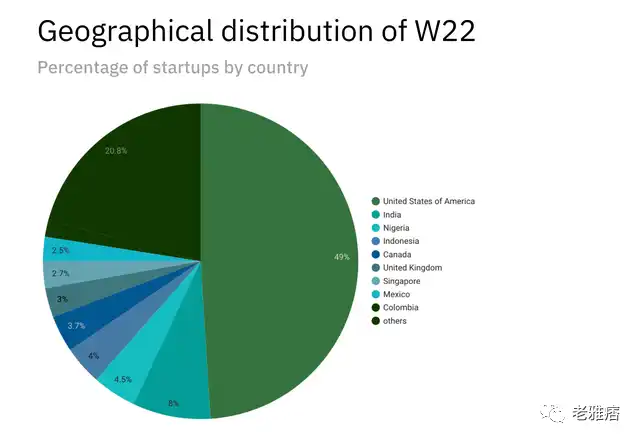
Given the unique value YC can bring to international founders, we should expect this trend to continue. While other investors may be able to offer more localised expertise, none has been able to embody Silicon Valley's networks so quickly. Given the concentration of existing venture capital in the US, this is extremely valuable. Christian Van Der Henst, co-founder of Platzi, a Latin American startup, points to this. "Since I started my company outside the U.S. and the Bay Area, the community and the program helped a lot," he says.
As you might expect, YC had little presence in China, given the company's previous desire to devote more resources to the country. Eleven start-ups came from China, the same number from Egypt, Spain and Denmark. All of these are much smaller markets.
industry
A more diversified trend can also be seen when looking at investment across industries. Starting in 2011, fintech companies accounted for a growing portion of YC's portfolio, expanding from about 7 percent to 24 percent. Healthcare startups saw a meaningful uptick over the same period, expanding from 5% to 10%. Consumer start-ups are in decline, shrinking from 30% to 14%. Crypto is conspicuously absent from the top category, although some fall into the "unspecified" category. To date, YC has funded only 85 cryptocurrency or Web3 ventures, although 24 were part of the last batch. For now, YC seems to have a poor grasp of this part of the start-up ecosystem.
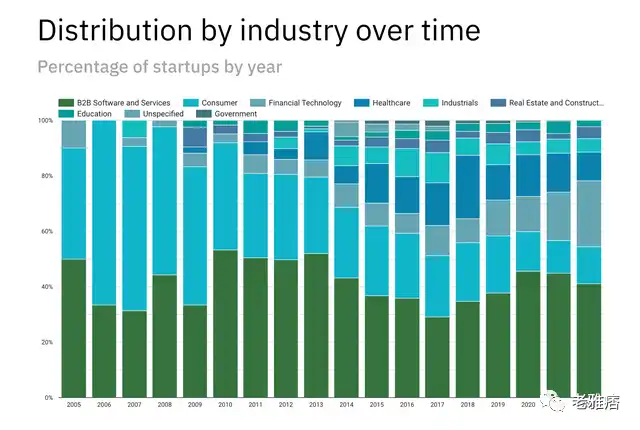
Similar changes were seen when looking at leading subcategories such as B2B, fintech and consumer, although the smaller sample size made this less meaningful.
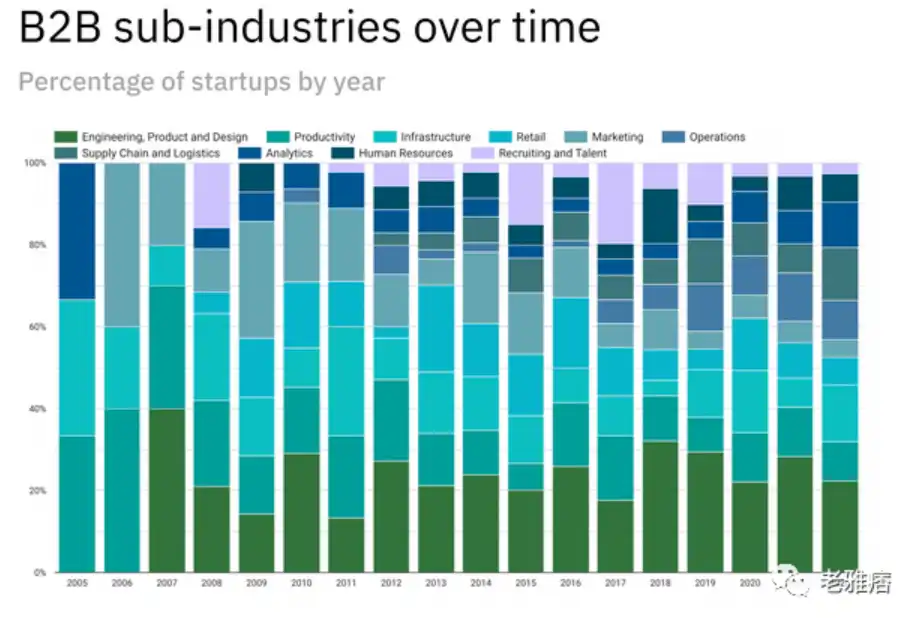
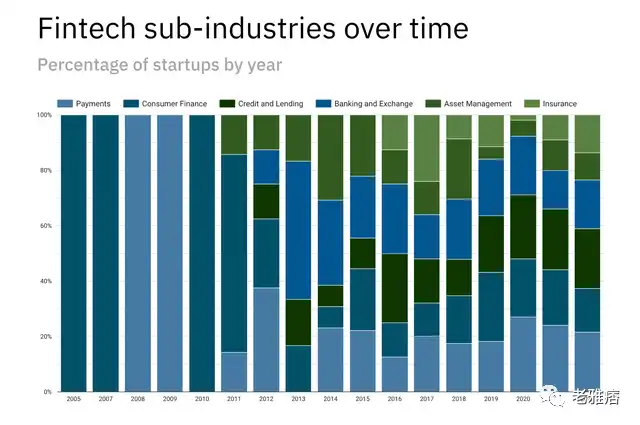
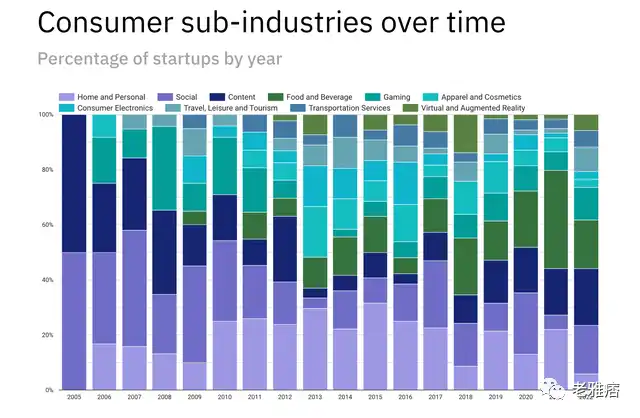
One effect of YC's geography and industry diversification is that it encourages venture capital firms to consider different startup scenarios. Dimitri Dadiomov commented on this issue:
Now, YC is targeting underrepresented regions, ethnic minorities, educational backgrounds... If YC doesn't offer "endorsements," it will be harder for founders to raise money. I always think it's interesting when someone says they're investing in something like "YC Fusion," and these people don't normally even meet fusion startups, but because it's "YC," suddenly it's a good thing to invest in.
In essence, accelerators have the ability to transform the Overton window of venture capital, making new categories and geographic regions "investable."
diversity
Some believe YC has not done a good enough job of supporting underrepresented founders. Paul Biggar, founder of CircleCI and Dark, points out that this is a particularly disappointing problem. "They were looking for Mark Zuckerberg and they found a lot of them," he said. (Biggar was kicked out of the YC community last year after sharing a Bookface conversation in which one of the founders explained how to cut the COVID-19 vaccine line.) Ekaterina Damer of Acclaim, noting her Ph.D. in Diversity sciences, highlighted the same problem:
YC can take a stronger stand on diversity and inclusion by sending clearer signals to historically underrepresented and marginalized founders to get them to say: "The tech community welcomes you. We want you here and we believe in your potential. We prove it by committing to D&I and taking deliberate actions X, Y, AND Z to make sure you get the same opportunities as straight white men in tech." And, we are monitoring our D&I work and correcting when we stray."
Over the course of its life, YC has increased the number of startups it supports that have fewer founders. Before going any further, it's worth clarifying what exactly this means. We use the term "underrepresented" to reflect YC's data on three categories: female, black, and Latino founders. YC provides company-level data, not founter-level data.
In 2010, just one out of 62 companies had a black, Hispanic or female co-founder, less than 2%. Of the latest batch, nearly 36 percent fit this category.
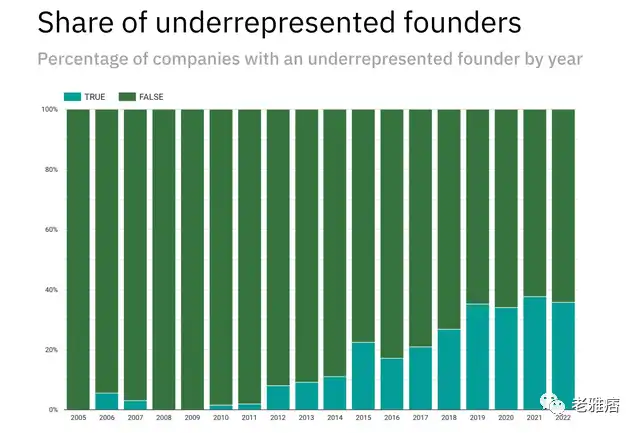
This crude trend exists for international or ONLY U.S. startups, though the latter is more modest.
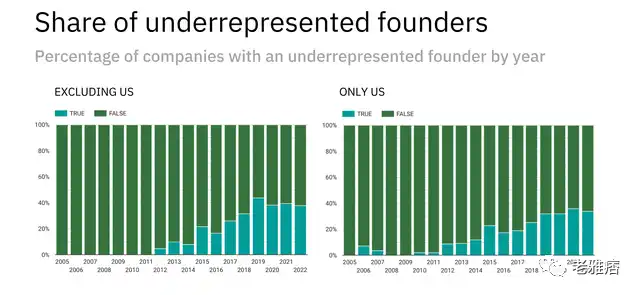
In all three views, it is clear that growth has stagnated (and in some cases declined) over the past three and a half years. In 2019, about 35% of start-ups were co-founded by underrepresented entrepreneurs. So far, in 2022, its trend is about 35.5 percent. Of the three categories for which YC provided data, black founders were the least common, co-founding 8% of companies in 2022. Women make up 19 percent and Latinos 13 percent.
How does YC compare to the wider risk industry? After reiterating the caveats about corporate data -- and the difficulty of making perfect comparisons between different data sets -- we find the data to be favorable to YC. In 2021, U.S. companies with at least one female founder received 17 percent of all venture capital funding, according to Pitchbook. (That same year, YC's figure was just over 23 percent.)
Black founders received 1% of total venture capital investment in 2020, according to Accenture. In the first half of 2021, the share was basically stable at 1.2%, although it increased fourfold from the same period of the previous year. About 7 percent of YC's U.S. investments in 2020 were black cofounders, which fell below 6 percent the following year.
Hispanic founders have a similar pattern. While total investment increased significantly between 2020 and 2021, rising from $2.8 billion to $6.8 billion, market share remained reasonably constant, rising from 1.7% to 2.1%. The YC figure declined over the same period, but was still quite high, falling from 13.2% to 10.2%.
The trendline of YC's diversity efforts is a source of considerable frustration for founders like Ekaterina Damer: "Right now, I'm mainly unhappy with the pace of change. Not only are things moving too slowly, but sometimes we are moving backwards."
Another frustration is the feeling that there is so much more that can be done, but YC doesn't seem motivated to improve. When Biggar raised the need to improve diversity with senior leadership in 2017, he came away disappointed that it didn't seem to be a priority. "You can't reform people who don't want to be reformed," says Biggar. That lack of urgency is a major reason Biggar doesn't bring future startups to the company.
Biggar's critique makes it clear that he doesn't think YC should be comparing these measures to traditional venture capital. "We're kind of looking forward to VC," Biggar said. Everyone at YC thinks they're good people. An interesting aspect of Biggar's assessment is that it reveals that the source of differentiation in YC is one of the few situations that attracts criticism. The firm was founded on the idea that traditional venture capital was broken and needed to be reinvented by hackers like Graham. In the years since, YC has emphasized that it is not a venture capital firm but something entirely different, closer to a university. While this provides valuable positioning to enable YC to improve itself in this area, it may mean that it is evaluated differently. Measured against VC as an industry, YC looks pretty good; Compared with an educational institution like Stanford, it suddenly seemed very far removed from the essence of a university.
YC has taken steps to improve its diversity. Since 2014, Jessica Livingston has hosted the Women Founders Conference to support women entrepreneurs. It has since been renamed the Aspiring Founders Forum. The accelerator holds events that draw participants from historically black colleges and other underrepresented groups. Anu Hariharan offers weekly office hours for women in engineering. YC only started listing underrepresented founders in its public database in 2020. This is something many other companies don't do, demonstrating their willingness to be evaluated and held accountable for their performance.
results
So far we have looked at how the composition of batch YC changes. But what about the companies themselves over time?
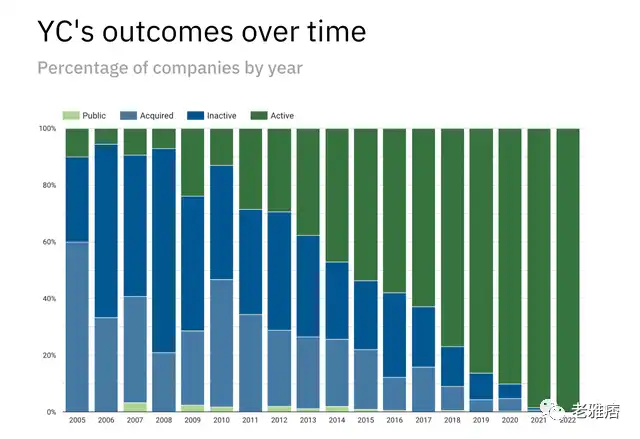
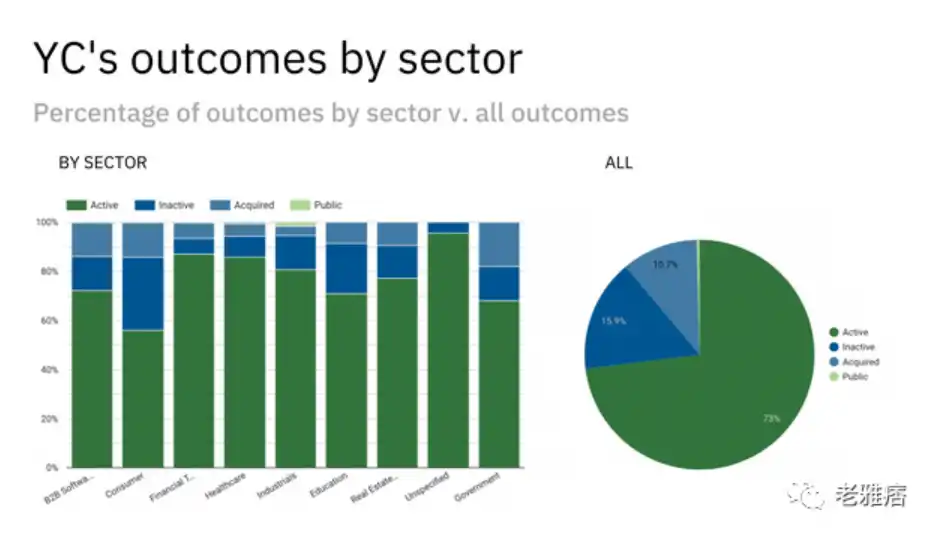
As you might expect, most mature companies eventually get acquired or go out of business. Of pre-2015 startups, 29 percent were acquired, 40 percent died, 30 percent are still active, and 1.4 percent have gone public. Results varied widely by sector, with consumer start-ups closing about twice as fast as the average.
So far, 268 YC startups have been valued at or above $150 million, with the time to reach that benchmark declining over time. On that basis, W16 looks particularly compelling, with 28 enterprises valued at more than $150 million. Rappi, Daily, Sendbird, Paystack, Outschool, Embark Trucks, Astranis, Tovala and Podium are among those in this batch.
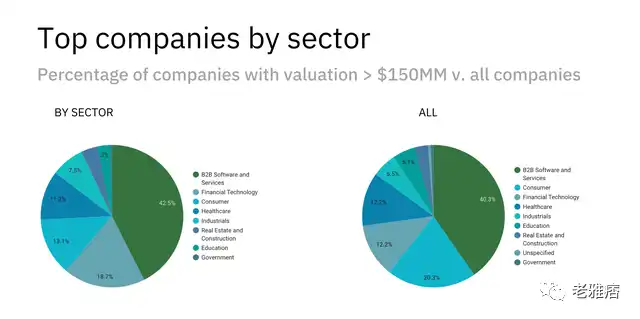
On an industry basis, the number of startups passing the $150 million mark perfectly matches the total. The only category that is clearly doing well is fintech: while only 12.2 per cent of YC companies are from this sector, they account for nearly 19 per cent of the high-value group.
Startups with fewer founders tend to survive longer than those without founders, although this is partly due to greater diversity in late-stage batches. However, even among pre-2014 startups, the trend persists.
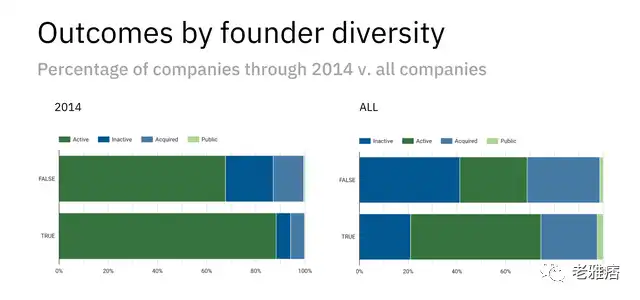
The success of underrepresented founders will hopefully give Y Combinator and the broader market a reason to prioritize this segment. "I believe YC and all other venture capital firms can do more to help address the funding gap," Damer said. This is not just an ideological position, but an economic one. The potential of minority founders is undertapped and the opportunity costs are enormous. Venture capital firms are missing out.
Terms: pricing power
In January, former Bolt CEO Ryan Breslow went viral with two tweets criticizing Y Combinator. Breslow calls the company, along with Sequoia Capital and Stripe, silicon Valley's "mob bosses."
It is hard to take Breslow's portrayal of Grahambino's crime family seriously. His thesis is a mixture of inaccuracy, pointlessness, and contradictions. It reads like a gulf of paranoia.
Breslow believes YC didn't fund Bolt because it supports Stripe, a competitor on the same track. Don't forget that YC is known for this practice, often supporting direct competitors in the same batch. Breslow believes Hacker News deleted Bolt's posts in favor of Stripe. As if forum rankings have any meaningful, lasting impact on the success of a venture-backed startup. According to Breslow, YC is almost omnipotent, capable of crushing anyone who threatens its business, but not worth paying for equity. Interspersed with advice to buy Breslow's book on fundraising and sign up for news about his upcoming incubator.
The valuation
Hidden in Breslow's criticism is an issue worth discussing. Are YC's conditions fair? Or are they, as Bolt's CEO put it, "beyond predatory"?
When YC started, it invested $20,000, or about 6 percent of a business. In 2011, the company raised its stake to 7% for $100,000. Since then, the initial investment has hovered between $120,000 and $150,000, or 7%. As mentioned earlier, the Most recent version of YC has an investment of $125,000, an uncapped SAFE of $375,000, and a "Most Favored Nation" clause. The implied valuation of YC start-ups has grown from about $333,000 to a high of $2.1 million, before settling at $1.8 million.
Compared with the wider risk market, YC's terms look expensive. Median pre-seed and seed valuations from 2012 to 2021, according to data collected by fund firm Cendana Capital. While YC does accept more mature businesses, its batches are best suited to the seed stage. In 2012, the median pre-seed estimate was $2.8 million, while the median seed estimate was $7.6 million. By 2021, the pre-seed valuation has increased to $6 million, while the seed is valued at more than $15 million. Of course, valuations vary by geography and industry. Cendana's figures are based on its portfolio, which has international reach but a greater presence in the United States.
From this point of view, the conditions of YC are remarkable. How can the accelerator invest in high-potential startups at a discount of 88-70% relative to the median? How has it managed to stay so high for so long? In relative terms, YC conditions have actually become more expensive over the past decade, even as the risk market has become more competitive. In 2012, YC's $100,000 for 7% equity deal was an 81% discount to the median seed valuation and a 49% discount to the pre-seed price.
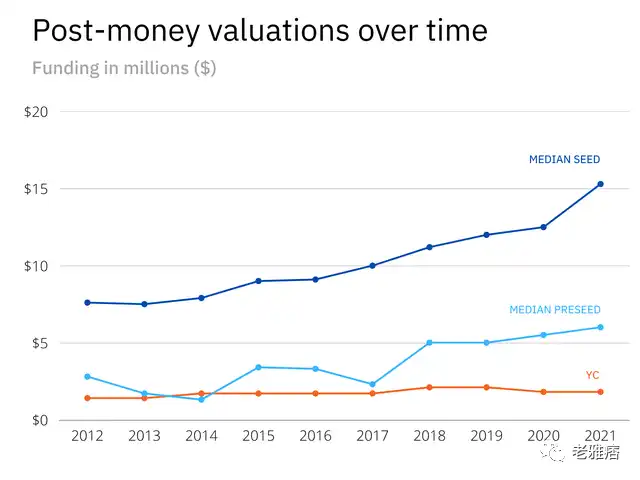
While in some cases YC invests in start-ups that others may not, by and large it supports teams that can afford to raise money elsewhere, often on better financial terms. The fact that so many powerful entrepreneurs still try out for YC is testament to YC's crazy pricing power. No other fund in the world can reliably invest in so many brilliant founders at below-market prices.
Does this mean that YC conditions are predatory? If so, someone forgot to tell the founders. Even critics like Biggar call these conditions "perfectly fine," adding: "[YC] was worth getting into when it wasn't a trump card. It's certainly worth it now.
The founders note that YC's reputation helps in recruiting, finding clients and working with outside partners. "When we talk to banks, we are 'a YC company,'" says Dimitri Dadiomov, "and they talk to us for at least that reason." Malcolm-wiley Floyd, from Stairs Finance, says: "When we started recruiting for Stairs we wanted to convey to people that they were making a good decision about their careers, adding:" YC definitely helps with that ".
The graduates don't seem to be worried about the rigors of YC, another reason is that Demo Day gives them a chance to quickly recover any "lost" equity. Hundreds of VCS are scrambling to invest, inevitably raising start-up valuations and making it possible to walk away with more money and more equity than you might otherwise have been a mid-sized start-up.
As a YC company, we get the extra media attention that probably adds 20-30% to our valuation. I think it's part of the perks of being a YC company, but it's also part of the feeding frenzy that happened after Demo Day, when people felt the time pressure of investing in a company made sense.
These dynamics mean that YC may be a worthwhile choice before considering the extended network and lifetime benefits of continued guidance through Continuity. One sign that YC is winning its stake is the number of returning founders. While the company declined to give precise figures, "several hundred" are said to have returned once or more. Many have returned as full-time employees or visiting partners.
Of course, not everyone will return. Discuz's Daniel Ha hesitated when asked if he would return to YC for future business. "It really depends," he said. If I were a first-time startup, absolutely. Of course, more experienced and connected founders may find they can get more generous terms elsewhere."
The new agreement
YC's new standard protocol is worth discussing in more detail. From the beginning, YC treated other venture capital firms as a qualitative evil. While the firm has good relationships with many venture capital firms, including some that regularly receive special access grants, it has a fundamental distrust of those asset class groups.
YC's revised terms look like a confrontation. Because the founders now receive an upfront payment of $500,000 (convertible to $375,000 in the next round), they are significantly more leveraged than before. In the past, it was a viable strategy for seed funds to approach new YC companies and offer to invest a few hundred thousand dollars. This is attractive to investors, as it usually means providing capital to the company at a discount to what Demo Day is worth; This is also attractive to founders because it gives them more room to grow and means they don't have to run for a bad deal at the end of a project. YC's new terms eliminate this tactic. Now, the company itself absorbs the opportunity of gap equity, giving its company the upper hand in future negotiations. It's cruel, and it's smart.
When it comes to the YC terms, we might ask one final question: Where is the money coming from? While YC's success means it may rely in part on revolving capital, other funding is also necessary. At the current rate, YC is on track to deploy $400 million a year.
Geoff Ralson declined to name any LPs, though he did note that the company has "permanent capital." Given its previous involvement, it would not be surprising if Sequoia was involved. Endowments, charities and perhaps even sovereign wealth funds are also expected to contribute.
Risk: Look to the throne
YC shows that setting up a company can be standardised -- and a good business. Since its debut, other companies have jumped on the bandwagon, offering different forms of acceleration and incubation services. While this change means that competition is not always positive, other projects almost invariably overlap with YC in some way.
At the same time, YC has problems it should address at home. Let's look at external and internal threats.
External threats
Techstars launched a year after YC, Seedcamp followed in 2007, and 500 Startups opened in 2010. Entrepreneur First (EF) launched in 2011 and focuses on matching co-founders. Co-founder Matt Clifford sums up the company's approach:
We think you should start a company with a stranger. When we look around the world and ask, "Why aren't there more great companies?" We think the obvious answer is: Because many of the best potential founders in the world don't have a world-class co-founder in their personal network.
This approach has worked well for EF. Clifford points out that the portfolio is worth "$10 billion and counting". By building around this phase of the entrepreneurial process -- and establishing a strong presence in Europe -- EF has had some success upstream of YC. In addition to giving grants to entrepreneurs it accepts, EF invests between $54,000 and $98,500 in 10% equity. The exact terms vary across the company's six international territories.
Hyper is another interesting rebel. Launched in mid-2021, the accelerator is associated with Product Hunt, which uses the platform's distribution to help its portfolio find customers. Hyper seems to be focusing its work on more mature businesses, expressing interest in seed and Series A startups. Given the community Product Hunt already has, it's not surprising to see another version of Bookface created by Hyper, although it needed to figure out how to split internal and external information between Hacker News and Bookface like YC.
Pioneer, founded by Daniel Gross, a former PARTNER at YC, followed a particularly aggressive plan. Anyone can enter for Pioneer's global championships. By making progress, the company moved up the league table. Companies that thrive will receive an offer from Pioneer: 1 percent of their company will participate in the Remote First incubator, or 2 percent will receive an additional $20,000. Pioneer's structure is designed to support and leverage a distributed base of neglected and under-networked founders. In this respect, it is similar to YC's entrepreneurship school, albeit with a more peer-to-peer approach.
Over the past few years, traditional venture firms have shown interest in accelerator games. In 2019, Sequoia launched Surge, a program aimed at startups in India and Southeast Asia. Surge invests $1.5 million a year in two tranches in 10 to 40 companies. Earlier this year, the company announced another variation on the theme, Arc. The founders will receive $1 million over the course of the seven-week program. The first Arc projects are focused on Europe, but Sequoia notes that the North American version is coming in a few months.
The A16z is trying something similar. START invests $1m in start-ups but seems to take a more casual approach to programming. Accepted founders receive mentoring but do not appear to belong to a structured cohort.
Do Sequoia and A16Z really want to run an accelerator? One source thinks this is unlikely. Running a batch like YC -- even on a smaller scale -- takes time and considerable coordination. Efforts like Arc and START are likely designed to show entrepreneurs that no company is too early to talk to companies like Sequoia and A16Z, according to this person. By providing structured investment terms, mentor commitment, and the urgency of a deadline may just help the incubator expand the funnel through the top aisle.
Internal threat
YC's biggest threat may be itself. While it has seemed to scale well so far, growing too fast could undermine its core value. Venture capital is a service business, and one-on-one time with partners and experts can be the most impactful thing an incubator can offer. Can it maintain the standard of its guidance as it adds more partners? Does it ensure that each new batch of members gets as much attention as the last? While founders can help each other and rely on Bookface's wider network, losing that would deprive YC of something fundamental.
YC may also want to freshen up its image. While There is little substance to Breslow's controversy, the response they got suggests that many people feel somewhat hostile to accelerators. At first it was a dog and dog, now it is an industry leader. Although it has attracted some negative flak associated with it. But its attitude may not help itself, as some see it as elitist.
Ralston told Eric Newcomer, "I'm not interested in competition right now. Because I think we've put ourselves in a very unique position to have a first choice, a first look at almost every major startup."
While YC may have more weapons than any other fund, these are provocative statements. Compare that tone to that of Sequoia's Roelof Botha in a recent Protocol profile. Despite running the world's most famous company, Sequoia's butler doesn't brag or bow to it. Why can't Sequoia do what YC does?
Sniping at individual references like this is unfair, but this example illustrates the kind of arrogant criticism that YC almost automatically emanates. As it nears its 20th anniversary, there may be a more open and humble tone to reflect the relentless drive for self-improvement that the organization has shown.
* * * * * * * * * * * * * * * *
Since the turn of the millennium, few organizations have had a more positive impact than Y Combinator. Given the criticisms mentioned above, not everyone would agree with this assessment. But if you believe that progress depends on innovation and entrepreneurship, the significance of YC is obvious.
It has played an important role in the creation of 7,000 entrepreneurs. The businesses it supports have transformed the way we travel, learn, entertain, move goods, move money and treat disease. Today, there's a good chance you've interacted with a company YC helped at some point, whether it's accessing a file on Dropbox, ordering groceries on Instacart, watching a stream on Twitch, buying cryptocurrency on Coinbase, Still get paid through Gusto.
Perhaps more importantly, YC has changed the way people think about commercial construction. It's no longer crazy for a new college graduate to try to start her own company; In fact, it's a fad. Much of this shift is due to YC and the curriculum it helped popularize. Even those who did not attend the accelerator benefited from courses such as doing things without scale.
This is not to say that YC is perfect or can't be improved. While it has an advantage over venture markets, the percentage of underrepresented founders has stagnated and deserves more attention and action. So is the hostility that springs up when critics take to Twitter. Its pursuit of scale sometimes contradicts its commitment to expert guidance. If YC can solve these problems, it will enter its third decade not only admired by those it helps, but even better admired by those it does not.
It is hard not to be optimistic. Products like "Startup School," "Work for Startups" and "Co-Founders Match" are still in their infancy, and Continuity's growth plan is still much newer than YC's core plan. A decade from now, these individual elements could expand and sharpen, adding even more power to YC's formidable Arsenal.
Accelerators prefer to see themselves as a form of higher education, though earlier than many venture capital firms. Compared with the centuries-old university, Y Combinator's legacy is just beginning.
The original link
Welcome to join the official BlockBeats community:
Telegram Subscription Group: https://t.me/theblockbeats
Telegram Discussion Group: https://t.me/BlockBeats_App
Official Twitter Account: https://twitter.com/BlockBeatsAsia

 Related Articles