Vitalik Buterin: Two Thought Experiments for Evaluating Algorithmic Stablecoins

Original title: "Two thought experiments to evaluate automated stablecoins"
Original author: Vitalik Buterin
Original compilation: Block unicorn
< /p>
Special thanks to Dan Robinson, Hayden Adams, and Dankrad Feist for their feedback and review.
The recent LUNA debacle cost tens of billions of dollars and sparked a firestorm of criticism for the category "algorithmic stablecoin" , many consider them a "fundamentally flawed product." Increased scrutiny of defi financial mechanisms, especially algorithmic Stablecoin mechanisms that work very hard to optimize "capital efficiency", are very welcome. A greater acknowledgment that current performance is no guarantee of future returns (or even a guarantee that the future will not crash completely) is more welcome. However, where market sentiment is very wrong is that the same statement is used to describe all decentralized encryption algorithm Stablecoins, and kill all algorithmic Stablecoin projects with one stick.
While there are many algorithmic Stablecoin designs that are fundamentally flawed and ultimately doomed to collapse, there are also many Stablecoins can survive in theory, but the risks are high, but there are also many stablecoins that are very robust in theory and have withstood the extreme tests of crypto market conditions in practice. Therefore, what we need is not Stablecoin proponentism or Stablecoin doomsday, but a return to principle-based thinking. So, what are some good principles that can be used to evaluate whether a particular algorithmic Stablecoin is truly stable? For me, I set out to test Stablecoins with two thought experiment reactions.
Hint: What is Algorithm Stablecoin?
For the purpose of this article, Algorithm Stablecoin is a system with the following properties:
1. It issues a Stablecoin that tries to Anchor to a specific price index. Usually, the goal is $1, but there are other options. There are targeting mechanisms that consistently push the price towards the Stability Index ($1) when the price deviates in either direction. This makes ETH and BTC not stablecoins.
2. The target mechanism is completely decentralized, and the protocol does not depend on a specific credible participant. In particular, it must not rely on asset custodians, which makes USDT and USDC not stablecoins.
In practice, (2) means that the target mechanism must be some kind of smart contract that manages a reserve of cryptoassets and backs them up when prices fall price.
How does Terra work?
Terra-style Stablecoin (with Minting Stake is roughly the same, though many implementation details are different) works by having two currencies, which we call Stablecoin and Volcoin (in Terra, UST is Stablecoin and LUNA is volcoin), Stablecoin uses a Simple mechanism to maintain stability:
· If the price of the Stablecoin exceeds the target price, the system auctions off new Stablecoins (and uses the revenue to burn LUNA) until the Stablecoin price returns to the target price.
· If the price of the Stablecoin is lower than the target price, the system will buy back and burn the Stablecoin ( Issue new LUNAs to fund the burn) until the Stablecoin price returns to the target price.

What is the price of LUNA now? LUNA The value of Stablecoins may be purely speculative, based on the assumption that demand for Stablecoins will increase in the future (which would require burning Stablecoins to issue UST). Alternatively, value can come from fees: transaction fees on the Stablecoin/LUNA exchange, or annual holding fees charged to Stablecoin holders, or both. But in all cases, the price of the fluctuating coin comes from anticipation of future activity in the LUNA ecosystem.
How does RAI work? ;
In this post, I focus on RAI rather than DAI, as RAI better represents the pure (decentralized) "ideal type" Algorithm Stablecoin, supported only by ETH. DAI is a hybrid system backed by both centralized and decentralized collateral, which is a reasonable choice for their product, but it does make analysis trickier.
In RAI, there are two main types of participants (there are also FLX holders, speculative Token, but their role is not very important):
RAI holders hold RAI, which is the Stablecoin of the RAI system.
RAI lenders deposit some ETH into a smart contract object called a "safe", and they can then withdraw up to 2/3 of the RAI's value in ETH (e.g. : If 1 ETH = 100 RAI, then if you deposit 10 ETH, then you can withdraw up to about 667 RAI). If the lender repays their RAI debt, they can recover the ETH in the same way.
There are two main reasons for becoming a RAI lender:
1. In ETH Long Up: If you deposit 10 ETH and withdraw 500 RAI in the example above, you end up with a position worth 500 RAI, but with 10 ETH exposure, so for every 1% change in ETH price, it goes up/down 2%.
2. Arbitrage If you find an investment denominated in fiat currency rises faster than RAI , you can borrow RAI, put your money into this investment, and make a profit on the difference.
If the ETH price falls and there is no longer enough collateral in the safe (meaning, RAI debt is now more than one-third times the value of ETH deposited), a liquidation event occurs. By offering more collateral, the safe is auctioned off for others to buy.
Another major mechanism to understand is the redemption rate adjustment. In RAI, the target is not a fixed amount of dollars; instead, it moves up or down, and the rate at which it moves up or down is adjusted according to market conditions:
· If the price of RAI is higher than the target, the redemption rate decreases, reducing the incentive to hold RAI and increasing the incentive to hold negative RAI as a lender. This drives the price down.
· If the price of RAI is lower than the target, the redemption rate will increase, increasing the incentive to hold RAI and reducing the incentive to hold negative RAI as a lender, which in turn can put Prices are pushed up.

Thought Experiment 1
Could Stablecoin be theoretically safely reduced to "zero users"?
In the non-encrypted real world, nothing lasts forever. Companies always fail, either because they failed to find enough users in the first place, because the once-robust demand for their products no longer exists, or because they were replaced by a stronger competitor. Sometimes, there is a partial breakdown, from mainstream status to niche status. (MySpace). Something like this has to happen to make room for new products. But in the non-crypto world, when a product shuts down or declines, users usually don't suffer much. Of course there are instances where some people have been overlooked, but overall, the shutdown is orderly and the problems are manageable.
But what about Algorithmic Stablecoins? If we look at Algorithmic Stablecoins from a bold and radical perspective, there are The ability to avoid system crashes and loss of a large number of users and funds should not depend on the constant influx of new users.
Is Terra safe to exit?
In Terra, the price of Luna (LUNA) is derived from the expectation of future activity fees on the system. So what happens if expected future activity drops to near-zero levels? LUNA’s market cap drops until it becomes considerably smaller relative to stablecoins. At this point, the system becomes very fragile: a small shock to the demand for the Stablecoin would cause the target mechanism to print a large amount of volcoin (LUNA), which would cause LUNA to overinflate, at which point the Stablecoin would also lose its value.
The collapse of this system can even become a self-fulfilling prophecy: if it seems likely to , will reduce the expected value of LUNA in the future, which will lead to a decline in the market value of Volcoin (LUNA), making the system more vulnerable, which can trigger a very serious crash, as we saw in May.

LUNA price, May 8~May 12

UST price, May 8~May 12
First, the LUNA price dropped. Then, the Stablecoin started to dangle. The system attempts to support demand for Stablecoins by issuing more LUNA. Due to lack of confidence in the market and few buyers, the price of LUNA dropped rapidly. Finally, once the price of LUNA approaches zero, the Stablecoin will also crash.
In principle, if the decline is very slow, The future cost of LUNA's ecological expectations and its market value are relatively better than Stablecoin. However, it is unlikely that it will be managed successfully to allow it to drop slowly, more likely to drop rapidly in a split second, followed by a bang.

Safe gradual exit: every step must ensure the market value of LUNA Enough revenue is expected in the future to keep the Stablecoin safe at its current level.

Insecure phase-out: At some point, there is not enough expected future revenue to justify enough LUNA market cap to keep the Stablecoin safe, and there is a risk that it will crash.
Can RAI exit safely?
RAI's security relies on assets outside the RAI system (ETH), so RAI is easier to exit safely. If the drop in demand creates an imbalance (thus, either hold demand falls faster or loan demand falls faster), the redemption rate adjusts to bring the two into balance. Lenders hold leveraged positions in ETH, not FLX, so there is no risk of a positive feedback loop where confidence in RAI decreases leading to a decrease in demand for loans.
If, in extreme cases, all demand to hold RAI disappears simultaneously, except for one holder, the redemption rate Will soar until eventually every lender's safety is liquidated. The only remaining holders will be able to buy safes in a liquidation auction, use their RAI to instantly liquidate their debt, and withdraw ETH. This gives them the opportunity to get a fair price for their RAI, bought from ETH in the safe.
Another corner case worth looking at is RAI becoming a major application on Ethereum. In this case, the expected reduction in future demand for RAI will affect the price of ETH. In extreme cases, there could be a cascade of liquidations leading to chaotic collapse of the entire system. But RAI is much more resistant to this possibility than Tura-style systems.
Thought experiment two
If you try to combine a Stablecoin with an annual 20% index pegged, what happens?
Stablecoins tend to be pegged to the USD right now. RAI is a minor exception, as its peg adjusts up and down as the exchange rate changes, and the peg starts at $3.14, not $1 (the exact starting value is subject to math Human friendly, as a real math nerd would choose tau=$6.28). But they don't have to. You can combine a Stablecoin with a basket of assets, a consumer price index, or any complex formula (“a value that is sufficient to buy a hectare of land in the Yakut forests (i.e., the global average CO2 concentration minus 375})” ) for hooking. As long as you can find an oracle to prove the index, and there are people from all parties in the market, you can make such a Stablecoin work.
We can use a thought experiment to assess sustainability by thinking about a stablecoin with a specific index: If the dollar grows at 20% per year, then Mathematically, the index is 1.2^(t-t0), where t is the current year and t0 is the year when the system was released. Another more interesting index is 1.04^1/2(t-t0)^2 USD, where stablecoins denominated in USD start out flat, but their returns continue to increase at a rate of 4% per year.
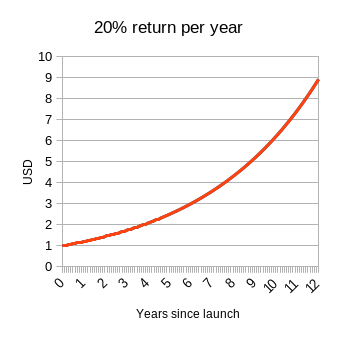

Obviously, there is no real investment that will return anywhere near 20% per annum, and definitely no A real investment that can maintain a 4% annual rate of return forever. But what happens if you try?
What I'm trying to say is that Stablecoin basically has two ways to track such Index:
1. It charges holders some sort of negative interest rate in order to The dollar-denominated growth rate in the underlying offset index.
2. It became a Ponzi scheme , which gave Stablecoin holders fantastic returns for a while, until one day it suddenly crashed.
It should be easy to understand why RAI(1) and LUNA(2), so RAI is better than LUNA. But it also speaks to a deeper, more important truth about Stablecoins: For a secured algorithmic Stablecoin to last, it must somehow include the possibility of implementing negative interest rates. If RAI is programmatically prevented from implementing negative interest rates (which was the basic practice of early single-collateral DAI), it can also become a Ponzi scheme if it is pegged to a rapidly appreciating price index.
Other than the crazy assumption that you build a Stablecoin to track a Ponzi Index, a Stablecoin has to be able to cope somehow even if At zero interest rates, the situation where holding demand exceeds borrowing demand. If you don't, the price will rise above the anchor, and the Stablecoin becomes vulnerable to two-way price swings, which are rather unpredictable.
Negative interest rates can be achieved in two ways:
< /p>
1. RAI dstyle, has a floating target, if the redemption rate is negative, this target can drop over time.
2. Actually, the balance will decrease over time.
Option (1) has UX flaws, Stablecoin no longer clearly tracks "$1" . Option (2) needs to have the disadvantage of developer experience, that is, developers are not used to dealing with receiving N Tokens, which does not mean that you can send N coins unconditionally in the future. But choosing one of them seems inevitable — unless you go the way of MakerDAO, a hybrid stablecoin that uses pure (decentralized) crypto assets and centralized assets (such as USDC) as collateral.
What can we learn?
In general, encryption The field needs to change the attitude that depends on endless growth to be safe. It is certainly unacceptable to maintain this attitude by saying "the world could work the same way". Because the world is not trying to provide any return, the economy does not rise according to rationality, but rises pathologically, and of course there must be fierce criticism.
Instead, while we should expect growth, we should look at their steady state, even It is the pessimistic state of how they will behave under extreme conditions, and whether they can exit safely in the end, to evaluate the security of the system. If a system passes this test, it does not mean it is secure, it may still be vulnerable for other reasons. Collateral ratios are insufficient, or there are flaws or governance holes, but corner cases and robustness should be the first things we check.
Original link
Welcome to join the official BlockBeats community:
Telegram Subscription Group: https://t.me/theblockbeats
Telegram Discussion Group: https://t.me/BlockBeats_App
Official Twitter Account: https://twitter.com/BlockBeatsAsia