Bankless: 5 Best DeFi Yield Opportunities in a Bear Market

Original title: " Bankless: Best Gain in Crypto Bear Market "
Original author: Ben Giove, Bankless analyst
Original compilation: Nanfeng, Unitimes
DeFi revenue Is the glory days of farming over?
As token prices fall, liquidity mining incentives dry up, and on-chain activity slows, DeFi yields continue to decline. Gone are the days when stablecoin deposits placed into DeFi money markets could generate double-digit returns, as returns over 4% are now hard to find in these same protocols.
The drying up of income is also accompanied by the overall capital outflow of DeFi. With the collapse of UST, the TVL (total value locked) of all blockchains within a week From $137 billion to $85 billion, a drop of almost 38%. We have also seen many pegged coins such as stETH-ETH drift away from the peg as panic spreads throughout the system.
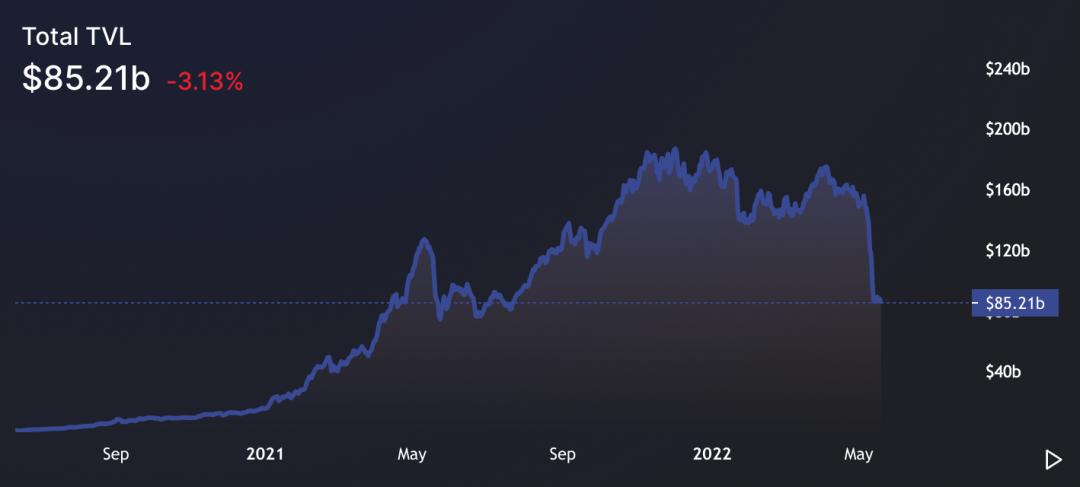
Above: TVL changes of all DeFi. Source: DeFi Llama
Nevertheless, there are still some attractive income opportunities for users willing to take risks. Remember, DeFi is a frontier - in order to achieve high returns, you must take corresponding risks.
Let’s explore some of the most attractive and risk-adjusted income opportunities still available in ETH, BTC and stablecoins.
***This article does not constitute any investment advice or recommendation.
1. Maple Finance
Network: Ethereum, Solana
Assets: ETH, USD
Expected Yield: 5-9% APY
Risk: Medium/High
Protocol Overview
Maple is an under-collateralized lending protocol. The platform provides a venue where users (liquidity providers) can lend their tokens to KYC-certified institutions, such as Alameda Research and BlockTower Capital, allowing these companies to obtain on-chain credit.
Loans issued on Maple come from lending pools managed by other professional Crypto companies (called Pool Delegates, i.e. liquidity pool representatives) Users/liquidity providers can deposit assets into these lending pools), and these companies conduct due diligence on the creditworthiness of borrowers in their respective pools. The protocol, which is live on Ethereum and Solana, has generated more than $1.3 billion in loans since launch.
Earning Strategy
Currently there are three Ethereum pools on Maple accepting user deposits: by Orthogonal A USDC pool managed by Trading (a trading company), and a USDC pool and wETH pool managed by asset management company Maven 11. Users can deposit assets of the same name in each pool to earn loan interest and MPL rewards. The USDC pool earns between 8.3-8.7%, while the wETH pool earns 6.9%.
Risks
Before deciding to deposit assets into the Maple protocol, users should know a few key risk. The first is liquidity risk, as Maple's depositors are subject to varying lock-up periods, currently 90 days for each pool discussed above.
In addition, the depositor of course bears the risk that the borrower will not be able to repay the loan. While this is a permanent on-chain stain on the borrower’s reputation, it is of course possible for the borrower to default on their loan. Given the low principal coverage ratios of these pools (between 1.5-3.5% of borrowed principal coverage per pool), users have little recourse in the event of borrower default.
2. Convex Finance
Network: Ethereum, Solana
Asset: USD
Expected rate of return: 8-11% APR
Risk: Low
Protocol Overview< /h4>
Convex is a revenue protocol built on the decentralized exchange Curve. Seasoned DeFi users know that Curve uses veToken (Voting Escrow Token ) model, in which Curve protocol’s native governance Token CRV holders can lock their CRV Token In exchange for veCRV (an illiquid, non-transferable Token ). When providing liquidity, veCRV holders can earn "boosted" CRV rewards (up to 2.5x), the size of the boost is the same as the CRV held by LPs (liquidity providers) Token Quantities are proportional.
Consider that for many Curve users a higher amount of CRV will be required in order to receive a larger "accelerated" CRV reward Token , so the cost is too high. For this reason, Convex provides a valuable service, which is to provide "accelerated ’ CRV rewards, thereby increasing their earnings.
Earning Strategies
There are many farms on Convex where users can stake their Curve LP Tokens to earn Curve transaction fees, CRV rewards, and CVX rewards. The three farms with the highest yields are d3Pool (consisting of FEI, alUSD and FRAX stablecoins), alUSD-3CRV pool (consisting of alUSD, DAI, USDC and USDT stablecoins), and GUSD-3CRV pool (consisting of GUSD, DAI, Composed of USDC and USDT stablecoins). The three pools currently yield between 8-11% respectively.
Risk
Although providing stablecoin liquidity on Curve and pledging Curve LP tokens On Convex, there is a reduced risk of impermanent loss (since many of these assets are pegged to each other), but there are still several important risks that users should be aware of. First, users are exposed to the risk of the underlying assets in each pool. If the market loses confidence in one of the assets in the pool, the assets in the Curve pool may become disproportionate. This means that not all LPs ( Liquidity Providers) can withdraw each asset in the same proportion. In addition, users are also exposed to two layers of smart contracts, Convex and Curve.
3. Balancer
Network: Ethereum, Arbitrum, Polygon
< p>Assets: ETH, USDExpected rate of return: 5-11% APR
Risk: Low
Protocol Overview
Balancer is a decentralized exchange. The protocol is highly customizable as it supports the creation of multi-asset liquidity pools with different weights (i.e. assets in the liquidity pool can have different weights), unlike other AMMs (automated market makers such as Uniswap and Curve) has a traditional equal-weight liquidity pool model.
The Balancer pool also uses a vault structure, so that idle funds in the liquidity pool can be routed to other protocols (such as the lending market), providing liquidity sex provider (LP) to earn additional income. Like Curve, Balancer uses a veToken (voting escrow Token ) model, BAL Token Holders can lock their BAL in exchange for veBAL Token , allowing them to receive "accelerated" rewards when providing liquidity.
Revenue Strategy
Like Curve, there are many liquidity pools on Balance, and In these pools, liquidity providers (LPs) can earn income without incurring impermanent losses. This includes the bb-aUSDT-DAI-USDC pool, which currently yields between 8-18% (depending on the size of the LP "acceleration"), and users can earn transaction fees, BAL rewards, and interest income from Aave (because there is no The used liquidity will be deposited into the Aave money market to further increase the income of LPs).
Other attractive Balancer liquidity pools include USDC, DAI, and USDT pools (with yields between 5-11%, depending on veBAL holdings amount) and wstETH-ETH pool (yield between 7-11%). It is worth noting that the current wstETH-ETH pool is unbalanced, which holds approximately 65% of wstETH and only 35% of ETH.
Risk
The risk of providing liquidity on Balancer and providing liquidity on Curve risks are similar. In addition to smart contract risk, Balancer's LPs are exposed to every underlying asset in the liquidity pool and the risk that the liquidity pool becomes unbalanced. Additionally, they may be at risk of impermanent losses.
4. GMX
Network: Arbitrum, Avalanche
Assets : ETH, BTC, USD
Expected rate of return: 30-45% APR
Risk: medium/high
Protocol Overview
GMX is a decentralized perpetual contract exchange launched on Arbitrum (L2 network) and Avalanche. The protocol allows traders to borrow from a multi-asset liquidity pool called GLP, allowing them to gain up to 30x leverage.
GLP is similar to an index in that it mainly includes high market capitalization assets such as ETH, BTC and stablecoins such as USDC, DAI, USDT and FRAX. Individual assets in the GLP pool are weighted based on their position utilization, with volatile assets weighted higher when traders on GMX are long, and stablecoins on GLP when traders are short The pool occupies a larger proportion.
Revenue Strategy
The main way for users to obtain income on the GMX platform is to flow to GLP Liquidity pools provide liquidity. The liquidity pool is currently yielding about 43%, and its returns include ETH-based borrowing interest from traders using leveraged positions, as well as esGMX (escrowed GMX), which is a vested return on GMX.
Risks
There are several important risks, GLP Token Holders should know. First, just like providing liquidity for any liquidity, they also hold price exposure to the underlying asset in the GLP pool. In addition, by providing leverage to traders through GLP, liquidity providers are essentially all traders' counterparties. The price of GLP reflects this, rising when the market moves against the trader's position and falling when the market moves in line with the trader's position. Additionally, GLP holders are of course exposed to smart contract risks.
Opportunities for Additional Earnings
Now that we have discussed in depth some of the more profitable opportunity, let's quickly highlight some of the other ways in which users can put their capital to work.
1) Notional Finance (3-6% APY - Risk: Low)
< br>
Users can deposit ETH, USDC, DAI and BTC to Notional Finance, an Ethereum-based lending platform, and receive fixed-rate loan interest, currently ranging from 3-6%.
2) Tokemak (6-9% APR - Risk: Medium)
Users can unilaterally deposit ETH and various stable coins (such as USDC, DAI, alUSD, FEI, and FRAX) into the decentralized market-making protocol Tokemak to earn TOKE rewards.
3) Ribbon Finance (14-25% APY - Risk: High)
< br>
Ethereum, Avalanche and Solana users can deposit their funds into Ribbon's vaults by running automated options strategies (such as selling covered calls and cash-secured puts) to generate income,
Summary
The current rate of return has been compressed, but still exists Attractive opportunities where users can earn healthy yields relative to traditional markets and expand Crypto reserves in this bear market.
In this time of panic, capital may be fleeing DeFi, but those willing to stay on the front lines will continue to be rewarded.
**This article only represents the views of the original author and does not constitute any investment opinion or suggestion.
Original Link
Welcome to join the official BlockBeats community:
Telegram Subscription Group: https://t.me/theblockbeats
Telegram Discussion Group: https://t.me/BlockBeats_App
Official Twitter Account: https://twitter.com/BlockBeatsAsia
 Related Articles