Is Terra stable and faith collapsing? In-depth interpretation of Anchor lending mechanism
原文标题:《 Terra 算稳信仰崩塌?Anchor 借贷机制深入解读 》
Author: Alice, Jonas, Foresight Research
Content in this paper,
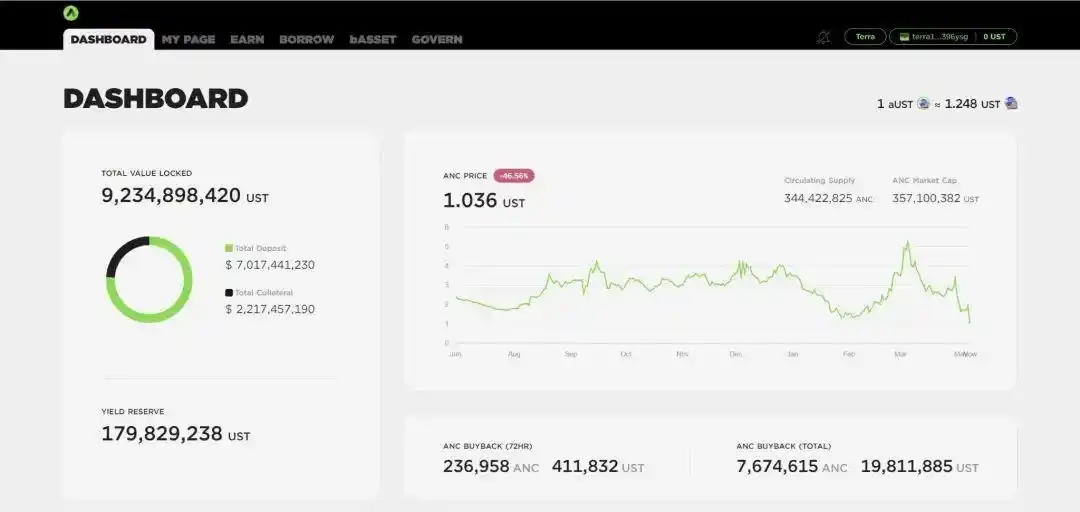
As Terra UST was heavily unanchored from the DOLLAR, a large number of investors pulled out of the market. The Anchor Agreement, the most important agreement in Terra ecology, saw its total deposits collapse from $14 billion to below $7 billion, with the Agreement Token ANC down 48% on the day.
If a benign business cycle can be maintained, the business model of Anchor Agreement is feasible in theory, but its biggest problem lies in the low actual borrowing rate and low capital utilization efficiency. The income generated by Anchor agreement (interest paid by the borrower + pledge income) cannot balance with the expenditure (APY of 19.5% annualized by the depositor), and the deficit of the two parties depends on long-term blood transfusion from the Treasury.
在 Terra 此次暴跌之前,Anchor 做过不同的尝试提实际高借款率。比如,给借款人发放 ANC Token 激励、计划推出 Borrow V2 以绑定 sol avax 等其他公链资产,并提供更优惠的借款条件。这些尝试尚未见到成效,Anchor 距离在没有外部资金持续注入的情况下实现自给自足还很遥远。
Terra's Treasury will not be fully depleted until June 2022, given the amount of time the reserves can buy, but Terra's steady empire's financial storm is coming sooner than we thought.
The credibility, market confidence and community communication of stablesoin platforms are very important during a slump, especially to the extent that participants agree not to sell at a certain price point.
As the pledge is gradually unlocked, it is expected that LUNA will continue to have selling pressure in the next 21 days, which will form great pressure on TVL of Anchor. It is hoped that Anchor can fall on its feet and survive this difficulty, emerge from ashes and re-enter a virtuous cycle track.
preface
May 10, 2022 UST is seriously unanchored from the DOLLAR, falling as low as $0.60 in 24 hours. Terra's algorithmic stable currency and the financial empire built around it are under tremendous pressure.
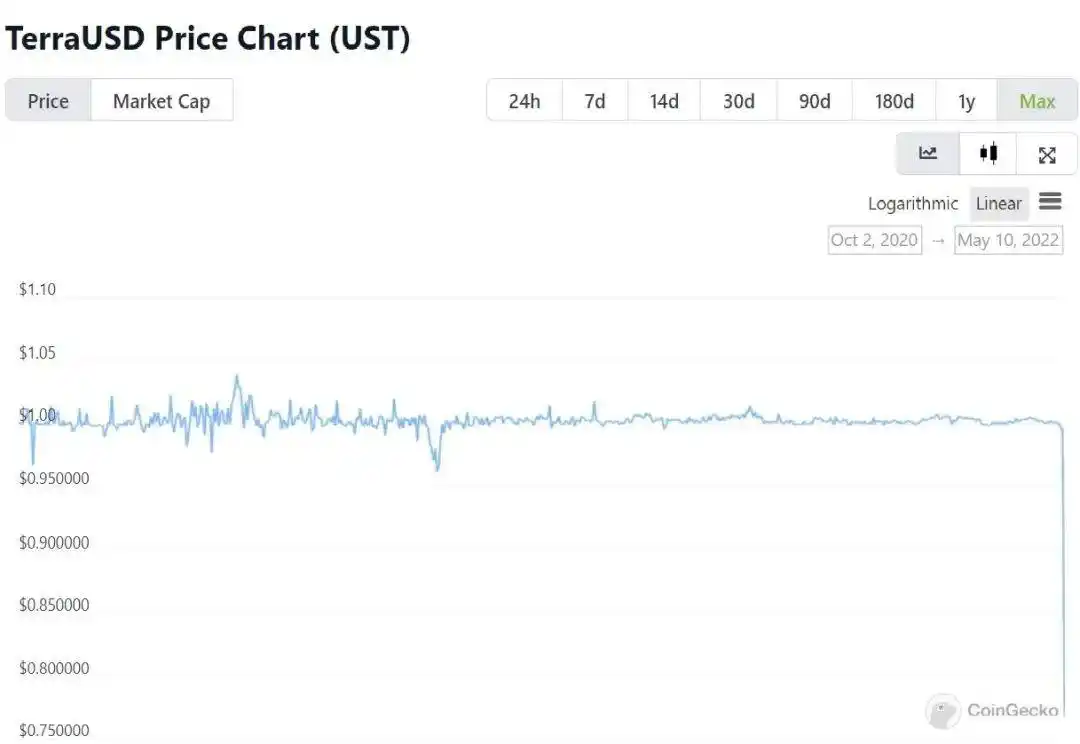
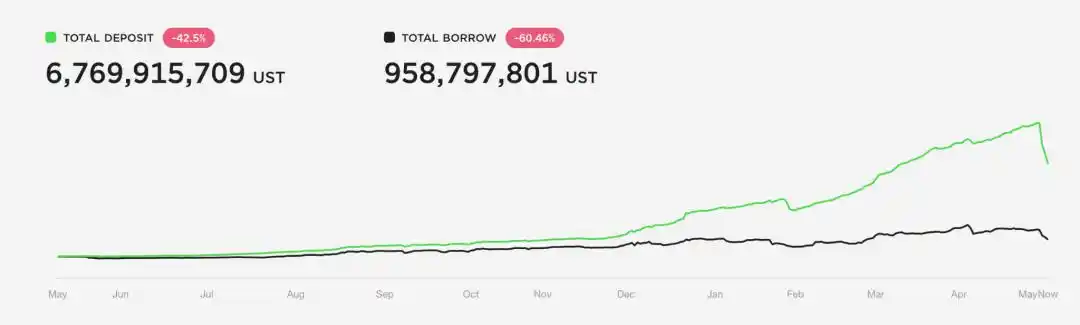
Terra stabocoin UST's 19.5% APY yield rate has become the key to Anchor's rapid growth. This interest rate can be provided while keeping UST price anchored to US dollar through the borrowing mechanism based on Anchor. This paper will explain how the lending mechanism of Anchor operates, the latest status quo of the agreement and the problems exposed.
1. Loan mechanism
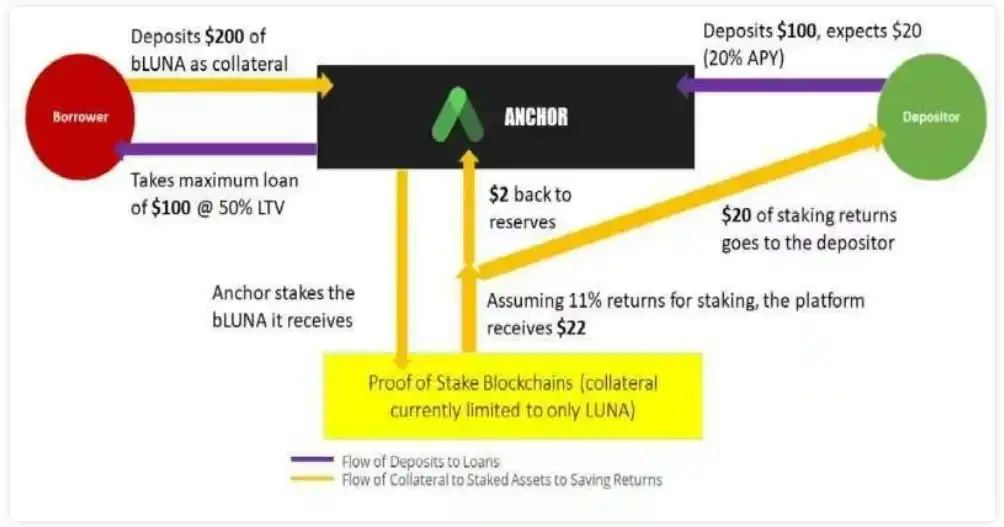
The Anchor agreement is essentially a Defi lending agreement. On the one hand, it attracts more deposits to improve the utilization rate of UST and pays the depositors an annual rate of return of 19.5%, which is the expenditure side of Anchor. On the income side, Anchor lends out the deposit in the agreement, and the borrower needs to provide bluna assets with excess mortgage (LTV ~ 60%-80%), and pay interest on the loan to Anchor. After receiving collateral from the borrower, Anchor will pledge the assets it receives in return for staking yield.
The Anchor business model can be summarized by the following formula:
Profit /loss of the Anchor agreement = the interest the borrower pays to the agreement + the borrower's collateral asset staking yield- 19.5% APY to the depositor
It can be clearly seen in this formula that Anchor income is generated by borrowers, while expenditure is generated by depositors, so the utilisation ratio directly affects whether Anchor agreement can be self-sufficient or not. As of April 25, 2021, Anchor's borrowing rate was only 22%, that is to say, for every $of deposit in the agreement, only $22 was lent out and generated actual income.
In fact, Anchor also made different attempts to improve the actual borrowing rate before UST collapsed
Next, we will quickly introduce how its Anchor stimulates borrowers and how to determine the interest rate of borrowing.

截至 2022 年 4 月 25 日,Anchor 的借款利率(APR)目前为 11.7%,问题来了,我们为什么要在 Anchor 上借款呢?其他货币市场,比如 AAVE、Mars 和 Edge,借款利率还不到这个利率的一半。为了吸引借款人,Anchor 提供了 ANC 形式的 Token 激励,而获取 Token 后用户有权对即将到来的协议提案进行投票。目前 Token 激励的上限暂定为 1 亿枚 ANC,从启动开始的 4 年内会逐步释放,而这一设定可以通过治理投票进行调整。

2. Asset mortgage requirements
In order to loan a UST, users must first provide assets as collateral, and if their loan-to-value ratio is too high, they can be forced to reduce the loan. This is to ensure the supply of liquidity for deposits.
There are currently 3 bAssets available as bLuna, bEth and bAtom. BAssets are a simple staking of each kind of collateral, by which an Anchor gets a pledge yield (in UST units), which is transferred to the Treasury's revenue reserve for payment to the depositor. Among them, Lido will be responsible for the pledge of bLuna and bEth, while pSTAKE will be responsible for the pledge of bAtom.
As noted above, the proceeds of the bAssets pledge are not attributable to the borrower who provided the collateral. Instead, the proceeds go into reserves, which can then be used to replenish the Treasury in times of need. And that's why Anchor has so far been able to maintain a much higher rate of return than other borrowing/lending services. The borrower not only has to pay interest, but also has to put in additional proceeds from the collateral it provides.
举例来看,对于存款方而言, 假设如果一个借款人提供 1000 美元的 bLuna 作为抵押品,并借入 500 美元。
Suppose the borrowing rate (APR) is 10%, while Luna's pledge yield is 8%. Then the $500 lent will create (10%+8%+8%) =26% income for Anchor deposit.
This mechanism creates capital efficiency for Anchor depositors, who can not only get the interest payment of the borrower, but also get pledge income for the $500 they lend. However, there are some obvious problems with this approach on the borrowing side. Logically, forgoing 8 percent of Luna's proceeds and then paying 10 percent is not an attractive proposition for anyone. This means that whatever they do with UST must have a high enough yield to be motivated to borrow, which will undoubtedly affect borrowers' motivation.
继续刚刚那个例子, 对于借款方而言,一个用户提供 1000 美元的 bLuna 作为抵押,并借入 500 美元。
Assuming that the annual interest rate of borrowing is 10%, since the interest rate can be partially offset by ANC incentive, the annual interest rate of net borrowing is (10%-ANC incentive), continue to assume that Luna's pledge yield is 8%& NBSP;
So this $500 loan will yield to the borrower :(-10%+ANC incentive + $500 investment return)
The borrower only produces investment income in the loan. When the net borrowing rate + Luna yield is greater than the sum of opportunity costs, they will have an incentive to borrow.
3. Main problems faced by Anchor
It worked very well in the bull market of 2021. In a bull market, volatile coins rapidly and consistently soared in price, meaning that not many people were willing to hold them and earn a profit. As deposits shrink and borrowing increases, the borrowing rate + pledge rate can easily meet the minimum yield requirement of 19.5%, so that the Treasury is in surplus and yields can start to grow in preparation for a possible bear market later.
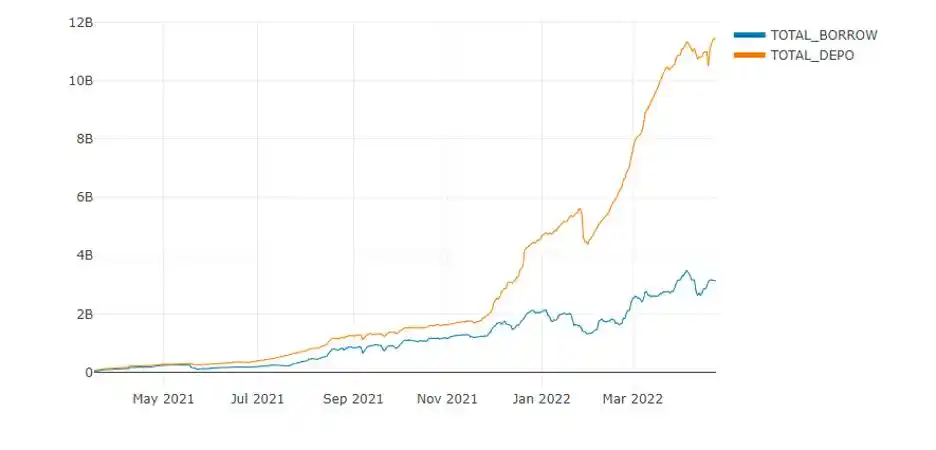
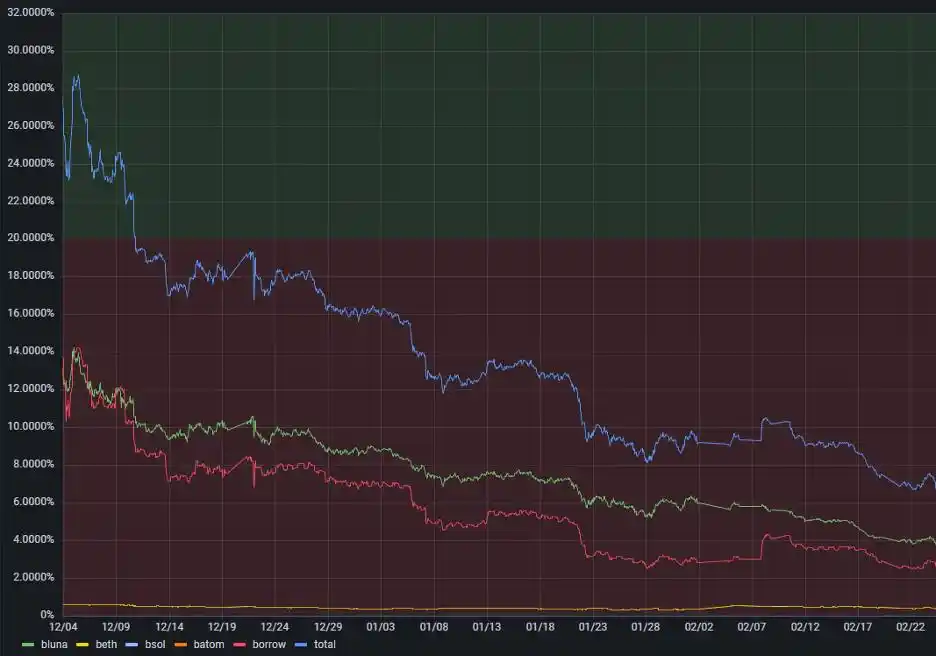
The exponential growth in deposits also means a decline in utilization, which we know will lead to a decline in the lending APR in an attempt to motivate borrowers to borrow. But such "incentives" are ineffective in a more pessimistic environment.
Where will the other 14.1% come from? The answer is reserves.
As noted above, this is a pre-designed solution in which yields saved during bull markets are used to "save the day" during downturns. Unfortunately for Anchor this issue has not really been addressed and the huge gap will still quickly deplete the reserve pool.
Anchor is supported by Terraform Labs (TFL) and Luna Foundation Guard (LFG). During the May 2021 crash, TFL burned $70 million worth of Luna for UST, directly into the yield reserve to maintain yields and keep UST stable. LFG (with a donation from TFL) recently injected $500 million worth of UST into its reserves.
But that will do little to stem the drain on the reserve, which at the current rate is still set to run out by mid-June 2022.
In a sense, the continuous infusion of external funding can be viewed as a marketing expense to sustain the needs of UST long enough to establish a mature, multi-chain ecosystem with multiple use cases. This will enable UST to compete directly with centralized stablecoins such as USDC and USDT. However, at this point, it doesn't matter if Anchor only gives UST a yield rate of 10-15%, because it is still higher than the interest rate of other stablecoins.
From the perspective of continuous capital injection and other behaviors, The Anchor team clearly knows that the APY of the depositors will eventually decline, and the reserves cannot remain solid forever. This has caused caution among potential savers and has meant the withdrawal of some existing deposits.
4.Anchor Borrow v2
With the launch of Anchor Borrow V2, Anchor has upgraded its borrowing mechanism to improve borrowing enthusiasm. Rather than simply transferring the pledge reward to the depositor, V2 uses collateral derivatives that compound automatically as collateral. That means their collateral rewards can be used to buy more of the asset, boosting the value of the derivatives.
Currently the only mortgage asset on Anchor that supports this mechanism is sAvax, backed by BenQi on Avalanche. For people who offer sAvax, they don't lose the return on their collateral, so their only cost is the APR. In addition, the borrower does not need to pay interest at any time, the borrower only needs to pay interest when the loan is closed or liquidated. The new borrowing rate calculation method has not been fully determined, is expected to be composed of borrowing rate + pledge income. Such a mechanism seems more attractive than letting users post bAsset as collateral to borrow money.
Borrow V2 also enables agreements to support more collateral categories. Because the new mechanism does not require additional auditing of smart contracts, it is easy to convert sAvax pledge rewards into UST and inject income reserves. Increasing the variety of collateral is critical to the health of the platform. First, it can attract users who hold these assets to become new borrowers and make Anchor more stable at the same time. But this is just a prediction at the moment, as sAvax has only recently been supported.
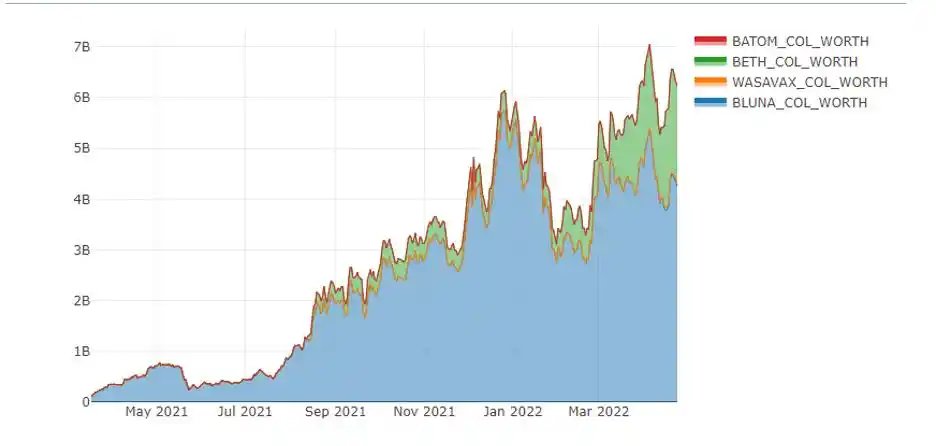
Since its inception, UST has been aiming to be the primary exchange intermediary for all DeFi applications, not just Terra Ecology itself. This means that it is understandable that more public chain collateral assets will be introduced and other public chain ecosystems will be connected, which will promote the growth of UST market demand and hopefully promote the continuous growth of loan demand. However, the problem is that the cross-chain of Anchor not only brings the borrowing demand, but also brings a large amount of deposit demand. Anchor's 19.5% stablecoin yield is far more attractive than anything else Anchor has to offer. The rapid growth of the user base is accelerating this risk.
Therefore, before stepping up efforts to promote cross-chain implementation, attempts should be made to find an answer to this problem. There have been a number of proposals on the Anchor forum that attempt to address the aforementioned issues.
In March this year, the community adopted a proposal to adjust the APY of deposits to a semi-dynamic rate of interest based on fluctuations in yield reserves. If Treasury reserves continue to fall, the minimum yield will fall to 18.5% from May 1, 2022, and continue to fall by up to 1.5% each month thereafter until 15%. If Treasury reserves recover, the yield will also recover.
However, the problem still exists. The transition from Anchor Borrow V1 to Anchor Borrow V2, and the transition to automatic compound mortgage derivatives as collateral, is likely to mean less amount flowing into the Treasury and longer remittance period, because the system lacks additional contribution to income reserve. So the dynamic rate of return is in some sense a relatively manageable solution.
But on the other hand, it can also be seen as taking the easiest approach, choosing to cut incentives directly to the recipients rather than finding ways to stimulate demand for borrowing and bring in more capital.
至于寻求刺激借款需求的建议,大多数都集中在改善 ANC Token 的价值累积上。
ANC incentives paid to borrowers are basically the only reason to borrow on Anchor. High borrowing rates and forgone mortgage yields (if the user provides bAssets as collateral) mean that the system is ineffective without a high enough allocation rate to compensate.
5. Liquidation mechanism
A UST can be lent upon Posting collateral, but the position will be liquidated if the value of the UST borrowed reaches a certain percentage of the collateral value. This ratio depends on the type of collateral. Mortgage bLuna can lend 80% of UST, while bEth, bAtom and sAvax borrow 75%, 60% and 60%, respectively.
Clearing is necessary to keep the pool of deposits liquid and to prevent depositors from being unable to withdraw their money properly. To incentivize users to bid on liquidated collateral, discounts of 1-30% are offered on each bid. For example, users can bid for bLuna at a price 4% below the market price. The bidding will be carried out in the order of discount premium, and the bidding with lower discount will be the priority.
How much of your collateral is sold in a liquidation event depends on the total value of the collateral posted at the time of liquidation. If the value of the collateral provided is less than $2,000, it will be liquidated in full. If the value of the collateral is more than $2000, then your collateral will be liquidated to less than 80% of a specific liquidation ratio (for example, if you have $5000 bLuna as collateral at liquidation, you will be liquidated to 64% of LTV).
Any user can bid on any form of collateral under liquidation. This can be done by interacting directly with smart contracts or through a front end such as Kujira, which makes clearing more efficient due to its ease of use. This means that liquidated collateral is often sold at a lower discount, which can also reduce the volume of clearing.
In Luna's plummeting market, as the currency price falls all the way, a large number of Bluna mortgage assets will hit LTV and be forcibly liquidated, triggering the asset auction process and robot arbitrage, which will undoubtedly lead to Luna's serial decline.
6. The importance of the credit and market confidence of stabocoin issuers
After the collapse of the Bretton Woods system, the dollar was decoupled from gold, but the dollar still maintained its status as the world's currency, the most crucial point is that people have faith in its value. Because both the dollar and the pound are just pieces of paper, a currency symbol with no value in and of itself, people's confidence in it comes from the promise of the dollar's purchasing power and the Backing of the Federal Reserve.
Similarly, what determines Terra's total market value and trading depth is the degree of consensus and market confidence in the value of UST, an algorithmic stabocoin that challenges fiat currencies. In Terra's ecology, UST is the engine of Luna, while Luna is the stabilizer of UST. When the two interact, they tend to form a positive spiral when the trend is good, and when it is not, they tend to fall into a death spiral:
If people can stably exchange 1 DOLLAR OF UST for 1 dollar of Luna, and Anchor depositors can continue to obtain benefits, people will have stronger confidence in the staboin model, and more people will be willing to participate in ecology, so as to improve the liquidity of capital pool and broaden application scenarios. As a result, more Luna will be burned to raise the price of the coin, thus attracting more people to enter and promoting the large-scale adoption of UST chain up and down through a set of self-reinforcing business model.
The possibility of a staboin death spiral increases if the staboin agreement fails to support anchoring effectively, or if staboin issuers lose public credit, undermining confidence in the staboin model and panicky selling by participants
No one likes to take a loss, but there is a herd mentality, and in this case, stablesoin users are actually more likely to dump their stablesoin if they become unmoored. Therefore, the credibility of the stablesoin issuing platform, the confidence of the market in stablesoin and the communication between the community are very important, especially to persuade participants to agree not to sell at a certain price point, which is very important to some extent.
Look to the future
It still has a long way to go for Anchor to be completely self-sufficient without external capital injection. The current problem lies in low borrowing rate and low capital utilization efficiency, and 19.5% APY needs to be paid to a large number of depositors, resulting in the whole system going beyond its income.
Terra's reserves will not be fully depleted until June 2022, given the amount of time the reserves will buy, but the financial turmoil in Terra's stable empire is coming sooner than we thought.
LUNA currently has about 350 million units in circulation, about 70% of which are pledged. About 250 million LUNA pledged has a waiting period of 21 days for withdrawal. It is expected that LUNA may continue to sell in the next 21 days, which will form great pressure on Anchor's TVL.
It is hoped that Anchor can fall on its feet and survive this difficulty, emerge from ashes and re-enter a virtuous cycle track.
Welcome to join the official BlockBeats community:
Telegram Subscription Group: https://t.me/theblockbeats
Telegram Discussion Group: https://t.me/BlockBeats_App
Official Twitter Account: https://twitter.com/BlockBeatsAsia

 Related Articles