Well-known entrepreneurs such as SBF and Circle founders talk about NFT, stablecoins, finance and regulation
Original title: "Foundational technology for a new financial system"
Original source: Bank for International Settlements
Original translation: Alpha Rabbit, Alpha Rabbit Research Notes
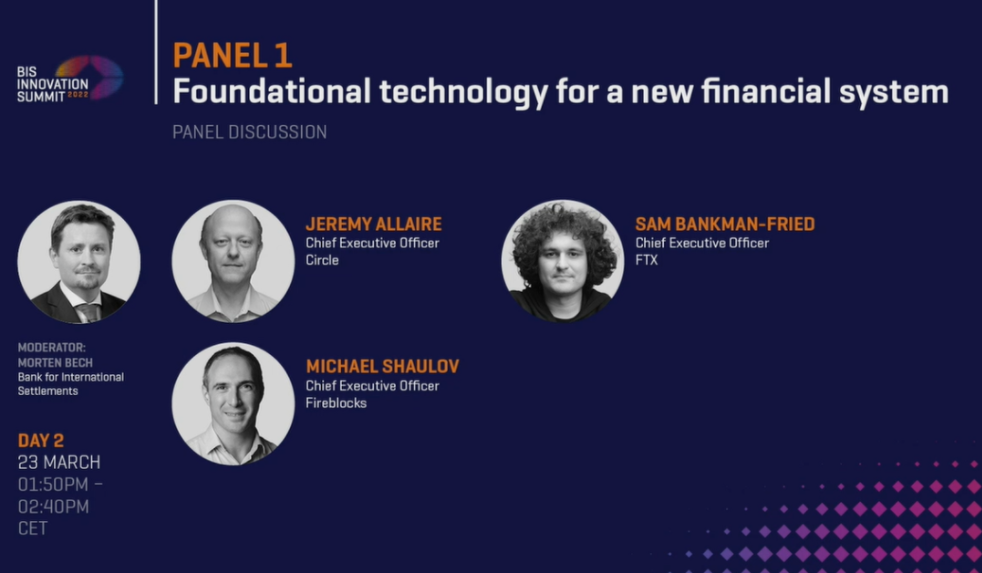
From March 23rd to March 24th, 2022, the Bank for International Settlements (BIS) held the Bank for International Settlements Innovation Summit. In the panel 1 discussion session, Circle CEO Jeremy Allaire and FTX CEO Sam Bankman were invited - Michale Shaulov, CEO of Fried and Fireblocks.
The author participated in the meeting and listened to the content. How do well-known entrepreneurs in the encryption field see the central bank’s digital currency? How do you view the relationship between regulation and technological innovation? Below is the full text of Panel 1.
*Note: Due to equipment, network, speech speed and other issues, the author's guess of the original words may not be accurate, it is for reference only, and notes are added where necessary It is up to the readers to make their own deduction and judgment, and the official expression of the conference shall prevail. Do not provide any investment advice, do not accept any PR requirements, this article does not constitute any investment advice.
Summary of Core Points
· In the future, we will see to considerable disintermediation. Users have fairer access to financial markets, and we are approaching a world where every user, whether it is a complex trading firm or an ordinary person, has access to fair financial applications, protocols, and liquidity .
· In essence, NFT is not just digital art, it actually has other implications, including security, participation in other financial applications, and more. And we actually see a lot of participants, including many large asset management companies and investment banks, starting to study how to spread NFT to the primary and secondary markets.
· Everyone will be able to abstract away the complexities of DeFi's decentralized financial space. But the real question is, it's still an open question as to who will be able to create the best experience, the one that consistently links these services.
· New infrastructure is being built for value exchange, not just in the field of payment, but in the structure of how economic organization occurs, including how entities conduct economic Swapping all the structures, it's amazing. A lot of times when these breakthrough technologies come out, what if we look at them from an old world point of view and compare them to faster facsimiles? Better long distance calls? This is not appropriate.
· There are inherent compatibility issues between new technologies and legacy systems, for example in the case of integrating our infrastructure with core banking platforms. For example, many DeFi infrastructures run indirectly on the cloud, and most of them are OK at the level of technical implementation, but the problem is that the Know how, capability gap, and risks faced by different teams are very different. It can be seen how strong some market players are, while others are very average.
· The real problem is the very lack of regulatory clarity that exists in many jurisdictions. But most regulators are currently looking for workarounds to enable innovation.
· Success and failure will happen, in my opinion, break down the problem, for example, what value can the service create? How to get more customers? Improve the economic system? I think the regulatory framework for cryptocurrencies around the world is a bit of a mess right now. Each region's approach is different, and each jurisdiction, is trying to address regulatory issues individually. But I think that there has been a lot of improvement in terms of regulation. In the past few years, almost no country in the world has a framework for digital assets.
· Regarding regulation: the United States has made great progress in the last year, and the core we will see is: one, the reserve audit proof of stable currency may become the standard; the second is to include the market , regulation, clarity, federal oversight, systemic risk, protection aspects. The third is that there will be a registration system for some digital assets, many of which may blur the boundaries between traditional asset classes.
· In my opinion, software changes the architecture, which in turn changes the nature of the asset. We need to come up with new definitions for digital assets, rather than trying to cram everything into an existing system. Digital asset is a currency, it is a commodity, and it is a security, but our definition of digital assets must be very specific, because we have found many digital assets that meet two or more of the above attributes.
· However, risks still exist, including various risks in fund monitoring, custody, and operation. Disclosing risks is of course important, but we need to reach some kind of consensus. At present, some people are trying to map the operation of the existing financial system and its regulations to the open source infrastructure of the Internet, but I don’t think there is any way to compare the two.
· I think there is definitely a coexistence between CBDC and stablecoins, including digital treasuries. But most of the market and money is actually run through different assets and bonds in the market to unleash the real power. The central bank has to take both things into account, unless we have a cross-chain swap like an atomic swap between these two assets.
· I think what might be really interesting is to give people the freedom to create sandboxes that don't necessarily run across the entire world, but do put some of these projects in one Test it in a controlled environment, and then people can actually see the effect, and they can iterate on it.
Basic Technology of the Emerging Financial System
Introduce the participants first: the moderator is Marten Bech, head of the Swiss Innovation Center of the Bank for International Settlements
< /p>
Entrepreneurs include:

Circle Company, Jeremy Allaire—CEO (well-known serial entrepreneur) < /h4>
Circle was founded in 2013 by Jeremy Allaire and Sean Neville. In September 2015, Circle received its first BitLicense issued by the New York State Department of Financial Services. In April 2016, the British government approved Circle's first virtual currency license, and Circle is also the issuer of the USDC stable currency.
Financing situation: From 2013 to 2016, Circle received more than 135 million US dollars in venture capital in 4 rounds of investment, including 50 million led by Goldman Sachs dollars. In June 2016, Circle D round of financing was $60 million, and on May 15, 2018, Circle raised $110 million.
Let me introduce the CEO of Circle, Jeremy D.Allaire:
Jeremy was born in 1971 , co-founded Allaire Corporation with his brother JJ Allaire in 1995; Allaire Corp. went public in January 1999 and was acquired by Macromedia in 2001.
In February 2003, Allaire left Macromedia to join venture capital firm General Catalyst as a technologist and entrepreneur-in-residence. Allaire, who founded Brightcove in 2004 and took the company public in 2012, stepped down as CEO in 2013 and is now chairman of the board.
In October 2013, Allaire announced the launch of Circle, an internet-based crypto/consumer finance company that aims to leverage the power and benefits of digital currencies such as BTC to mainstream consumers.
FTX Corporation, Sam Bankman-Fried—CEO
Sam Bankman-Fried is Stanford Son of law school professors Barbara Fried and Joseph Bankman, attended Canada/US Math Camp (a summer program for mathematically gifted high school students as a teenager. From 2010 to 2014, Bankman-Fried attended MIT , he majored in physics and minored in mathematics.
In the summer of 2013, Bankman-Fried worked at Jane Street Capital, a well-known hedge fund. In November 2017, he founded Quantitative trading company Alameda Research.
After attending the cryptocurrency conference held in Macau at the end of 2018, and also inspired by the concurrent fork of BTC, he moved to Hong Kong, founded the cryptocurrency derivatives trading platform FTX in April 2019. SBF is a supporter of altruism and pursues altruism as a career to make money. He is also a member of Giving What We Can and plans to Donates most of his wealth to charity. SBF is a vegetarian and often sleeps in his office next to his computer.
FTX: Well Known Cryptocurrency Trading platform, as of July 2021, the trading platform has an average daily trading volume of 10 billion US dollars and more than 1 million users;
· January 2022, FTX raised $400 million in Series C financing at a valuation of $32 billion;
· On February 11, 2022, FTX.US announced that the company will
· In February 2022, it was reported that FTX was creating a gaming division that would help video Game developers use blockchain-based technologies like cryptocurrencies and NFTs for video games;
Michael Shaulov—CEO, Cybersecurity Serial Entrepreneur, Fireblocks )
Michael is the CEO of Fireblocks, a secure digital asset infrastructure company. Before joining Fireblocks, he participated in the founding of Lacoon Mobile Security, which was later acquired by Check Point. Michael is the network Safe for serial entrepreneurs and entrepreneurs.
He has presented numerous times at RSA Conference, BlackHat and Infosec conferences. Prior to business, Michael pioneered mobile security at the Israeli Military Technology Unit (8200) and received a special honor from the President of Israel for his outstanding contributions.
Fireblocks: Founded in 2018, Fireblocks is committed to building security infrastructure and hosting services. The core technology is mainly composed of Fireblocks Networks and MPC-based wallet infrastructure . Clients such as banks, fintech firms, trading platforms, liquidity providers, OTC traders and hedge funds are able to securely manage digital assets for a variety of products and services.
Financing situation: There are currently five rounds of financing. In December 2021, the E round of financing will be 550 million US dollars. From its establishment to the present, it has raised a total of 1 billion US dollars.
The following is the full text of the panel 1 discussion
Moderator Morten:I'm Morten from BIS, and I'm very pleased to be able to participate in this conference, which will discuss how to promote the basic technology of innovation in the financial industry. We will discuss the advantages and risks surrounding stablecoins and Defi, and we will also discuss what the public sector can do to keep the financial system safe and stable. Today we have invited three guests, who can also be said to be giants in the field of cryptocurrency and DeFi, and they are all committed to creating the next generation of financial market infrastructure. Let us introduce:
Jeremy Allaire, CEO of Circle, a global financial technology company; Sam Bankman Fried, chief executive of FTX, one of the largest cryptocurrency trading platforms in the world Executive and Founder; Michael shavlov, CEO of Fireblocks, a company in the field of digital hosting + security.
Welcome, before starting the discussion, you can introduce yourself, for most people, you must be familiar with you, but because the audience There are also officials from the central banks of various countries, who can introduce themselves and their companies again.
Jeremy Allaire:Thanks for the invite. I'm Jeremy Allaire and the CEO of Circle. I've been an entrepreneur with a technical background for almost 30 years. I've also worked in a lot of different jobs in the Internet space and software technology product development, and about 9 years ago, founded Circle.
Our mission and vision is to focus on the specific application of the public chain, and how to establish a hybrid currency model, which can take fiat currency, such as the US dollar or the euro Or other mainstream currencies, and express it digitally, and play a role on this infrastructure through the public Internet. Our task is, how can we make storing and transmitting value as cheap and secure as possible?
Secondly, how open to innovation, which model is feasible when you have cryptocurrencies that are programmable on the public internet? We are the main operator and issuer of USD Token/USDC. USDC is one of the largest USD digital currencies in the world. It has grown by 1000% in the past two years, and the current circulation is about 53 billion.
This is indeed the core market infrastructure of the encrypted economy, which can be used for trading platforms of digital assets, decentralized finance, and Increasingly interface with existing payment systems. That's about myself and Circle.
Sam Bankman Fried:I am Sam Bankman Fried, the CEO of FTX, and I worked on Wall Street for a while after graduating from MIT. FTX is a cryptocurrency trading platform, which means that in the background, it is a complete system.
We do a good job of everything from the front-end interface, back-end technology, matching engine, mobile app, custody, clearing, $15 billion a day on the platform The trading volume ranks among the top three in the world.
For the past year, FTX has focused mainly on regulation, obtaining regulatory approval as much as possible, and we are also working hard to assist in the establishment of global regulation of key currency ecosystems infrastructure.
Michael shavlov: This is Michael shavlov. I'm the co-founder of Fireblocks. The first 20 years of my career were in cybersecurity, initially working for the Israeli Cyber Command. Before starting Fireblocks, at Checkpoint's company, Checkpoint is one of the largest network security companies. In 2018, started Fireblocks, our goal is to protect the cryptocurrency (field). First, we provide our clients with a secure custody infrastructure where institutions and businesses around the world can safely store these (encrypted) assets.
Second, we have built the Fireblocks Network over the past few years, which is essentially a messaging infrastructure layer that allows institutions to Safe settlement is carried out on the chain, and it is not vulnerable to various attacks, which simplifies the operation process. Over the past 18 months, we have gone very deep in providing and enabling DeFi (security) for our customers, empowering them to operate safely and efficiently in DeFi innovation.
As a result, Fireblocks is currently serving more than 1,000 financial institutions, ranging from hedge funds and trading platforms to some of the world's largest and most well-known banks. We also cooperate with many payment service providers. And we have caught many cases where assets have been transferred.
The Future of Finance & The Role of Banks in the Future
Moderator: The first question is about the future of finance. Finance will never stand still. What do you think about the future of finance? What will the financial system look like in 5 years? How can cryptocurrencies truly be leveraged against real-world assets? Or, what role do you think banks will play in the future? What will be decentralized and what will be centralized in the future?
Sam Bankman Fried:First question: I don't know, no one does. We're all talking as we go. But if I had to make one prediction, it's that we're going to see quite a bit of disintermediation.
Users have fairer access to financial markets, and we are approaching a world where every user, whether a complex trading firm , or ordinary people, can obtain fair financial applications, agreements and liquidity. This situation is different from the way many markets operate today.
This is the advantage of cryptocurrencies, and I think that in the next few years, we will see encryption being fed into many other areas of the financial system. So this is an area that I'm very bullish on.
Michael shavlov:I agree with Sam that the future is hard to predict, but we spent some time trying to think about it. Perhaps at some point in the future, the transformation of the financial system will develop in the direction of decentralization. For us, because this is a part of our business, we spend a considerable amount of time dealing with traditional financial institutions, including banks, including central banks and other departments.
Now in the market, many people pay attention to the legal digital currency, and many powerful application cases about it are emerging. In addition, I think many Everyone has heard of NFT, but in essence, NFT is not only digital art, it actually has other impacts, including security, participation in other financial applications, and so on. And we actually see a lot of participants, including many large asset management companies and investment banks, starting to study how to spread NFT to the primary and secondary markets.
But I think the question now is, what will happen in the future? They will be able to abstract away the complexities of DeFi's decentralized financial space. But the real question is, it's still an open question as to who will be able to create the best experience, the one that consistently links these services.
Jeremy Allaire: I would add that whenever I think about things five years from now, I I will try to go back to first principles to think, that is, what I think may be possible, and then try to imagine.
As Michael pointed out, we are just beginning to think about some of the most basic points that can have a full reserve, a digital dollar, that can In any place that can be connected to the Internet, exchange and even transaction settlement can be performed at the speed of the Internet. There is a very strong guarantee of privacy and security, and the transaction cost only accounts for a small part.
If you look at the past, we find that the Internet is essentially an open, permissioned network, people can connect computers, network protocols appear, and then through A common protocol for exchanging structured information and data protocols over the Internet. At that time, no one predicted that not only all users in the world could instantly obtain free knowledge on the Internet, but also no one expected that the amount of information created and published in the world would increase by 1 million times. The speed and scale will be like this.
Similarly, the world 5 years from now, procedural capabilities overlaid through (crypto) currencies, although the current building blocks are relatively rudimentary , but that captured the imagination of a lot of people, and the idea had been around for 5 or 6 years, and then it started to have real growth over the last few years. The speed at which pure science is happening, innovation, developer innovation, business model innovation, thousands of ideas around the world are being built on this (cryptocurrency superimposed procedural capabilities) public infrastructure.
The new infrastructure is being built for value exchange, not just in the field of payment, but in the structure of how economic organizations take place, including It is surprising to see all the structures of how economic exchange takes place. A lot of times when these breakthrough technologies come out, what if we look at them from an old world point of view and compare them to faster facsimiles? Better long distance calls? This is not appropriate.
What happened in reality? This requires entrepreneurs to actually create the future. In 2007, when the Apple mobile phone came out, it could have a touch screen and a good interface, and then other technologies gradually merged and developed.
For example, with the advent of 3G, faster and more rapid data exchange is possible. Ever since, some mobile phone companies decided to combine GPS with their mobile phones. Many people think that this is just a navigation, but what they didn’t expect is that when we combine these things, it can be used in logistics, transportation, etc. And other links have produced profound changes.
Today, programmable (encrypted) money on the Internet, including public infrastructure accessible to anyone, will unleash economic innovation for anyone at this point , are difficult to predict.
On transition and challenges
Moderator: Thank you, and one more question, how do you think the transition in this field will happen? Will there be some clear winners and pitfalls? In our project with some partners at BIS, we basically integrated a new digital asset-based infrastructure with the traditional ancient banking system, and it felt like this posed a lot of challenges for us, but also probably limited the potential innovation.
Michael shavlov: Are there any particular technical channel challenges in this transition? I think there are. There are inherent compatibility issues between new technologies and legacy systems, for example when integrating our infrastructure with core banking platforms.
For example, many DeFi infrastructures run indirectly on the cloud. There is a big difference in Know how, capability gap, and risks faced between them. We can see how strong some market participants are, while others are very average.
The real problem at the moment is also the very lack of regulatory clarity that exists in many jurisdictions. But most regulators are currently looking for workarounds to enable innovation.
Jeremy Allaire: Many things are done step by step. Everything the three companies here do is based on continuous iteration, not To solve all existing problems. In my opinion, one of the strongest things about this particular technology is that innovation is completely open, all infrastructure is open source, run spontaneously by the community, and everyone invests in their own computing infrastructure and improves the protocol, which represents public interests and public opinion. This is how much of the Internet was built, and has become an extremely resilient infrastructure.
The technical foundations of the encrypted computing layer are all created in an open mode. Some teams are working hard to create a better whole. Of course there are challenges, whether it's scalability, privacy and security, or regulation; but everyone understands that these require continuous improvement. For example, there are many blockchains that are being improved with zero-knowledge proofs or similar techniques.
I am very encouraged by the engagement from central banks, regulators, policy makers, all over the world to come together constructively and engage with these topics to understand them.
How to Understand Risk
Moderator: How to think about the risks of operation or other risks in different ways? How can one take a somewhat technology-neutral approach to thinking about these issues?
Sam Bankman Fried:Success and failure will happen, in my opinion, decomposing the problem, such as what value can the service create ? How to get more customers? Improve the economic system?
When this is clarified, many things become clear. Is it a loser or a winner? Or is it not important at all? What new value can be added here? When this is identified, it often becomes very clear how we can continue to create value, as we have always done. Even though the form may change, the fundamentals remain the same. Therefore, I pay more attention to what specific companies should do and how to adapt to changes.
Moderator: All central banks will think of a problem when facing DeFi, and that is its scalability. Jeremy, in terms of scalability, what do you think? Do you think this problem can be solved? Approximately how long will it take to resolve this issue?
Jeremy Allaire: The current progress is there, and it can process 7 transactions per second at the earliest. is now rising sharply. If you think about blockchain and computing architecture together, the real scale improvement comes from the improvement of its computing input, the continuous cycle of productivity following Moore's law, and the growth of bandwidth. I think there will be continuous great progress in this field.
How do you view supervision? What do you want the central bank to do?
Moderator:All the guests present also mentioned risks. Listen to your thoughts, how should regulation be viewed in this future new world? What do you want from central banks and regulators? How to understand risk?
Sam Bankman Fried:I think the regulatory framework for global cryptocurrencies is currently a bit confusing. Each region's approach is different, and each jurisdiction, is trying to address regulatory issues individually. But I think that there has been a lot of improvement in terms of regulation. In the past few years, almost no country in the world has a framework for digital assets.
Right now, 5 or so countries have comprehensive regulatory frameworks, and many more are moving in this direction. In particular, the United States has made great progress in the past year. The core we will see is: first, the reserve audit proof of stable currency may become the standard; the second is to include market, regulation, clarity, federal supervision, systemic risk, protection.
The third is the registration system of some digital assets, many of which may blur the boundaries between traditional asset classes limit.
Jeremy Allaire:I would add that I think the way blockchain and financial services built on different. As Sam said, their combination of custody, clearing, settlement, and payment transactions, so many different components, can be completed in one software stack. Historically, these parts of the capital market have been separated.
In my opinion, software changes the architecture, which in turn changes the nature of assets. We need to come up with new definitions for digital assets, rather than trying to cram everything into an existing system. Digital asset is a currency, it is a commodity, and it is a security, but our definition of digital assets must be very specific, because we have found many digital assets that meet two or more of the above attributes.
But risks still exist, including various risks including fund monitoring, custody, and operation. Disclosing risks is of course important, but we need to reach some kind of consensus. At present, some people are trying to map the operation of the existing financial system and its regulations to the open source infrastructure of the Internet, but I don’t think there is any way to compare the two.
Therefore, this requires more study and discussion. On the regulator's side, there are many more detailed issues worth discussing. But we have also seen that serious discussions on these issues can take place in many of the major financial regulators over the past few years, which is very encouraging.
Michael shavlov:Yes, I agree. My point is, first of all, we need to make sure that we don't incorporate new things that come out of nowhere that are disruptive and innovative in nature. A lot of the time, either it basically reinvents the old essence, and that sort of thing doesn't make sense. Now for the regulators, what I think makes sense are two things. One is that regulation is a global matter, so there must be a reasonable global consistency framework in the end, and encrypted assets have no borders, so I think that there needs to be some degree of coordination between the regulations of countries in various regions of the world.
Second, I think regulators need to ask themselves first. How can existing innovations be used to improve end-user protection? It's absolutely doable. Even though people often complain or criticize cryptocurrencies for crimes such as money laundering, in fact, I think cryptocurrencies are probably the worst way to launder money because it is traceable and one address can track all transactions. KYC and new technologies will enhance user protection.
The new system has also brought interesting start-ups. There are start-ups that can add protections to the system, and regulators need to learn how they work.
Sam Bankman Fried: From other assets to cryptocurrencies, many similar policy or regulatory principles, The details surrounding consumer protection, however, must be somewhat improved in many specific cases.
The role played by the central bank
Jeremy Allaire: Start with the history of electronic money, innovate, and then establish standards and adjust details. I think stablecoins are just another outgrowth of this innovation that merges with the public internet and open source technology. So it has its own unique strengths, and at the same time, from a central bank perspective, obviously, the architecture needs to evolve along with that.
I believe that lessons from the pace of innovation and technology choices that have occurred in public internet innovations will also persist. I'm leaning toward there will be forms of coexistence, but I also believe that the core architecture will evolve from computing and data and transaction technologies of the past to something more secure and interoperable.
Michael shavlov: I think there is definitely a coexistence between CBDC and stable currency, including digital treasury. But most of the market and money is actually run through different assets and bonds in the market to unleash the real power.
The central bank has to take both things into consideration unless we have a cross-chain swap like an atomic swap between these two assets.
Suggestions for BIS Innovation Hub
< /p>
Moderator: Do you have any suggestions for BIS Innovation Hub? The BIS Innovation Hub was basically set up to help central banks explore technology. I'd be very interested in hearing any suggestions from you.
Michael shavlov: Regarding the open community, open source can definitely help bring about some innovation. I think what might be really interesting is to give people the freedom to create sandboxes that don't necessarily run across the entire world, but really put some of these projects to the test in a controlled environment, and then you can really see to the effect, and they can iterate on it.
Jeremy Allaire:I think there is a lot of innovation happening in the open source, open blockchain ecosystem, with some major open Blockchains collaborate, even run with their own private consensus models, in sync with the infrastructure the market is building for experimental stacks.
Sam Bankman Fried:There are so many cool things to do, especially thinking about how to win together.
References:
https: //en.wikipedia.org/wiki/Circle_(company)
https://en.wikipedia.org/wiki/Jeremy_Allaire
https://en.wikipedia.org/wiki/FTX_(company)
< /p>
https://en.wikipedia.org/wiki/Cryptocurrency_exchangeCrunchbase
Original link
Welcome to join the official BlockBeats community:
Telegram Subscription Group: https://t.me/theblockbeats
Telegram Discussion Group: https://t.me/BlockBeats_App
Official Twitter Account: https://twitter.com/BlockBeatsAsia

 Related Articles