How do Grayscale and Messari define "long-term crypto capital market assumptions"?
Original author: Liu Qiushan, Chief Researcher of Bytom
In the long history of encryption for more than ten years, 2022 is more than any year in the past All are particularly critical, which means how big it will be in the future, how much time window is left, and whether it is the last chance to obtain the original accumulation of "encrypted" capital. Establishing long-termism is the driving force for continuing to move forward in the encryption industry, and it is more likely to become a half-life-long value investment belief, looking for an anchor of certainty in an era of uncertainty.
Long-term capital market assumption
Long-term capital market assumption, originally JPMorgan asset management based on historical The data and the control of the future macro have established a forecast of the future global asset investment value and allocation, which has lasted for more than 20 years, and has established a reasonable risk of 10 to 15 years and return expectations.
The long-term capital market hypothesis represents a kind of long-termism of value investment, which focuses on the selection and allocation of strategic assets, for example: If you want to provide customers with a long-term rate of return of 8% to 10%, you should have a higher proportion of stock assets in your investment portfolio (while bond assets are relatively lower), and further, in the next few years, you should choose the U.S. Stocks are still Chinese stocks; or, based on the macro control of the future global economic situation (whether it is developed countries or emerging markets, the world economy is slowing down, and expectations are constantly being lowered), the economic downturn will moderately reduce the value of stock assets. Matching, and at the same time find the right hedging assets (for example, Morgan Stanley believes that the best hedging assets to deal with the possible "stagflation" crisis in the future are energy commodities), and vice versa. These are inseparable from a long-term assumption of the capital market.
Long-term assumptions generally have a long time span and often need to go through economic cycles, such as 10 years, 15 years or even 25 years (generally, the economy goes from recession, growth, prosperity to From recession to recession, a cycle is about 6-8 years, and it has been shown in recent years that it will be even longer, such as more than 10 years). Its first essence is to select and predict the right strategic assets in such a long time (even if it looks inconspicuous today, it should not be underestimated in the span of 20 years). Studies have shown that 90% of the return generated by an investment portfolio comes from whether the strategic asset allocation is done correctly. For example, you can choose to "always believe in U.S. stocks." Why—although the volatility of U.S. stocks has been very high in the past one or two years, and the negative range is also very large, as time goes on, not only the volatility range shrinks, but by 25 years The negative returns have also disappeared (US stocks cannot be remonstrated, but "Crypto" can still be pursued).

Sequoia enters the encrypted capital market, Shen Nanpeng is all in cryto
The significance of establishing long-term assumptions is exactly a kind of determination and firm execution of long-term investment in the future. Period average return value.
The foundation of long-term assumptions, in addition to the precise grasp of macroeconomic trends and national economic policies, there is also a very critical, but more difficult to grasp factor— —Innovation and technological progress (because Web3.0 will be mentioned again below). Social progress takes productivity as the main indicator, and capital investment is one of the key factors for the improvement of productivity. For example, China’s world-leading GDP growth rate mostly benefits from continuous capital investment to obtain new productivity. But from a longer-term perspective, from the perspective of the big era, innovation is the most critical factor affecting productivity. In recent years, as Internet technology has reached its peak, the technological innovation capability of society has become a bottleneck, and relying solely on the pull of capital investment, the efficiency of productivity improvement has become increasingly weak. Compared with ten years ago, people could continue to enjoy the improvement of social productivity brought about by Internet technology innovation to cope with the economic cycle, but in today's era of double pressure of economy and innovation, the road is more difficult, as if lost grasp hand.
Throwing bricks to attract jade, let's first Let's take a look at the "2022 Long-Term Capital Market Hypothesis" released by Morgan Asset Management, the creator of the long-term capital market assumption——
(a) With a 10-year span, more than 200 major asset classes are included. It is predicted that investors will continue to implement a 60/40 stock-bond portfolio in the future. The expected return rate is low, and they need to look beyond the traditional asset market to seek higher returns. This has unintentionally put pressure on investors and fund managers. (Note: 60/40 stock-bond portfolio consisting of 60% MSCI All Country World Index and 40% Bloomberg US Aggregate Index)
(b ) Inflation is expected to be high and the return on public market assets is expected to be low. Rising inflation will erode the return on fixed-income assets. Therefore, investors need to consider alternative assets and include private equity investments in their investment portfolios to expand investment returns Sourcing – Put simply, opportunities occur outside of public market assets and core markets.
(c)It is expected that in the next 10 to 15 years, the overall global economic growth will be relatively slower than in the past decade.
Based on the authoritative prediction of JPMorgan Asset Management in terms of traditional economic cycles and open market assets, we introduce the long-term assumptions of Grayscale and Messari in the encryption capital market to Complete the last plank that Morgan Asset Management failed to complete.
How does Grayscale define a post-modern investment portfolio
First of all, it is necessary to introduce a professional Economic Theory - Modern Portfolio Theory (MPT).
MPT (Modern Portfolio Theory), based on the mathematical framework of mean-variance analysis, has become the mainstream framework for constructing diversified asset portfolios, seeking the overall investment risk With return optimization, for a given level of risk, the expected return is maximized. Breaking away from the mathematical definition, MPT theory has a very important big logic guideline - a properly diversified portfolio of risky assets can provide higher returns than those assets alone, and the overall risk is also smaller.
Give me a bold prediction of Grayscale first: In the past, MPT has never considered the inclusion of encrypted assets, but today, encrypted assets are increasingly becoming a post-modern investment portfolio key components of . The core justifications are:
(1) Encrypted assets can be used to improve global 60/40 investment portfolios.
Over the past few decades, 60% of funds have been allocated to stocks related to economic growth, and 40% of funds have been allocated to bonds as a balanced investment as a buffer against economic downturns The strategy, the "Global 60/40 Portfolio", has been widely trusted by investors around the world.
But now times have created a whole new class of investment - cryptoassets, and what would happen if you included it in a 60/40 portfolio.
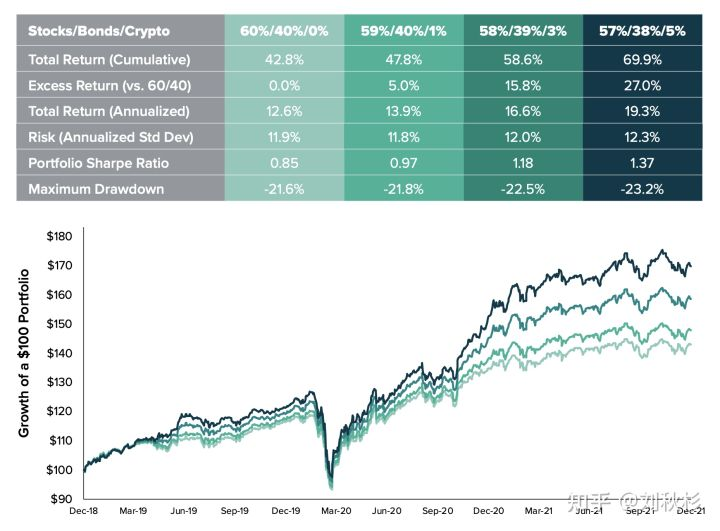
Grayscale gives the following simulated graph:
If four portfolios were created three years ago: (60% stocks, 40% bonds, 0% crypto), (59% stocks, 40% bonds, 1% crypto), (58% stocks, 39% bonds, 3% crypto), (57% stocks, 38% bonds, 5% crypto). Over three years, the portfolios with crypto assets all delivered higher returns, albeit with slightly higher volatility and larger drawdowns, but with a Sharpe ratio (or overall risk-adjusted return) higher than the global 60/40 portfolio itself.
Note: Sharpe ratio (Sharpe ratio) measures the performance of a portfolio relative to risk-free assets after adjusting its risk. The mathematical definition is the expected value of the difference between the investment return and the risk-free return, divided by the standard deviation of the investment (ie its volatility). In layman's terms, it represents how much reward investors can get for each additional risk they take. If it is positive, it means that the fund's rate of return is higher than the volatility risk. If it is negative, it means that the fund's operational risk is greater than the rate of return. The ratio The higher the value, the better the portfolio.
(2) Grayscale’s long-term crypto capital market assumptions (LTCMAs)
The past three years The simulation does not represent the future. It is equivalent to just doing an arithmetic problem. From this limited answer, a possible future is shockingly proposed-encrypted assets may really help improve the 60/40 portfolio and become a 60/40 portfolio. 40 The road to the final conclusion.
To enable global investors to continue to build confidence in this post-modern investment portfolio, the key is to have a long-term future growth forecast for the encrypted asset market.
For this reason, Grayscale, as the world's largest encrypted asset management company, has also proposed its own "Long-Term Encrypted Capital Market Hypothesis" (LTCMAs)——
If this is true in the future, then The Modern Portfolio may really be upsetting Wall Street.
What is Grayscale based on to arrive at such an exciting long-term hypothesis. You can't become an "encryption blower" with ulterior motives in order to "sell" your postmodern portfolio.
(3) Four key "sparks" support the long-term hypothesis "prairie fire"
· Nothing else The choice
refers to the fact that the future macro investment environment for traditional mainstream core assets is not optimistic The Long-Term Capital Market Hypothesis is similar. All consensus is directing the world's attention to the emerging asset market, and in the emerging asset market, the encrypted asset market has become a well-deserved "crown jewel" due to its outstanding performance.
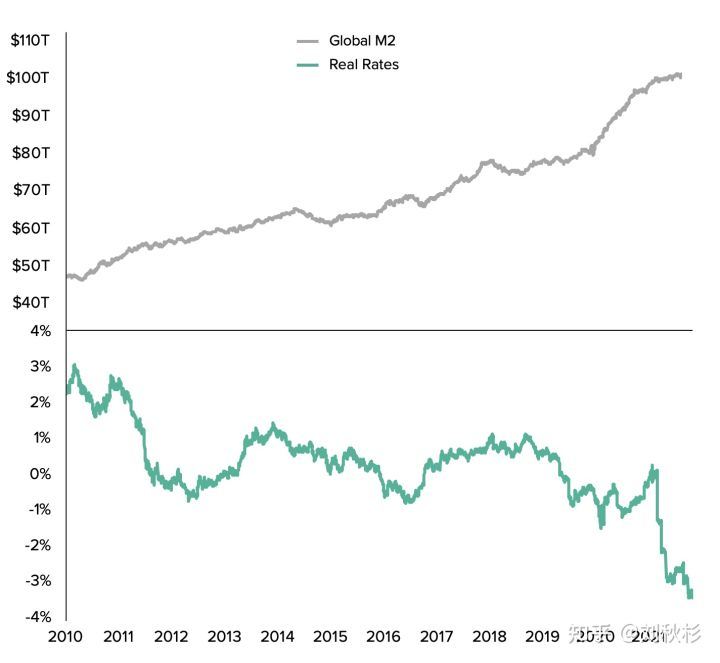
In money supply growth (global money supply has doubled in the past decade as central banks around the world stimulate the economy) and negative real interest rates (global liquidity growth stocks and bonds Valuations have reached historically high levels, exacerbating the decline in expected returns, urging investors to “seek to a greater extent less liquid private market alternatives while taking on greater portfolio volatility to Maintain the expected rate of return of 7%.
It can be said to be performance pressure, or it can be said that "not taking risks is actually one of the biggest risks".
Global M2 money supply and real interest
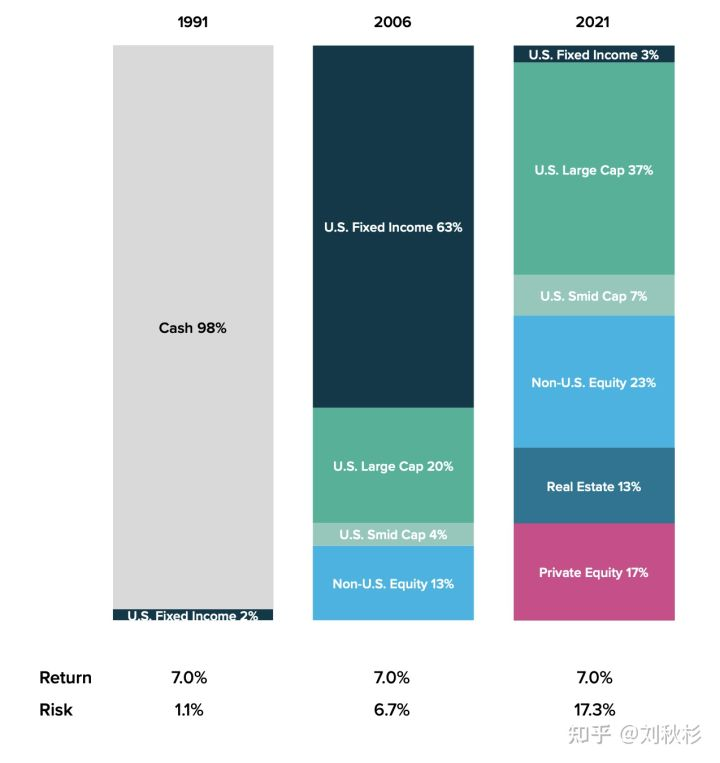
Supplement: 30 years ago, you could easily obtain an expected return of 7% by holding cash alone, but as time went on, the investment portfolio became more and more complex. By 2021, this portfolio will expand to 6 types of assets, of which High-risk private equity investment accounted for 17%, and the proportion of US fixed income dropped from 63% in 2006 to only 3%.
The past ten years
Cryptoassets have been the highest-returning asset class in eight of the past 10 years, providing a hedge against inflation. During periods when risky assets such as stocks performed well, cryptoassets performed stronger; but at the same time, during the two years when safe-haven assets such as the US dollar and bonds strengthened, cryptoassets were the worst-performing asset class.
Looks like learning how to tame this beast:
(i) Sharpe Ratio - Higher absolute returns, but at the same time higher absolute volatility, which also contributes to higher risk-adjusted returns for cryptoassets (beware, this was a little known open secret in the past ). The simulation shown in the figure below shows that in the past few years, the top three asset classes in the Sharpe ratio were "encryption basket", Bitcoin and US technology stocks.
(ii)Correlation——From historical data, encrypted assets are correlated with other major The correlation of asset classes is low, which is in line with the diversification of investment portfolios (see the correlation matrix below for details).
( iii) The market size that cannot be underestimated - the overall encrypted asset market size is close to 3 trillion (2.7 trillion) US dollars, accounting for 1% of the world's core financial assets, which can be called a milestone. The encrypted asset market does not only refer to cryptocurrencies (such as Bitcoin and Ethereum), but also includes encrypted stocks (such as mining machine manufacturers, trading platforms) and private equity (such as industry unicorn companies). Simply put, it has grown large enough to be included in institutional portfolios.
As Grayscale puts it: "Old capital allocation boundaries have historically limited investors to a narrower range of risk and return The ability to include cryptoassets in a portfolio changes that boundary.”
·An analogy to the development of the Internet
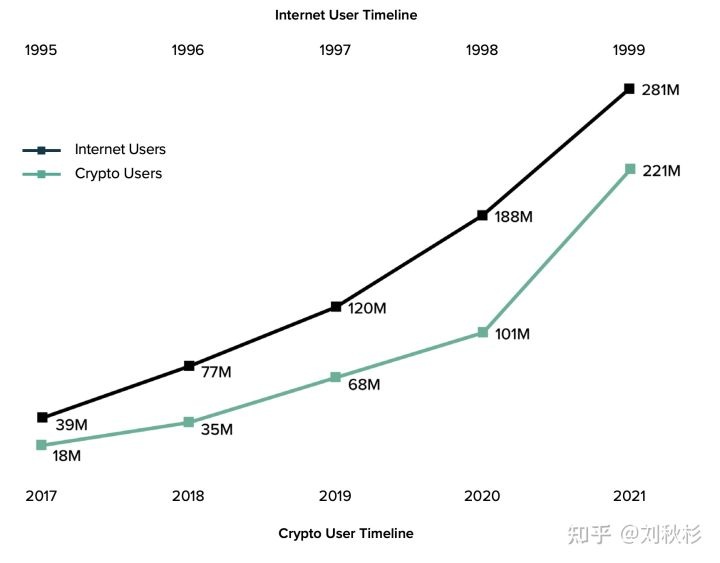
The number of users in the encrypted asset market has been growing rapidly. In 2021, the number of encrypted users in the world will reach 220 million, which is roughly the same as the Internet penetration rate (280 million people) in 1999, and the growth rate is similar.
At the same time, the development of the Internet in the late 1990s is also used to benchmark the development of today's encryption industry. The proportion of the two in the global stock market value is already close, as shown in the figure below. The encryption industry accounts for 3% today , while the Internet accounted for 5% in 1995 (note: the Internet accounted for 14% in 1999); today the total market value of the encryption industry is nearly 3 trillion US dollars, and the total market value of the Internet industry at the beginning of this century also exceeded 50,000 billions of dollars (and subsequently, the bubble burst).
If you want to point out the difference between the two early days, compared to the speculative carnival of the Internet industry at that time, the encryption industry seems to be "calm" . People in that era first discovered the Internet, a "new world machine" that subverts the old order, and chanted the revolutionary slogan "Internet changes everything", which is no less than today's "blockchain revolution". History has proved that the timing was wrong, which eventually led to a big burst of the bubble, and it took a long time after the burst to catch up with the valuation at the peak. It can also be seen from the figure below that today the Internet industry accounts for 24% of the global stock market and has just returned to the peak of the dot-com bubble.
Internet technology (26 years) and encryption industry (12 years) in share of stock market value
·Beyond Internet Development
The analogy prediction method cannot fully reveal the essence of the development of new things, and more is to find the first principle, that is, the greatest innovation value and the trend of the times.
When Grayscale established the long-term encryption market assumption, it was also based on the fact that in the next 30 years, the encrypted asset industry will continue to subvert the technology industry and replace the glorious 20-year growth of the Internet in the past , becoming the core of future global stock market shares. All of this stems from a massive Internet revolution—the next generation Internet, or Web3.0.
Well, I have written "cocoon" about Web3.0. Related reference articles include: "f (Metaverse) Web3.00", "When Surveillance Capitalism Meets Web3.0", "The End of the Internet-Metaverse", "Web3, meta-account layer and infinite games", 《Web3.0 is the emperor's new clothes? " .
In Grayscale's view, encrypted assets provide exposure to the next generation of Internet Web3.0, and users can directly own and control the next generation of Internet through encrypted assets :
(a) Web 1.0: The network is static, only users and companies are allowed to share information, and the value of the entire network does not belong to anyone.
(b) Web 2.0: The web becomes dynamic, companies create services on it, users read, write and interact with it, users enjoy services, and companies control the web value.
(c) Web 3.0: The network is built on encrypted assets, and the company can still serve users, but the company and users can jointly control the value of the network.
Messari: Institutions really bring money
Grayscale is to build macro Assuming masters, in fact, there are more micro-levels that are also assisting the establishment of the "long-term encryption capital market hypothesis".
In the "Messari 2022 Encryption Industry In-Depth Research Report", it is mentioned that the core players currently supporting the entire encrypted asset market with a market value of nearly 3 trillion US dollars-institutions.
(1) The number of institutions and financing is incredible
"In a revenue-poor In a world where institutions are reevaluating investments with high potential returns.”
As early as 2015, Grayscale’s parent company DCG (Digital Capital Group) invested 25 million The USD funding was already one of the largest ever for a cryptocurrency investment firm at the time. Today, the well-known Polychain, Paradigm, a16z, Multicoin, Three Arrows, and more encrypted capitals all manage billions or even tens of billions of dollars. “Among their mid-size deals, $25m cash flows every once in a while. Hedge funds plan to put 7% of their assets in crypto over 5 years, and pensions are starting to be available for direct purchases .”
In 2017, only less than 2 billion US dollars entered encryption investment, but in 2021, 33 billion US dollars of venture capital has entered encryption, and at the same time attracted more than 800 hedge funds allocated $68 billion, a 100-fold increase. In BTC alone, 39 listed companies injected $14 billion into it. Among the very famous institutions are: Microstrategy, Tesla, Galaxy Digital, Block, BlackRock, Morgan Stanley, etc., adding cryptocurrencies to the company's balance sheet. Pimco, which has $2 trillion in assets under management and hundreds of institutional clients, is now trading cryptocurrencies with their funds and expanding their offerings. Insurance companies such as MassMutual and NY Life are helping to launch institutional-grade bitcoin platforms. Many traditional pension funds, endowment funds, nation-states and their sovereign wealth funds are also starting to enter the game, for example Binance is in talks with several sovereign wealth funds for major investments in their companies. Recent reports show that 70-80% of people plan to allocate their portfolios in the short term.
As mentioned earlier, the crypto market has created nearly $3 trillion in liquidity value in 10 years, which has surpassed all other venture capital-backed startups At the same time, the macro (negative interest rate background) environment makes it impossible for large Wall Street capital to ignore the encryption market in order to continue to improve asset allocation efficiency.
Messari has an optimistic long-termism similar to Grayscale, that is, in a long-term future, the market value of Bitcoin, the leading asset in the encryption market, will surpass gold. At today's gold prices, parity with gold's market value means that the price of Bitcoin will reach $500,000. So Bitcoin may still have a 10x investment opportunity, which is attractive enough for institutions. Messari’s theoretical ceiling doesn’t stop there, even mentioning that there is no upper limit if fiat currency fails.
Messari also expressed a similar view to Grayscale, starting from the global 60/40 combination, the traditional framework is too "boring", as interest rates hover at 1% Around that time, stock valuations are at all-time highs, and a 60/40 portfolio has a long-term expected return of just 4-5%. Institutional investors now need new and diverse sources of return. At the same time, it was suggested that "BTC increased the risk-adjusted return of the portfolio by up to 10%, and compared with the standard 60/40 portfolio, the 5% allocation appeared to be a leveling off of risk-adjusted returns and investors' improvement. , and a 4% ETH allocation would lead to similar results.”
It has also been proven that institutions investing in cryptocurrencies Annually outperformed institutions with no investment by 2.82%. Achieved performance.
The increase in the scale of institutional management of encrypted assets
(2) The infrastructure serving institutions is improving day by day
It is now possible to Liquidity Buy and sell ETP/ETF and BTC/ETH futures.
State Street and BNY Mellon, the world's largest custodian banks, are adding cryptocurrency custody in 2021.
"One size fits all" legal regulatory risk elimination - "In October 2021, we found that the United States will not ban cryptocurrencies like China. In March 2022, We understand that the Biden administration is exploring regulation in the context of promoting innovation and economic opportunity, and it’s getting better and better.”
Coinbase, FTX, Binance, Gemini and other trading platforms have been tested with billions of dollars in daily trading volume.
The mood is here. In 2021, institutional investors will trade $1.14 trillion worth of cryptocurrencies through Coinbase alone, 10 times more than in 2020. According to Fidelity, 70% of institutional investors plan to buy digital assets in the near future.
Subsectors such as DeFi have the potential to overtake the roughly $25 trillion global financial services industry.
A bullish macro story for cryptocurrencies has emerged - Web 3.0.
Finally
Maybe this time I can really say that sentence full of tears but full of hope Cry - this time it's different.
Welcome to join the official BlockBeats community:
Telegram Subscription Group: https://t.me/theblockbeats
Telegram Discussion Group: https://t.me/BlockBeats_App
Official Twitter Account: https://twitter.com/BlockBeatsAsia







 Related Articles