The leaked Biden directive highlighted stablecoins? How much the Fed loves stablecoins
Stablecoins: Growth Potential and Impact on Banking
Gordon y. Liao and John Caramichael
BlockBeats
3 月 9 日,美国财政部长 Janet Yellen 就 Joseph Biden 关于数字资产的指令发表声明,这份声明并没有对加密货币的利空观点,所以不少人认为是这份声明带动了市场情绪。声明疑似是不小心在财政部官网上提前泄露了,现已删除。不过从留存的痕迹上,我们依然可以看出一些着重点。
在满篇官方话术的声明中,Janet Yellen 特意提到了「稳定币」,她表示财政部会与多部门合作,研究稳定币并提出建议。有观点认为美国似乎要推出自己的 CBDC,但律动并不这么认为,去年在《美联储关于 CBDC 演讲全文:对稳定币、比特币、CBDC 的全面宏观理解》中,美联储对于 CBDC 的态度并不兴奋,而对于稳定币,他们显然更感兴趣。
今年 2 月,美联储发布了一份最新的稳定币报告,认为稳定币拥有下一代创新潜力,并着重讨论了稳定币对银行系统和信用中介的潜在影响。
Here are the highlights of the Fed's stablecoin: Growth Potential and Implications for the Banking System. BlockBeats has translated the full text for your convenience. Pending a formal statement from Janet Yellen, the report provides a preview of the Fed's stance on stablecoin. It is important to note that this is an "International Financial Discussion Paper (IFDP)", which is preliminary material distributed to stimulate discussion and critical comments.
TL; DR
Stablesoins are digital currencies that link their value to an external reference, usually the United States Dollar (USD). Staboins play a key role in the digital marketplace, and their growth is likely to spur innovation in the wider economy. The amount of STABoins circulating on the public chain has exploded in the past year, with the total circulating supply reaching nearly $130 billion as of September 2021, up more than 500 percent from a year earlier.
As staboins have gained more attention, a number of issues have been raised, including the stability of their hooks, consumer protection, KYC and compliance, and the scalability and efficiency of settlement. We will focus on the potential impact of the stablecoin on the banking system and credit intermediation. While a range of issues related to stablecoins can be addressed with appropriate institutional safeguards, regulations, and technological advances, the continued growth of stablecoins in circulation will ultimately impact traditional banking systems in important ways.
In this note, we begin by discussing the basics of stablecoins, their current use cases, and their growth potential. Second, we examine the historical behavior of stablecoins during periods of cryptocurrency and broader financial market distress in the past. We find that dollar-pegged staboins exhibit safe asset quality because their prices in the secondary market can temporarily be higher than the peg price in times of extreme market distress, thus encouraging more staboins to be issued. We also highlighted the risk of a "run" on certain stablecoins backed by non-cash equivalent risky assets.
Finally, we outline possible scenarios for bank reserves, credit intermediation, and central bank balance sheets if stablecoins gain wider attention. Our research suggests that the widespread adoption of asset-backed stablecoins is likely to be supported within a two-tier fractional reserve banking system without negatively impacting credit intermediation. Under this framework, stablecoin reserves are held as commercial bank deposits, and commercial banks conduct fractional reserve lending and maturity conversion like traditional bank deposits. We also found that replacing physical cash (paper money) with stablecoins led to more credit intermediation. By contrast, a "narrow" banking framework that requires stablesoin issuers to back their stablesoin with central bank reserves minimizes the risk of a stablesoin "run" but may reduce credit intermediation.
The basis of stablecoins
Stablecoins are digital currencies recorded on distributed ledger technology (DLT), usually blockchain, linked to a reference value. Most staboins in circulation are pegged to the U.S. dollar, but staboins can also be pegged to other fiat currencies, a basket of currencies, other cryptocurrencies, or commodities like gold. Stablecoins act as a store of value and medium of exchange on DLT, enabling stablecoins to be exchanged or integrated with other digital assets.
Stablecoins differ from traditional digital currency records in two main respects, such as bank deposit accounts. First, stablecoins are cryptographically protected. This allows users to settle trades almost instantaneously without double-spending or intermediaries that facilitate settlement. This also allows 24 X 7x365 transactions per day on the public chain. Second, stablecoins are typically built on programmable DLT standards and allow for composability of services. In this case, "composability" means staboins can act as independent building blocks that interoperate with smart contracts (self-executing programmable contracts) to create payments and other financial services. These two key features underpin the current stablecoin use cases and support innovation in both the financial and non-financial sectors.
Stablecoins on public chains such as Ethereum, Binance Smart Chain or Polygon have seen a surge in usage since 2020. As of September 2021, the largest public staboins linked to the U.S. dollar had nearly $130 billion in circulation. The graph shows that the circulating supply of public stabilization coins grew particularly strongly in early 2021, with an average month-on-month growth of around 30% in the first five months of this year.
The current stablecoin type
Staboins are a nascent, broadly defined technology that can take many forms. This technology is currently implemented in a specific form, which we describe below and summarize in Table 1. However, please note that stablecoin technology is in its infancy and has high potential for innovation. The current implementation of stablecoins discussed below, and their current status in the regulatory environment, do not reflect all potential deployments of stablecoins technology.
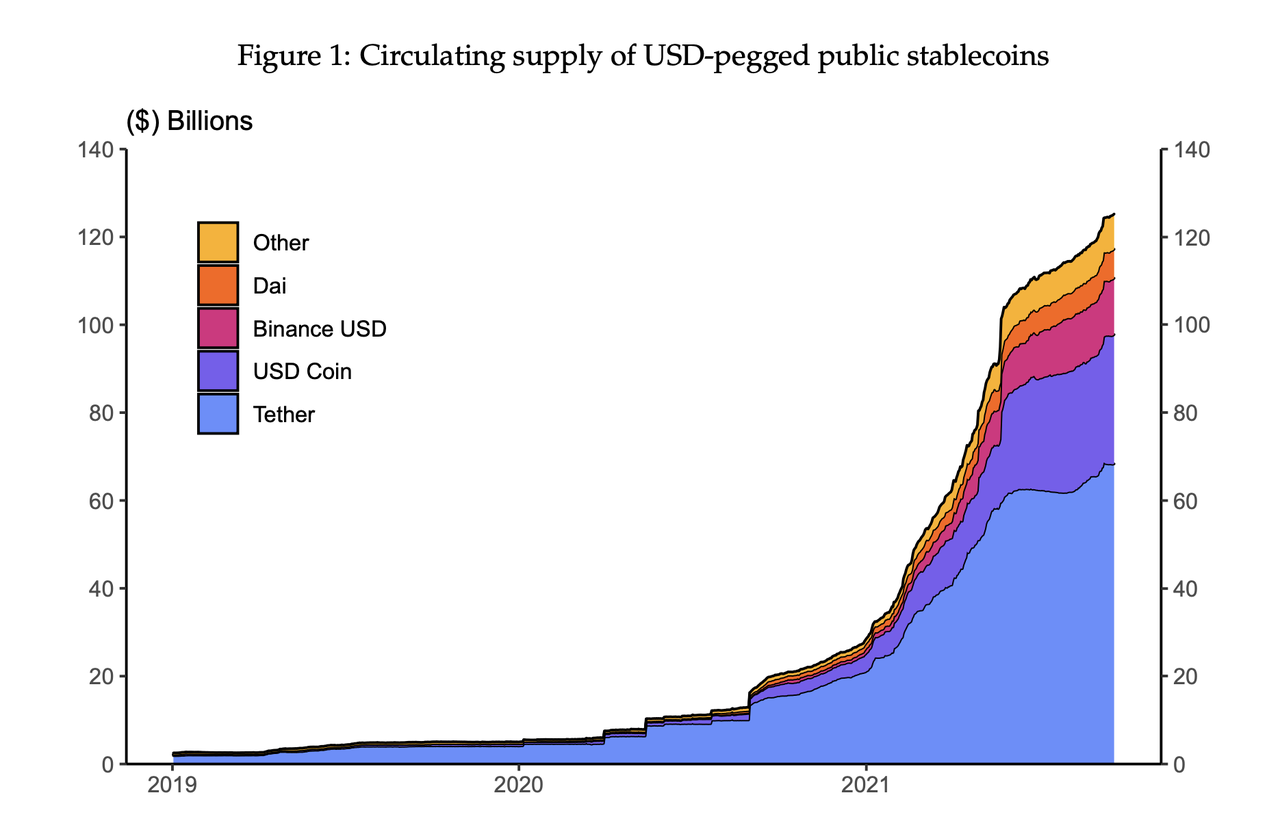
The circulating supply of ten dollar-linked public staboins by market value. The data are from January 2019 to September 2021. Other categories include Fei, TerraUSD, TrueUSD, Paxos Dollar, Neutrino USD and HUSD.
Stablecoin backed by public reserves
Most existing stablecoins circulate on public chains, such as Ethereum, Binance Smart Chain or Polygon. Most of these public stabilization coins are backed by cash-equivalent reserves such as bank deposits, Treasury bills and commercial paper. These reserve-backed staboins are also known as custody staboins because they are issued by intermediaries acting as custodians of cash-equivalent assets and offer 1-for-1 staboin liability redemption in US dollars or other fiat currencies.
The adequacy and robustness of some stablecoins backed by public reserves is questioned. In particular, Tether, the largest stablecoin in circulation, agreed to pay $41m to settle a dispute with America's Commodity Futures Trading Commission, which accused it of misrepresenting the adequacy of its dollar reserves. Other widely used reserves that support dollar-linked public stabbables with different levels of financial audit include USD Coin, Binance USD, TrueUSD and Paxos Dollar.
Common algorithm stablecoins
Some stablesoins use other mechanisms to stabilize their prices, rather than relying on the robustness of underlying reserves. These stablecoins are often referred to as algorithmic stablecoins. While reserve backed stablecoins are issued as liabilities on the balance sheets of legally registered companies, algorithmatic stablecoins are maintained by smart contract systems that operate exclusively on the public chain. The ability to control these smart contracts is usually conferred by owning governance tokens, which are dedicated tokens used to vote on changes to protocols or governance parameters. These governance tokens can also serve as a direct or indirect claim on future cash flows using staboin agreements.
The field of common algorithm stablecoins is highly innovative and difficult to classify. However, one can generally assume that the design of these staboins is based on two mechanisms :(1) collateral mechanisms and (2) algorithmic hooking mechanisms. When users deposit unstable cryptocurrencies such as Ethereum into Dai's smart contract protocol, public staboins with collateral are minted, such as Dai. The user then receives a Dai (dollar-linked) loan with a rate of more than 100 per cent. If the value of the Ethereum deposit falls below a certain threshold, the loan will be cleared automatically.
In contrast, algorithmic hooking mechanisms use automated smart contracts to protect hooking by buying and selling stablesoins with related governance tokens. However, these pegs can encounter instability or design flaws that can lead to "instability", as illustrated by the brief decoupling of the algorithm stablecoin Fei after its launch in April 2021.
Institutional or private stabilizers
In addition to reserve backed stablecoins circulating on the public blockchain, traditional financial institutions have also developed reserve backed Stablecoins, also known as "tokenized deposits". These institutional stablecoins are implemented on licensed (private) DLT, and they are used by financial institutions and their customers for efficient wholesale transactions. The most famous institutional stabbcoin is JPM Coin. Jpmorgan and its clients can use JPM Coin to conduct transactions such as intraday repo settlement and manage internal liquidity.
These privately owned, retention-supported staboins are functionally and economically comparable to products offered by some money transmitters. For example, Paypal and Venmo (a Paypal subsidiary) allow users to make near-instant money transfers and payments within their networks, and the companies hold balances similar to reserve-backed stabocoins. The key difference is the use of a centralized database rather than licensed DLT.
Stablecoin use cases and growth potential
Powerful use cases are driving the growth of stablecoins in all their current forms. We summarized these use cases. The most important current use case for stablecoins is their role in cryptocurrency transactions on the public chain. Investors generally prefer to trade cryptocurrencies using public stabilisers, as this allows for almost instant 24/7/365 transactions without relying on non-DLT payment systems or escrowed holding of fiat currency balances.
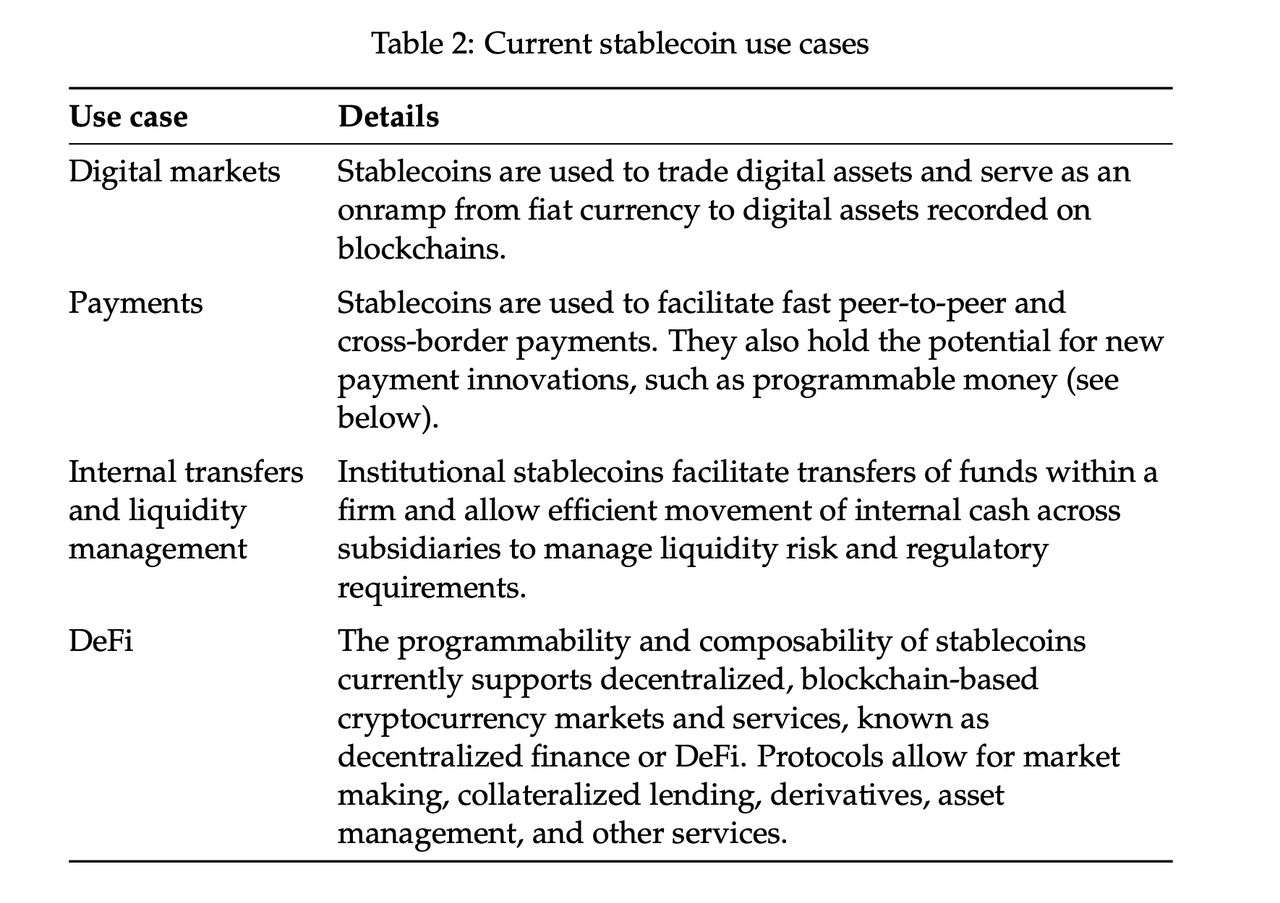
In addition to being used for crypto transactions, both public and institutional staboins are currently used for near-instant 24/7 unmediated payments, with fees likely to be low. This is particularly relevant for cross-border transfers, which often take several days and require high fees. The company also uses institutional staboins to transfer cash between its subsidiaries almost instantaneously to manage internal liquidity and facilitate wholesale transactions in existing financial markets, such as intraday repo transactions. Finally, because public stablesoins are programmable and composable, they are heavily used for decentralized, public blockchain-based markets and services called decentralized finance or DeFi. The DeFi protocol system allows users to use stablesoin to participate directly and with trading parent companies in various crypto-related markets and services, such as market making, mortgages, derivatives and asset management, without the need for traditional intermediaries. As of September 2021, about $60 billion of digital assets were mortgaged (locked up) in DeFi agreements.
Future growth potential
Stablecoins' defining features, cryptographic security, and programmability support powerful use cases that are currently driving the use of existing public and institutional stablecoins. However, these features have the potential to drive innovation beyond current use cases, which are largely limited to cryptocurrency markets, certain peer-to-peer payments, and institutional liquidity management for large banks. Looking ahead, staboin technology is likely to see diversified implementations and drive innovation in multiple growth areas: more inclusive payments and financial systems, tokenized financial markets, and microtransactions that facilitate technological advances such as Web 3.
A more inclusive payment and financial system
Stablecoins have the potential to stimulate growth and innovation in payment systems, enabling faster and cheaper payments. Because stabecoins can be used to move money between digital wallets almost instantaneously, point-to-point, with potentially low fees, stabecoins could lower payment barriers and put pressure on existing payment systems to provide better service. This is especially important for cross-border transfers, which can take days to clear and charge high fees. These costs and delays are a burden on low - and middle-income countries.
Stablesoin may also support a more inclusive financial system through the growth of DeFi, which may require stablesoin as a necessary component. It should be noted that DeFi faces significant challenges, including complex user experience, lack of consumer protection, frequent hacks, protocol dysfunction, and market manipulation. In addition, almost all DeFi protocols only support transactions or lending of cryptocurrencies or irreplaceable tokens (NFT). If the DeFi protocol matures beyond its current state and integrates with broader financial markets to support real-world economic activity, DeFi can encourage more inclusive financial systems that allow investors to participate directly in markets without intermediation. This growth in DeFi is likely to drive growth in staboin usage.
Tokenized financial market
In addition, staboins could play a key role in tokenization of financial markets. This will require converting securities into digital tokens on DLT and using stablecoins for trading and servicing. For delivery and payment (DvP) transactions, such as security purchases, tokenized markets will allow real-time settlement at a very low cost. This improves liquidity, transaction speed and transparency, while reducing counterparty risk, transaction costs and other barriers to market participation. This could particularly benefit certain asset classes, such as real estate, by allowing partial ownership of tokenised assets and more transparent price discovery. For pay-to-pay (PvP) transactions, such as cross-currency swaps, tokenization would also allow for near-instant execution, rather than the market's current traditional T+2 framework, in which the payment of the swap occurs a few days after two business settlement exchanges occur. In addition, for both types of transactions, tokenized financial markets will benefit from the programmability of DLT, which can automate security services and regulatory requirements such as required holding periods. If financial markets are partially or fully tokenized, this could drive further growth in staboin usage.
Next Generation innovation
Finally, stablecoins have the potential to support the next generation of innovation. An example of this innovation is Web 3, which may move from centralized networking platforms and data centers to decentralized networks. Under this paradigm, revenue from Internet services and social media platforms will shift from advertising to microtransactions, benefiting from the emergence of efficient, integrated online payment systems. Imagine, for example, a search engine or video streaming platform powered by stablecoin's near-instant micropayments rather than the sale of advertising revenue and user data. If such a shift in web services takes place, it could fuel further stablecoin growth.
In summary, staboin usage is currently primarily driven by cryptocurrency transactions, limited peer-to-peer payments and DeFi. Looking ahead, staboins are likely to achieve further growth by promoting more inclusive payments and financial systems, the tokenization of financial markets, and possible next generation innovations such as Web 3.
Hook stability
A core issue is the stability of the staboin's peg to its reference value. This is not the focus of our paper, but we briefly discuss this important issue here. In this section, we will first outline the sources of peg instability in the stablecoin currently supported by public reserves and discuss how to address these sources. We then review how stablecoins can serve as a potential safe asset in digital markets and provide evidence that stablecoins currently backed by public reserves may already play this role in cryptocurrency markets.
Currently, peg instability in staboins backed by public reserves takes two forms: investor redemption risk by issuers and price misalignment in the secondary market. The former is related to the safety and soundness of stabler reserves. There could be panic if stablecoin holders lose confidence in the robustness of stablecoin support. A run on stablecoin carries the risk of spilling over into other asset classes, as stablecoin reserves are sold or unloaded to meet redemptions. In addition, a run on staboins could cause further distress through interoperability by disrupting smart contracts for markets and services that rely on staboins. We believe that this type of instability can be addressed through appropriate institutional and/or regulatory barriers, such as transparent financial audits and adequate requirements for the liquidity and quality of stabler reserves. Concerns surrounding redemption risk and the extent to which it can be addressed have recently been addressed in Quarles(2021).
The second form of anchoring instability of staboins backed by public reserves stems from supply-demand imbalances in the secondary market. Because these staboins trade on both centralized and decentralized trading platforms, they are vulnerable to demand shocks that could temporarily dislocate their pegs until staboin issuers adjust supply. In particular, because public stablecoins serve as stores of value for the public blockchain-based market, these stablecoins have experienced high demand during periods of distress in the crypto market, as investors rush to liquidate their speculative positions into stablecoins. In these events, the price of stablesoin, which is backed by major public reserves, tends to appreciate temporarily until the issuer adjusts its supply. For example, the graph shows the cryptocurrency market crashes of March 12, 2020, and May 19, 2021. The first came at a time of general market turmoil over concerns about the spread of COVID-19. The second event occurred during the crypto downturn associated with a lot of deleveraging. In both periods, the price of stablesoins, backed by major public reserves, rose sharply as the prices of speculative cryptocurrencies Bitcoin and Ethereum plunged between 30% and 50%.
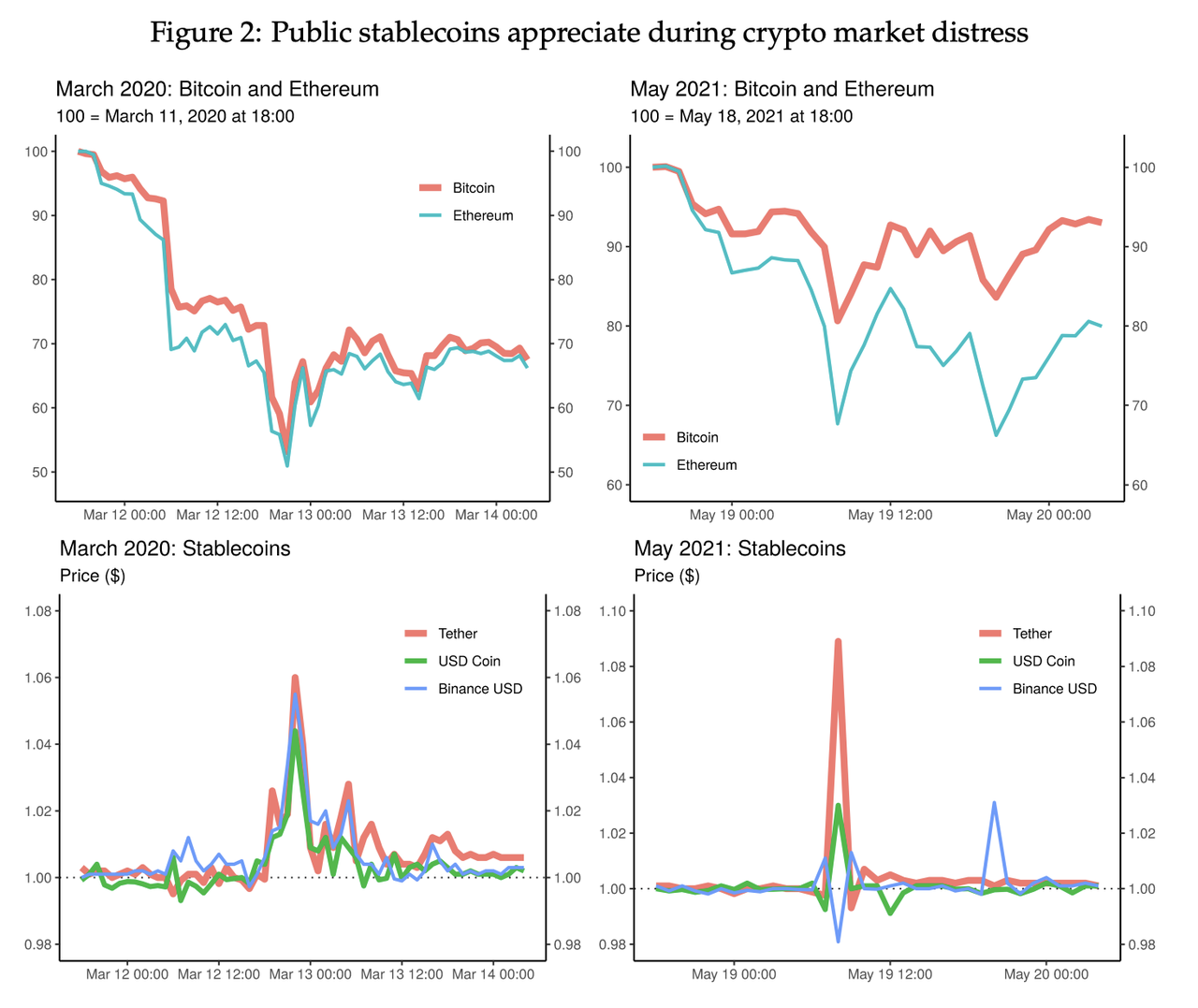
For these extreme crypto market distress events, staboins appreciate as a digital security asset, while more speculative crypto assets are temporarily in free fall until staboin issuers are able to increase their supply and purchase reserves and/or staboins experience declines from price pressure from arbitrageurs. The behavior of these public stablecoins is unique, unlike prime money market funds, which experienced significant outflows during the global financial crisis in 2008 and the height of the COVID-19 pandemic in 2020.
These events demonstrate stabocoins' potential as a digital haven during times of market distress. While discussion of the financial stability risks of stablecoins backed by public reserves has focused on redemption risks unique to the form of individual stablecoins reserves, our analysis suggests that countercyclical secondary market demand for stablecoins can reduce redemption risks during broader market downturns. With appropriate safeguards and regulations, stablecoins have the potential to provide stability comparable to the value of traditional forms of security.
The potential impact of stablecoin on credit intermediation
If stablecoins were widely adopted throughout the financial system, they could have a significant impact on the balance sheets of financial institutions. Regulators, market participants and academics are particularly concerned about stablecoins' potential to disrupt bank-led credit intermediation. In this section, we analyze several possible scenarios in which reserve-backed stablecoins are widely adopted in the financial system. We focus on reserve-backed stablecoins, rather than algorithm-based stablecoins, because reserve-backed stablecoins are by far the largest and most closely linked to the existing banking system. Using these scenarios, we highlight how the impact of stablecoin adoption on the provision of credit depends critically on two factors: the source of the stablecoin inflows and the composition of the stablecoin reserves.
We summarized our results. We found that in most of the cases we considered, credit provisions would probably not be negatively affected. In fact, replacing physical money (paper money) with stablecoins might allow for more bank-led credit supply. One notable exception, which could lead to large-scale disintermediation of credit, is the need for stabilization coins to be fully backed by central bank reserves, which we call a narrow banking framework. Under this framework, redemption risk is minimised at the cost of greater credit disintermediation (disintermediation).
Into the source
If staboins are widely adopted, the main inflows are likely to come from three sources: physical money (paper currency), commercial bank deposits and cash equivalent securities (or money market funds). First, as a form of digital currency, stablecoins will replace some of the paper currency in circulation, especially as the economy becomes more digital. In some of our scenarios, we saw an increase in the supply of credit as users moved from physical cash to reserves-backed stablecoins. This is because paper money is a direct liability of the central bank, replaced by reserve-backed stablecoins, which depending on the reserve framework can be used to create credit through loans or securities purchases.
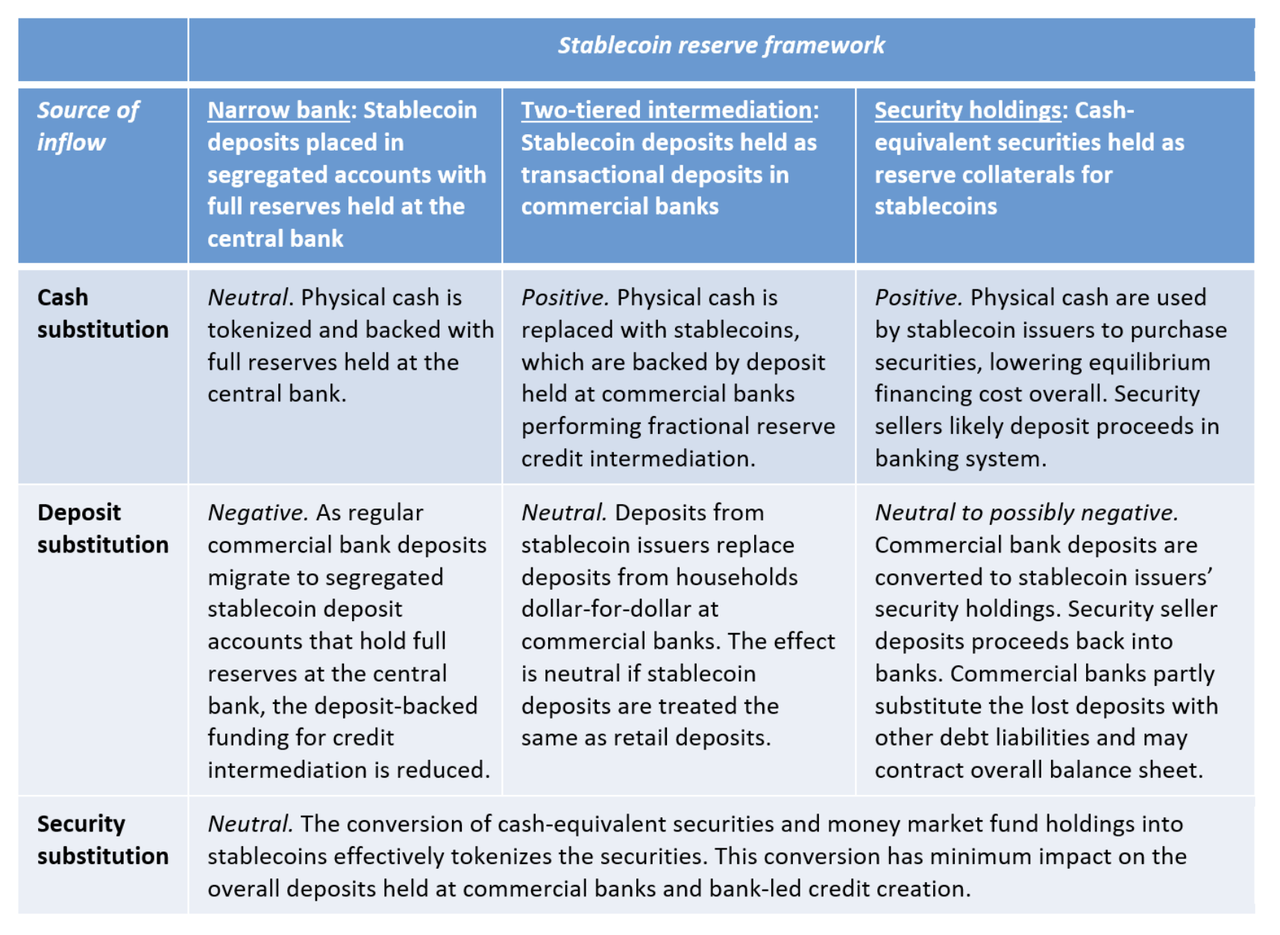
Second, stablecoins may flow from commercial bank deposits if households and firms prefer to hold stablecoins rather than traditional commercial bank balances. This source of inflows is of keen interest to policymakers because of widespread concern that a flood of alternative deposits could disrupt the supply of credit to commercial banks. We show that the effect of deposit substitution on credit supply can be positive, negative or neutral, depending on the reserve framework. Finally, stablesoins are likely to see an inflow of cash equivalent securities (or money market funds). This may have no effect on the supply of credit, as it requires recycling funds back into the banking system, which we will discuss in a later section.
reserves
The impact of the widespread use of reserve-backed stablecoin on credit provision also depends on the composition of stablecoin reserves. We propose three reasonable stablecoin reserve frameworks: narrow banking, two-level intermediary and securities holding. As shown above.
Under a narrow banking framework, stablecoins need to be backed by commercial bank deposits, which are backed entirely by central bank reserves. Similarly, it is possible for commercial banks to issue outright stablecurrencies (or tokenised deposits) backed by central bank reserves. The narrow banking approach is roughly equivalent to a retail central bank digital currency, where the digital currency is a central bank liability but can be used by households and companies through intermediaries such as commercial banks or fintech companies. The People's Bank of China has adopted this framework in its state-backed digital currencies (called digital currencies and electronic payments), the digital renminbi, or e-Renminbi. The possibility of requiring stablecoins to be held in reserve at the central bank is also mentioned in the proposed STABLE Act in the United States.
Although a narrow banking framework can guarantee the anchoring stability of stablecoin, as it is actually a pass-through central bank digital currency (CBDC), this reserve framework poses the greatest risk of credit disintermediation. Periods of financial stress or panic could lead to a massive shift of conventional commercial bank deposits into narrow bank staboins, which could disrupt the supply of credit. While this credit disruption effect can be mitigated by limiting stablecoin holdings and differential reserve interest rates, the overall structure of banks' narrow approach to stablecoin reserves could destabilize the banking system. In addition, a narrow banking approach could lead to an expansion of the central bank's balance sheet to accommodate the reserve balance requirements of stablecoin issuers.
These concerns about narrow bank stablecoin reflect broader concerns about narrow banks, which the Fed has taken note of. Recently proposed a will affect the narrow Banks (officially known as direct investment entities or PTIE) laws and regulations, the fed said "worry [narrow Banks] may disrupt the financial intermediation in unpredictable ways, and may also be a negative impact on financial stability" (regulation D: deposit reserve requirement, 2019). In addition, the Fed outlined serious concerns about demand for reserve balances, saying that "[narrow bank] demand for reserve balances could become very large. To maintain the desired stance of monetary policy, the Fed may need to meet this demand by expanding its balance sheet and the supply of reserves".
In contrast to the narrow banking framework, under the two-tier intermediary framework, stablecoins would be backed by commercial bank deposits for fractional reserve banking. Similarly, commercial banks may issue stablecoins or offer tokenized deposits for fractional reserve banking. To be clear, this does not mean that the stablesoin is not fully supported. Conversely, stablecoin issuers rely on commercial bank deposits as assets, and commercial banks use stablecoin and/or stablecoin deposits for fractional reserve banking, which means that stablecoin is ultimately backed by a combination of loans, assets and central bank reserves. It will affect the effective renaming of some regular deposits as stablecoin deposits. Importantly, for bank intermediation to remain unchanged, stablecurrency deposits must be treated in the same way as stablecurrency deposits with respect to required reserve ratios, liquidity coverage ratios and other regulatory and self-imposed risk limits.
Finally, stablecoin issuers can hold cash-equivalent securities, such as Treasury bills and high-quality commercial paper, instead of depositing funds with commercial banks. These securities can be purchased directly or indirectly through money market funds. This is the main framework currently used by issuers of stablecoin backed by public reserves, such as Tether, which Federal Reserve Chairman Jerome Powell recently noted is "like a money market fund."
Scenario building
In our scenario, we would consider the impact of one or more stablecoins backed by statutory reserves gaining widespread adoption in a stylized version of the banking system. The baseline balance sheet for the banking system is shown. Specifically, we consider the case of households and businesses substituting $10 for notes, commercial bank deposits, or securities, and then we do the accounting work to determine that the adoption of the stabler affects the balance sheets of central banks, commercial banks, and households and businesses. We analyze how this impact varies according to the stablecoin reserve framework and its source of inflow.
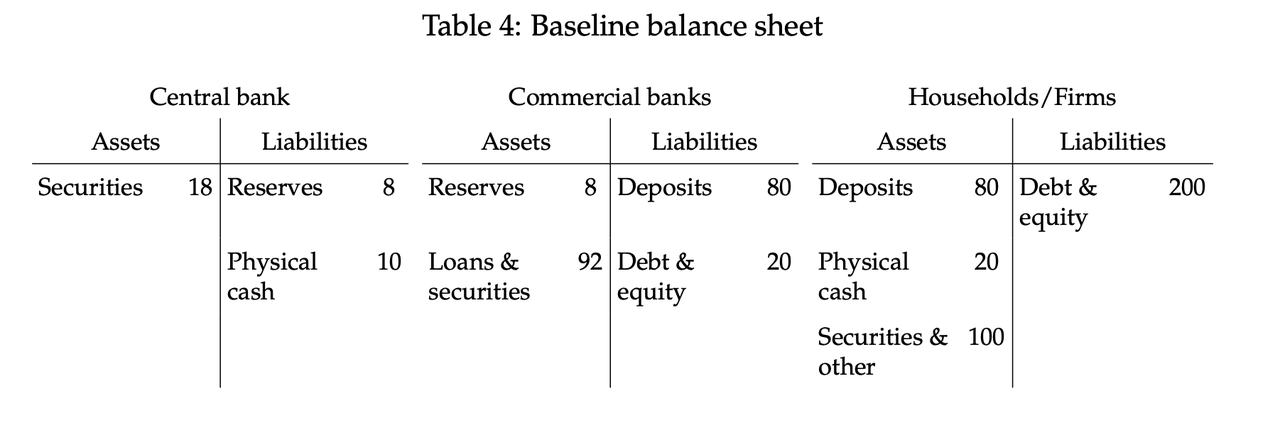
It's important to note that we made several key assumptions when building these scenarios. The first is that we do not know the exact form of the stablecoin. Our scenario is not intended to analyze, for example, the specific impact of widespread adoption of existing stablesoins such as Tether. We do not distinguish between institutional tokenized deposits, staboins circulating on a public blockchain, or other forms. Second, we show only illustrative advantage cases. In fact, stablecoins can see inflows from multiple sources and hold multiple assets as reserves. Third, these scenarios do not capture secondary knock-on effects or feedback loops, nor do they address heterogeneous influences within the industry. Finally, we assume that commercial banks have a 10 percent required reserve ratio for traditional deposits.
To illustrate the complex flows between the various parts of the banking system that support our edge case scenario, we visualize the subset of stablecoin inflows and reserve allocations we discussed in the figure. Specifically, we use charts to show the flow of commercial bank deposits (into A) and notes (into B) into stablecoins, and the distribution of these funds in the form of commercial bank deposits to reserves (reserve flow A) and securities (reserve flow B).
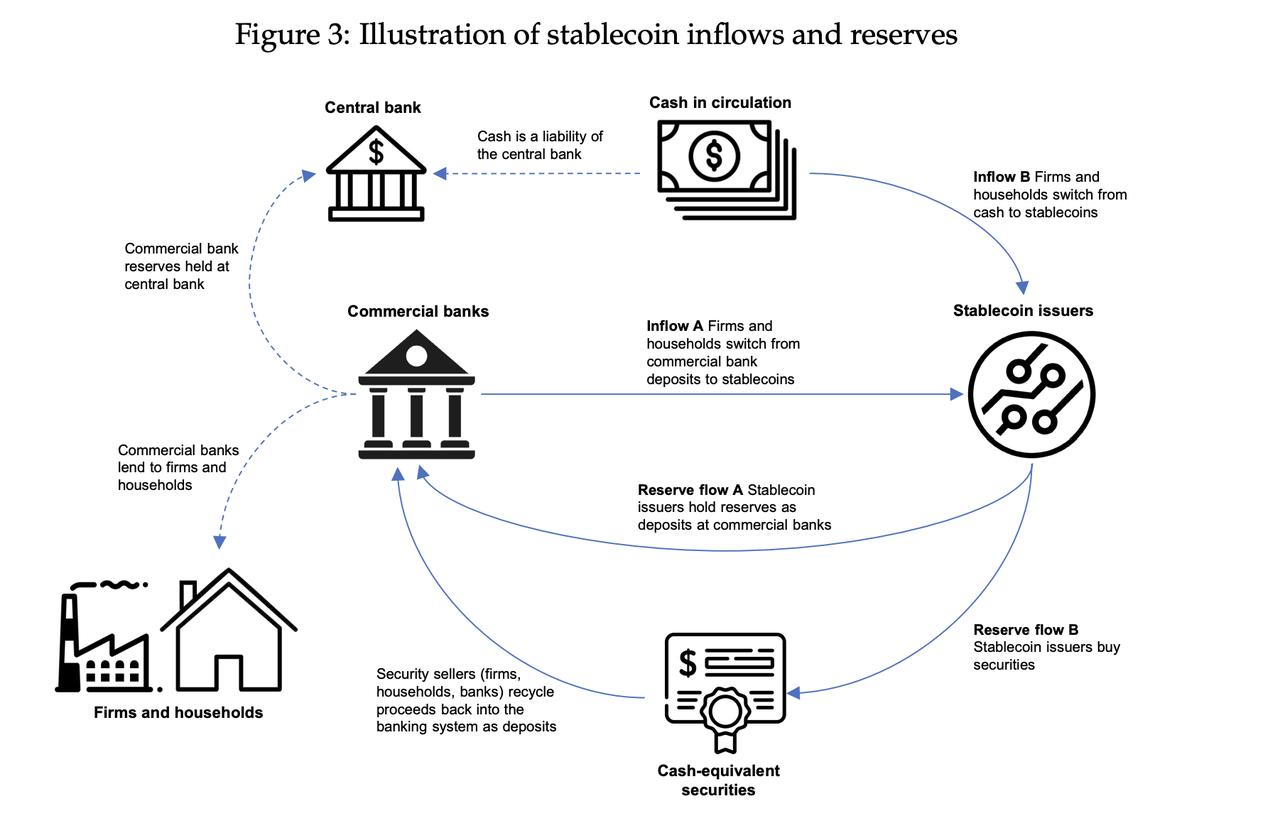
In the figure, we see how stablecoin inflows and reserve flows are correlated. Companies and households were replaced by stable currency from deposits (flowing into A) and notes (flowing into B). Stablesoin issuers deposit some of these funds in the commercial banking system, hold reserves as commercial bank deposits (reserve flow A), and use the funds to purchase securities as reserves (reserve flow B). These securities purchases also recycle money back into the banking system because the seller of the securities eventually gets the proceeds of the sale and deposits them back into the banking system. As the chart shows, these flows affect central banks, which maintain cash and central bank reserves as liabilities, as well as firms and households that borrow from commercial banks. While this chart does not capture the full flow between these entities, it is emblematic of how the widespread adoption of stablesoin is reshuffling complex financial relationships within the banking system.
Scenario analysis
Narrow banking framework
As noted earlier, the narrow banking framework poses the greatest risk to credit provisioning, depending on the source of inflows. In our narrow banking scenario, as shown in the table, we find that physical cash flows into the narrow bank stablecoin will have a neutral effect on credit supply, while commercial bank deposits disrupt credit supply.
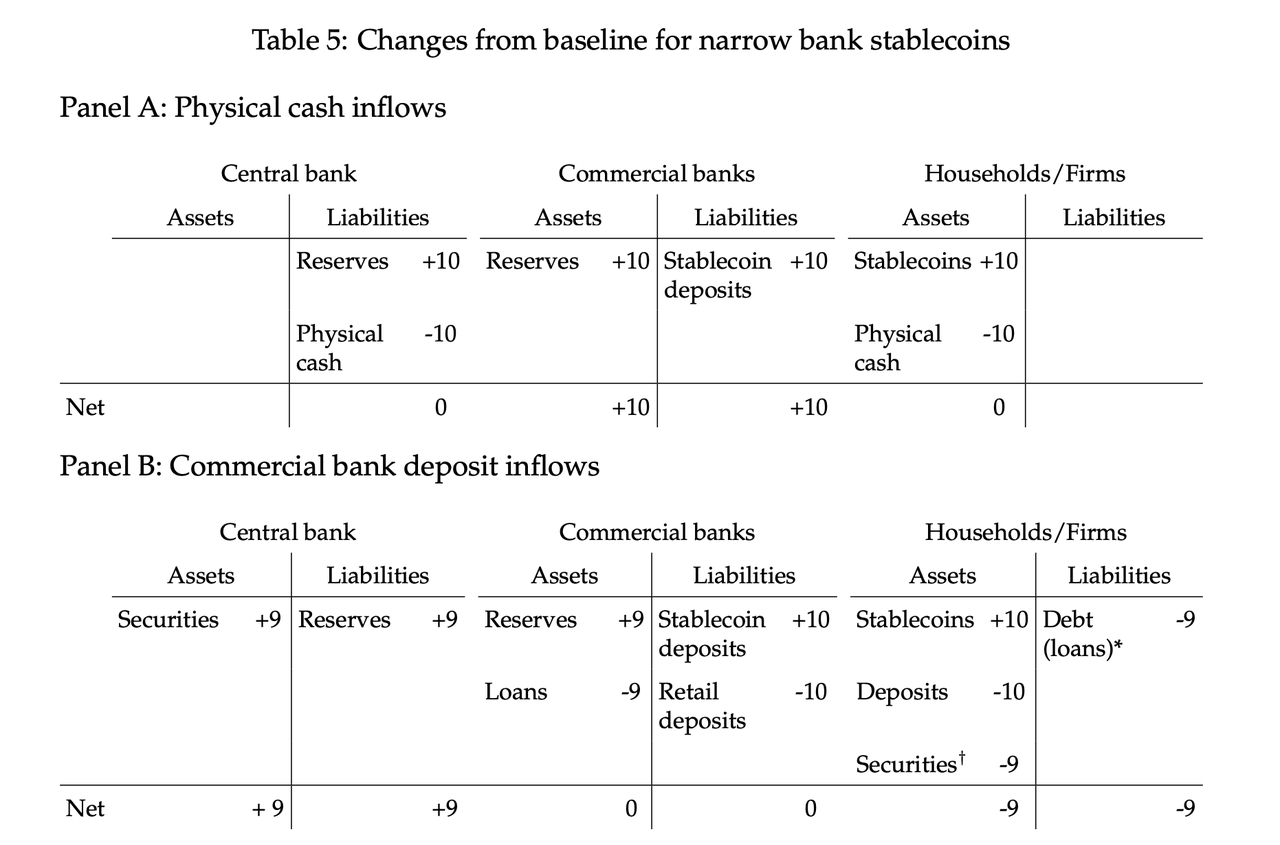
In Panel A (cash inflow scenario), we see stablecoins replacing cash on household and corporate balance sheets. The inflow of cash leads to an indirect increase in commercial bank balance sheets and commercial bank reserves. Central bank balance sheets were restructured, with reserve liabilities replacing cash liabilities. The net effect is that commercial bank balance sheets expand, but credit provisions remain unchanged. This assumes that banks are not constrained by the size of their balance sheets. That is, narrowly defined bank deposits and related reserve holdings are exempt from leverage calculations. This leverage exemption for central bank reserve holdings has been adopted by regulators in various jurisdictions.
Panel B shows a narrow bank scenario in which deposits migrate to stablecoin. As stablecoin deposits remain entirely on the balance sheets of commercial banks, banks must reduce their asset holdings to accommodate the decline in funds from stablecoin deposits. Central bank balance sheets would then expand to accommodate increased demand for reserve balances, rather than offset declines in cash liabilities. In this case, we assume that the central bank will meet the increased reserve requirements by buying securities. This assumption of central bank easing was raised by the Federal Reserve's previous ruling on narrow banking, as described above, in relation to Regulation D: Depository Reserve Requirements (2019). However, if the central bank determines the size of its balance sheet, we suggest two alternatives in table A1 of the appendix. In the first alternative, commercial banks shrink their balance sheets sharply to make up for the lack of deposit funding. In the second case, commercial banks issue debt securities to replace lost deposit funds. The result is a further decline in bank-led credit creation.
We do not envision a scenario in which narrow bank stablecoins flood into securities holdings. In this case, the impact on credit provisions is likely to be neutral. Under the same assumptions as above, the net effect on the supply of credit should be minimal if the central bank meets the increased demand for reserves by buying securities (from households). Unlike direct holdings of securities, the move to stablesoins would leave households with stablesoins backed by central bank reserves, which in turn are backed by securities. This scenario also assumes that increased narrow bank reserves are unaffected by leverage, as noted earlier.
A two-tier mediation framework
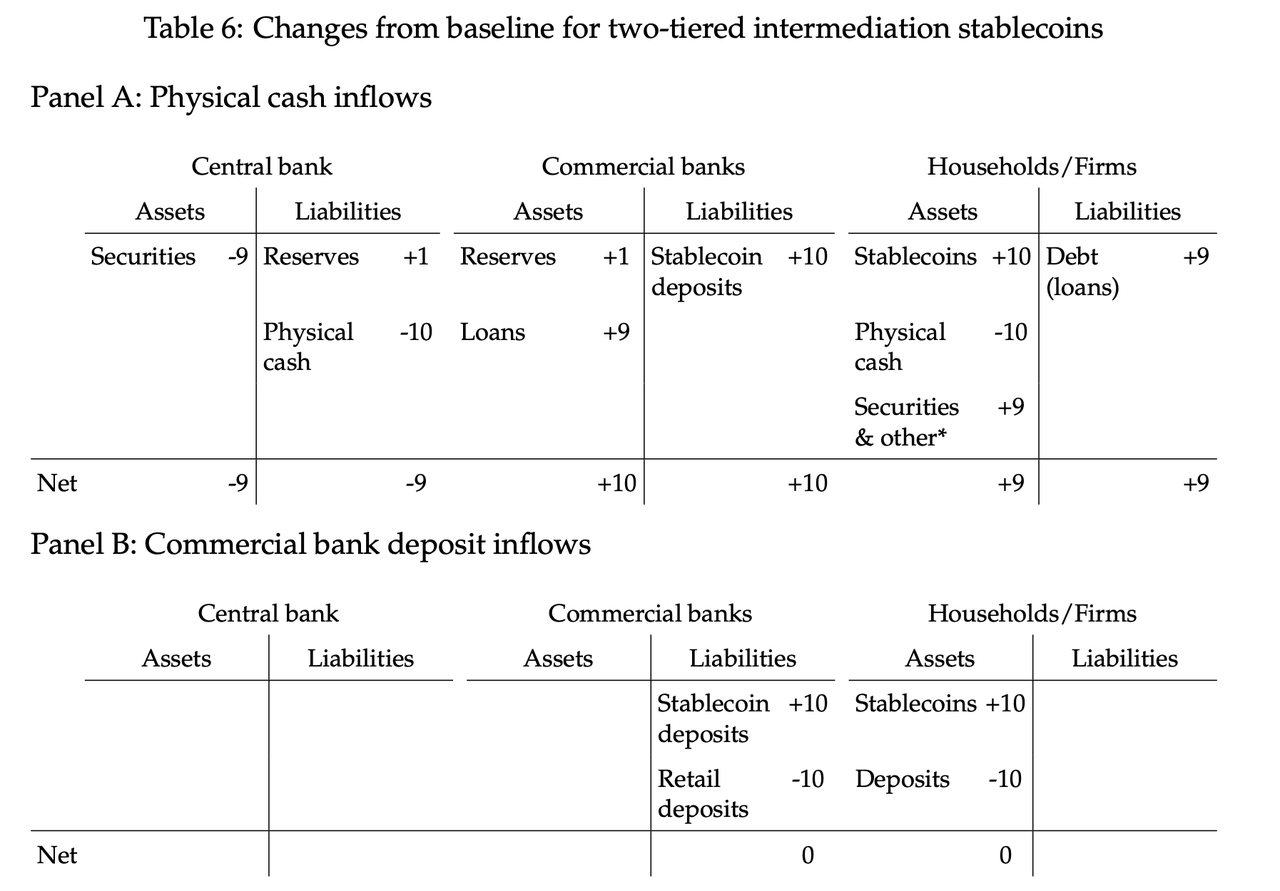
For the two-level intermediary framework shown in the table below, we find that large inflows of staboins will have a neutral to positive impact on credit supply. Panel A shows the situation of converting cash into stable currency. As commercial banks engage in fractional reserve banking through stablecoin deposits, their balance sheets have expanded along with the expansion of their credit and securities holdings, accounting for the bulk of the expansion. Central banks have shrunk their balance sheets, slightly increased their reserves and significantly reduced their cash liabilities. Households accumulated more assets and financed expansion in bank loans. The impact on credit provisions is positive. Panel B shows a two-tier intermediary scenario with deposit substitution. Overall balance sheets and asset holdings of commercial banks and central banks remain unchanged. The only change was in the composition of commercial bank liabilities as time deposits were converted into stablecoin deposits. As mentioned earlier, this scenario assumes that stablecoin deposits are treated in the same way as stablecoin deposits with respect to required reserve ratios, liquidity coverage ratios, and other regulatory and self-imposed risk restrictions.
Securities holding framework
As the table below shows, the impact of widespread adoption of security-backed staboins is the most difficult to predict. Many scenarios are possible. In Panel A, we propose A scenario in which securities-backed staboins see the inflow of deposits from commercial banks. We assume that stabocoin issuers purchase securities from commercial banks rather than the household and corporate sectors. In this case, commercial banks replace lost deposit funds by issuing their own securities as households swap their deposits for stable currency. In addition, commercial banks can reduce their portfolios to make up for the loss of deposit funds. If banks adjust the asset side of their balance sheets primarily by changing their securities holdings, the size of their loan portfolios may remain the same. In this case, the central bank's balance sheet also shrinks slightly because of losses on bank reserves.
Panel B shows the scenario in which households change their cash-equivalent securities into stable currency. This would result in an effective tokenization of cash-like securities without directly affecting the supply of credit in the banking system. We also consider another scenario (not shown) in which securities-backed staboins experience deposit inflows from the household and corporate sectors, while securities are sold to commercial banks. The sellers of securities are the household and corporate sectors, not the commercial banks as described in Panel A in Table 7. The net effect on the provision of credit is neutral, as commercial bank deposit balances held by households and companies that purchase stablesoin are eventually recovered by the banking system by transferring them to other households and companies that sell securities to stablesoin issuers. This restructuring of security holdings is illustrated in Figure 3 by inflows into A and reserve flows into B. The final result is the change of the balance sheet, which is the same as Panel B.
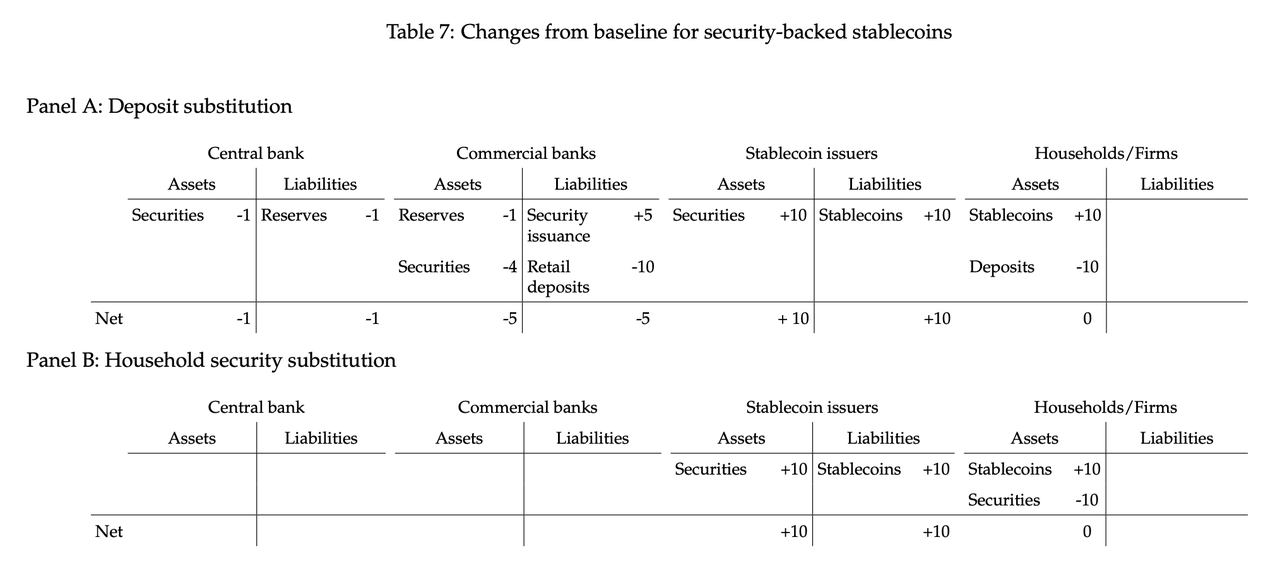
Finally, we did not describe the scenario of security-backed stablecoins flowing in from physical cash. However, this could have a neutral or positive effect on credit creation. If stabocoin issuers use notes to buy existing securities and those notes do not end up in the banking system, this will not affect the supply of credit, as this would constitute a direct exchange of notes for securities. However, if notes purchased for existing securities are deposited in the banking system, or if these notes are used to fund the issuance of new securities, this may increase the supply of credit by increasing loans and securities purchases by commercial banks, or by reducing the equilibrium cost of issuing securities. All in all, the likely impact is a modest increase in the supply of credit.
conclusion
Staboins have grown dramatically over the past year as digital assets have gained wider adoption and use cases for programmable digital currencies have been clarified. The rapid rise has raised concerns about the possible negative impact on banking activities and the traditional financial system. In this report, we discuss the current use cases and potential growth of stablecoins, analyze historical events of anchoring instability, and illustrate different scenarios of stablecoins' impact on the banking system. As noted in the introduction, this paper does not consider all the potential implications of staboins for financial stability, monetary policy, consumer protection, and other important unexplored issues. We focus on balance sheet effects and credit intermediation under a range of reasonable assumptions.
We examine reserve-backed stablecoins and find that the impact of stablecoin adoption on traditional banking and credit provision may vary depending on the source of inflows and the composition of stablecoin reserves. In various scenarios, a two-tier banking system can support staboin issuance while maintaining traditional forms of credit creation. In contrast, a narrow banking stablecoin framework can provide the greatest stability, but may introduce the potential cost of credit disintermediation. Finally, dollar-linked staboins can serve as a safe haven compared to other crypto assets during times of market distress if they are deemed to have adequate collateral.
The original link
Welcome to join the official BlockBeats community:
Telegram Subscription Group: https://t.me/theblockbeats
Telegram Discussion Group: https://t.me/BlockBeats_App
Official Twitter Account: https://twitter.com/BlockBeatsAsia

 Related Articles