"APY Addiction": The DeFi mess left by AC

Original author: 0x137, Rhythm BlockBeats
< br>
Last weekend, Andre Cronje, the soul of the DeFi field, liquidated all his assets in the Fantom ecosystem and announced his departure from the DeFi and encryption fields. The Fantom ecology fell, and Token prices and TVL experienced an extreme "roller coaster" experience in just a few months.
Actually, DeFi has shown obvious weakness before AC left. Solidly was originally an opportunity for him to revive DeFi, but it still ended in failure . What is the problem with DeFi? How should it develop in the future?
The departure of the leader
Revenue optimization "addict"
After AC withdrew from the encryption industry, many articles introduced his life, most of which listed the "hard core" development career of this DeFi leader. But people seem to forget his strong interest in optimizing financial returns. Throughout his crypto career, it seems like this has always been his obsession.
Before becoming famous, AC will always look for the optimal income strategy on lending platforms such as Aave and Compound, and constantly jump between these platforms go. However, this approach not only has high gas fees, but also wastes time, so AC wrote the process of finding the optimal return into code, named iearn. In order to make the code more accurate, more people need to participate in it and perform more deposit and withdrawal operations, and Yearn was born in this way.
This is a simple income optimizer, deposit assets into it, and the platform will automatically implement the most optimized income strategy for users. Although liquidity mining in cooperation with DEXs such as Uniswap and the more complex YFI Token were later launched, Yearn's core concept is still very simple, which is to provide users with the simplest and most optimized financial services. In AC's view, "Deposit And Forget" is the spirit and soul of DeFi products.
SOLID: Andre Cronje's Waterloo
After the "Curve Phenomenon" appeared, AC was Once saw the hope of DeFi. He wants to combine veToken and the potential of the agreement to have a liquidity model to revive DeFi. At the beginning of January, AC published three articles a day, explaining the vision of its new project ve(3,3), and the DeFi community, which had been silent for several months, was instantly in an uproar.
ve(3,3) In other words, the current Solidly is also a revenue optimizer. By holding more SOLID Token, users can Pool votes and get higher income (Beat Beats, in AC What exactly is ve(3,3) that is desperately advertised?" has a detailed introduction to Solidly).
Solidly was supposed to be the pinnacle of AC, but it ended up being its own Waterloo.
Everything seems to go wrong with Daniele Sesta. The latter is the founder of Frog Nation and another soul figure in the DeFi field. The Abracadabra.money he created and Wonderland once supported the TVL of the Avalanche ecology with one hand.
This is a strong alliance, Daniele is responsible for Solidly's publicity and public relations, and AC is, as always, dedicated to development. Solidly combined with Frog Nation and Yearn's ecological power can eclipse any OG protocol, there is no doubt about it.

A picture of AC’s Twitter background after the official announcement of the cooperation, with AC on the left and Daniele on the right
But to everyone's surprise, Frog Nation lost the chain at a critical moment.
On January 27th, Frog Nation’s CFO 0xSifu was revealed to have been involved in several fraudulent gangs, and the community exploded again (Rhythm note, in "< a href="https://www.theblockbeats.info/news/28999?search=1" target="_blank" rel="noopener noreferrer">Frog changed to F "rug", a tweet triggered a billion dollar panic The incident is described in detail in the Incident). AC, who has always been inactive on social media, immediately responded on Twitter, accusing Daniele of negligence. At this time, the AC was obviously tired.

In the end, Daniele had to quit the development of Solidly and rush back to his backyard to fight the fire. Although this incident did not have a serious impact on Solidly, and Fantom's TVL has been soaring, Daniele's departure has paved the way for Solidly's failure.
You must know that AC has no experience in public relations, and is often "disappeared" on social media. After Daniele left, AC had to have a Man juggles two jobs of PR and development. More importantly, the original ecological alliance has now become a one-man show between AC and Fantom ecology, and people know that it is almost impossible to rely on Fantom's native protocol to support half of the DeFi sky.
This kind of problem actually appeared before Solidly went online. In order to obtain the initial quota of SOLID Token, the TVL of the agreement must be ranked among the top 20, but the relatively good competition has become a mess under the veDAO, an external agreement, and various alliances and vampires attacked one after another, and the agreement also started Offering users increasingly outrageous APYs to compete for TVL, no one wants to focus on product development anymore. However, AC not only failed to correct this behavior in time, but instead added fuel to the fire and encouraged TVL competition, which caused many users of Fantom’s native protocol to accumulate a lot of resentment.
After Solidly was officially launched, the problems of the development team were completely exposed. The front-end bugs lead to extremely poor user interaction experience, the loopholes in the fund pool caused many people to lose a lot of money, and the serious congestion of the Fantom network made AC’s Twitter full of abuse.
Under the poor performance of the project and the pressure of public opinion in the community, AC deleted his Twitter account and finally chose to leave the DeFi and encryption world.
What is the problem with DeFi?
"APY Addiction"
As the soul of DeFi Summer, AC and him Yearn Finance seems to have implanted the idea of "pursuing APY" for DeFi from the very beginning. While ideas are not inherently wrong, like many things, a good idea can have unintended consequences.
In the early days of DeFi, mainstream protocols like Aave and dYdX provided financial services that were truly decentralized and convenient for the masses. Focus on product innovation and experience optimization.
But soon Compound promoted a new wave, namely liquidity mining. By providing its own Token COMP, Compound can provide higher APR for the platform's liquidity providers. For a while, Compound's market share soared sharply, and the wind vane of DeFi gradually began to tilt.


After the announcement of COMP liquidity mining, Compound TVL soared rapidly in a short period of time
Followed by Uniswap and other specialized With the rise of DEXs for trading Tokens, liquidity mining has also become the mainstream model for protocol startup. From here, DeFi's dependence on APY has become deeper and deeper, and it has embarked on a road of no return.
In order to solve the problem of "mining disaster" caused by DeFi 1.0 liquidity runaway, the 2.0 protocol represented by Olympus provides a higher and longer-lasting APY, however The DeFi protocol of the 2.0 model has obviously become very extreme.
For the DeFi 1.0 protocol, obtaining liquidity is to promote decentralized market transactions, but the 2.0 protocol does not have any practical scenarios, but more like a A Ponzi scheme. The so-called "protocol-controlled liquidity" has become a way for the team to quickly win over funds, and even engage in Rug (Rhythm note, in "APY 70,000%, DeFi 2.0 dominated by OHM forks" has a detailed introduction to DeFi 2.0).
With the rise of Curve War, the veToken model has also fallen into the quagmire of APY wars. The competition between protocols is no longer application scenarios and user experience, but is a higher APY "bribe".
Solidly's failure was largely due to this vicious APY competition. Protocols like veDAO, without bringing any substantial innovation to DeFi, simply rely on a higher APY to seize a large amount of TVL from Fantom's native protocol. This phenomenon has dealt a big blow to the serious development team, and it has also opened the way for more speculative projects to emerge.
Since the rise of liquidity mining, DeFi has gradually gone astray. The problem solved by the protocol is no longer how to provide users and the industry with more stable and more Convenient financial services, but how to provide higher APY and obtain higher TVL; users no longer regard DeFi as a source of stable income, but a channel for speculation. It doesn't matter what the new agreement does, as long as the APY is high enough, it will rush in regardless.
Compared with a year ago, DeFi today has become a mess and has become an APY "addict".
Token Empowerment
The DeFi field was born together with liquidity mining However, unlike the public chain, finding value empowerment for one's own Token has always been the main problem plaguing the DeFi protocol.
For DeFi 1.0 applications such as Uniswap, Token is a tool used by the protocol to attract liquidity. Liquidity providers provide liquidity for the trading pool and reap Protocol native Token in return. This model produced remarkable results at first, but the disadvantages were quickly exposed. As a user of the protocol, the user does not actually need the token of the protocol. In other words, these native tokens cannot capture and share the value and income created by the platform.
Taking dYdX as an example, users’ daily contract transaction operations have nothing to do with DYDX Token, and its functions are limited to governance voting, interactive discounts, etc. " aspect. Therefore, for liquidity providers, native Token has no long-term holding value, and mining, withdrawing and selling has become a routine operation for giant whales. Once the APY starts to decline, these "mercenary" capital will run away, and then cause a "mine disaster".
In order to solve this problem, DeFi 2.0 simply turns the Token into the protocol itself. If users want to use the protocol, they must hold the protocol Token. But in order to ensure a higher and longer-lasting APY, the dilution of the Token itself has become even crazier.
The biggest problem with DeFi 2.0 is that it has no practical use. The agreement is like a Ponzi scheme, relying on the continuous inflow of funds to provide "endorsement" for the agreement, and Create fake APY for token holders. The price of Token is entirely dependent on the user's trust in the promise of "agreement endorsement". But we know that this kind of endorsement has never happened, and the price of Token eventually plummeted, making 2.0 the DeFi version with the shortest average lifespan.

Olympus native Token OHM price chart, down 98% from the highest point
After Curve War became popular, the problem of token empowerment has been solved to a certain extent. By granting income voting rights to the locked veToken, Token has some practicality for liquidity providers, but the value empowerment brought by this practicality is still limited.
Taking Curve as an example, for liquidity providers, although holding more veCRV can bring higher APY, the income is ultimately in the form of CRV settlement, either locked or sold, has no other effect. In other words, the veToken model is only to alleviate the selling pressure of the original Token, and still cannot capture the value of the protocol itself.
Actually, AC himself has publicly questioned the necessity of "Token culture" for DeFi. Indeed, even without Token, DeFi protocols can provide users with convenient financial services. It’s not that DeFi protocols cannot have Tokens. The essence of “Token Culture” is that users who hold Tokens can own a part of the network, and capture the value created by the growth of the network through Tokens. But for now, the Token of the DeFi protocol does not do this.
Caesar is gone, who will inherit the DeFi banner?
AC’s departure left a blank space for DeFi, but it also helped this space take away a lot of silt. Although no one knows how DeFi will develop in the future, through this incident we can reflect on what kind of DeFi is sustainable and valuable. Perhaps, his departure will become another turning point in the development of DeFi.
LUNA: Growing amid doubts
LUNA has always been regarded by many people as a giant However, whether it is the previous panic market or the AC departure event, Terra's DeFi ecology has withstood the test and has not been greatly affected. It is true that Terra does have the risk of a "death spiral", but its true value is not seen by many people.
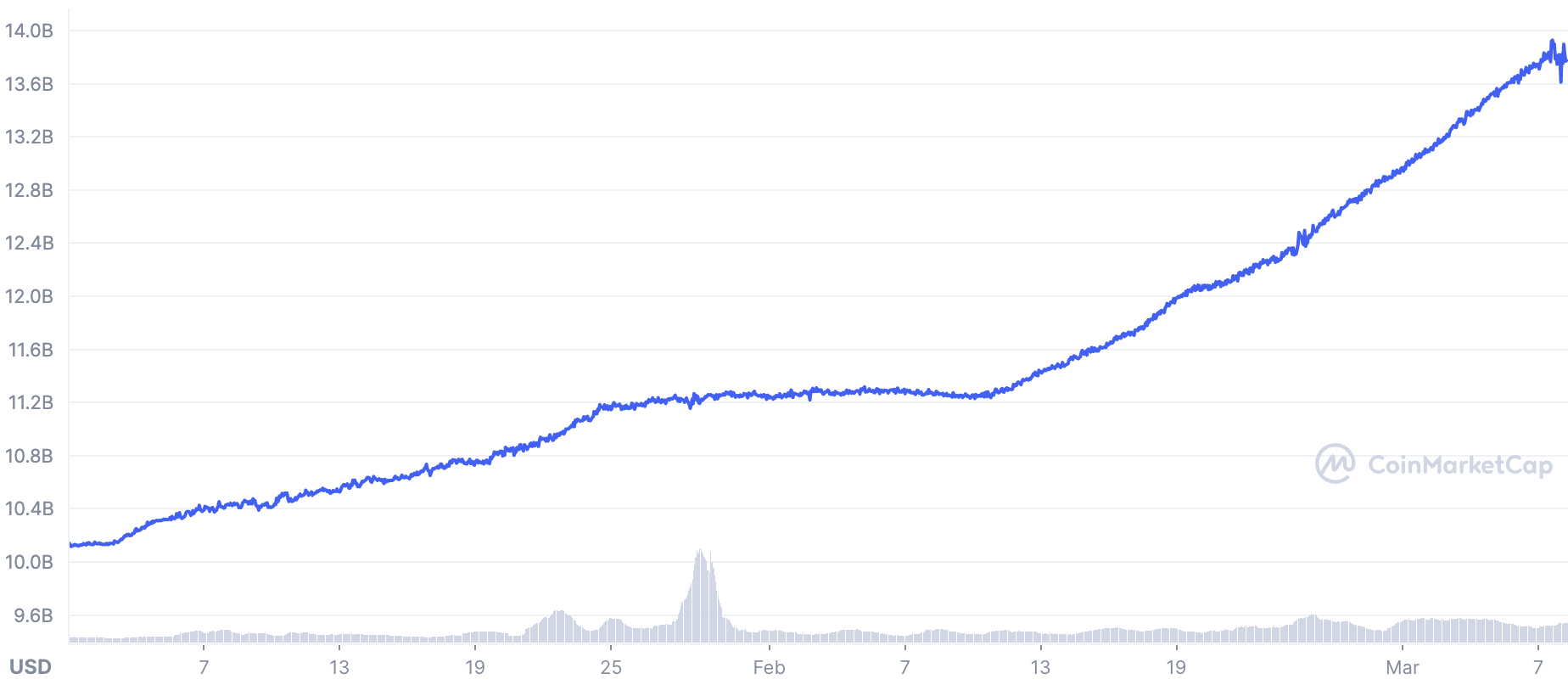
The market value of UST has been stable step up< p>
What Terra does is to improve the payment process of e-commerce through blockchain technology. For a long time, there has been a natural barrier between the encrypted world and the real world. Due to the large fluctuations in Token prices, it cannot be truly used in real life. Therefore, Stablecoin has become an important tool to bridge the two worlds.
But unlike most stablecoins, Terra really takes into account the strong regionality of legal tender. Its Stablecoin system is actually a rich set of currency combinations, linked to various fiat currencies, and meets the needs of different regions and scenarios through physical applications within the ecosystem, including the US dollar, Korean won, and Thai baht.
Under the chain, CHAI Pay helps companies and individuals to open up more than 20 payment channels such as wire transfers, local gateways, and credit cards, saving a lot of time and cost; On the chain, users can gain exposure to trading US stocks through Mirror. All kinds of investment needs in the Terra ecosystem will eventually be transmitted back to UST, capturing the value created by the network for holders in the form of LUNA Token.
In the early days of DeFi Summer, OG projects such as Compund, Aave, Yearn, and Curve were successful because they were committed to providing ordinary people with accessible finance Services, this is what the market and a wide audience really need, and it is also a product that can create real value. The same is true for Terra's success today.
“DeFi is not a world of one person”
DeFi and even the entire crypto field are still full of From this perspective, the departure of AC is also a good thing. It leaves more room for development for other developers and makes the entire industry more rational.
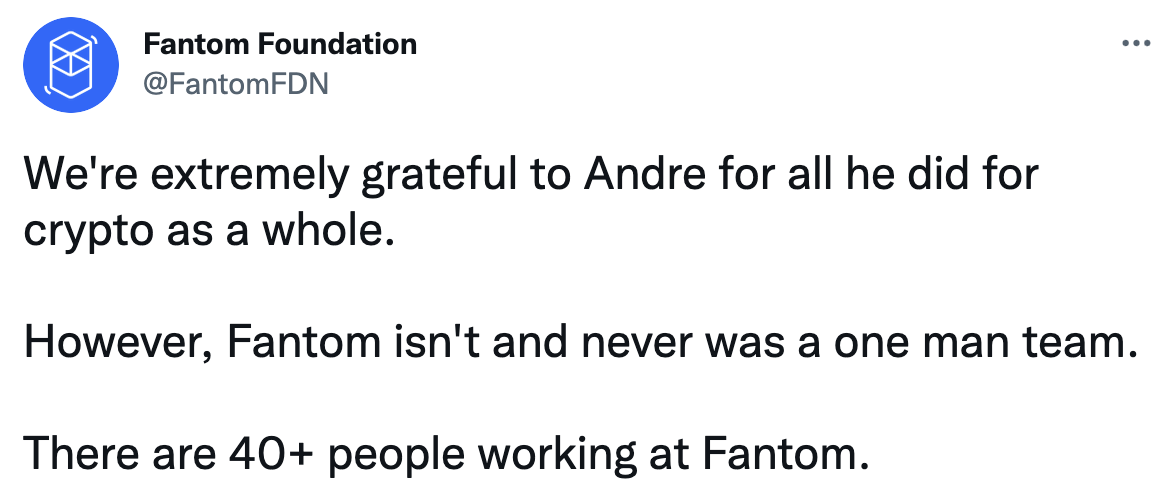
After Andre quit, the Fantom Foundation issued a statement: "Fantom has never been a team of one person."
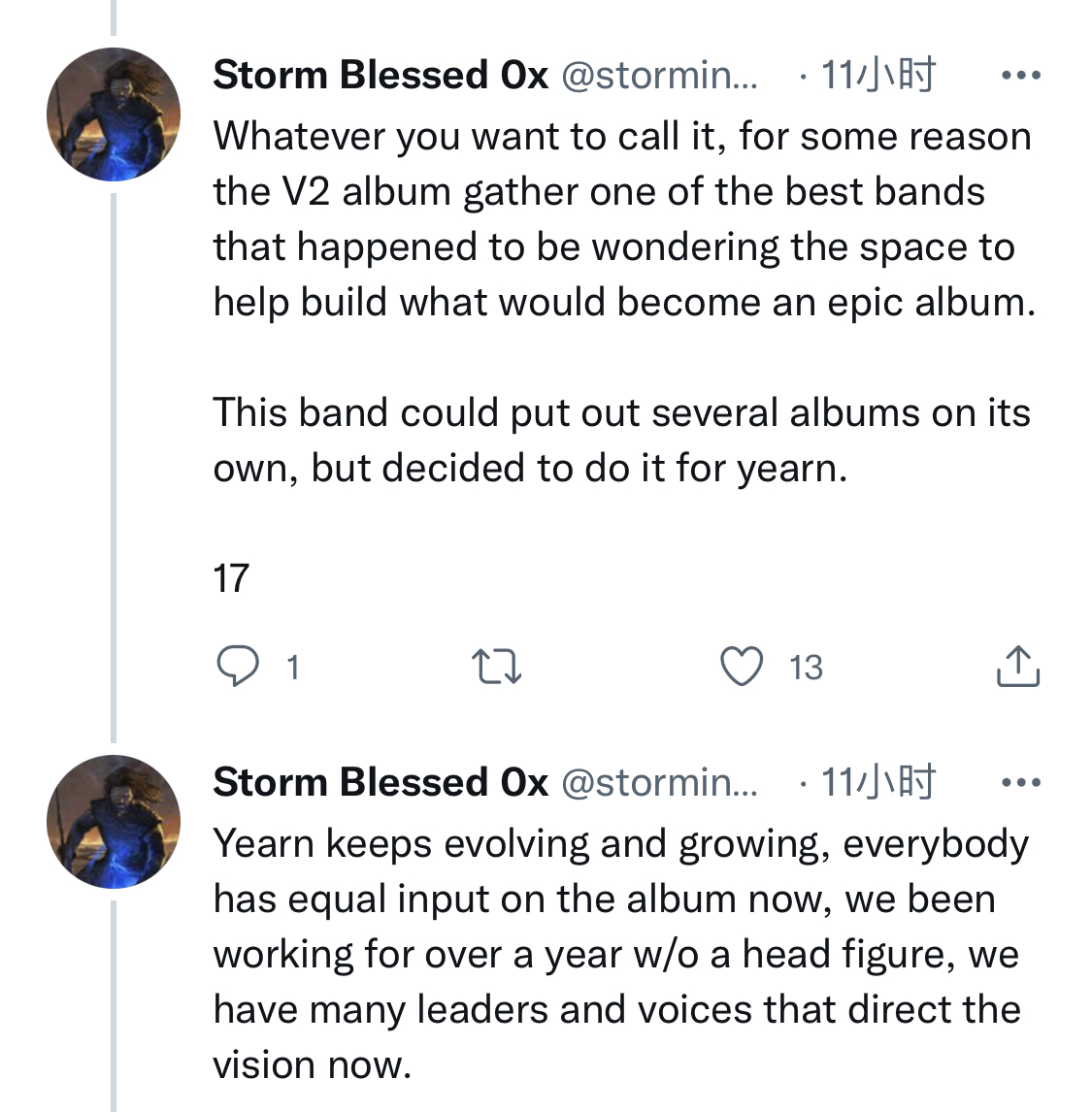
Yearn Finance members on Twitter recognized team's Contribution, and said that in the future, it will continue to bring more innovative products to DeFi.
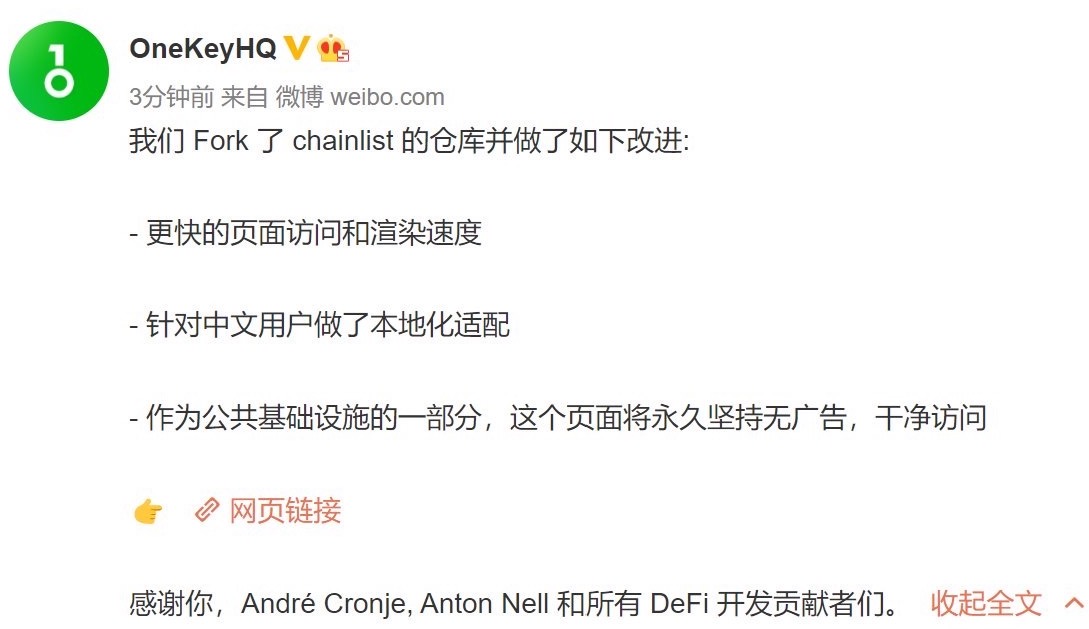
The community also stood up at critical moments and maintained necessary infrastructure.
DeFi Future development There is always more than one path, the important thing is that more developers are willing to make silent contributions to this field, fortunately, this is exactly what we have seen.
Welcome to join the official BlockBeats community:
Telegram Subscription Group: https://t.me/theblockbeats
Telegram Discussion Group: https://t.me/BlockBeats_App
Official Twitter Account: https://twitter.com/BlockBeatsAsia
 Related Articles