Arthur Hayes: War and Bitcoin in the Post-Inflation Era

Original Title: "Annihilation"
Original Author: Arthur Hayes (Founder of BitMEX)
Original Compilation: Wu Zhuocheng, Wu Shuo Blockchain
We are entering such an era, an era in which the order of the countries will change, an era in which wars may be ignited at any time. In this era, military demand will continue to squeeze civilian demand, and global inflation will be difficult to stop under such a background. Now, putting aside the human suffering caused by war, what should we do with our portfolios? I'm not trying to ease the grief of war by immediately turning to business matters - but we must prepare our own estates for the depletion of our personal and family resources.
Let's look at some charts depicting policy rates versus official inflation measures. The official figures are glorified, but even that looks like a disaster.
US CPI (currently negative 7%)

Eurozone CPI (currently negative 5%)
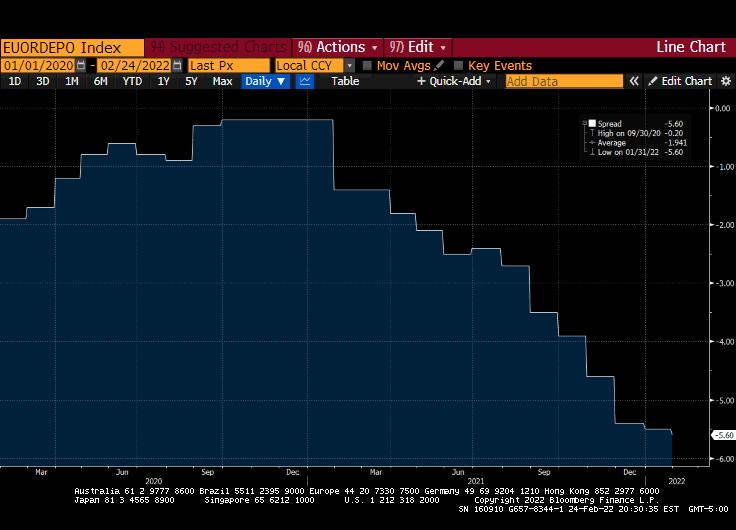
UK CPI (currently negative 5%)

The three charts above show official CPI data, which represent real interest rates. As you can see, real interest rates have been severely negative since the outbreak. Imagine you have a dollar, a euro or a pound in your wallet. Next year, the value of that fiat currency will suddenly drop by 5% to 7%. It wouldn't be a problem if workers' wages also rose that much. But for most salaried or hourly workers, their wage increases have not kept up with the decline in fiat currencies.
Politicians are now instructing "independent" central banks to control inflation. Central banks must now raise policy rates – there is no dispute about that. At issue is how much they decide to raise rates and how quickly they want to do so.
If the Federal Reserve raises interest rates six times this year, the entire financial world will paint a picture of the end of the world. That's what the fed funds futures market is predicting. If they raise rates by 0.25% six times, then their policy rate will be 1.5%. Even if the US CPI inflation rate above 7% is halved by the end of the year, real interest rates will remain at -2%.
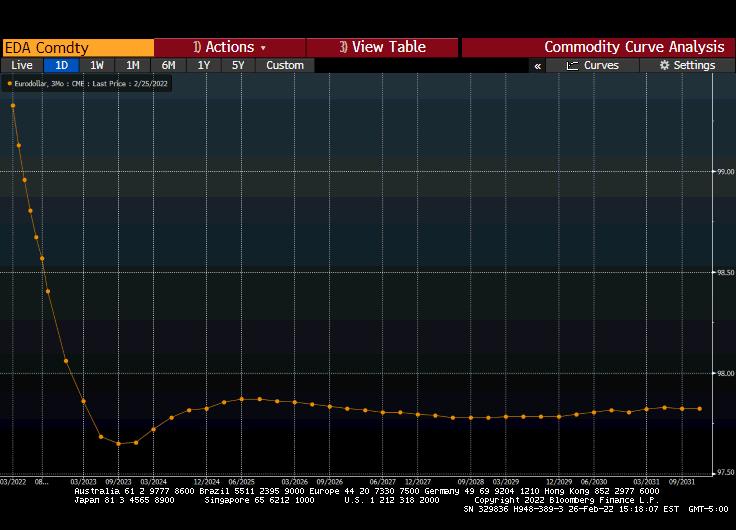
The picture above is the term structure of the Eurodollar futures contract. To find the rate of return on holding USD deposits outside the US, take 100 and subtract the futures price. For example, if the Eurodollar futures price is 98.00, the yield is 2%.
I could write thousands of words on the importance of the Eurodollar market, but TL and DR are the most important interest rate markets in the world. This market is heavily influenced by Fed policy.
If we look at the Eurodollar futures curve, it will peak near 2.5% next September. The Fed is expected to raise short-term interest rates because the benchmark for such futures is the three-month rate on U.S. dollar deposits. 2.5% is not enough to fight the current level of inflation, and this does not take into account the various medium or large conflicts that will completely distort global energy use in the next 12 months.
Politicians have given a directive - "fix inflation". Central banks will comply, but only to a certain extent. Why? Because nominal interest rates, which can lead to financial crises, get lower and lower with each recession.
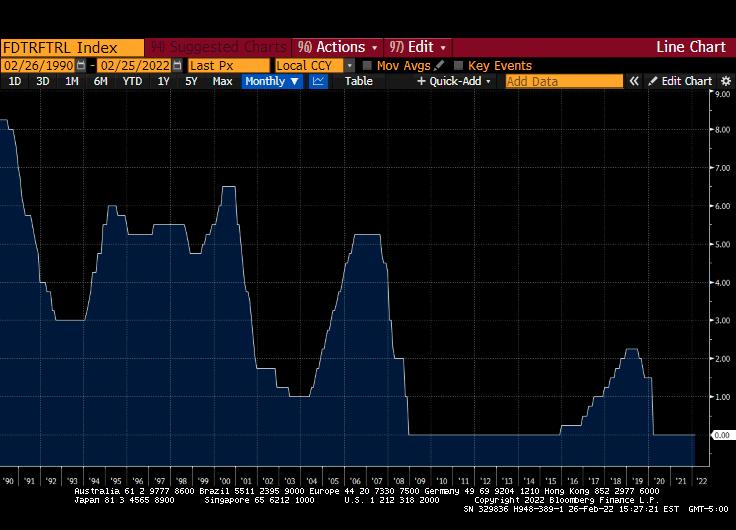
The graph above is a graph of the lower bound for the federal funds rate since 1990. Every major global financial crisis has happened because of the accumulation of leverage and debt in certain areas of financial markets. When the Fed raises rates, it pops the bubble because funding costs rise.
After the first Gulf War and the Iraq War, the Fed moved away from low interest rates, raising rates by about 5% to 6% by the end of 1994. This led to a financial crisis in Mexico, the U.S. Treasury bailed out U.S. banks in Mexico, and the Federal Reserve took steps to cut interest rates slightly. A few years later, when interest rates rose to nearly 6%, the Asian financial crisis erupted. Due to the increase in US dollar financing costs, the Asian Tigers have applied for economic assistance from the International Monetary Fund and the World Bank.
We all know what happened in the tech industry in 2000. The chart clearly shows that the Fed is raising interest rates again after cutting them slightly after the Asian financial crisis. Higher funding costs dent hopes and dreams of a tech utopia, and a full-blown stock market crash ensues.
Then the 9/11 attacks happened, the Fed cut rates and inflated the housing bubble. Rates then surged 5 percent, culminating in a 2006 high for the U.S. housing market. By 2008, losses from subprime mortgage derivatives infected the entire global financial system and caused a sensation!
After seven more years of zero interest rates, the Fed again began raising rates to just above 2% until late 2018/early 2019. The economy began a full-blown recession in late 2019 after rising interest rates, which, combined with the fallout from the global pandemic, transformed into one of the worst contractions on record.
6%, then 5%, then 2% - every decade, financial markets suddenly drop amid rising nominal interest rates. With the explosion of global systemic debt and leverage post-COVID-19 due to low or negative interest rates and the need to generate yield, I don't think global financial markets can afford even 2% nominal interest rates.
Looking at the chart above, major central banks are lagging far behind in terms of inflation, with 2% policy rates still negative in real terms. Unless workers start getting bigger raises, they will still suffer from consumer inflation month after month. This is the recipe for "social restructuring", let's revive the Jacobins.
Inflation
Each asset will be discussed as an effective hedge against inflation. Many people instinctively believe that, as a scarce asset, Bitcoin and other cryptocurrencies are good inflation hedges. They may be right in the long run, however in the short term Bitcoin’s price action is more like a risk asset than an asset that keeps appreciating when real interest rates are negative.
Bitcoin is clearly benefiting in large part from the global central bank money-printing spree caused by the epidemic. It needs to digest stretched valuations, but that won't help if liquidity keeps tightening. Now, let's move negative interest rates out of the picture for a moment.
Bitcoin has risen from $4,500 in March 2020 to nearly $70,000 in November 2021. But then central banks reversed course - saying they would do the right thing and curb inflation. Those comments alone were enough to push up short-term interest rates and stall the crypto bull market.
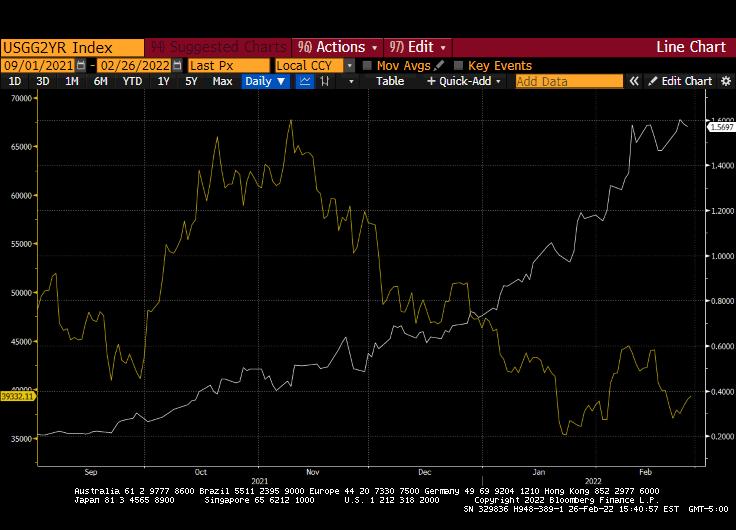
The graph above shows Bitcoin (yellow line) vs. 2-year US Treasuries (white line) since September 2021. In my opinion, the Bitcoin bull market stalled because of tightening global liquidity conditions. Markets repriced fiat credit in anticipation of future central bank hikes in nominal interest rates, which led to an 8x increase in 2-year yields and a small sideways move lower for Bitcoin.
However, the gold is finally starting to move in its grave. It started to move higher towards $2,000 as interest rates continued to stay in negative territory. Short-term nominal interest rates rise, and gold still rises because real interest rates remain negative. As a result, gold's historical trend of maintaining value in the face of devaluation of fiat currencies has recently regained investor attention. I expect Bitcoin to go through a similar process eventually. However, "eventually" is key - patience and the ability to control buying appetite is the right time to re-enter the space or reallocate assets.
War
Let's imagine if the current conflict in Eastern Europe expanded into a medium or large global conflict Some situations that may occur.
Due to environmental concerns, many countries have underinvested in the production and exploration of fossil energy, which has led society to replace cheap fossil energy with relatively expensive wind and solar energy (measured The criterion is the energy they each produce versus the energy investment required). As humans, we need energy to survive, so people pay more for it. One could argue that the cost of fossil fuels doesn't fully reflect their negative externalities on the environment - but for a household, they're now paying 50% more to heat in harsh winters.
Over the past 50 years, the world has printed the most money in human history. Now that the average age of the population is getting older in all major economies, there will be less and less productivity to service the huge and growing debts. But to keep the game going, central banks have to print money so that they can nominally pay off old debts. A government never voluntarily defaults on its debt in its own currency, but uses inflation instead.
After the epidemic, inflation will rise. Relatively scarce labor often prevails over capital, demanding greater pay for its work, and global costs continue to rise. Robots aren't ready yet, so companies still need to activate those "essential" workers.
Central banks in the most advanced economies would need to raise interest rates significantly to bring real interest rates into positive territory. However, the level of nominal interest rates at which the financial system could collapse is at an all-time low, and some sectors of the financial and real economy could collapse if interest rates rise another 1% to 2% from current levels.
War is usually a conflict over resources or access to markets. Its purpose is nothing more than "I want your energy reserves" or "I'm going to force you to buy my stuff". Ideological "isms" are just a cover-up for an economic reality of why one banner attacks another. As mentioned at the beginning, systematically, humans have never had a net gain from conflict. Thus, other things being equal, the act of one country seizing another country's resources or markets leads to a general increase in prices.
If you played Risk, read Brzezinski's Grand Chessboard or Mackinder's The Geographical Pivot of History , it will be clear that the conquest of Eurasia is the conquest of the world. This continent has the largest population in the world and holds a significant percentage of the world's natural resources, such as energy and metals.
If we as a global society cannot agree on a fair way to share these resources - which we have never done - war between nations It is inevitable. There have been periods of relative, apparent calm, but we are now in the past. Any interruption of energy supply in a region would add to an already precarious situation. Energy is not going to get cheaper as the war goes on. The mere fear of war would disrupt trade, and entities would hoard energy and trade on more unfavorable terms.
Back to monetary policy, what is the central bank going to do when the politicians who ask the central bank to curb inflation are brandishing swords?
Scenario 1: Curbing Inflation
In order to properly curb Inflation, the central bank must reduce real interest rates to at least 0%. This would require policy rates above 6% - which seems incomprehensible given current financial market conditions. But this is the lowest rate necessary to curb inflation and correct all the imbalances of the past 50 years.
Remember that a large part of current energy inflation is not a monetary phenomenon but due to chronic underinvestment in the cheapest energy sources and war. These are two problems that the central bank cannot solve. So they could raise rates, raise rates, raise rates and energy prices never go down, and then once the global economy collapses, per capita energy demand drops dramatically because we've drastically reduced our consumption patterns, energy prices could go down drop suddenly.
If interest rates were to go up to 5% or 6%, the global economy would be devastated, and 2008 was like kindergarten by comparison. This reset will wipe out many uneconomic businesses, but put humanity on a more sustainable growth trajectory. Yet this rebalancing is destabilizing society—especially for holders of financial assets who set all the policies.
If real interest rates plateau and then rise sharply, causing a severe shock to the world economy and causing energy use to drop, then nothing but volatility hedges (or even cryptocurrencies ) will save you, there will be nowhere to hide. I will continue to increase my exposure to volatility hedge fund managers that I endorse. Thankfully, banks still sell them mispriced FX and interest rate options.
This is an unlikely scenario in my opinion.
Scenario 2: Extended inflation
This is the base case for most of 2022.
Central banks are showing up in the financial media and telling politicians they are serious about fighting inflation. Bankers raised the policy rate to a range of 1% to 2% - the futures market tells us to do that, and that's it. At this level, real interest rates are still negative, which is very important in times of war or near war because governments need to spend money to fight wars and citizens don't like direct taxation to pay for wars, governments always resort to the covert trick of inflation .
By keeping real interest rates negative and nominal treasury bond rates below nominal GDP growth rates, the government can affordably finance and reduce its debt/GDP ratio. Negative real interest rates would smuggle wealth from savers to governments.
This level of nominal policy rate would lead to a recession - but would not significantly alter the social structure, and the government could still afford to go to war.
One problem is that the central bank is once again unable to control energy costs, which are likely to continue to rise. And because their monetary policy remains loose on government spending, governments will still crowd out the private sector in energy use. Energy costs will therefore continue to rise, and a lack of anti-inflation beliefs may lead to social unrest.
As it pertains to our portfolio, patience is key. If the Fed and other central banks raise rates, it will depress asset prices, but Bitcoin and cryptocurrencies will emerge from the carnage first. The crypto market is the only market that is freely traded and accessible to all humans with an internet connection. Therefore, the cryptocurrency market will have its ups and downs first compared to other TradFi markets. Remember, real interest rates will still be negative. Once persistently negative real interest rates erode the purchasing power of fiat currencies, the rush into scarce assets will be brilliant.
Central banks do not want to restructure society by raising interest rates to really dampen consumer demand and government spending. Once the elections are over, the political pressure to fight inflation will dissipate.
For us crypto traders, it takes patience. If you're already in what you consider a benchmark cryptoasset (mine are Bitcoin and Ethereum), stay there. Don’t short your ideal configuration – sit in your Corbusier chaise longue, uncork a low-intervention bottle of wine, read a book (no TikTok), and chill out. If you are a dedicated day trader, then remember that the shift from risky assets to inflation-proof assets will happen at the speed of light. For now, it's slow motion for you, crawling sideways in a meander. So don't be greedy - fast in, fast out, you can live a long time (the original text here is "get in, get out, and get long", it seems to be a pun, both live long and do long meaning).
I wrote this over the weekend when the conflict between Russia and Ukraine seemed short-lived and the reaction from the West was calm. Yet the war continues, and the West appears prepared to endure economic pain in order to decouple from Russia. Russia (and any territory considered Ukraine in the future) is a major supplier of food and energy. Removing this supply from the global market is highly inflationary.
Furthermore, we cannot know with certainty what the financial consequences would be if the decoupling were to occur. You never know where the cockroaches are hiding on the balance sheets of financial institutions unless you have an understanding of market volatility. Therefore, it should be assumed that decoupling will lead to financial distress for a small number of large financial institutions. Given the massive leverage in the financial system, this predicament could turn into a global financial crisis.
The West's political reaction to Russia presents an opportunity for global central banks to drop their commitment to fighting inflation. I'm not sure they'll be able to do it politically, because inflation will only continue to rise as the world tries to exclude Russian energy. So I'm cautiously bullish on Bitcoin and I'm trying some Bitcoin and Ether call options. This might be a little overtrading, but I just love the market.
Fed funds futures for March suggest the market is pricing in a 0.25% rate hike from the Fed. But keep an eye out for the big investment banks' favorite Fed comments and the Wall Street Journal's opinion section. The Fed will test out whether the potential or actual market turmoil resulting from the current conflict is severe enough to warrant a more "accommodative" theme. Depending on how markets and politics react, they may think that, politically speaking, they can keep rates at zero.
To be clear, I'm not ready to back up my gas-guzzling G-Wagon and add more exposure to cryptocurrencies. This is a prudent purchase in the face of changing circumstances. Central bank officials will provide a clear "all hands" signal for the inflationary crypto magic carpet. The first sign will be whether the Fed deviates from market expectations of a mid-March rate hike of 0.25% to 0.50%. My base case remains that financial leverage will drive crypto markets down again before we reach new highs.
Scenario 3: Accelerating inflation
A sharp global conflict would change the game forever . Inflation becomes the name of the game as political necessity shifts from "Let's fight inflation and keep the middle class economically dignified" to "That flag over there is evil and must be defeated, so your responsibility, citizens , win the war by enduring inflation.”
Price controls, rationing, and inflation will become the new normal for nations so that all available resources go to the military. Domestic currency is spent as soon as it is earned. Gold, Bitcoin and other cryptocurrencies will be hoarded. This would be Gresham's law in action. Access to the gold and crypto markets will become more difficult as capital controls will limit the ability of ordinary citizens to protect themselves from inflationary theft.
In reality, most fiat-denominated financial assets will be worth less than toilet paper. Yes, your stock portfolio may rise in nominal terms, but the price of milk, butter, eggs, sugar, etc. will rise faster than your cheap stock index fund.
I sincerely hope this doesn't happen. You'll read about the everyday experiences of citizens during the world wars, with varying degrees of unpleasantness depending on the borders of the flag you live on. But reading and living are two different experiences. I don't want to have that experience. But unfortunately, the history of humanity is a history of conflict.
While I hope this is only a remote possibility, if you think this is a likely scenario, you should be trading ahead of time. That means taking out idle financial assets and buying globally recognized portable stores of wealth. Domestic assets, such as real estate and stocks, will not hold real value. Gold, Bitcoin, and some other cryptocurrencies will hold global value compared to energy.
At some point the conflict is over and hopefully your "savings" are not valuable before the war but worthless after. No class of society escapes war economically unscathed - the best you can do is protect what you can until you deem it necessary. If you don't believe me, just watch "Downton Abbey" again. Great Britain's extended families had to sell their family's "birthright" as devastating inflation and the economic cost of war bankrupted the country. The political result is a tax on those who still own fixed assets.
Naive
Nowadays, citizens of the world have smartphones that can fit in their pockets. It is a mass communication tool for instant sharing of knowledge. We can show each other the ravages and devastation that war has wrought on our respective societies.
But while we can all be idealistic and hope that the proliferation of information will change the human propensity to wage war against itself, we must prepare our property , in order to resist the damage of inflation. That's not to say we should ignore short-term price action, I think anything will go down in the short-term. The key is to realize when it's time to sell, no matter what the price is - because whoever sells fiat first gets the best price.
Original link a>
Welcome to join the official BlockBeats community:
Telegram Subscription Group: https://t.me/theblockbeats
Telegram Discussion Group: https://t.me/BlockBeats_App
Official Twitter Account: https://twitter.com/BlockBeatsAsia

 Related Articles