Why the veToken model took off: The magic of economics
The Pillars of Tokenomics & AMP; The VE Token Model
By Captain BTC
原文编译:0xzshanzhan,深潮 TechFlow
It is difficult to design the Token economic model
For the project, the design of Token's economic model is very important, and it is also one of the most difficult things in the project. . Because you're essentially creating an entire economy from scratch, and you're doing it without any real-world experience. A subtle mistake in the design of the Token model can affect the entire project, even if the rest of the project's design is fine, and the immutable nature of smart contracts further underscores the importance of the initial Token design. Once a contract is published, a fork is required to update the protocol.
Despite the complexity of Token economics, it is still subject to the fundamental law of economics, namely supply and demand. To put it simply, the design of Token economic models is to design ways to affect short-term and long-term supply and demand. Ideally, the best design would encourage demand while reducing supply, but this is easier said than done.
The four pillars
Before delving into the complexities of "VE" Token design, this article will cover the basics of Token economics. In my opinion, each cryptocurrency has four basic pillars of Token economics, which is the first thing investors should analyze before delving into Token economics. . Any design flaw in the prop is a hidden danger to the Token economic model in the future. If the flaw is serious, it could cause the entire economic model to collapse or cause the project to slowly bleed like an abandoned building rusts.
supply
Nothing is more fundamental or important than quantity management of tokens, and part of quantity management of tokens is supply. We can divide the supply into:
Circulation supply:
The number of tokens circulating in the market
Maximum supply:
The maximum number of tokens that a protocol can theoretically generate
Total supply & NBSP; :
Number of tokens issued. This includes destroying and locking tokens. Even if these tokens are not part of the circulating supply.
The higher the supply, the lower the price. I'm sure you often see things like "Look at ADA, it's only $1, imagine how much MONEY I'd make if it only hit 50% of the price of Bitcoin!" "And so on. Because they don't realize that the ADA supply is 45 billion and bitcoin supply is 21 million. This is why market cap is a more accurate indicator than just looking at the Token price, as it affects both price and supply.
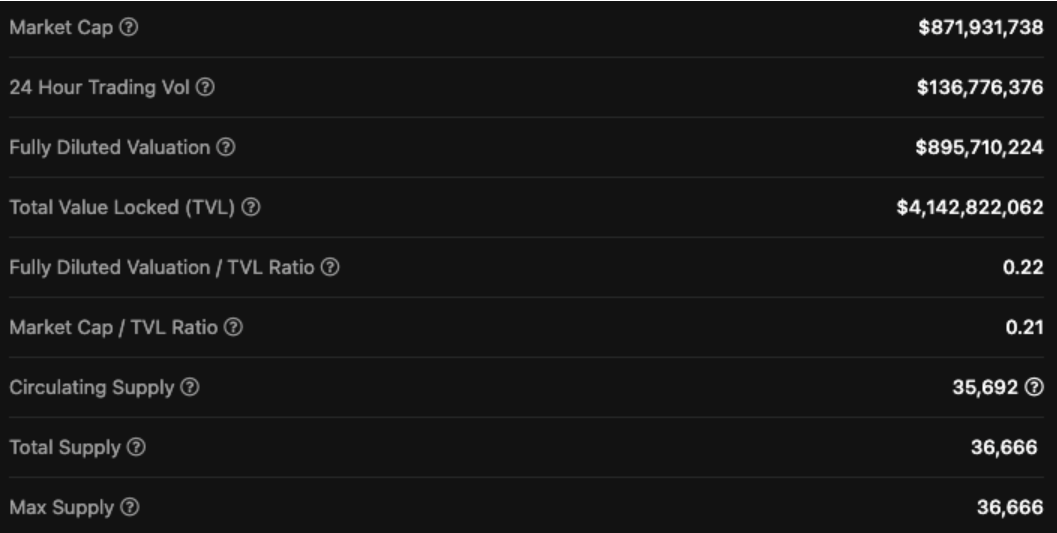
A comparison of circulation supply with total and maximum supply reveals an interesting phenomenon. For example, if circulation supply is low and total supply and maximum supply are high, this is a big red flag because the value of your Token will be diluted, as shown below: & NBSP;
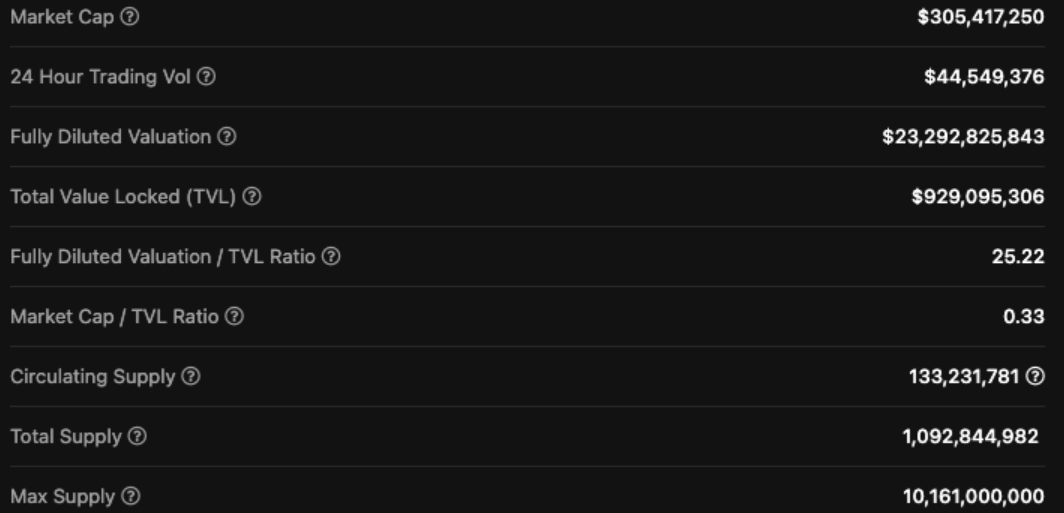
The circulating supply of this Token is about 133M, with a maximum supply of 10B. There is about 8x dilution risk for your Token and this is a major issue. If all tokens were released tomorrow, your Token would be worth 1/8 of what it was yesterday. Let's say you buy at 305m today and expect to reach 100x in five years. This would give a market cap of 30B (quite high, but not uncommon among cryptocurrencies), but a fully diluted valuation of 2.3T (higher than today's cryptocurrency market cap).
Moreover, even if the market value increases, regular issuance of these tokens will increase the circulating supply, which will put downward pressure on prices. That's not to say everything about this Token is bad, and they may even have ways to offset supply pressures, but it's a risk factor long-term investors should be aware of. Short-term investors don't worry too much about maximum supply as they may run long before the Token is unlocked.
Here's an example of the opposite, where circulation supply is close to maximum supply. That doesn't mean the project is a reliable one, but it does reduce the risk for investors.
distribution
Token distribution is the next pillar of the Token economic system that investors should be aware of, and it's a very simple pillar. Distribution refers to the distribution of the percentage of each wallet that holds a particular Token. Would you want one person to hold 70% of the token supply? If you want, the project will be very concentrated and he can sell tokens endlessly, making us retail investors poorer and ruining the project's prospects.
A good distribution design is to distribute tokens to as many people as possible.That way, if someone wants to exit, their selling won't have much of an impact on prices. The best way to check the Token distribution is to look at the Token distribution chart in their white paper and check the wallet distribution on the blockchain browser.
Monetary Policy & NBSP;
Monetary policy determines whether the Token is an inflation or deflation model, and also determines the degree of inflation/deflation and the overall consensus mechanism of the project. As noted earlier, high inflation causes asset prices to fall over time. Low inflation combined with POWs (such as Bitcoin) can be a good thing because it creates productivity in the ecosystem. Ethereum 2.0 and EIP 1559 allow ETH to be destroyed on every transaction, which in theory should make Ethereum deflationary.
This leads me to my next idea, which is how to analyze together the four pillars of Token economics and their interactions. Let's go back to the example of highly diluted tokens in the provisioning section of this article. Although it has a high FDV, suppose its monetary policy is to consume 7% of the revolving supply annually and 5% of the token release program annually, so even if 7/8 of the supply is locked up and there is inflationary pressure, this results in a 2% year-on-year decline in the deflation rate. Under this monetary policy, tokens will not face any locked inflationary pressures, but in reality there are negative supply pressures due to a reduction in circulating supply.
Looking for the interplay of the various pillars of Token economics can clarify the merits of Token economics. Looking at just one pillar is often misleading. (Please note that there is debate as to whether destruction is an efficient use of funds, so Token destruction is only used in this article as a simplified example to explain the concept.)
Value capture
The final pillar is how much value the protocol captures and how that value should be distributed. In Web 2, all of the value gained goes back to companies like Facebook, Google, and Twitter. They make billions of dollars from users' data and social media interactions, while users get zero dollars in return. The user will get at most one blue check mark. Web 3 turns this on its head, because protocols capture the value they provide and assign it to Token holders. You can become a user of the agreement and be rewarded at the same time.
Not all protocols capture value effectively, and I think a lot of research and experimentation is still needed before we have a Token architecture that can capture 100% of the value that protocols provide.
The simplest comparison is Uniswap vs Sushiswap in 2020. Uniswap released their AMM (automated market maker) but did not release tokens. Sure, they offer innovative products with a lot of value, but they capture 0% of the value for the network participants. Sushiswap then forked Uniswap to create SUSHI & NBSP; Token.
SUSHI holders can vote on governance issues, pledge their SUSHI to xSUSHI, and receive transaction fees generated by the agreement. While this model is far from perfect, giving Token holders a share of revenue yields far more value than Uniswap's model. Sushiswap would have had a harder time acquiring new users if Uniswap had introduced a Token to capture value when AMM was launched.
VeToken economic model
So that's the basics. So what is Ve?
Ve is a "voter escrowed". Since it was proposed, it has rapidly become a popular Token economic model. It adopts the newer DeFi protocol. Interestingly, the VE model was invented by Curve Finance and is "DeFi 1.0".
It works by locking your CRV token and then converting it into a veCRV with protocol governance capabilities. The lock-up period is not fixed and Token holders can decide how long they want to lock up their CRV, up to 4 years.
Over time, the number of VECRVs owned by the holder declines linearly during its lock-in period. This provides an incentive for holders to periodically re-lock their CRVS for veCRV to maximize governance and rewards. The main innovation is how to create weighted votes and weighted rewards. In addition, once you convert CRV to veCRV, you are locked in for a specified period of time. You can't unlock early like you can with other protocols.
Suppose Bill And & have spent Alice has 100 CRVS each. Bill decided to lock his CRV for 2 years and Alice locked hers for 4 years. Even if they start with the same number of CRVS, Alice will receive twice as many VECRVs as Bill, meaning she will receive twice as many governance votes and awards as he does.
Effect of VeToken economic model
One of the main problems solved by the veToken economic model is the 1 token = 1 vote problem. Under the non-VE model, the whale can buy a large number of tokens for short-term governance and be rewarded without taking any risk in the game beyond the short-term price. So a similar protocol could buy millions of dollars of rival protocol tokens, vote for bad proposals, and then dump the tokens.
This type of whale manipulation is much less effective under the VE model, because their votes are not as valuable as those of long-term holders.If one protocol or whale wants to have a significant impact on another, they will have to lock in their tokens for a period of time.Once their tokens are locked in, this creates an incentive to act in the best interest of the agreement. The CRV war is the best example.
In addition, hard-core supporters who choose the protocol with the longest lockup period will have a bigger say than they would under the 1 Token = 1 vote model. These hard-core supporters make more income and passive income than short-term speculators. As long as the agreement goes forward, the pledgers will understand that they will receive passive income for the foreseeable future, rather than jumping from one agreement to another with uncertainty.
Finally, the VE model has a direct impact on three of the four pillars, with distribution being the only pillar that has a weak relationship with the VE model.
The Ve model influences supply through long-term lock-in of tokens.Holders are incentivized to lock in their tokens for long periods to maximize influence and return. When these tokens are locked in, they exit the market over a long period of time, reducing selling pressure. Because there is less supply, this should lead organically to higher prices over time. Compared to the 1 token = 1 vote model, this flow-through provision performs very well.
VeToken holders are the ones who decide the monetary policy of the protocol, just as under the 1 token = 1 vote model. The difference is that the veToken model is an upgrade because it aligns the long-term incentives of the agreement with those of the pledgee. As noted earlier, this would provide an incentive for holders with the most vested interests to vote for the favorable monetary policies of the agreement, rather than for potentially malicious third parties or third parties with only their own interests in mind to support policies that undermine the agreement.
The final pillar of the Ve model's impact is how the protocol allocates captured value to its holders. The model allocates captured value based on how long you are locked in. But there is still plenty of room for innovation to maximize the return of value to users.
innovation
Many of the protocols in the DeFi world are working hard to implement the veToken economic model, which is great! This is an improvement over the traditional token economic model, but veTokenomics will not be the pinnacle of token design. This section describes some of the innovative designs that are being built on the basis of the veToken economic model. (Note that I'm not talking about putting your entire net worth into the tokens I discuss below, I'm just talking about the innovation they're working on with the veToken economic model, which is still an unknown experiment.)
Cartel is currently creating a VE version for their BTRFLY token, but with one difference. Instead of veBTRFLY, they plan to release blBTRFLY and dlBTRFLY, which stand for bribe lock and DAO lock BTRFLY respectively. BlBTRFLY is a retail-oriented Token that maximizes returns for holders, while dlBTRFLY focuses on DAOs and protocols that want to maximize their DeFi governance. Simplified understanding:
BlBTRFLY = Higher yield
DlBTRFLY = Higher DeFi governance rights
This is an interesting design based on the veToken economic model, and I'll look at how it works in practice.
The next innovation protocol is Trader Joe's. They released a new Token economics model, introducing three Joe derivatives to replace xJOE, namely: rJoe, sJoe, veJoe.
Pledging JOE for rJOE allows rJOE holders to participate in the launch of projects in the JOE ecosystem. (Rocket Joe is more subtle than that, but that's beyond the scope of this article.)
Pledging JOE for sJOE gives sJOE holders a share of the revenue paid by the platform. This income is paid in stablecoin, which gives users passive income.
Pledge JOE for veJOE gives the veJOE holder higher rewards on JOE's farm, as well as governance.
The veToken economic model is currently in development stage. We see protocols starting to create multiple derivatives of their main tokens, each with a specific use case. This allows users to maximize their investment strategy on the part of the agreement they most want to participate in.
conclusion
In short, Token economics is difficult, and the agreement needs to ensure that the four pillars match correctly with the economic system. In addition, they need to innovate on these four pillars to remain competitive. The VeToken economic model is a big step forward and a huge improvement over the previous Token economic system. It reduces supply, rewards long-term investors and combines agreements with investor incentives. In 2022, more agreements will continue to add the veToken economic model to their design architectures and innovate with the veToken economic model as the middleware foundation on top of the four pillars to create unique economic systems.
The original link
Welcome to join the official BlockBeats community:
Telegram Subscription Group: https://t.me/theblockbeats
Telegram Discussion Group: https://t.me/BlockBeats_App
Official Twitter Account: https://twitter.com/BlockBeatsAsia
 Related Articles