Finally found Bitcoin, Intel's 20 years of depression
Written by: 0x49, Rhythm BlockBeats
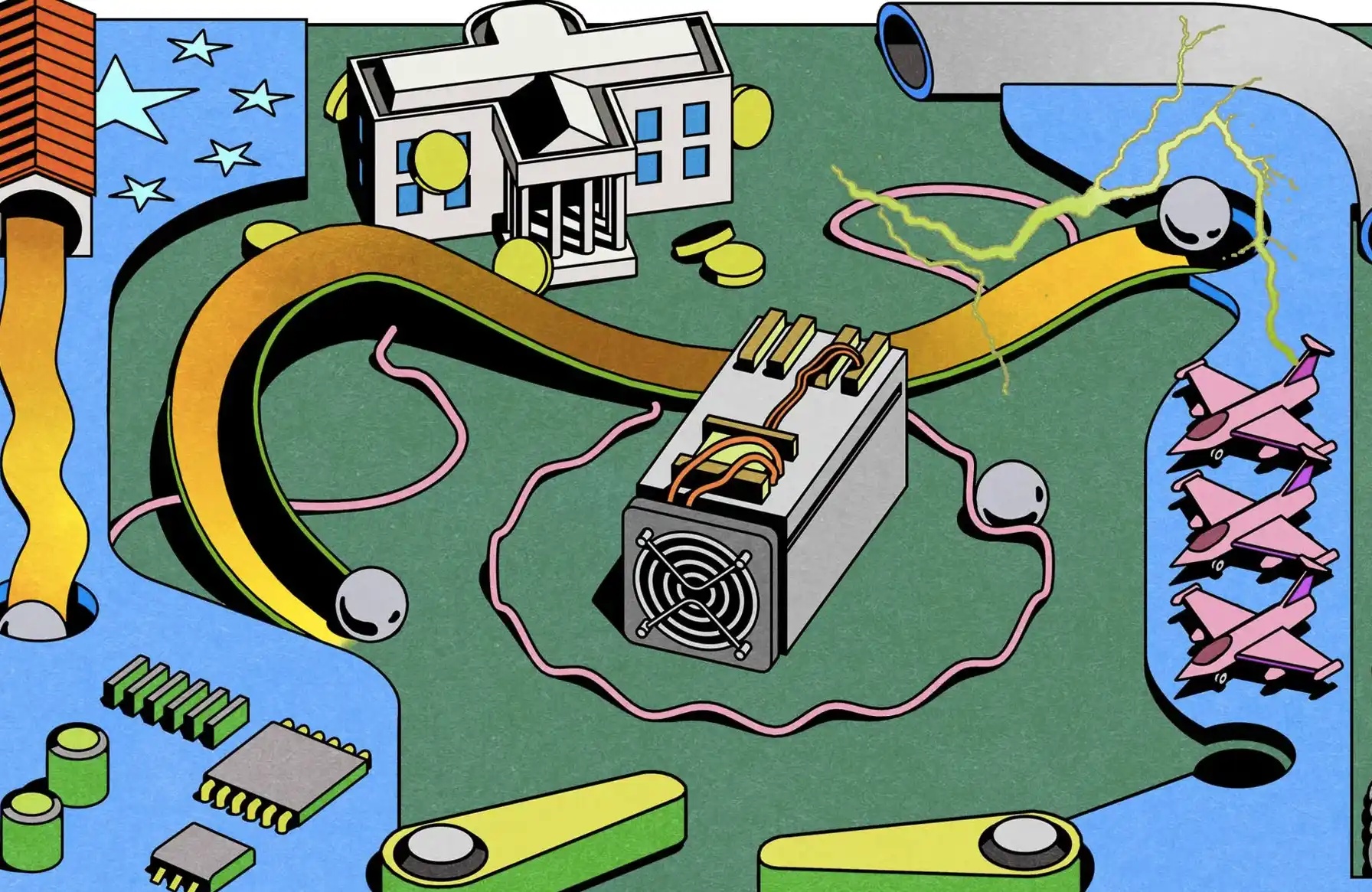
A few days ago, there was news that was not widely concerned by the industry: the traditional chip giant Intel (Intel) will release its own bitcoin mining chip.
This was actually discovered after a speech was leaked. In the speech, some media noticed that Intel will give a keynote speech on "Bonanza Mine: An Ultra-Low Voltage Energy Efficient Bitcoin Mining ASIC" at the upcoming International Solid State Circuit Conference (ISSCC). It is reported that Intel has prepared two generations of SHA-256 ASICs: BZM1 and BZM2, which are suspected to use the Intel 4 process (ie 7nm). The BZM1 will be unveiled at ISSCC this time.
According to the grapevine It said that BZM1 has a computing power of 137 GH, a power consumption of 2.5 W, and an energy consumption ratio of only 18.2 W/TH, which is lower than the 21.5 W/TH of Bitmain's current most powerful mining machine, the S19 XP. It should be known that the energy consumption ratio is the most critical parameter of Bitcoin mining machines. The lower the energy consumption ratio, although it does not mean that the performance is stronger, but it can mean that the cost performance is higher.
From the perspective of parameters, BZM1 is undoubtedly very suitable for home deployment. It is still unknown whether BZM1 has the advantages of large-scale deployment or is designed for families, but the BZM2 whose parameters have been hidden is more like a product specially launched for mining farms.
Intel launches mining chip The accuracy of the news is very high, and the market has found that someone has signed an order with Intel. Ohio mining company GRIID revealed in the S-4 filing filed with the SEC that GRIID said it had signed a four-year BZM2 procurement contract with Intel.

Cryptocurrency has undergone tremendous changes in the past two years, the market value of Bitcoin It has also exceeded the trillion-dollar mark, and it is on an equal footing with technology giants such as Tesla and Facebook. The mining machine orders of leading mining machine manufacturers like Bitmain are scheduled to a few months after the peak period.
Finally, Intel, which has been suppressed for decades, is about to board the bitcoin train.
Missing the Golden Age of Mobile Internet
Founded in 1968, Intel is currently one of the semiconductor chip manufacturers with the highest income in the world, and the Moore’s Law proposed by its founder Gordon Moore is even more influential With the development of integrated circuits. However, if you look at the stock price, the past two decades are the two decades that Intel has lost.
Since 1995, Riding on the express train of Internet development, Intel's stock price rose all the way from $3.98 until the Internet bubble burst. Intel's stock price peaked at $75.81 in September 2000. In more than five years, Intel's stock price rose as high as 1806%.
$75.81, not only The high point of Intel's stock price before the Internet bubble is also the historical high point as of now. In the following 21 years, Intel's stock price has never exceeded this level.

Intel 1994-2021 stock price trend< /blockquote>
Some people think that the Internet bubble is too big to make Intel's market value so high that Intel has not slowed down until now. Is it really?
Between 1994 and 2000, its net profit after tax increased from US$2.288 billion to US$10.535 billion, with a compound annual growth rate of 28.98%. In 2020, Intel's after-tax net profit is only 20.9 billion US dollars. If calculated from 2000 as the starting point, the compound annual growth rate is only 3.4%.
Not too bubble Big, because Intel's own development can't keep up with everyone's expectations.
Reviewing the development of Intel, It is not difficult to see that Intel has no chance to return to the top, but the opportunities have been missed. Just like the recent golden decade of missing the mobile Internet.
On the other hand, they are both chip manufacturers, but they firmly grasp the mobile Internet, occupying 27% of the market share of smartphone chips and 5G baseband chips, 62% of Qualcomm, now has a market value of 187.8 billion US dollars, which is almost the same as Intel's 191.8 billion US dollars. In 2000, Intel's market value was several times that of Qualcomm. Qualcomm’s annual report for the 2021 fiscal year shows that its full-year after-tax net profit was US$9.043 billion, less than half of Intel’s.
Of course, Intel is not without Trying to participate in the wave of mobile Internet. At the earliest, Jobs had intended to purchase Intel chips in the original iPhone, but Paul Otellini, the then CEO of Intel, rejected Apple's offer for being too low. To this end, Apple had to purchase ARM-based chips designed by Samsung.
In 2016, Apple decided to Introduce a new baseband chip manufacturer to prevent the exclusive supplier Qualcomm from dominating the baseband supply. Intel once again entered Apple's field of vision. However, Intel's poor performance in the baseband field caused this cooperation to last less than 3 years. After losing Apple as a customer, Intel had to shut down the baseband business, and finally sold the business to Apple for $1 billion.
Surrounded by strong enemies
Many people wonder, what did Intel do in the golden 10 years when it missed the mobile Internet? Maybe we take a peek at Intel's earnings reports for years.
Intel is expanding other businesses while ensuring a steady and small increase in revenue from the CCG business of the Client Computing Group (PC Client Group).
Intel's revenue structure in the past 10 years, source: wind
Intel’s PC client group business revenue will grow from $31.5 billion in 2010 to $40.5 billion in 2021, and as a percentage of total revenue from 7.243 % dropped to 51.26%. Presumably, Intel also realized that relying on this segment of business alone cannot bring the company a higher growth rate. Therefore, in the past few years, Intel has begun to develop new business lines while ensuring its main business. The data center group DCG, the Internet of Things group IOTG, the non-variable storage solution group NSG and the programmable solution group PSG etc.
However, when Intel's diversification strategy has not yet shown results, the PC client group business, which is the main business, has been challenged.
Q1 2021, AMD With its 7nm process and Zen 3 architecture, the Ryzen 5000 series CPU has a cost-effective advantage, surpassing Intel in the desktop CPU market share for the first time in 15 years. Then in Q4 of 2021, Intel changed the 14nm process technology used by the 5th to 11th generation CPUs in the past, and used the Intel 7 process technology (10nm) on the 12th generation CPUs, and the performance has been greatly improved. Grab a lot of shares. However, AMD is about to release the Ryzen 7000 series CPU, which is more powerful than the Ryzen 5000 series, in the second half of the year. Whether Intel's desktop market share can hold its advantage still needs to be verified by the market.
Similarly, in the server market, Intel also Facing competitive pressure from AMD. Although from the perspective of market share, Intel is still a well-deserved overlord. However, at present, a large number of server users have begun to accept AMD, such as the AMD EPYC 7763 used by Wang Sicong's own million server computers. According to the latest research report from investment bank KeyBanc, AMD's market share in server CPUs is expected to reach 20% by 2022.
In addition, Apple The de-Intelisation of the internet has also deprived it of a huge source of revenue. Although MacOS (excluding Hackintosh) has always been classified as a niche system, its shipments in 2019 also accounted for 6.6% of the global PC market share, and these computers all use Intel CPUs. According to user estimates, the CPU used by the Mac accounts for about 7.8 percent of Intel's Client Computing Group revenue, or about 4 percent of total revenue.
The outlook is uncertain, and the main business is facing major challenges. What should Intel do?
Low power consumption Bitcoin ASIC mining chips may just be Intel’s experimental field
On February 15, 2021, Intel announced that it will replace its CEO with Pat Gelsinger. This is Pat Gelsinger's return to Intel after 12 years. Pat Gelsinger joined Intel at the age of 18. During his 30 years at Intel, he went from a quality control technician to the company's youngest vice president before leaving in 2009. The three fires he returned to Intel were to promote the development of 7nm process, invest 20 billion US dollars to build two fabs, change the existing IDM model, and launch IDM 2.0.
Back to Pat Gelsinger Less than a year after Intel, in January 2022, Jeff Wilcox, Apple's director of system architecture and head of M1, M1 Pro and M1 Max chips, announced that he would leave Apple to join Intel and serve as CTO of Intel's design engineering group, responsible for all Intel customers' systems. chip (SoC) architecture.
In fact, Jeff Wilcox Like Pat Gelsinger, an Intel veteran, he spent 12 of his 25-year chip career at Intel, serving as Chief Component Architect at Intel from 1997 to 2007, and Chief Architect of Client PC Chips from 2010 to 2013 .
Since then, we seem It can be found that Intel's launch of low-power Bitcoin ASIC mining chips is a matter of course. Alternatively, the development of low-power Bitcoin ASIC mining chips is just a technical experiment for Intel.
Intel 12th Generation The CPU adopts a new performance hybrid architecture, that is, performance core + energy efficiency core (large and small cores or heterogeneous multi-core). Such a mechanism can improve the multi-core energy consumption ratio under the same area. From the design idea, it can be seen that Intel has begun to pay attention to the energy consumption ratio. Similarly, the M1 series chips advertise that they consume less power with the same performance.
In addition, Highly integrated ASIC chips have begun to become a development trend in the computer field. For example, the Apple Afterburner accelerator card, an ASIC expansion card designed by Apple for the Mac Pro at a price of up to 15,000 yuan, was integrated into the M1 Pro and M1 Max chips.
Intel's upcoming BZM1 They all have the technical applications required for industry development, and the deadline for the contract signed with GRIID is 2025. At that time, Intel's new fab will also be put into production in 2025. Of course, maybe all of this is a coincidence. Obviously, compared to Bitcoin ASIC chips, we should pay more attention to what kind of products Intel, which has the most advanced fab, will launch after 2025, and whether Pat Gelsinger can lead the semiconductor giant back to the top.
Welcome to join the official BlockBeats community:
Telegram Subscription Group: https://t.me/theblockbeats
Telegram Discussion Group: https://t.me/BlockBeats_App
Official Twitter Account: https://twitter.com/BlockBeatsAsia



 Related Articles