Nansen Research: Can LooksRare's unique mechanism successfully shake OpenSea's dominance?
Original title: "LooksRare and OpenSea: NFT's Own Case of David vs. Goliath?"
Original author: Louisa Choe, Nansen
Original compilation: Shenchao TechFlow
Summary
This research article seeks to separate the hype from the reality of the recent LooksRare token airdrop. LooksRare prides itself on being a "community-first, non-functional marketplace that actively rewards participating traders, collectors, and creators." “In exploring its token economics and incentive system, we believe that despite widespread concerns about what appears to be trade brushing, this instead favors opportunistic traders maximizing LooksRare’s ‘trade reward’ system. "
This article is divided into four parts.
The first part explains the goal of LooksRare to benefit the NFT community, and how to achieve this goal through token mechanism design. Here, we will compare the user retention rates of the two platforms, OpenSea and LooksRare.
The second part details the three parts of the LooksRare reward system: staking rewards, liquidity provision rewards, and transaction rewards.
The third part sheds light on the so-called wash trading issue and what it means for platforms and users.
Part Four leverages insights from the Nansen Dashboard to understand overall LooksRare trends.
Background
A little over a week after the launch of LooksRare and its token airdrop, market entrants The sales volume was approximately 1.5 million ETH (approximately 5.15 billion USD). The platform was introduced to the NFT and wider crypto community on January 10, 2022, with the aim of providing a "community-first NFT marketplace that actively rewards traders, collectors and creators for participation." OpenSea largely rules The NFT market accounted for 3.6 million ETH (approximately $12.5 billion) of NFT transactions in 2021. Perhaps because of OpenSea's success, especially after its recent fundraising at a $13.3 billion valuation, other innovative competitors are being attracted to this fledgling industry.
Airdrop
In the field of mainstream marketing, attracting buyers (ie consumers) The pursuit is not always an easy task. Blockchain has revolutionized this, giving new projects like LooksRare the possibility to interact directly with their target customers. At the press conference, LooksRare announced that it will provide its native token LOOKS to OpenSea users through airdrops. Users who have traded at least 3 ETH of nft on OpenSea over a period of more than 6 months are eligible for the airdrop. There are 9 layers of LOOKS token airdrops—the more transactions users make on OpenSea, the more LOOKS tokens they can apply for. Figure 1 shows. Details the tiers of the airdrop campaign where active OpenSea customers were incentivized to switch to LooksRare.
Figure 1: LooksRare reward levels

Source: LooksRare (2021)
The columnist described LooksRare’s listing activity as “vampire attack” or “frontal attack”, That is, a new entrant competes head-on with a dominant market competitor.
In short, the goal of LooksRare’s airdrop is to take liquidity away from competitors and inject it into its own platform. However, when it comes to David vs. Goliath, some commentators see LooksRare's "disruptive" strategy as necessary to capture the interest of the most active users of the moment.
Note: David vs Goliath (David vs Goliath) is an allusion from the Old Testament of the Bible. David is a young Israeli who shepherds sheep , he became famous by defeating the giant Goliath and became a miracle. In this article, Goliath is referred to as OpenSea and LooksRare is referred to as Young David.
Figure 2: Comparison of daily active users between OpenSea and LooksRare

Figure 2 depicts the comparison between the daily active users of OpenSea and LooksRare. Active users are defined by addresses that make purchases or sales. A new user refers to an address that made its first transaction on the platform, while a retained user refers to an address that has made at least one transaction. A closer look at the data reveals that LooksRare was slower than OpenSea to acquire new users within the first 9 days of launch.
During January 10-19, LooksRare saw a 5.55% increase in the number of daily users, while OpenSea saw a 38.17% increase, see Figure 2a.
It is clear that the LooksRare platform did not take long to initially attract new users. However, when analyzing retained user activity, LooksRare’s retained user growth rate exceeded OpenSea during the same period (Note: 3658% for the former and 14.86% for the latter, see Table 2b).
Table 2a: Comparing the change of new users between the two platforms

Table 2b: Comparison of retained user changes between the two platforms

< br>
Platform goals and token economics
In addition to airdropping convertible LOOKS tokens, LooksRare has passed Deliberate community focus, token economic models, and novel reward systems increase the incentive for users to switch to new markets.
Figure 3: LooksRare’s description of its platform

Source: LooksRare (2021)
Figure 3 outlines the core goals of the LooksRare platform, and the NFT community is the platform architecture design center of. The founding team at LooksRare ensured that the community is rewarded for participating in making this happen. They announced that three quarters (75%) of tokens issued were for the community. Of the 75% tokens allocated to the community, 12% are reserved for airdrops, 18.9% of the token supply will be circulated through the issuance of equity pledges, and the final 44.1% of the tokens will be distributed through the transaction reward system (see Figure 4) .
Figure 4: LOOKS token economics

Source: LooksRare (2021)
After carefully reading the token economics of LOOKS, it is found that the token supply is designed Teams redeem the value of their allocated tokens 180 days after platform launch.
Observers have noticed that the distribution model of LOOKS has similarities with the Crypto Punks NFTs launched by Larva Lab (for example, angel investor moon (@ A tweet by MoonOverlord). The rationale behind such a token release schedule is that the founding team has a personal interest in ensuring the success of the project after launch. Only when the platform is successfully issued can the team's convertible value be realized.
Unique Features
At first glance, the LOOKS token issued by LooksRare is There are clear differences between platforms. The token is designed to encourage the use of the LooksRare platform to trade NTFs, which is similar to the liquidity mining practice of NFTs.
LooksRare takes a 2% profit on every trade. Currently, the OpenSea platform charges a 2.5% fee. Although the fee difference between the two platforms is small, the difference in the fee structure between the two platforms is "Who benefits from the fee?" Through LooksRare, the fee will be distributed to LOOKS token holders.
Other competing features of LooksRare include the ability for users to make public offers, applicable to any work in a single NFT collection. This feature is especially useful for users who want a piece from their collection but don't have a specific piece in mind.
In addition, the royalties on the LooksRare platform are paid to NFT creators in real time. OpenSea creators, on the other hand, take a week to receive royalties for their work. While these features speak to the project's "community-centric" focus, the platform's success remains highly dependent on LooksRare's ability to attract buyers and subsequent demand for its platform.
To attract potential buyers, LooksRare has deployed an attractive reward system to motivate users.
Rewards
LooksRare website says it offers three unique reward systems:
1. Staking (pledge)
Figure 5: Cumulative LOOKS token quantity< /b>

LOOKS holders can stake their tokens to earn passive income. At the time of writing, the return on staking is 819.31% APR. But this is variable and will adjust accordingly based on the number of participants staking their tokens on the network and the price of the Looks token. At the time of writing, the cumulative number of stakes for LOOKS tokens is approximately 120 million (see Figure 5.)
The ability of token holders to earn passive income is The incentive to lock up its token supply. The way this payoff is derived has two components: i) the token economics design intentionally uses staking as a reward system, thus reserving a portion of the token supply (see above on token economics), and ii) it comes from the fees charged on all swap transactions percentage. LooksRare breaks down relevant staking reward information on its website.
2. Liquidity Provider
Figure 6: Hold

Liquidity provider options may not be desirable Users who have full exposure to the LOOKS token are attractive, but choose to mitigate the possible volatility associated with the token by exposing them to Ethereum (ETH). This distribution of rewards is also variable and adjusts accordingly as participants move liquidity in and out of the network. In theory, the rewards paid to liquidity providers should be more consistent since this is derived from transaction fees charged by the platform.
In short, in addition to earning proportional exchange fees, by staking LOOKS-WETH LP tokens in LooksRare’s smart contract, users can also Get extra LOOKS token. However, liquidity providers face the risk of impermanent losses, which is a risk factor that users need to consider additionally.
3. Transaction reward
Among these three rewards, the most controversial One of the most revolutionary is LooksRare's "trading rewards". Discussion around the implications of this reward system has rapidly heated up on social media (see, for example, a tweet by djo.eth (@dylanorrell) explaining observations about using Meebits for wash trading).
LooksRare encourages NFT trading on its platform by offering incentives to buyers who purchase eligible collectibles. This reward system allows buyers to earn more LOOKS at regular intervals (within 24 hours). On the one hand, users find this system particularly attractive for those who missed out on the airdrop, while increasing the trading volume on the platform.
However, the trading reward system has raised concerns among some opportunistic users who trade on the platform in order to accumulate more LOOKS tokens. However, it has been argued that in the medium to long term, platform fees are a mechanism that can deter long-term wash trading behavior, especially when trading returns diminish over time.
According to LooksRare's reward plan, the transaction rewards in the first phase will decrease significantly over time. Interestingly, it can be speculated that the profits of early speculative wash traders affirmed their decision to switch platforms. Figure 7 highlights some of the largest addresses that benefit from the LooksRare reward system.
Figure 7: LOOKS Reward Amount Claimed by Address Compared to Quantity and Fees Paid to LooksRare (actual profit may vary depending on price at time of sale varies)

Cooperate with Nasen to explore on-chain activities
< br>
Figure 8a: Comparison of transaction volume between LooksRare and OpenSea (January 10-January 19)
< br>

Figure 8b: Transaction volume of LooksRare compared to OpenSea (January 10 to January 19)

Figure 8a shows the transaction volume on LooksRare over time volatility. Two possible reasons for this fluctuation include:
1) LooksRare is an emerging platform, and the user base has not yet stabilized; it may affect users' trading behavior. A time-based analysis shows that transaction volume typically spikes an hour before the transaction reward expires. (11pm-12am Universal Time). The graph hints at the relationship between the two platforms when analyzing transaction volume against the number of transactions.
On January 10, the number of deals closed on LooksRare increased, while the number of deals closed on OpenSea decreased. This can be understood as LooksRare's strategy to direct OpenSea's users to its platform. However, starting on January 12, both platforms experienced a decline in transaction volume (see also January 20). This trend can be attributed to the overall state of the cryptocurrency market.
Figure 9: How LOOKS holders use their airdrop tokens (based on FIFO)
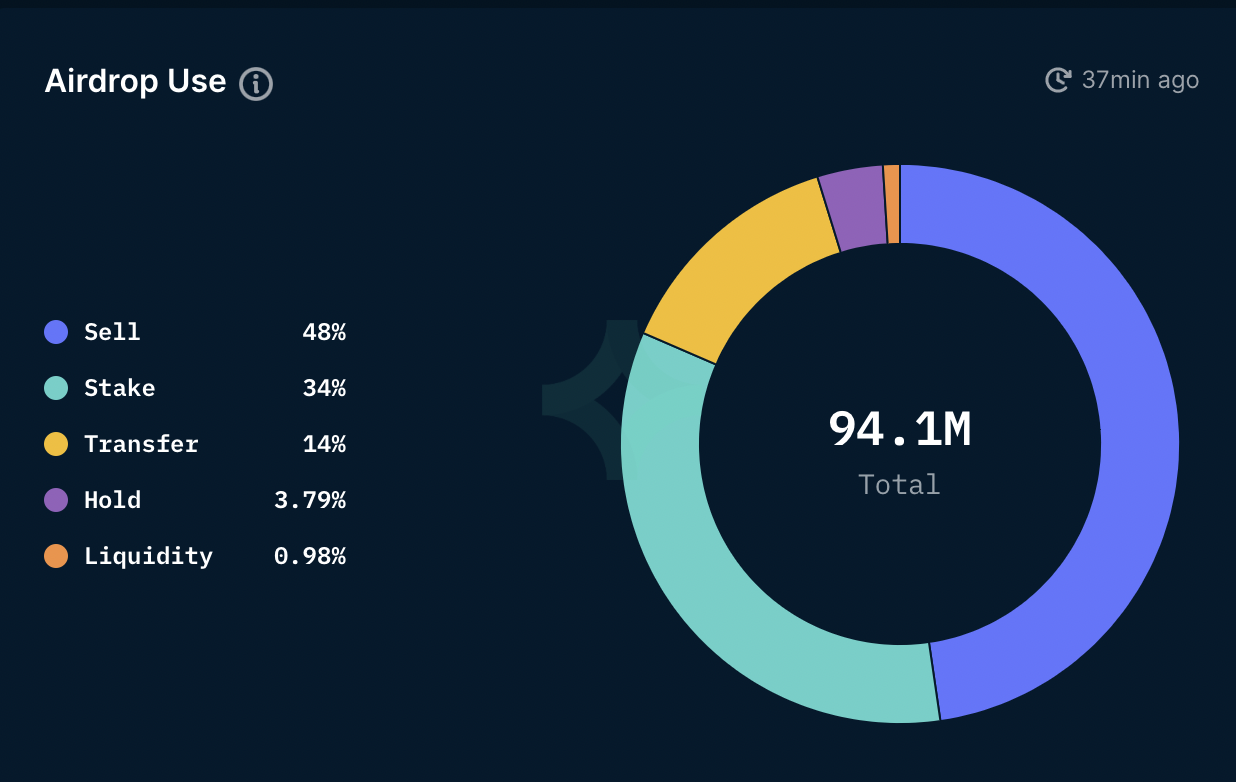
While most empty users choose to sell their LOOKS tokens, a third of users hold their tokens: 4.1% hold Yes, 0.85% has entered the liquidity provider pool. Figure 9 details this decomposition.
Figure 10: Comparing the daily activities of smart money on two platforms

Nansen's Smart Money brand tracks wallets with a proven track record of making smart investment decisions. Since LooksRare launched, the number of Smart NFT Adopters and Smart NFT Hodlers active on LooksRare has declined. In contrast, last week on OpenSea, the number of Smart NFT Adopters and Smart NFT Hodlers was relatively consistent. While the number of Smart NFT Minters initially declined, the trend reversed on Jan. 18.
Interestingly, the performance of Smart NFT Traders on LooksRare is relatively stable. From the overview of Smart Money on these two platforms, we can infer that LooksRare’s reward system does attract and retain Smart NFT traders.
Conclusion
In this article, we reviewed LooksRare’s token economics design and rewards system to understand how it positions itself as a disruptive, "community-focused" competitor to OpenSea. We believe that despite concerns about what at first glance looks like wash trading, there is an opportunity for traders looking to maximize their LOOKS tokens using LooksRare’s “trading rewards” system.
With reference to Nansen’s on-chain data, we explore whether there are early signs of success in LooksRare’s proactive strategy of directing users and buyers to its platform. Analysis data shows that despite the controversy surrounding LooksRare's launch, they did attract new users and keep them on the platform. Whether this trend will continue, however, only time will tell.
Original link
Welcome to join the official BlockBeats community:
Telegram Subscription Group: https://t.me/theblockbeats
Telegram Discussion Group: https://t.me/BlockBeats_App
Official Twitter Account: https://twitter.com/BlockBeatsAsia

 Related Articles