A16z Partner: Is a Web 3 application with centralized services still Web 3?
原文作者: Chris Dixon
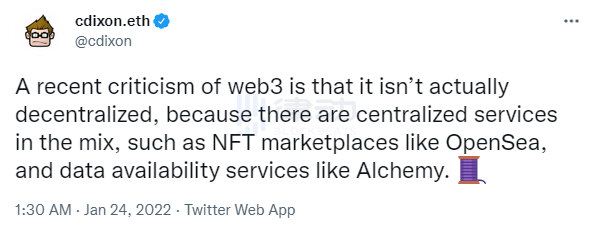
Chris Dixon, a partner at A16Z, posted on social media on January 24 that there has been a lot of criticism of Web 3 because many people think it's not decentralized, Because many Web 3 applications mix centralized services, such as the Opensea NFT marketplace and Alchemy data availability services. But this criticism is based on a mistaken understanding of decentralization.
There will be centralized services in Web 3, just as in Web 1. The key question for Web 3 is whether network effects are based on "private goods" (as Web 2 did) or "public goods" (as Web 1 did). Network effects are a source of attraction for users and developers, and if big Vs leave Twitter they will lose the fans they have accumulated over the years, because in Web 2 network effects are driven by private companies like Twitter.
By contrast, we can leave the web hosting provider and retain inbound links, search rankings, and so on by switching DNS records. This is because in Web1, network effects accumulate as a common resource, thanks to open protocols such as HTTP and SMTP, and community-owned services such as DNS. The killer apps of the Internet are actually "the Web" -- the Web and email are the Web, social apps like Instagram and Twitter are the Web, and markets like Uber and Airbnb are the Web. Network effects enable networks owned by companies like Facebook and Twitter to dominate and achieve very high acquisition rates (ranging from 30% to 100% in the Web 2 market).
Block chain provides a powerful new method to construct the network, the network effect as a public product accumulation, like in Web 1 do, such as the etheric fang NFT can be seen as a user and the NFT interoperability and form a connected network, the network based on Ethernet block chain, users can complete control of their data. There are many centralized services that give you access to the web, including OpenSea, Zora, LooksRare, etc., but they don't have network effects.
There will be centralized services in Web 3, and in fact, as we saw in Web 1, there is a huge wave of innovation and entrepreneurship around the public Web. Entrepreneurs and investors in the 1990s knew they could build and invest freely without worrying that the web would change their economics or limit their access. Web 2 is controlled by large corporations, leading to serious risks for the Internet, such as social broadcasting services being owned by dominant companies and not making room for startups and new ideas. Web 3 provides a new approach to network building that combines the public network effects of Web 1 with the advanced features of Web 2.
The original link
Welcome to join the official BlockBeats community:
Telegram Subscription Group: https://t.me/theblockbeats
Telegram Discussion Group: https://t.me/BlockBeats_App
Official Twitter Account: https://twitter.com/BlockBeatsAsia

 Related Articles