BitMEX founder: What are the possible trends of cryptocurrencies in 2022 under the influence of macroeconomics?

Original title: 《 Maelstrom 》
Original author: Arthur Hayes ( BitMEX founder )
Original translation: Wu Zhuocheng, Wu said blockchain
The most psychological measure of the health of your portfolio is the annual rate of return. As always, the goal is to maintain or increase the purchasing power of assets relative to energy costs. The essence of human civilization is to convert the potential energy of the sun and the earth into kinetic energy to support our body functions and modern lifestyles. Making money is not the goal, because money is just an abstract concept of energy. The right way to measure your financial success is to determine how much energy your lifestyle currently costs (using oil as an example later) and how much it will cost in the future (of course, this is difficult to measure). Then, you must ensure that your financial savings grow faster than your expected energy consumption rate.
Markets don’t stop at the sound of 12:01am on January 1, 2022, gains are compounding and path-dependent in nature. Unfortunately, only a few trading days really matter. A simple example will illustrate this.
Back to January 1, 2020, when the world was simpler and the global coronavirus madness hadn’t yet taken shape. Bitcoin was at $7,216. On the last day of that wonderful year, Bitcoin was at $28,996, an average annual return of 302%. Who made more money, Bitcoin investors or Pfizer?
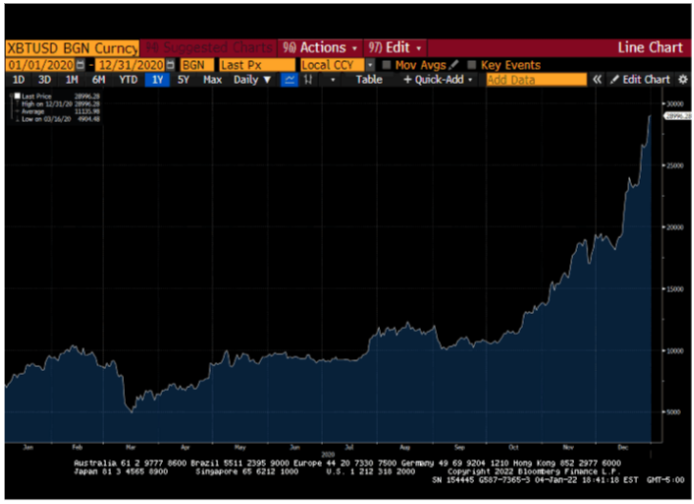
While this is an impressive annual return, it masks the extreme volatility that the market experienced in mid-March. Let’s focus on March 2020.
On March 16th, Bitcoin experienced a correlation moment, as it was hammered along with every other risk asset in the world as the world discovered that the COVID-19 pandemic was real and extremely destructive. A correlation moment is when all risk assets fall at the same time, and investors on margin rush to sell everything in order to increase the world’s reserve currency (currently the U.S. dollar) so that they can repay their loans. No asset is spared. Only when the dust settles and the fear dissipates will asset prices begin to move in more idiosyncratic ways again.
From January 1st to March 16th, the price of Bitcoin plummeted 38%. Many people were stopped out, either psychologically or forcefully (a psychological stop out is when the price of an asset reaches some kind of built-in pain point that forces you to hit the “sell” button. A forceful stop out is when your leverage provider closes your position to preserve some collateral value).
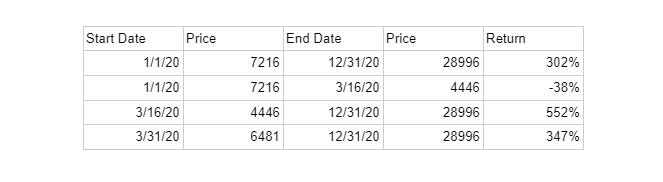
The above chart illustrates both good and bad results of path dependency. The most important lesson is that trading action on March 16th was by far the most important day of the year. The very best traders who were strapped onto the trading ship had the opportunity to significantly increase their portfolio returns, with returns from the low on the 16th to the end of the year being 250 percentage points higher than if they had invested from January 1st onwards.
If you are unfortunate enough to exit on the 16th, but have the energy and financial resources to re-enter the market, the date you re-enter your position is extremely important. Bitcoin did not recover to its January 1st level until April 21st. The longer you wait, the lower your 2020 compound return will be.
Active traders must be present on any day like March 16th and sell positions and buy them back soon after to create a constant compound return.
For investors who are not willing to watch Bitcoin 24/7, you must construct a portfolio that is convex to a catastrophic day like March 16th. The most important psychological hurdle to overcome is to abandon the concept of year-over-year arithmetic returns and instead switch to compound returns. The above example illustrates the negative effects of compounding, if you don't protect your position on the downside, you won't be able to participate in the upside rally. To do all of this, you must remove emotion from your investment decisions and use a certain amount of leverage judiciously. The former requires more skill than the latter, as it is very difficult to completely change your investment philosophy (especially given that most investment literature focuses on arithmetic returns). To make matters worse, all trustees (i.e., fund managers) are paid bonuses on an annual basis. If your fund manager loses all of your assets, the worst that can happen to them is temporary unemployment, and if the market goes their way, you'll still be paying them a percentage point of your returns every year, which will destroy your compounding over time. I don't have a solution to the trusteeship problem, but just remember that it exists and adjust your behavior accordingly.
The point of this Bitcoin price history lesson is to start a discussion about how I should position my portfolio this year ahead of what I believe will be a string of disastrous trading days like March 16, 2020. As usual, this is about the Fed cutting growth on its balance sheet to 0% and then raising rates one to three times in 2022.
I will start the discussion with why interest rates are so important and then discuss how aggressive short-term policy rates set by central banks will inflict the most pain on global risk assets over a three- to six-month timeframe. I believe the Fed and other lemming central banks around the world will eventually have no choice but to keep printing money. But at some point soon, domestic politics in many countries may require tightening the money supply to quell dissent from the populace whose food, housing, and transportation costs are rising, and by leaps and bounds.
Listen Up
When it comes to central banks, it is fashionable to be as transparent as possible about future actions. Yet in the face of obvious data, the top refuses to admit that money printing is the cause of the inflation that is tearing society apart. Those who do what they are told have accumulated a lot of fiat currency since the Great Recession of 2008. Those who care about fundamentals and other such nonsense have underperformed, don't be stupid, just buy the damn market.
While policy changes frequently, the Fed is very clear about what they intend to do. "Temporary" inflation is now on hold, and the Fed has signaled that they think it is time to curb inflation in food, energy and transportation at the expense of financial asset prices. To do this, they have decided to stop buying bonds by March of this year, and if their "dot plot" holds up, the first rate hike will occur between March and June.
Most market participants believe that Democrats will instruct the Fed to raise interest rates, and the Fed will do so. Democrats must demonstrate their hawkish stance on inflation to avoid being soundly defeated in the November congressional elections. However, there is no consensus on how short-term rate hikes will affect financial assets - that is, whether they will weather the storm or buckle under the pressure.
Forgetting the views of non-crypto investors, my reading of crypto investor sentiment is that they naively believe that the fundamentals of overall network and user growth will allow crypto assets to continue their unabated rise.
In my opinion, this portends a severe crash, as the harmful impact of rising interest rates on future cash flows could prompt speculators and margin traders to sell or significantly reduce their holdings of crypto assets. I don't deny that loyal diamond hands are constantly adding positions after the price crash, but in the short term, such "iron fans" cannot prevent a catastrophic drop in prices. Remember, as long as there is 1 Bitcoin trading at $20,000, the final price will be $20,000, even if there are 19 million Bitcoins in the world that are not traded in the market. The final trading price is caused by the abandonment of marginal sellers, although the trading volume is small.
The most devastating impact of the final trading price is the psychological impact on weak traders, and it affects the liquidation of underwater positions on leveraged trading platforms. So don't tell me that all crypto market OGs are busy buying the limit down; none of this matters when fund managers destroy your positions.
For more than a decade, cryptoasset investors have been salivating at the prospect of “institutional” investors entering the space. Now, they are finally here, as the Bloomberg headline below suggests. While asset allocations are small, there are enough believers from the world of TradFi to make a difference.
「Billionaires Are Embracing Crypto in Case Money 『Goes to Hell』」
The article discusses how high-profile CEOs and investors like Tom Peterffy (InteractiveBrokers) and Ray Dalio (Bridgewater) are holding Bitcoin and other crypto assets as a hedge against a decline in fiat currencies.
While the wealthy who run large TradFi companies can withstand severe price declines, the lemmings that follow them cannot. The asset management industry is more than happy to invest in crypto assets, as long as these overpaid imitation chefs don’t lose their well-paid jobs when prices fall. They have no faith in, and no allegiance to, Satoshi. Therefore, if external conditions warrant reducing their crypto asset allocations, they won’t hesitate to liquidate their positions — no matter how large the loss.
Institutional investors are subject to the power of Eurodollars (holding dollars outside the domestic U.S. banking system). Essentially, the whole world is shorting the dollar. When the dollar price falls, credit expands and financial assets are happy. When the dollar price rises, credit contracts and financial assets are sad. Read the Alhambra Investments blog for a more in-depth discussion of how this market works.
The rate of change of money supply growth, its first derivative, is the most important factor in determining whether institutional investors are bullish or bearish.
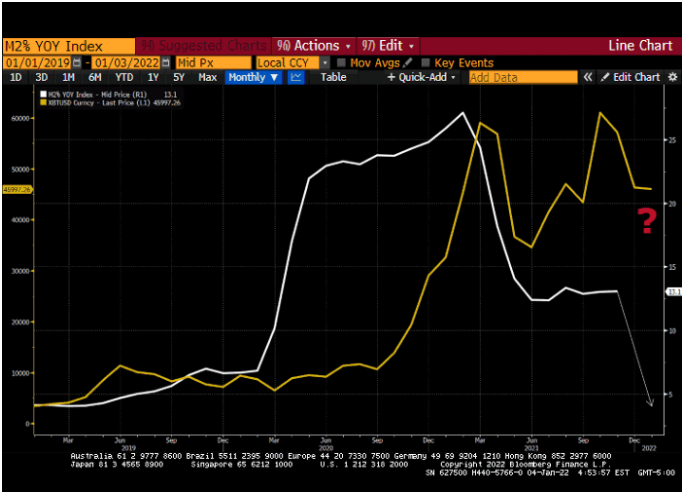
The white line is the U.S. M2 growth rate, which has been gradually increasing in 2019. In March 2020, the Fed used its magic money printing machine to nationalize the corporate bond market and rescue the US Treasury market by bailing out a bunch of over-leveraged macro hedge funds. This caused a jump in M2. The Fed's balance sheet grew, and as a result, the larger M2 grew, the slower it grew (law of large numbers), and the US government did not enact enough fiscal spending to continue to accelerate money printing.
Currently, the Fed is forecasting that the growth of their balance sheet will slow to zero. If they do not reinvest maturing bonds in their portfolio, their balance sheet will actually shrink. The ugly white arrows in the chart above show the impact this may have on the money supply.
The yellow line is the price of Bitcoin/USD. The loose monetary conditions in the United States have definitely influenced the rapid rise in prices (albeit with a delay of several months). Bitcoin has been trading sideways since M2 growth stalled. If M2 growth hits 0% or even negative in the near term, the natural conclusion is that Bitcoin (in the absence of any incremental growth in the number of users or transactions processed through the network) is likely to be lower as well.
I could post more charts depicting the credit impulse in different countries, but they all paint the same picture. The villagers are waking up because the prices of meat, vegetables, taxis, rent, and other necessities are rising faster than their wages. Now their public enemy number one is inflation. If domestic politicians around the world want to continue to sit back and enjoy their gains, they will have to pretend to do something. So it's time for some song and dance from central banks, and at least for a short period of time, they will be willing to unwind their balance sheets and return to positive interest rates that reflect various domestic economic realities.
Benchmark Assets
Bitcoin is a cryptographic representation of money/energy.
Ethereum is the decentralized computer of the internet.
For the most part, every other major crypto asset can be categorized as follows.
1. Tokens tied to Layer 1 protocols are expected to become the "next Bitcoin or Ethereum". These networks have greater scalability, can process more transactions per second, or are anonymous. For example, Monero is to Bitcoin, or Solana is to Ethereum.
2. Another category is to use existing Layer 1 protocols as tokens to complete certain intended functions, such as Axie Infinity, a token-based game that uses NFT assets residing on the Ethereum blockchain to make money.
A token is either trying to be a better version of Bitcoin or Ethereum, or it leverages the features of both networks to create a new product or service.
Both Bitcoin and Ethereum have some pretty significant shortcomings, and if another crypto asset were to replace either of them, its value would naturally explode. Anyone who discovered the above tokens in advance would be a rich man in crypto assets. There are many Layer 1s with high and rising expectation premiums, but these protocols are traded based on expectations because the fundamentals of these protocols (such as the number of wallet addresses or the amount of actual transaction fees paid in the native token) pale in comparison to Bitcoin or Ethereum. This does not mean that over a long enough period of time, a particular coin cannot be a winner. However, we are not concerned about the long term, we are concerned about the next 3 to 6 months and protecting the downside of our portfolio.
Regarding tokens that rely on the Bitcoin or Ethereum blockchains to achieve their functions, these tokens should (in theory) not be worth more than the protocols they are built on. This is the difference between investing in general applications and specific applications of a technology - general applications are more likely to provide iterative power for multiple successful specific applications, so general applications should be valued higher. Although there is a large gap between the market capitalization of Ethereum and ERC-20 dAPPs, the price of dAPPs will rise faster than Ethereum in a specific time frame. Of course, during the decline, the above dAPPs will lose value faster than Ethereum.
This is how I see the world. Therefore, I benchmark all returns in my crypto portfolio to Bitcoin or Ethereum. I enter this crypto world by exchanging fiat for Bitcoin and Ethereum, and these tokens always lead a rally, and then it is time to buy low and sell high. In the process, my Bitcoin and Ethereum holdings may increase.
If I believe that Bitcoin and Ethereum will trade below $30,000 and $2,000 in three to six months, I will sell all my shitcoins. This is because Bitcoin and Ethereum are the highest quality tokens, and they have fallen less than all unproven competitors. Any specific application that uses Bitcoin or Ethereum will also experience a free fall greater than 9.8m/s, and in a true crypto asset risk-off environment, these shitcoins may fall 75% to 90%.
TradFi systems move primarily in the swings of Eurodollar costs, while crypto markets may move in Bitcoin and Ethereum. I have no hard data on this, but my gut feeling is that there are billions of dollars worth of Bitcoin and Ethereum being used as collateral right now, with holders depositing Bitcoin/ETH and receiving USD in return. These USD are being used to buy assets like cars or houses, as well as gold rush altcoins. If you believe we are in a bull market, and you already own the benchmark, it makes sense as a trader to leverage and buy an altcoin to get a 10x gain if Bitcoin goes up another 10%.
Whether you buy shitcoins or more SHIB, if Bitcoin or Ethereum drops 20% to 30%, you will be forced to sell assets and raise Bitcoin or Ethereum to avoid being liquidated. The contraction in the fiat price of the benchmark asset will cause some margin traders to desperately sell their altcoin positions, regardless of whether they are making money or not. That's why the last price was affected by marginal weak hand sellers.
It doesn't take much marginal selling pressure to puncture this bubble. CTMD Those high Farming APYs, once the shitcoins start to shit, everyone will exit to take profits. Even if only a small number of traders get a lot of altcoins in a leveraged manner, it will be difficult to find sizable buying on the way down due to the lack of liquidity of these coins. Remember, big in, small out.
Timeline
What if I'm wrong? If the crypto market bull run continues without a big drop, what will hurt my portfolio?
1. March to June
During this period, the Fed either raises rates or it doesn’t. The market expects the Fed to raise rates, and they will be disappointed if one of three things happens.
1. The Consumer Price Index (CPI) growth rate falls below 2%. This is almost impossible to happen, given that this index is "managed" by government statisticians. But if the CPI trend falls sharply and the political pressure from voters dissipates, then the Fed may be able to publicly reverse the trend.
2. The extremely complex and opaque money market and some parts of the US Treasury market will collapse. You will know it when you see it - this is the one thing the Fed fears most. Given that all of TradFi's assets are valued based on prices in the US money market, the Fed must do whatever it takes to ensure that this market operates in an orderly manner. Normally, restoring order requires a lot of money printing.
3. Inflation is no longer the number one concern for American voters ahead of the November election.
Of these three scenarios, I think the second is the most likely. No one can predict what will happen to the currency/Treasury markets when the Fed stops providing money. There is so much leverage embedded in the system that it is impossible to know whether methadone will kill drug addicts.
Given the law of large numbers, simply resuming the previous trend of asset purchases will not lead to a sudden and sharp acceleration in the growth of the money supply. Therefore, while risk assets will rejoice, including crypto assets, the best case scenario is that asset purchases slowly climb back to previous all-time highs. Even if this happens, the only way for the crypto market to rise is for the Fed to open the tap publicly and then fiat money flows to cryptocurrencies.
If this starts to happen, there will be plenty of time to sell fiat and increase your total crypto holdings, or move up the crypto risk curve by increasing your altcoin holdings. You always go up the stairs and down the elevator.
If I’m wrong, I won’t suffer major losses as crypto markets resume their upward movement. It won’t cost much to be patient.
II. June onwards
Assuming I’m right and the Fed raises rates at least once before the June meeting, if any of the following scenarios occur, the Fed will suddenly slash rates to zero and start printing money faster than Usain Bolt.
1. The S&P falls 20% to 30% from its all-time high (reached in the first half of 2022). Whether you are a net exporter in Asia or Europe, or a wealthy American, you probably own a huge amount of U.S. stocks. The U.S. stock market is the best performing stock market in the developed world, and it is also the largest and most liquid. There are too many wealthy people paying taxes and spending recklessly, and the Fed will not let them down if there is a serious turmoil in the stock market.
Another interesting reflexive fact is that the conventional wisdom of maintaining a 60% stock-40% bond mix means that if 60% of stocks fall, fund managers with trillions of dollars must sell bonds to maintain this ratio, which is completely written in the instructions. Therefore, if the Fed allows stock prices to fall, it will increase the federal government's borrowing costs - because as bond prices fall, yields rise - at a time when the government is facing record deficits.
2. Extremely complex and opaque currency markets and parts of the U.S. Treasury market will collapse.
3. The November 2022 election is over.
Chaos
I don’t actively trade around my positions. My goal is to construct a portfolio that I believe will be able to participate in the upside while limiting losses on the downside. As I mentioned before, I’m doing well if the return curve of my portfolio is convex. While I’ve spent most of this post talking about the crypto side of my portfolio, I expect my portfolio of long interest rates and FX options — through my investments in volatility hedge funds — to make up for any losses on the crypto side. However, if I’m honest with myself, I may need to add more so that I have enough vega to act on the downside.
I don't want to sit in front of a screen for hours on end, staring at my Bitcoin day in and day out, I don't like it. Some traders do this and are successful short-term traders, but these traders have to be very focused. If you can't or don't want to be on call 24/7, watching your crypto portfolio, don't try to trade it.
As these thoughts brewed in my head over the past few weeks, I resolved to take action. I went through my entire crypto portfolio. Any shitcoin I wasn't willing to add to my position after a 75% drop from current levels, I dumped. That left me with Bitcoin, Ethereum, and a few other metaverse and algorithmic stablecoins. Position size is not determined by the notional amount you hold, but by what percentage of your total assets they are. A 100 Bitcoin position is large for some, and too small for others. Everything is relative.
Now, I wait. I remain fully invested in my benchmark crypto asset. Your crypto benchmark may or may not be similar to mine. I gave you my reasons and you should think clearly about why you think your benchmark is valid in the context of your energy goals.
If Bitcoin hits $20,000 or Ethereum hits $1,400 then I will start to question whether these crypto assets have energy value. Both prices are previous all-time highs during the 2017 bull run, but those are fiat prices and if oil goes negative again then who cares if the fiat price of the benchmark crypto asset decreases.
I hold my fiat and prepare for the vertical candle. I have been trading this market long enough to spot the final blow that breaks the soul of the speculative bull market. While I am confident in my ability to spot bottoms, I have also learned not to try to catch a falling knife. If you didn’t bottom the market, so what? Let the market heal and then buy at a higher level as the marginal trades from sellers are over.
He who sells first, sells best. Now is the time to evaluate whether positive interest rates will seriously hurt your portfolio to buy more energy. No matter how hard governments try to suppress the volatility of the universe, the normal state is chaos. We are entropy.
Original link
Welcome to join the official BlockBeats community:
Telegram Subscription Group: https://t.me/theblockbeats
Telegram Discussion Group: https://t.me/BlockBeats_App
Official Twitter Account: https://twitter.com/BlockBeatsAsia